Have You Lost Your Confidence or Have You Simply Lost Sight of Yourself?
Sep 21, 2026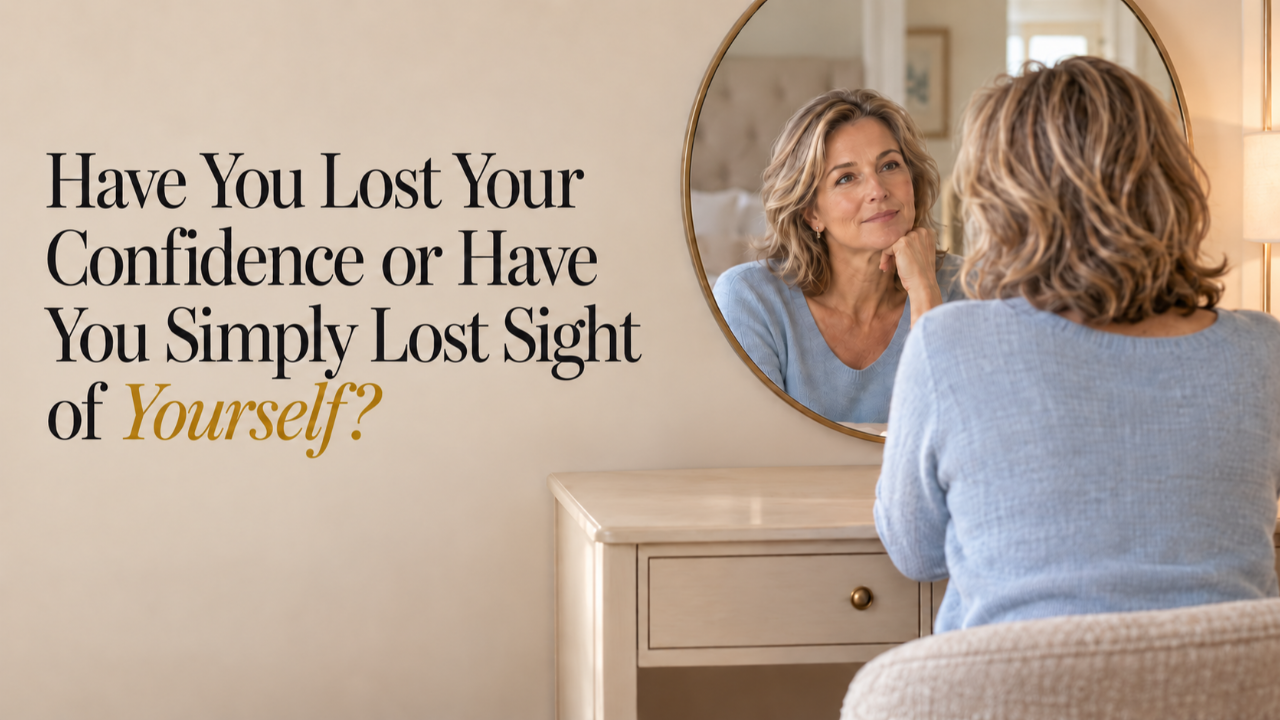
There may have been a time when you made decisions without rehearsing them repeatedly in your head. You spoke without wondering whether you sounded foolish, wore clothes because you liked them and trusted yourself to deal with whatever came next. Perhaps that woman feels difficult to find now not because one dramatic event took her away, but because life slowly became louder than she was.
Somewhere between work, home, ageing parents, changing relationships, children who may be older but still need you, and a body that no longer responds quite as predictably as it once did, you may have stopped hearing your own voice. You still organise, remember, solve and support. From the outside, you may look as capable as ever, privately, however, you may wonder where your confidence went.
But what if you have not lost it? What if you have simply lost sight of yourself?
Confidence does not always disappear dramatically
Losing confidence in midlife rarely looks like suddenly becoming unable to cope. More often, it appears in quieter ways: hesitating before contributing to a meeting, declining an invitation because you do not feel comfortable in your clothes, avoiding photographs, postponing an idea or asking everybody else what they think before admitting what you want.
It can sound like, “I’m just tired,” “Now isn’t the right time,” or “It doesn’t really matter.” Sometimes those things are true. But when they become your answer to almost everything that might make you visible, stretched or hopeful, they may be protecting you from the risk of being seen.
This can happen to the woman leading a team in an office and to the woman working remotely who feels as though she never fully leaves either work or home. It can happen while supporting teenagers, adult children or parents, and it can happen after divorce, redundancy, bereavement or a relationship that has changed shape. A woman can be deeply competent and still feel disconnected from herself.
Menopause can change how confidence feels
Perimenopause and menopause do not affect every woman in the same way, but they can influence far more than periods and hot flushes. Sleep disruption, low mood, anxiety, poor concentration, memory difficulties and fatigue are all recognised symptoms, and each can make ordinary situations feel harder than they once did.
If you lose your train of thought during a presentation, forget why you entered a room or feel unusually anxious before a familiar journey, it is easy to interpret the experience as evidence that you are becoming less capable. Yet a difficult symptom is not a reliable verdict on your intelligence, value or future. It tells you that something deserves attention and not that you have become a lesser version of yourself.
Midlife also carries pressures that cannot be reduced to hormones alone. Your roles may be changing, your relationship with your body may feel unsettled and years of putting other people first may have left very little space in which to ask who you are now. Confidence can be affected by the menopause transition and by the life happening around it; often, the two overlap.
You may be measuring yourself against the wrong woman
Many women judge themselves against a former version of who they were: the woman who could manage on less sleep, whose body felt familiar or whose days seemed more open. Every comparison ends with the present woman appearing to have fallen short. But your younger self did not have your current body, responsibilities, losses, knowledge or experience.
You do not have to recreate her to feel confident again. The aim is not to travel backwards and become who you were at 30 or 40. It is to become acquainted with the woman who is here now—and to stop treating change as proof of failure.
Confidence in this season may be quieter and more discerning. It may look less like saying yes to everything and more like knowing what deserves your energy. It may be the courage to change your mind, ask for help, begin again, set a boundary or admit that a life which once suited you no longer does.
Notice where you have disappeared from your own life
Before trying to “be more confident”, notice where you have become absent. Think about the past seven days and ask yourself: When did I silence an opinion I wanted to express? When did I automatically put my need at the bottom of the list? When did I dismiss something I wanted because it felt impractical, selfish or too late?
Do not use the answers to criticise yourself. Treat them as information. You cannot come back into view if you are only looking for everything you believe is wrong with you.
Then ask a different question: Where am I still unmistakably myself? Perhaps it is in the way you make someone laugh, solve a problem, tend a garden, move through a yoga practice, lead with calmness, choose colour, cook intuitively or keep going through a difficult week. Confidence is often easier to rebuild when you begin with evidence that you are already there.
Try the ten-minute “come back into view” practice
Take a sheet of paper and divide it into three sections headed What I carry, What I have outgrown and What I want to explore. Under the first heading, acknowledge the responsibilities, strengths and experiences you carry now. Include the invisible things: emotional labour, recovery from setbacks, professional knowledge and the patience you have developed.
Under the second heading, write down one expectation, habit or identity that no longer fits. It may be always being available, needing everybody’s approval, hiding your body, proving that you can cope alone or believing that your most interesting years are behind you. You are not promising to change everything today; you are simply naming what has been taking up space.
Under the final heading, write one small desire that belongs to you. It might be returning to a class, applying for a role, walking alone with a podcast, strength training twice a week, wearing something brighter or spending an hour developing an idea. Choose something small enough to do within seven days, because confidence grows when you see yourself keeping a promise to yourself.
If movement is one way you would like to reconnect with your body and capability, you may also find Do Women in Midlife Really Need to Lift Weights? a practical place to begin. Strength training is not about punishing or shrinking your body; approached progressively, it can help you experience what your body can do.
Speak to yourself as accurately as you speak about other women
When a friend forgets a word after several broken nights, you probably do not decide that she has become incompetent. When she feels uncertain after a divorce or uncomfortable in a changing body, you do not tell her that her best years have passed. You see the full context of her life.
Offer yourself the same accuracy. Replace “I am useless now” with “I am exhausted and finding concentration difficult today.” Replace “I have completely lost myself” with “I have been giving most of my attention to other people, and I need some of it back.” This is not empty positive thinking; it is refusing to turn a hard moment into a permanent identity.
Getting support is an act of self-trust
If low mood, anxiety, sleep problems, brain fog or other symptoms are affecting your daily life, speak to your GP or another appropriately qualified healthcare professional. Menopause symptoms deserve to be taken seriously, and there are different management and treatment options to discuss. Persistent low mood, depression or thoughts of harming yourself require prompt professional support; you do not need to carry them alone.
Seeking help does not mean that you have failed to manage midlife well. It means you are paying attention to yourself. Confidence sometimes begins not with pushing through, but with believing that your wellbeing is important enough to support.
You are not starting again as a stranger
You are still the woman who has learned, adapted, survived, cared, worked, loved and made difficult decisions. She may be tired. She may be changing. She may have been out of the centre of her own life for a while, but she is still there.
Today, do not demand that you feel completely confident. Make one decision without asking five people to approve it. Say one honest sentence. Keep one small promise to yourself. Let that be enough evidence that you are coming back into view.
Tomorrow, we will look more closely at what happens to confidence when your body changes in midlife and how to build a relationship with your body based on respect rather than constant correction.
Stay connected with news and updates.
Join our mailing list to receive the latest news and updates from our team.
Don't worry, your information will not be shared.
We hate SPAM. We will never sell your information, for any reason.