Do Women In Midlife Really Need to Lift Weights?
Sep 16, 2026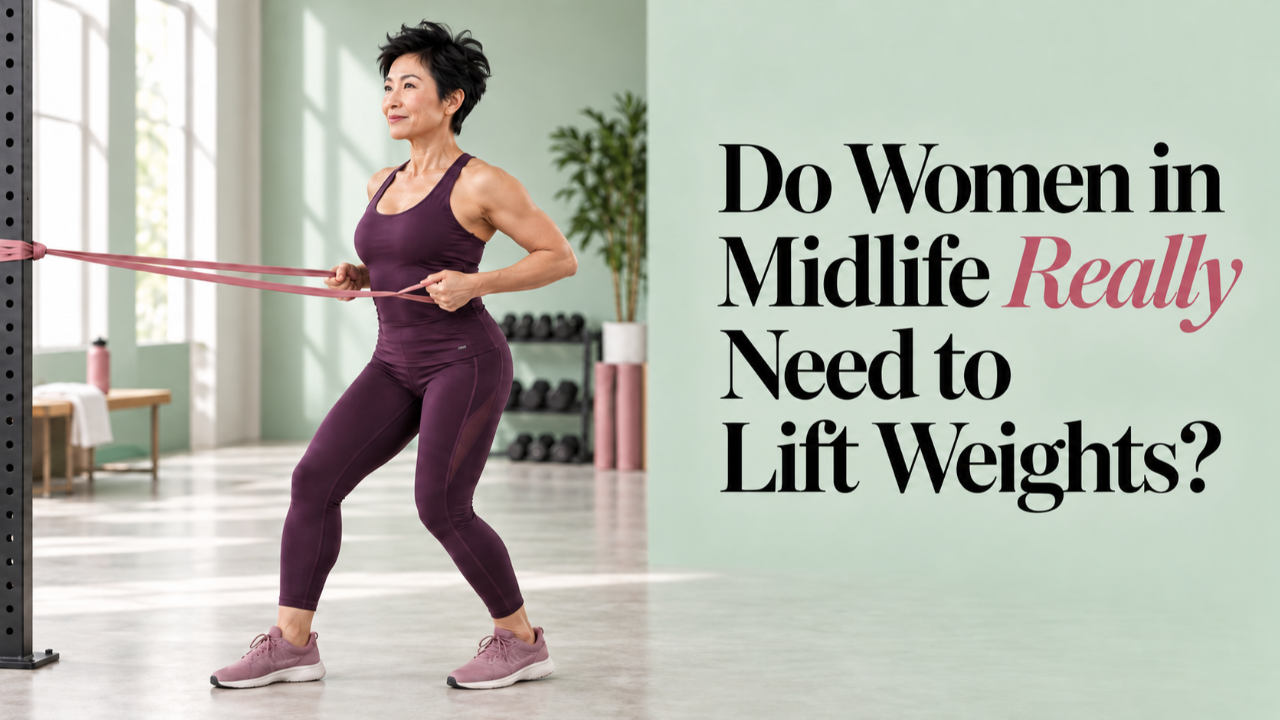
Perhaps you have noticed that carrying the shopping feels heavier than it once did, getting up from the floor takes more thought, or your body feels softer even though the number on the scales has barely changed. You may already walk, practise yoga or attend the occasional exercise class and wonder whether lifting weights is genuinely necessary. Then there are the images of crowded gyms, complicated machines and very heavy barbells, which can make strength training feel as though it belongs to somebody else. The reassuring answer is that you do not need to become a weightlifter but in midlife, your muscles do need a reason to stay strong.
The honest answer: yes, but “lifting weights” is broader than you think
Women in midlife benefit from regular resistance training, although that does not have to mean lifting an enormous barbell. Resistance training simply means asking your muscles to work harder than they are used to by pushing, pulling, squatting, hinging, carrying or holding against resistance. That resistance might come from dumbbells, gym machines, resistance bands, kettlebells, your own body weight or even a heavy bag of shopping. What matters most is that the challenge is appropriate, the movement is controlled and the work gradually becomes more demanding as you grow stronger.
Walking, swimming, cycling and yoga all offer valuable benefits, and there is no need to give them up. However, they do not always provide enough progressive resistance to strengthen every major muscle group. Walking the same route at the same pace can become excellent practice for your heart and lungs, yet increasingly familiar to your muscles. Strength training supplies a different message: please keep this tissue because I still need it.
Why does strength become so important in midlife?
Changes in muscle and bone do not begin on a single birthday, and menopause is not the sole explanation for every physical change a woman notices. Ageing, activity levels, nutrition, sleep, illness and hormonal changes can all play a part. What we do know is that muscle mass and strength tend to decline as we get older, while the fall in oestrogen around menopause accelerates bone loss for many women. This makes midlife an important opportunity to protect the physical capacity we want to carry into later life.
Muscle is not simply about appearance. It helps you climb stairs, lift a suitcase, protect your joints, steady yourself when you trip and remain independent as the years pass. Strength training also improves the nervous system’s ability to recruit muscle, which means women often become noticeably stronger before they see a dramatic visual change. That is why a heavier dumbbell, an easier flight of stairs or a more confident rise from the floor can be a more meaningful measure of progress than body weight alone.
The evidence supports this practical view. A large meta-analysis of resistance exercise in ageing adults found that it increased lean body mass, while research consistently shows substantial improvements in strength and physical function. In middle-aged women specifically, resistance-training studies have reported improvements in strength and body composition, although results vary with the programme, training history and consistency. The science does not promise to freeze ageing; it shows that muscle remains responsive when it is given a sufficiently challenging reason to adapt.
What about bones?
Bone is living tissue, and it responds to the forces placed upon it. Resistance training can contribute to bone health, particularly when exercises are progressive and load the hips and spine appropriately. In the LIFTMOR randomised controlled trial, supervised high-intensity resistance and impact training improved bone mineral density and physical function in postmenopausal women with low bone mass. This is encouraging evidence, but it is not an instruction for a beginner or anyone with osteoporosis to copy a high-intensity research programme without skilled supervision.
For bone health, the complete picture also includes adequate nutrition, vitamin D, weight-bearing activity, balance work, not smoking, sensible alcohol intake and medical treatment where required. Strength training cannot guarantee that osteoporosis will be prevented, nor should it replace prescribed treatment. Its value is that it supports both sides of fracture prevention: stronger bones where adaptation is possible, and stronger muscles and better balance to help reduce falls. If you have osteoporosis, osteopenia, a history of fragility fracture or significant back pain, ask a physiotherapist or appropriately qualified exercise professional to adapt your programme.
Will lifting weights make me bulky?
This is one of the most persistent worries women bring to strength training, yet the usual outcome of two or three sensible sessions a week is not sudden bulk. Building a large amount of muscle requires a considerable training stimulus, sufficient food, time and often a programme designed specifically for hypertrophy. For most midlife beginners, the early changes are much more everyday: better posture, firmer-feeling muscles, improved confidence and tasks becoming easier. You are far more likely to feel capable than to wake up looking like a competitive bodybuilder.
Strength training can also help with body composition, but it should not be sold as a magical solution for menopause weight gain. It may help preserve or build lean tissue during weight loss and can support metabolic health, yet it cannot selectively remove fat from the waist. Sleep, stress, food intake, daily movement, medication and health conditions still matter, and the scales may not tell the full story when fat mass falls while lean mass is maintained. Waist measurement, strength, energy, clothing fit and consistency can therefore be more useful alongside and not instead of body weight.
“I already feel tired. Won’t weights exhaust me?”
When sleep is disrupted, joints feel stiff and the working day is already demanding, another task can feel like the last thing you need. A well-designed beginner session should not leave you unable to move for three days; it should offer a manageable challenge from which you can recover. The aim is not to punish your body, burn the maximum number of calories or prove how tough you are. The aim is to practise movements that make life easier, then allow your body time to adapt.
Some muscle tenderness can occur when you begin or change a programme, but severe soreness is not a badge of success. Starting with a small dose and repeating it consistently is more useful than completing one heroic workout and avoiding the next three. On difficult weeks, twenty focused minutes twice a week can still be worthwhile. Your programme should fit your life closely enough that you can continue it.
How much strength training do you actually need?
The NHS recommends muscle-strengthening activity for all the major muscle groups on at least two days each week. It describes 8–12 repetitions as one set, suggests at least two sets and advises starting gradually, building over several weeks. This sits alongside, rather than replaces the recommendation for aerobic activity. Two full-body sessions a week is therefore a realistic and evidence-based place for many women to begin.
The final repetitions should feel challenging, but your technique should remain controlled. Imagine that you finish a set knowing you could probably complete another two good repetitions if you absolutely had to. If you could easily perform ten more, the resistance may be too light to keep producing progress; if your form changes, you hold your breath or you feel sharp pain, the load or movement needs adjusting. Effort is necessary, but strain and pain are not the goal.
A practical full-body starting plan
Begin each session with five minutes of comfortable movement, such as marching, walking, shoulder circles and a few unweighted versions of the exercises you plan to do. Choose one movement from each of the patterns below and complete one or two sets of 8–12 controlled repetitions. Rest for roughly 60–90 seconds when you need it, and allow at least a day between full-body sessions. The entire session can take 20–30 minutes.
1. Squat or sit-to-stand
Sit towards a sturdy chair and stand again, using your legs as much as possible. This develops the thighs and glutes needed for stairs, chairs and getting up from lower positions. Begin with a higher chair or light hand support if necessary. Progress by holding one dumbbell close to your chest or lowering with greater control.
2. Hip hinge or deadlift pattern
With a long spine and softly bent knees, send your hips backwards as though closing a car door, then press the floor away to stand. This pattern strengthens the glutes, back of the thighs and trunk for lifting objects safely from a lower surface. Start by learning the movement with your hands sliding down your thighs. Progress to dumbbells or a kettlebell only when the pattern feels comfortable.
3. Push
Try a wall press-up, an incline press-up against a stable worktop or a chest press using dumbbells. This strengthens the chest, shoulders and arms for pushing doors, moving furniture and supporting yourself. A wall version is not an inferior exercise; it is simply a sensible starting angle. Step farther from the wall, use a lower surface or add load as your strength develops.
4. Pull
A resistance-band row or supported dumbbell row trains the upper back and arms. Think of drawing your elbows behind you without lifting your shoulders towards your ears. Pulling movements are particularly valuable when much of the day is spent sitting at a desk, although no single exercise can “fix” posture by itself. Choose a resistance that allows a smooth return rather than letting the band or weight snap back.
5. Carry or trunk stability
Carry a weight securely by your side while walking slowly, or practise a supported bird-dog on hands and knees. These movements train the trunk to manage force rather than simply chasing abdominal fatigue. Begin with a short distance or brief hold while breathing normally. Progress by adding a little time, distance or load without leaning or bracing so hard that you cannot breathe.
6. Calf raise and balance
Rise onto the balls of your feet beside a sturdy support, pause and lower slowly. Strong calves assist walking and stairs, while balance practice helps you respond when the ground or your body shifts unexpectedly. When it is safe, add a short single-leg balance while keeping a hand close to support. Balance should feel attentive, not frightening.
How do you know when to progress?
Progressive overload sounds technical, but it simply means gradually asking your body to do a little more. When you can complete the top of your repetition range with good form and could comfortably continue, increase the resistance by the smallest available amount. You could instead add one or two repetitions, an additional set, a slightly harder exercise variation or a slower lowering phase. Change one variable at a time so that you can judge how your body responds.
Keep a simple note of the exercise, resistance and repetitions you complete. Without a record, it is easy to repeat the same comfortable workout for months and wonder why nothing changes. Progress will not be perfectly linear, particularly when sleep, menopausal symptoms, work or caring responsibilities fluctuate. A lighter session is not failure; it is often intelligent adjustment within a longer, consistent pattern.
When should you ask for individual guidance?
Seek medical or qualified professional advice before progressing if you have diagnosed osteoporosis, a recent fracture or operation, unstable heart symptoms, uncontrolled blood pressure, unexplained dizziness, significant joint pain or a health condition that affects exercise. Stop and obtain urgent medical help for chest pain, fainting or severe breathlessness that is unusual for you. Pelvic heaviness, leaking or pain does not mean you must avoid strength training, but it does deserve assessment from a pelvic-health physiotherapist so that breathing, pressure and exercise choice can be adapted. A good programme meets you where you are; it does not demand that you ignore your body.
Technique support can also be valuable if you feel intimidated or unsure. A qualified coach should explain the purpose of an exercise, offer alternatives and help you progress without making you feel judged. You do not need to earn your place in a weights area, arrive already fit or keep pace with anyone else. You are there to build the strength your own life requires.
The strength you are really building
The most important reason to lift weights in midlife is not to make your body smaller. It is to expand what your body can do: carry luggage, tend the garden, enjoy an active holiday, play with children, rise from the floor and meet later life with greater physical reserve. A dumbbell is only a tool; the real outcome is capacity, confidence and choice. That is a far richer goal than chasing exhaustion.
So, do women in midlife really need to lift weights? They need regular, progressive muscle-strengthening activity, and weights are one highly effective way to provide it. Start with what feels achievable, learn the movements, make the final repetitions meaningful and progress patiently. You are not too old, too unfit or too late, you are training for the life you still want to live.
Evidence and further reading
NHS guidance recommends strengthening all the major muscle groups on at least two days each week.
A meta-analysis of resistance exercise in ageing adults found that resistance training increased lean body mass.
Research examining resistance-training frequency supports training the major muscle groups at least twice a week for muscle growth.
The LIFTMOR randomised controlled trial investigated supervised high-intensity resistance and impact training in postmenopausal women with low bone mass.
Research in middle-aged women has also examined how resistance training affects strength and body composition across menopausal stages.
Stay connected with news and updates.
Join our mailing list to receive the latest news and updates from our team.
Don't worry, your information will not be shared.
We hate SPAM. We will never sell your information, for any reason.