Can Yoga Make You Stronger, or Do You Still Need Weights?
Sep 17, 2026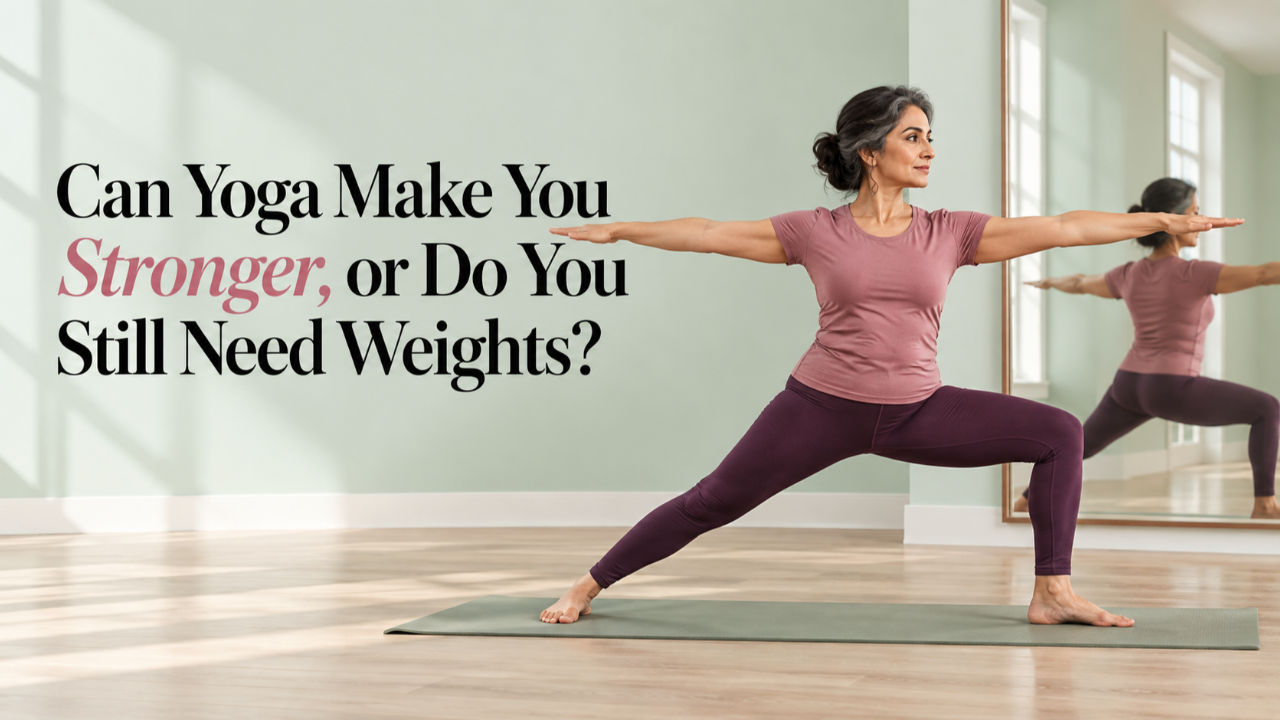
You hold a strong Warrior pose, your thighs begin to tremble and suddenly there is no doubt that your muscles are working. A few minutes later, you move through Plank, lower slowly towards the mat and discover that yoga can feel every bit as demanding as a session in the gym. It is natural to wonder whether this already counts as strength training. If you practise yoga regularly, do you genuinely need to lift weights as well?
The answer is not a dismissive “yoga is only stretching”, because that is simply untrue. Yoga can build strength, particularly when it asks you to support your body weight, hold demanding positions or move slowly with control. However, yoga and dedicated resistance training do not challenge the body in exactly the same way. Whether you need both depends on the yoga you practise, your current ability and what you want your body to remain capable of doing.
Yoga can absolutely make you stronger
Strength develops when a muscle is asked to produce more force than it is accustomed to producing. That resistance does not have to come from a dumbbell, barbell or gym machine. Your body weight can provide resistance, and yoga uses it in many intelligent ways. Chair Pose challenges the thighs and hips, Plank asks the shoulders and core to stabilise the body, while Bridge and Warrior variations recruit the legs, gluteal muscles and trunk.
Yoga also develops different types of muscular work. Muscles may shorten as you press up from a position, lengthen under tension as you lower with control or contract without obvious movement while you hold a pose. These are known as concentric, eccentric and isometric actions, and all can contribute to strength. The slow transitions and sustained holds used in many practices can make a familiar pose surprisingly demanding.
Research supports the idea that yoga can improve physical function rather than simply flexibility. A systematic review and meta-analysis of randomised trials in older adults found improvements in lower-limb strength, balance and lower-body flexibility when yoga was compared with inactive controls. A separate 2021 meta-analysis also reported moderately positive effects on strength, mobility and balance in older people. The studies used different styles, programmes and measurements, so they do not prove that every yoga class will produce the same result.
The style of yoga makes a considerable difference
“Yoga” describes a broad family of practices rather than one standardised workout. A dynamic Vinyasa sequence containing Plank, Chaturanga, Chair Pose, Warriors and controlled transitions places very different demands on the muscles from a restorative class supported by bolsters. Both may be valuable, but they are designed to create different effects. It would therefore be misleading to ask whether yoga builds strength without considering what actually happens during the practice.
A slower class can still require significant strength when poses are held for longer and alignment is carefully controlled. More dynamic practices may add repeated transitions, balance challenges and a greater demand on the shoulders, legs and core. Yin and restorative yoga can support mobility, relaxation and recovery, but they should not automatically be counted as comprehensive strength sessions. The name of the class matters less than whether its movements make your major muscle groups work hard enough to need a brief rest.
The NHS includes yoga among activities that can strengthen muscles, while also recommending that adults work all the major muscle groups on at least two days each week. This wording matters because yoga can count, but only when the practice provides a sufficient challenge across the body. A gentle session that leaves the muscles largely unchallenged remains worthwhile, although it may be serving a different purpose. Your body responds to the demand created, not to the label on the class timetable.
If you would like to explore the wider benefits beyond strength, read Why Yoga Becomes Even More Powerful After 40. It explains how yoga can also support mobility, balance, body awareness and emotional wellbeing during midlife. These qualities are not secondary or unimportant. They are part of what helps women remain confident and capable as the body changes.
Why yoga may feel harder than lifting a weight
A pose can feel intensely difficult without placing the greatest possible load on a particular muscle. In Warrior II, for example, your front thigh may burn because it is working continuously while you hold the position. In a resistance exercise such as a squat, the muscle moves through a larger changing range while an external load can be increased in small, measurable steps. Both experiences involve strength, but the stimulus is organised differently.
Balance and coordination can also make a yoga pose feel demanding. Standing on one leg requires the nervous system to manage position, control and stability while several smaller muscles work together. That challenge is useful, yet it does not always mean the larger muscles are receiving enough resistance to maximise strength or muscle growth. Difficulty and muscular loading overlap, but they are not exactly the same thing.
This explains why a highly experienced yoga practitioner can be remarkably strong in certain positions yet still find a basic weighted pulling exercise unfamiliar. Strength is specific to the task, joint angle and movement pattern being practised. Yoga makes you stronger at the work yoga asks you to do. A broader programme prepares you for a wider range of demands.
Where yoga is particularly effective
Yoga is especially good at integrating strength with balance, mobility and body awareness. Instead of training a muscle in isolation, many poses ask several areas of the body to coordinate while you breathe, stabilise and maintain control. This can make the strength feel useful and connected to movement. It may also help women regain trust in a body that has begun to feel stiff, unpredictable or less capable during midlife.
The core is challenged in a particularly practical way because it must manage the relationship between the ribs, pelvis and limbs. Plank, Side Plank, Bird Dog variations and controlled standing balances ask the trunk to resist unwanted movement. The shoulders and arms can become stronger through weight-bearing poses, while standing sequences develop endurance through the legs. For someone moving from a largely sedentary lifestyle, these demands can create meaningful improvement.
Yoga is also highly adaptable. A wall, chair, blocks or a change in lever length can make a pose more accessible without removing its purpose. The same movement can later become more demanding through a longer hold, a slower transition or reduced support. This makes yoga a useful entry point for women who feel intimidated by conventional strength training.
Where yoga may leave gaps
The first potential gap is pulling strength. Yoga contains plenty of pressing through the hands, but relatively few movements that ask you to pull resistance towards the body. The upper-back muscles, biceps and grip may therefore receive less direct challenge than the chest, shoulders and triceps. Resistance-band rows, cable rows or supported dumbbell rows can provide the pulling work a yoga practice may be missing.
The second gap is progressive loading. Your body weight is a perfectly valid form of resistance, but it becomes difficult to increase that resistance gradually once a pose is familiar. You can change the position, increase the hold or attempt a more advanced version, although the progression may involve more balance or flexibility rather than placing a clearly greater load on the target muscles. Weights and bands allow the resistance to rise in smaller and more measurable increments.
The third gap can appear in the muscles of the hips and legs. Chair Pose, Warriors, lunges and single-leg balances can be challenging, especially for a beginner. Over time, however, the legs may need more resistance than a standard yoga practice provides if the goal is to maximise or preserve strength and muscle. Squats, step-ups, loaded hip hinges and carries can add that missing challenge without replacing yoga.
Grip strength and the ability to carry an external load are also difficult to train comprehensively on a mat. Everyday life involves shopping bags, suitcases, gardening equipment and objects that do not distribute their weight conveniently. A loaded carry teaches the body to walk while managing resistance through the hands, shoulders and trunk. This is a simple example of something weights can offer that yoga rarely reproduces.
What this means for muscle and bone in midlife
Maintaining muscle becomes increasingly important as women move through midlife and beyond. Ageing, changing hormones, reduced activity, disrupted sleep and long working days can all influence strength and body composition. Yoga can help protect function by keeping the body active and asking muscles to work. Dedicated resistance training provides a more direct and adjustable way to preserve or build muscle when that is a priority.
The evidence base for resistance training is extensive. A 2025 systematic review and network meta-analysis covering 151 randomised trials found that even lower volumes of resistance training improved physical function, lean body mass and muscle size in older adults, while higher volumes tended to be more effective for maximising strength. This does not mean every woman requires a large or exhausting programme. It shows that a relatively modest amount of well-designed resistance work can make a worthwhile difference.
Bone health adds another reason to consider a combined approach. Yoga creates some weight-bearing load and may contribute to balance, which matters for reducing the likelihood of falls. However, bone adaptation depends on the size, direction and novelty of the forces applied, and not every pose provides a strong enough stimulus at the sites most vulnerable to fracture. A 2026 network meta-analysis in postmenopausal women found that programmes combining mind–body exercise with resistance training performed particularly well across several measures of bone mineral density.
This does not make yoga ineffective or weights magical. Bone responses are site-specific, develop slowly and are influenced by nutrition, hormones, health conditions and medication as well as exercise. Women with osteoporosis or a high fracture risk may need individual guidance about loaded spinal flexion, deep twisting, impact and resistance. The most responsible message is that yoga can contribute to a bone-supportive lifestyle, but it should not automatically be assumed to provide every stimulus the skeleton needs.
Do you personally need to add weights?
Begin by noticing what your current yoga practice asks of you. Do your muscles feel genuinely challenged during the final part of a hold, or could you continue comfortably for a long time? Does your week include work for the legs, hips, back, abdomen, chest, shoulders and arms? Most importantly, does your practice include pushing, pulling, squatting, hinging and carrying in some form?
Your everyday life can provide further clues. Perhaps you can hold a Tree Pose confidently but struggle to lift a suitcase into the car. You may move beautifully through Downward-Facing Dog yet find that carrying heavy shopping quickly tires your hands and upper back. You might have excellent hip mobility but lack confidence getting up from a low chair without using your hands.
These observations do not diminish what yoga has given you. They simply reveal the difference between being skilful on the mat and being prepared for a broad range of physical demands. If yoga still challenges all your major muscle groups and your strength is progressing, it may already be doing a substantial amount of the work. If the practice has become comfortable or leaves obvious gaps, adding resistance is a sensible next step.
You do not have to choose one or the other
Yoga and weights are often presented as competing identities, as though women must decide whether they are a “yoga person” or a “gym person”. The body does not recognise those categories. It responds to load, movement, recovery, repetition and progression. A thoughtful combination can provide more complete support than either activity is expected to deliver alone.
Yoga can maintain mobility while teaching you to control the ranges you have. Resistance training can increase the amount of force you can produce and give you a clear way to progress. Yoga may calm a busy mind and reconnect you with your body, while weights can build confidence in your capacity to lift, carry and move against resistance. Together they create a useful partnership between being supple and being strong.
For many women, a realistic week could include two yoga sessions and two short full-body strength sessions. One strength session might include a chair squat or weighted squat, a resistance-band row, a wall or incline press-up, a hip hinge and a carry. The second could use step-ups, a glute bridge with added resistance, a shoulder press, another pulling movement and a core exercise. Twenty to thirty focused minutes can be enough when the movements are chosen well.
If four separate sessions do not fit your life, add a short strength section to the end of two yoga practices. Ten to fifteen minutes of rows, squats, hip hinges and carries can cover several movements that the class may not provide. Another option is one longer strength session and a second brief session later in the week. The best plan is not the most impressive one; it is the one you can repeat and gradually progress.
How to start without losing what you love about yoga
Begin with resistance that allows you to complete approximately eight to twelve controlled repetitions while keeping your technique steady. The final two or three repetitions should feel challenging, but you should not have to strain, hold your breath or sacrifice control. Start with one or two sets and allow enough recovery before training the same muscles hard again. When the top of the repetition range begins to feel easy, increase the resistance by the smallest practical amount.
Keep yoga in the week for the reasons it matters to you. You do not need to turn every peaceful practice into another demanding workout or judge a restorative session because it did not build muscle. Recovery, breathing and mobility have value even when they are not strength training. Let each form of movement do its own job instead of expecting one practice to provide everything.
If you are new to weights, resistance bands and a pair of manageable dumbbells can provide an accessible starting point at home. Gym machines can also be useful because they offer stability while you learn to produce force. Technique should be comfortable and controlled rather than based on copying the deepest squat or heaviest lift you see online. Professional guidance is particularly valuable if you have persistent pain, osteoporosis, pelvic-floor symptoms, a recent injury or a health condition that affects exercise.
The honest answer
Yes, yoga can make you stronger. For a beginner, a carefully chosen yoga practice may produce noticeable improvements in the legs, core, shoulders, balance and overall control. As your body adapts, however, yoga may become less efficient at providing the progressive and comprehensive loading needed for further gains. Pulling strength, grip, carrying capacity and heavier work for the hips and legs are common areas that benefit from added resistance.
You do not need to abandon the mat, join an intimidating gym or lift the heaviest weight in the room. You simply need to ask whether your current practice is still challenging your muscles in all the ways your future life will require. Yoga can help you move with awareness, steadiness and freedom, while weights can expand the amount of force your body is able to handle. Midlife women deserve both mobility and strength and the freedom to build them in a way that feels supportive, intelligent and sustainable.
Stay connected with news and updates.
Join our mailing list to receive the latest news and updates from our team.
Don't worry, your information will not be shared.
We hate SPAM. We will never sell your information, for any reason.