Why Hiding the Biscuits Doesn't Always Solve the Problem
Oct 30, 2026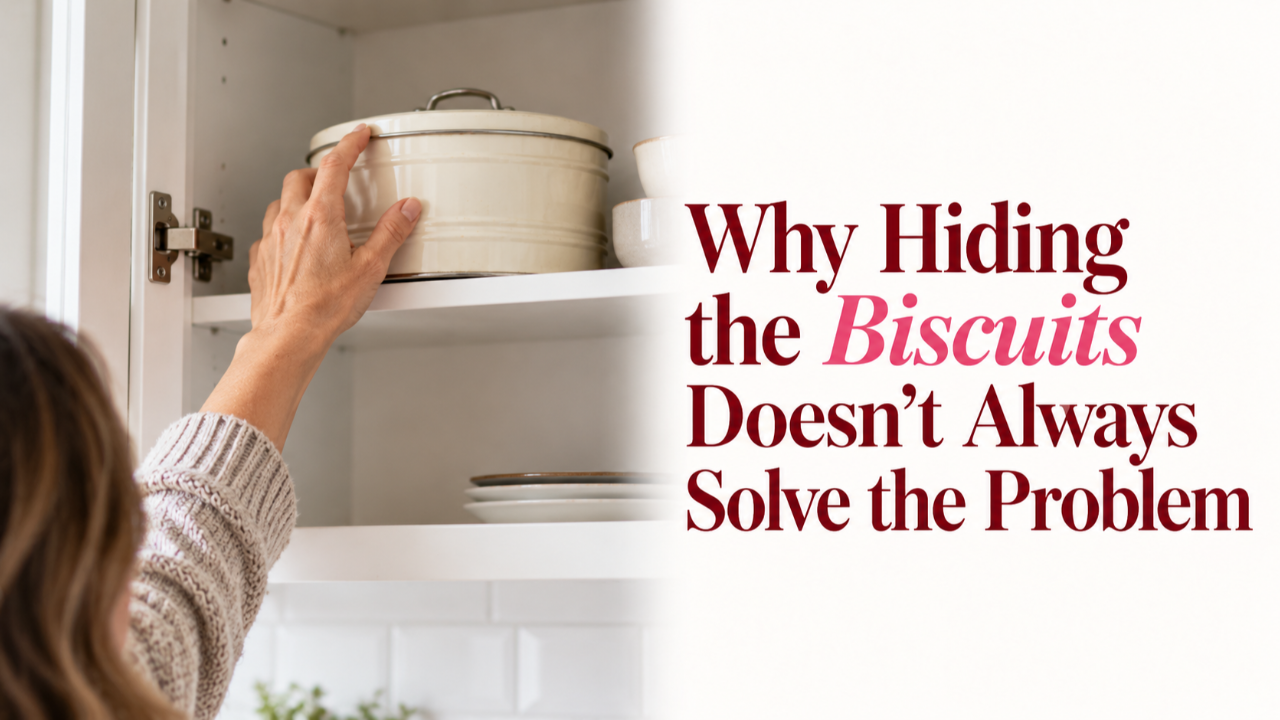
Understanding food rules, restriction and why a healthier relationship with eating may begin with changing how you think about food, rather than simply removing it from the cupboard.
You've decided that this week will be different. The biscuits are going, the chocolate is being moved out of sight and you're determined not to buy anything that might tempt you. After all, you've been trying to make healthier choices, and surely removing the things you find difficult to resist will make everything easier.
For the first few days, you feel rather pleased with yourself. You choose nutritious meals, walk past the biscuit aisle without stopping and congratulate yourself on being disciplined. Then Thursday arrives, you've had a demanding day and somebody offers you a biscuit with your afternoon tea. Suddenly, something that ordinarily wouldn't seem particularly important feels like a decision you need to think about far too much.
Do you have one? Will that spoil your progress? If you eat it now, will you end up wanting more?
It's extraordinary how much emotional energy we can spend on something as ordinary as a biscuit.
Perhaps you've experienced the familiar cycle of promising yourself that certain foods are off-limits, managing without them for a while and eventually finding yourself eating them again. You might then feel disappointed and decide that the only solution is to become even stricter next time. Before long, the problem is no longer simply what you're eating. It's the amount of pressure, judgement and anxiety surrounding your choices.
What if the answer isn't always to hide the biscuits, but to reconsider why they've become something you feel you must control?
For many women navigating perimenopause, menopause and the years beyond, this is a question worth exploring. Particularly when changes in weight, body shape and confidence have made eating feel more complicated than it used to.
When did certain foods become something to fear?
Think back over the dietary advice you've encountered throughout your adult life. You may remember years when fat was considered the enemy, followed by an obsession with avoiding carbohydrates. Then came detox plans, sugar-free challenges, fasting schedules and countless recommendations about foods we should never eat after a particular time.
If you've spent thirty years navigating changing nutritional advice, it's hardly surprising that you may have developed a complicated collection of food rules. Some were probably based on sound health advice, while others were influenced by popular diets, marketing and the promise of quick results. Yet over time, these messages can become so familiar that we rarely question whether they're still helpful.
Perhaps you believe bread should be avoided after six o'clock, chocolate is only acceptable at weekends or eating dessert means you need to exercise more the following morning. Maybe you tell yourself that certain foods are bad, even though you enjoy them and have no medical reason to avoid them. These rules can become part of the background conversation you have with yourself whenever you eat.
It's worth distinguishing between sensible nutritional choices and rigid restrictions. Choosing to eat more vegetables, include adequate protein or moderate foods high in added sugar can support your health. But believing that one biscuit has ruined your entire day is something very different.
Healthy eating shouldn't require you to spend every meal negotiating with yourself.
What does the science tell us about restrictive eating?
The relationship between food restriction and eating behaviour is more complicated than popular diet advice sometimes suggests. Researchers distinguish between different types of dietary restraint, including flexible approaches to managing food intake and more rigid patterns involving strict rules or attempts to avoid particular foods entirely.
A systematic review published in Obesities in 2024 examined research investigating the association between dietary restraint and binge eating. The researchers explored factors that may influence the relationship, recognising that not every person who restricts food develops binge-eating behaviours. The findings highlight the importance of individual differences and the limitations of treating all forms of dietary restraint as though they have identical effects.
You can read the paper here: A Systematic Review of Moderators of the Association Between Dietary Restraint and Binge Eating.
This distinction matters because making a deliberate decision to eat fewer biscuits is not automatically unhealthy. Equally, the research does not suggest that enjoying a previously restricted food will inevitably lead to overeating. What deserves attention is whether your eating rules have become so inflexible that breaking one produces distress, guilt or a sense of failure.
Imagine deciding not to have chocolate during the working week. If this is a comfortable personal preference that doesn't cause you anxiety, it may be perfectly manageable. But if eating one square of chocolate makes you feel that you've ruined everything and might as well finish the entire bar, the rule may be creating more difficulty than it solves.
The issue isn't necessarily the chocolate. It's the belief that your eating choices must be either completely right or completely wrong.
For women who have spent years moving between strict diets and periods of frustration, learning to recognise that pattern can be an important step towards greater food confidence.
Why menopause can make food rules feel even more tempting
Midlife brings physical and emotional changes that can affect how women feel about their bodies. During perimenopause, fluctuations in reproductive hormones may be accompanied by disrupted sleep, mood changes and other symptoms. Around menopause, changes in fat distribution can also mean that weight is carried differently, particularly around the abdomen.
The NHS recommends a balanced diet, regular activity and attention to sleep and mental wellbeing during this stage of life. There is no universal recommendation to eliminate biscuits, bread, chocolate or other familiar foods simply because you've reached menopause.
Read the NHS guidance on looking after yourself during menopause.
Nevertheless, it can feel unsettling when your body begins changing in ways you hadn't expected. Perhaps your favourite trousers fit differently, or you find yourself comparing your present body with photographs taken ten years ago. You may feel that the most obvious solution is to reduce portions, eliminate treats or impose stricter rules.
It is understandable to want to feel comfortable and confident in your body. But menopause-related changes in body composition are influenced by several factors, including ageing, activity, sleep, muscle mass and hormonal changes. They are not simply evidence that you have been eating too many biscuits.
When weight management becomes the central focus of every food decision, it can be easy to overlook other important goals. You need nourishment to maintain muscle, support bone health and remain active as you age. You also deserve a relationship with eating that allows room for enjoyment and ordinary social occasions.
There is no need to choose between looking after your health and enjoying your favourite foods.
The difference between managing your environment and banning food
Let's imagine two women who both enjoy biscuits with their afternoon tea.
The first decides she would like to eat them less frequently because she has noticed that she sometimes reaches for them out of routine. She keeps a variety of foods available, enjoys biscuits when she wants them and doesn't give the decision much further thought. Her approach feels comfortable, flexible and sustainable.
The second decides that biscuits are forbidden. She stops buying them, worries whenever somebody brings them into the house and feels disappointed whenever she eats one. A perfectly ordinary snack has become something surrounded by rules and self-criticism.
Both women may be trying to make healthier choices, but their experiences are very different.
Creating a supportive food environment is sensible. You might keep nourishing ingredients available, plan satisfying meals and arrange your kitchen so that preparing food is convenient. These changes can make everyday nutrition easier without requiring you to label certain foods as dangerous or morally unacceptable.
You may also decide that keeping large quantities of a particular snack at home doesn't suit your preferences. There is nothing wrong with that decision when it comes from practical consideration rather than fear or punishment.
The important distinction is whether your environment supports your choices or whether you feel that you cannot trust yourself around ordinary food.
A supportive kitchen should make eating well easier, not turn your cupboards into a collection of things you're afraid to open.
The problem with the words good, bad and naughty
Have you ever described yourself as being good because you ate a salad or naughty because you enjoyed a slice of cake?
These expressions are so common that we often use them without thinking. Someone offers us a biscuit, and we laugh that we're being naughty. We choose fruit instead of dessert and proudly announce that we're being good.
But food doesn't determine our character.
A biscuit contains ingredients and nutrients. A salad contains ingredients and nutrients. Their nutritional contributions differ, but neither makes the person eating them morally superior or inferior.
When we repeatedly describe foods as good or bad, we can begin attaching those labels to ourselves. A day of eating according to our rules feels successful, while a day that includes an unplanned treat becomes something to regret.
This way of thinking can be particularly unhelpful when you're trying to develop sustainable habits. Instead of considering your eating patterns over time, you may begin judging your entire day according to a single choice.
Try changing the language you use around food. Instead of saying, I've been bad because I ate cake, you might say, I enjoyed a slice of cake this afternoon. Rather than calling a balanced lunch good, you could simply recognise that it was satisfying and provided useful nourishment.
This isn't about pretending that every food has the same nutritional value. It's about recognising that your worth as a person has absolutely nothing to do with what you ate at lunchtime.
Can you eat your favourite foods and still look after your health?
Yes, although the overall pattern of your diet remains important.
A balanced eating approach makes room for nourishing meals, adequate protein, fibre-rich foods, fruit, vegetables and foods that provide calcium and other essential nutrients. It can also include biscuits, chocolate, cakes and other enjoyable foods in amounts that suit your preferences and circumstances.
The NHS encourages a balanced approach to eating, with an emphasis on dietary quality and appropriate portions. Foods high in added sugar are generally best enjoyed less frequently and in smaller amounts, but this does not mean one enjoyable treat undermines an otherwise nourishing diet.
A useful question to ask is whether your usual meals are providing enough satisfaction and nourishment. If breakfast and lunch are consistently too small, or you've eliminated foods you genuinely enjoy, your eating pattern may become unnecessarily difficult to maintain. This is one reason rigid food rules sometimes feel manageable for a short period but exhausting over time.
If you've been skipping meals in an effort to control your weight, our earlier article, Skipping Lunch to Save Calories? Why It Can Backfire by Evening, explores why adequate nourishment matters and how to build more satisfying meals.
A sustainable approach to health should work during ordinary weekdays, family celebrations, restaurant visits and the occasional afternoon when somebody brings a beautiful homemade cake into the office.
You don't need to start again every Monday because you enjoyed something on Friday.
What if allowing yourself a biscuit feels uncomfortable?
This is where developing food confidence may require a little patience.
If you've spent years believing that certain foods should be avoided, changing that belief can feel strange. You might worry that allowing yourself to eat something will mean you always want it. Or perhaps you fear that without strict rules, your eating habits will become completely unpredictable.
Those feelings deserve understanding rather than another instruction to simply relax around food.
A useful starting point is to identify one rule that causes unnecessary pressure. Perhaps you believe you should never eat chocolate on weekdays, always refuse dessert or compensate for eating more than planned.
Consider whether the rule serves a genuine health purpose or whether you've continued following it because it feels familiar. You may decide to keep some boundaries and reconsider others. The aim isn't to abandon every nutritional preference but to develop greater flexibility where rigid thinking is making eating stressful.
For example, if you normally refuse dessert even when you'd enjoy it, you might occasionally choose one and allow yourself to experience the meal without planning how to compensate afterwards. If that feels comfortable and appropriate for you, notice whether the experience is as significant as you previously imagined.
You may simply discover that dessert is something you can enjoy and then move on from.
For someone experiencing significant food anxiety, loss-of-control eating or a history of an eating disorder, however, changing restrictive rules is best approached with support from an appropriately qualified professional. You don't need to challenge distressing food fears on your own.
A practical exercise: Reconsider one food rule
Rather than deciding that you need an entirely new approach to eating, choose one familiar food rule to examine over the coming week.
Start by recognising the rule itself. Perhaps it's I must never eat biscuits during the week, I shouldn't have bread with dinner or If I eat dessert, I need to be extra careful tomorrow. Try writing the sentence exactly as it usually appears in your thoughts.
Next, think about where the belief came from. Was it something you learned from a diet many years ago? Did a friend recommend it, or did you adopt it during a period when you were particularly worried about your weight? You might discover that you've followed the rule for so long that you no longer remember why it began.
Now consider how the rule affects your everyday life. Does it help you make choices you feel comfortable with, or does it create guilt, anxiety and unnecessary negotiation around food? Does it fit your current health needs, or has it become an obligation you rarely question?
Finally, think about how you could express the same intention more flexibly. Instead of I must never eat biscuits, perhaps your approach becomes I enjoy biscuits sometimes, and I also want my usual meals and snacks to be nourishing and satisfying. Instead of Dessert will ruin my diet, you might remind yourself that one dessert does not determine your long-term health.
You do not need to put the new approach into practice perfectly. Simply noticing the difference between a rigid rule and a flexible intention is a valuable beginning.
What does the research say about a less restrictive relationship with food?
Another useful area of research examines intuitive eating, mindful eating and eating competence. These approaches differ in their methods, but they generally place greater emphasis on recognising bodily needs, responding to hunger and satisfaction, and developing a more flexible relationship with eating.
A systematic review published in Nutrition & Health examined 86 studies, representing 75 unique datasets, investigating relationships between these eating approaches and health outcomes.
The review found that greater intuitive and mindful eating were associated with lower levels of disordered eating symptoms and depressive symptoms, alongside more positive body image, self-compassion and mindfulness. Some measures were also associated with aspects of dietary quality and other health behaviours.
Read the systematic review: Food for the Mind.
These findings are encouraging, but they need to be interpreted carefully. Much of the evidence is observational, meaning it cannot establish that adopting intuitive eating directly produces every reported benefit. The research also does not mean nutritional guidance is unnecessary or that everybody will benefit from exactly the same approach.
What it does suggest is that our relationship with food matters alongside the nutritional composition of our meals.
For women who have spent years following increasingly restrictive diets, this can be an empowering perspective. Rather than constantly asking what they should remove, they can begin considering how to develop eating patterns that support nourishment, flexibility and long-term wellbeing.
Five changes that may be more useful than hiding the biscuits
Make your usual meals satisfying. If you're continually eating small portions, avoiding carbohydrates or missing meals, begin by reviewing whether your body is receiving adequate nourishment. A satisfying lunch containing protein, fibre-rich carbohydrates, vegetables and some healthy fats may be more useful than spending the afternoon trying to ignore hunger.
Stop treating one food choice as a verdict on your day. Enjoying cake at a birthday celebration doesn't cancel out the nourishing breakfast you ate or the movement you enjoyed earlier. Your overall patterns matter far more than a single occasion.
Think about what you genuinely enjoy. Perhaps you've spent years eating foods marketed as healthier alternatives even though you don't particularly like them. Sometimes a modest portion of something you genuinely enjoy may feel more satisfying than repeatedly choosing substitutes that leave you disappointed.
Allow your preferences to change. You may love chocolate on some days and not particularly fancy it on others. Having a favourite food available doesn't mean you are obliged to eat it, just as deciding not to eat it doesn't need to become a rule.
Focus on adding nourishment, not only removing foods. Consider whether you could include more vegetables, adequate protein, fibre-rich foods or calcium-rich options in your usual meals. This creates a positive direction for your nutrition without requiring you to organise your entire diet around avoidance.
These are not instructions to abandon your health goals. They are ways to make those goals feel more achievable and less emotionally exhausting.
What if you have been dieting for most of your adult life?
This is a particularly important question for women in midlife.
Perhaps you began your first diet in your late teens, joined slimming groups in your twenties and spent your thirties trying to lose weight after having children. By your forties, you may have accumulated an impressive knowledge of calorie values, portion sizes and foods you were told to avoid.
Then perimenopause arrived, your body began changing again and you found yourself questioning everything that had previously seemed to work.
After decades of dieting, it can be difficult to imagine eating without a detailed collection of rules. You may feel that being relaxed around food means abandoning your health goals, particularly if maintaining your weight has become more challenging.
But there is room between strict restriction and eating without regard for your health.
You can care about nutrition, maintain a suitable weight where appropriate, enjoy regular physical activity and still allow flexibility around everyday food choices. You can make thoughtful decisions about portion sizes without treating hunger as an enemy. You can also acknowledge that your body at fifty-five will not necessarily look or function exactly as it did at thirty-five.
There is no obligation to spend the rest of your life trying to recreate an earlier version of yourself.
Midlife wellbeing is about supporting the woman you are today and protecting the health, strength and independence you want for the years ahead.
Perhaps the biscuits were never the whole problem
Imagine opening your kitchen cupboard tomorrow and seeing your favourite biscuits sitting there.
Perhaps you decide you'd enjoy one with your tea. Perhaps you prefer something else, or maybe you're not particularly interested in eating anything at that moment.
The important thing is that the decision no longer needs to become an argument with yourself.
You don't have to calculate whether you've earned the biscuit, promise to exercise afterwards or decide that your day is ruined because you ate something sweet. You can make an ordinary choice and allow it to remain ordinary.
That doesn't mean nutrition stops mattering. It means you've begun separating the food itself from years of unnecessary judgement.
For some women, this will be a relatively simple change. For others, particularly those who have spent decades moving between restrictive diets and frustration, it may take time and appropriate support.
Either way, there is something reassuring about realising that you don't need to fear your kitchen cupboard to look after your health.
Your relationship with food deserves a fresh start
By midlife, many women have become remarkably capable of managing responsibilities, supporting other people and adapting to life's changes. Yet when it comes to food, we can still find ourselves following rules established years ago, sometimes without remembering why.
Perhaps this is an opportunity to reconsider a few of them.
You can nourish your body, support your bones and muscles, manage your health and enjoy the foods you love. You can make deliberate choices without turning every decision into a test of discipline. And you can recognise that confidence around eating develops through understanding, not simply through removing everything you find tempting.
The next time you feel the urge to hide the biscuits, consider what you're hoping that decision will achieve.
Perhaps changing what you keep in the cupboard would genuinely make your routine easier. Or perhaps the more meaningful change would be to stop viewing certain foods as something you must battle against.
Because a healthier relationship with food isn't simply about what you keep out of your kitchen. It's about developing the confidence to make choices without fear, guilt or the feeling that you have to start again tomorrow.
And that is a kind of food freedom worth working towards.
Begin Your Midlife Wellbeing Reset
If you're ready to approach your nutrition, movement and everyday wellbeing with greater confidence, my Free 7-Day Midlife Hormone & Wellness Reset is a gentle place to begin.
Opening on 10 November 2026, the Reset is designed to help women take practical, manageable steps towards supporting their health during perimenopause, menopause and beyond.
No unrealistic expectations. No need to have everything worked out before you start. Just an opportunity to begin making meaningful changes that fit your life.
Join the Free 7-Day Midlife Hormone & Wellness Reset interest list
Warm wishes,
Monica Rafiq
Founder, Fitness Inspiration for Women
Certified Menopause Coach | Nutrition & Weight Loss Specialist | Life Coach & NLP Practitioner
Research and further reading
Mason, T.B., Dolgon-Krutolow, A. and Smith, K.E. (2024). A Systematic Review of Moderators of the Association Between Dietary Restraint and Binge Eating. Obesities, 4(2), 132–144. Read the paper.
Food for the Mind (2025). A systematic review of mindful and intuitive eating approaches for mental health and wellbeing. Read the systematic review.
NHS. Things you can do to help menopause and perimenopause symptoms. Read the guidance.
Stay connected with news and updates.
Join our mailing list to receive the latest news and updates from our team.
Don't worry, your information will not be shared.
We hate SPAM. We will never sell your information, for any reason.