Your Body Is Changing After 40. Should Your Exercise Change Too?
Jul 30, 2026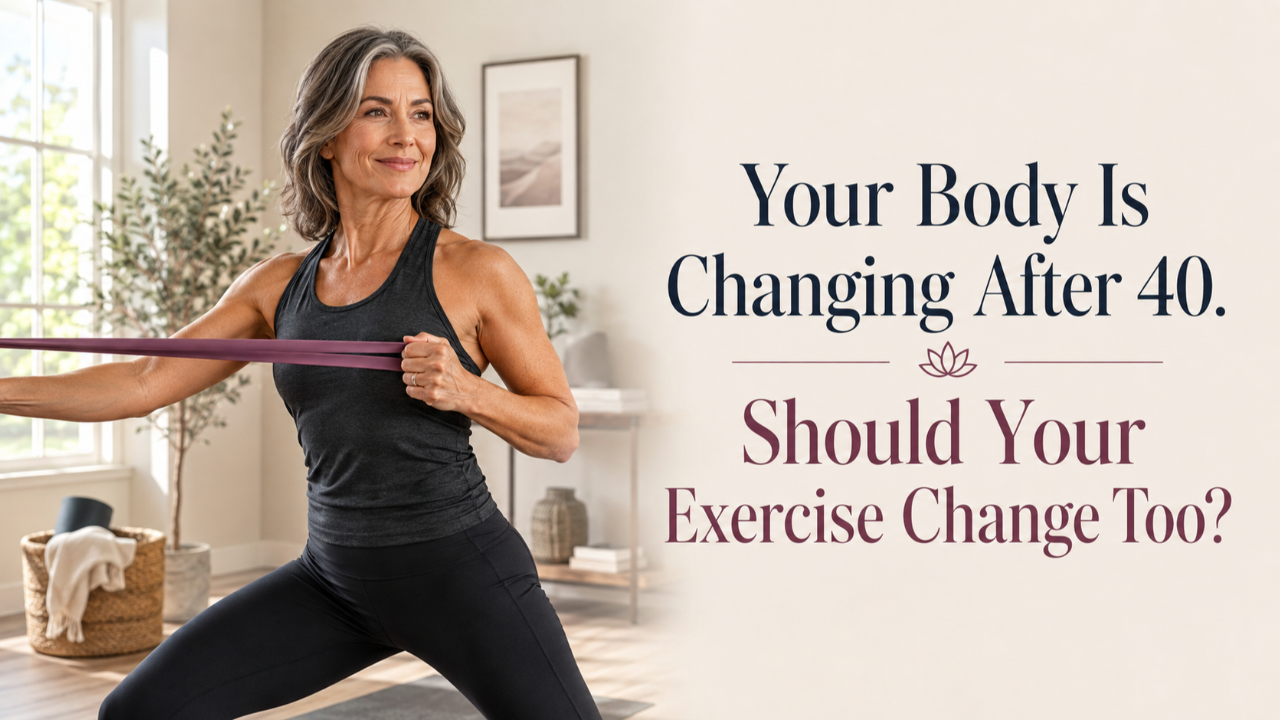
You may still be walking regularly, going to yoga, squeezing in the occasional workout and generally trying to stay active. Yet somewhere in your 40s or 50s, you may begin to notice that the exercise that once kept you feeling fit does not seem to have quite the same effect. Your waistline may be changing despite your habits staying much the same, your muscles may feel less firm, and recovery can take longer than it used to.
Perhaps your back feels stiff after a long day at your desk, your knees complain more than they once did, or lifting a suitcase into the car suddenly requires more effort. It is easy to assume that the answer is simply to exercise more, but that is not necessarily the case. A better question may be whether the way you exercise needs to change.
During perimenopause and menopause, your body is navigating both hormonal change and the natural effects of ageing. Harvard Women's Health Watch explains that ageing is associated with a gradual loss of muscle mass, while falling oestrogen levels during the menopause transition can also influence where the body stores fat. At the same time, lower activity levels can contribute to changes in weight and body composition, which is why exercise in midlife needs to become less about simply burning calories and more about preserving strength, muscle and function.
One of the most important things to protect is muscle. Muscle is not simply about how toned your arms or legs look. It allows you to climb stairs, carry shopping, lift luggage, maintain good posture, get up from the floor and continue managing everyday life with confidence.
Harvard Health highlights that the gradual loss of strength can be surprisingly easy to miss. For many women, it becomes noticeable only when standing up from a chair, carrying heavier bags or walking up stairs starts to feel more difficult. Regular resistance training can help maintain and improve muscle strength, power and physical function as we get older.
For professional women, this is particularly relevant. You may spend much of the day sitting in meetings, commuting, working at a computer and managing other people's needs, so even if you are active, your muscles may not be receiving enough resistance to remain strong. A lunchtime walk is excellent for your cardiovascular health, mood and general movement, but walking does not provide the same muscular challenge as strength training.
This does not mean you should stop walking, swimming, cycling, yoga or any other form of exercise you enjoy. Cardiovascular exercise and strength training perform different jobs, and both have an important place in healthy ageing. Harvard researchers have highlighted evidence linking both aerobic activity and muscle strengthening with long term health benefits, so the aim is not to replace what you already do but to add what your body increasingly needs.
Strength training simply means asking your muscles to work against resistance. That resistance can come from dumbbells, resistance bands, gym machines or your own body weight. Squats, lunges, rows, presses, bridges, wall push ups and appropriately modified planks can all form part of an effective programme.
You also do not need to become someone who spends hours in the gym. Harvard Health's updated guidance on resistance training emphasises that some strength training is far better than none and recommends training the major muscle groups at least twice a week. This can be achieved with weights, resistance bands or body weight, making it far more adaptable for women trying to fit exercise around demanding careers and family life.
Two well structured sessions during the week can be more valuable than continually waiting for the perfect hour that never arrives. You might train for 20 or 30 minutes before work twice a week, keep a pair of dumbbells at home or complete one longer session at the weekend and a shorter session during the week. The key is not creating the perfect schedule but creating one you can genuinely maintain.
There is another important reason strength deserves more attention after 40, and that is bone health. Bone mass gradually declines with age, and menopause is an important period for protecting bone density. Harvard Health explains that strength training places useful mechanical stress on bones through the pulling and pushing created by working muscles, which can help support stronger bones and slow bone loss.
This is particularly relevant in areas such as the hips, spine and wrists, where fractures can have a significant impact later in life. It also changes the way we can think about individual exercises. A squat is no longer simply an exercise for your thighs; it is helping to build the strength you need to get in and out of a chair comfortably as you age.
A rowing movement is not simply about toning your back. It helps maintain the strength and posture needed to carry, pull and lift with confidence. Core exercises are not only about creating a flatter stomach; they help build the stability and control you need for balance, movement and everyday physical independence.
This is one of the biggest shifts I would encourage women to make in midlife. Exercise becomes less about punishing your body for what it weighs and more about preparing your body for the life you want to continue living. Strength becomes something you build because you value what your body can do, not simply because you want to change how it looks.
Strength training can also support changes in body composition that often become more noticeable around menopause. Harvard Women's Health Watch notes that declining oestrogen is associated with greater fat storage around the abdomen, while declining muscle mass can reduce the amount of energy the body uses at rest. Maintaining muscle through resistance training is therefore an important part of supporting metabolism and body composition during this stage of life.
That does not mean lifting weights will magically remove menopause belly fat, and no single form of exercise can do that. What it does mean is that muscle becomes something worth protecting. The more muscle you maintain, the better positioned you are to support strength, function and metabolic health as you age.
To build strength, your muscles also need to be challenged gradually. This is known as progressive resistance, and it simply means increasing the demand on your muscles as you become stronger. Progress might mean lifting a slightly heavier weight, adding a few more repetitions, improving your technique or moving on to a more challenging version of an exercise.
You do not need to leave every workout exhausted for it to be effective. The aim is simply to provide enough challenge to encourage your muscles to adapt. Over time, that gradual progression can make a meaningful difference to how strong and capable you feel in everyday life.
For women dealing with perimenopause symptoms, this more flexible approach can also be freeing. There will be days when sleep has been poor, energy is unpredictable or your joints feel less comfortable. Your exercise does not have to look identical every day, and consistency does not mean pushing yourself at maximum intensity regardless of how you feel.
Strength training can sit alongside mobility work, yoga, walking and cardiovascular exercise. Some days you may lift more heavily, while on others you may focus on technique, balance or mobility. The goal is not relentless intensity but a combination of consistency, appropriate challenge and enough recovery.
It can also help to think beyond what you want your body to look like today and consider what you want it to be capable of in ten, twenty or thirty years. Perhaps you want to travel without worrying about whether you can manage your suitcase, continue hiking, swimming or gardening, or get down onto the floor and stand back up with ease. You may want strong bones, good balance and enough physical confidence to keep saying yes to new experiences.
The training you do now contributes to that future. If your body feels different after 40, you do not necessarily need to exercise harder. You may simply need to exercise with a different purpose.
Keep the walks that clear your head, the yoga that helps you move well, and the swimming, cycling or classes you genuinely enjoy. But make room for strength too. Pick up the weights, use the resistance band, practise the squat, strengthen your back and core, and gradually ask more of your muscles.
Because the most valuable result of exercise in midlife may not be a number on the scales. It may be reaching your 60s, 70s and beyond and realising just how much your body can still do.
Stay connected with news and updates.
Join our mailing list to receive the latest news and updates from our team.
Don't worry, your information will not be shared.
We hate SPAM. We will never sell your information, for any reason.