Why Stress Can Make You Hungry Even When You Have Eaten Enough
Aug 04, 2026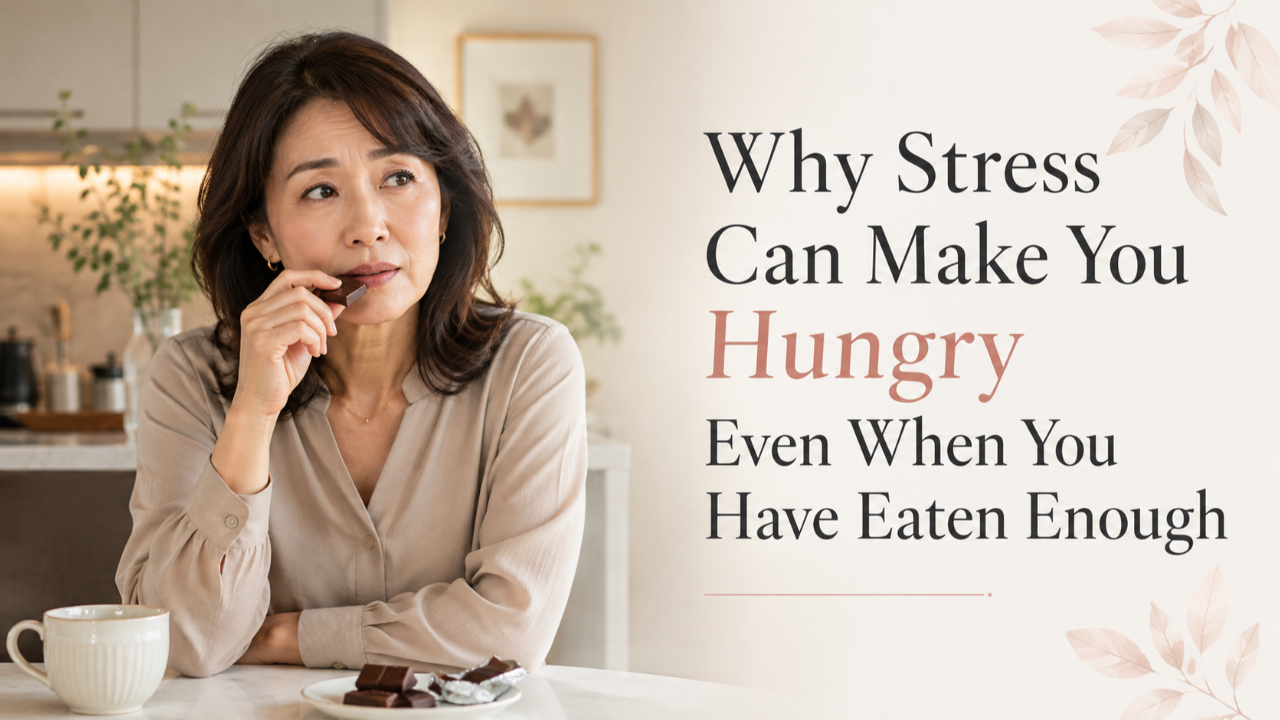
You have eaten dinner. You know you have eaten enough. Yet twenty minutes later you find yourself opening the cupboard looking for something else. Perhaps it is chocolate, toast, crisps, biscuits or cheese. You may even stand there thinking, Why am I doing this? I cannot possibly still be hungry. For many women in midlife, this moment happens at the end of a long working day, when the body has been fed but the mind is still searching for relief.
You may have spent the day answering emails, solving problems, sitting through meetings, managing deadlines, travelling home and thinking about everybody else's needs. You have been capable, professional and composed, yet the moment you finally stop, food suddenly feels unusually compelling. It is easy to interpret that as poor willpower, but hunger is not controlled by willpower alone, and wanting to eat is not always the same thing as physically needing more food.
Stress can influence appetite, reward, cravings and eating behaviour. Research has shown that women who produce a stronger cortisol response following stress may consume more calories afterwards and show a greater preference for sweet foods. Other studies have also found associations between periods of greater stress and increased emotional eating. This does not mean cortisol is somehow forcing you to eat biscuits, nor does it mean every craving is hormonal. The relationship between stress and eating is far more nuanced, and different women respond to stress in different ways.
Some people temporarily lose their appetite when they are under acute pressure, while others find themselves wanting to eat more once the immediate stress has passed. What matters is recognising that physical hunger and the desire to eat are not always the same thing. Physical hunger usually builds gradually and can normally be satisfied by a range of foods. Stress driven eating often feels faster, more specific and more urgent. You may have eaten a perfectly adequate meal, but suddenly you want something sweet, crunchy, creamy or salty.
That is because eating is not governed solely by your stomach. Your brain is deeply involved too. Food interacts with brain systems involved in pleasure, reward and motivation, and stress can make highly palatable foods feel particularly appealing. Sometimes your brain is not asking, Do we need more energy? It is asking, What will make this moment feel better?
Imagine you have spent the entire afternoon dealing with a difficult situation at work. You remained professional, said the right things and continued with your meetings. By the time you arrive home, the problem may technically be over, but your nervous system has not necessarily caught up. Food provides something immediate: pleasure, comfort, distraction and a small reward after an exhausting day. There is nothing inherently wrong with that. Food can be enjoyable and soothing, and that is part of being human. The issue arises when food becomes the only reliable way you know how to come down from the day.
This is particularly relevant in midlife because your evenings may be carrying the accumulated load of work, family, disrupted sleep, caring responsibilities, hormonal changes and the feeling that there is very little genuinely unclaimed time left in your day. You may have eaten quickly or inadequately earlier because you were too busy, and then arrive home both emotionally depleted and physiologically hungry. In that situation, what looks like stress eating may actually be a combination of stress and under eating.
That distinction matters enormously. If breakfast was rushed, lunch happened beside your laptop and the afternoon was held together with coffee, the evening craving may not require a complicated explanation. Your body may simply be asking for the energy you failed to give it earlier. One of the most useful practical experiments is therefore surprisingly simple: eat properly during the day.
Make breakfast substantial enough to carry you through the morning. Include protein at meals. Eat a proper lunch rather than collecting random snacks between meetings. Include fibre rich foods and satisfying carbohydrates instead of trying to keep every meal as small as possible. Then observe what happens later. Many women spend years trying to control evening eating without noticing that they have spent the entire day creating the conditions for it.
Sleep can intensify the problem. Research has shown that sleep restriction can alter appetite related hormones, increase food intake and change the way the brain responds to food. The exact hormonal response varies between studies, so it would be too simplistic to say that every poor night's sleep automatically produces the same appetite effect. What is clear, however, is that poor sleep can leave you more tired, less emotionally resilient and more drawn towards quick sources of energy.
After a bad night, food can simply feel more compelling. Decision making is harder, energy is lower and the chocolate bar at three o'clock may feel far more attractive than it would after a restorative night's sleep. On these days, the answer is not stricter eating. It is often better to make eating easier and more supportive. Have breakfast, do not skip lunch, keep useful snacks available, drink enough and reduce the number of food decisions you need to make when your mental energy is already depleted.
The end of the working day deserves particular attention because food often becomes a marker of transition. You close the laptop and open the fridge. You walk through the door and pour a glass of wine. You start picking while you prepare dinner. Over time, the cue is no longer hunger. The cue becomes work is over.
This is where creating another form of transition can be powerful. Before going straight to the kitchen, give yourself ten minutes to shift state. Change your clothes, walk around the block, take a shower, make tea, stretch, sit outside or simply sit quietly for a few minutes. You are not trying to suppress hunger. You are giving yourself enough space to discover what the urge actually represents.
A very useful question is: What would help me most right now: food, rest, comfort, connection or space? If the answer is food, eat. If you skipped lunch and you are genuinely hungry, eat. If dinner was hours ago, eat. The goal is not to become suspicious of appetite. It is to stop assuming that every urge to eat needs exactly the same response.
You can also try a simple ten minute pause when you notice yourself heading towards food shortly after eating. Rather than telling yourself that you are not allowed to have it, tell yourself you can have it if you still want it in ten minutes. During that time, leave the kitchen, drink something, move, breathe or do something that changes your physical environment. If you still want the food afterwards, have it consciously and enjoy it rather than eating it while standing beside the cupboard feeling guilty.
That pause can be enough to separate automatic behaviour from genuine choice. It also brings an element of mindfulness into eating without turning it into another complicated task. Mindfulness in this context simply means being present long enough to notice what is happening. Perhaps you are angry, lonely, bored, tired or overstimulated. Perhaps you have spent the entire day taking care of other people and want something that feels entirely yours. Perhaps you simply want chocolate. All of these are useful pieces of information.
What is less useful is falling into the familiar cycle of eating automatically, feeling guilty, deciding to be “good tomorrow”, restricting the next day and then becoming ravenous again in the evening. That cycle has very little to do with building a healthy relationship with food. Try removing the moral language altogether. One evening of eating more than you intended does not require punishment, fasting or extra exercise the next morning. Return to normal meals and move on.
Your working environment can also influence how this pattern develops. If your diary regularly prevents lunch, the problem is not weak willpower at six o'clock. Protect a lunch window where possible. If you know a particular day is always hectic, take a satisfying snack with you. If you arrive home ravenous every evening, consider eating something before leaving work or during the commute so that you are not walking into the kitchen at your most depleted.
The same principle applies at home. This is not about banning foods you enjoy, but it is worth noticing how often your environment prompts eating. If biscuits sit next to the kettle and you make tea several times while working from home, you are repeatedly exposing yourself to the same food cue. You can make supportive choices easier by keeping satisfying foods available, putting useful options where you see them and moving foods you tend to eat automatically somewhere that requires a deliberate decision.
Another practical step is to identify your own stress eating window. Do not simply say, “I eat when I am stressed.” Be specific. Does it happen between four and six? After difficult meetings? When you work late? On Sunday evenings? When your partner is away? When you finally sit down at night? The more precise you are, the easier the pattern becomes to understand.
If Thursday is always your hardest working day, then Thursday evening may need more support, not more discipline. Plan dinner. Have food ready. Create a decompression ritual. Avoid adding unnecessary commitments after work if you can. Protect your bedtime. Sometimes the smartest nutrition strategy has surprisingly little to do with nutrition.
Movement can also help, not because you need to burn off what you have eaten, but because it gives your nervous system another route out of the working day. A short walk, some yoga, mobility work, swimming or a strength session can change your physical and mental state. The aim is to shift out of work mode before food becomes the only way you know how to unwind.
Professional women can become very skilled at functioning while depleted. You can still deliver the presentation, attend the meeting and get everybody where they need to be, which makes it easy to underestimate how exhausted you actually are. Then food becomes the first pleasure you allow yourself all day. If that sounds familiar, the answer cannot simply be taking the pleasure away. You need to add other forms of pleasure back into your life.
Think about what you genuinely enjoy that has disappeared from your week. Reading, music, walking, gardening, swimming, yoga, talking to somebody who makes you laugh or simply sitting somewhere quietly without turning the moment into another productivity exercise can all matter. Food does not need to stop being pleasurable. It simply becomes less responsible for carrying your entire emotional wellbeing.
Occasional emotional eating is normal. Having chocolate after a horrible day, eating cake because you are celebrating or choosing comfort food when life feels difficult does not automatically mean you have a dysfunctional relationship with food. It deserves more attention when eating regularly feels out of control, causes significant distress, involves repeated binges or begins dominating your thoughts and daily life. At that point, seeking support from a qualified healthcare professional is far more helpful than simply becoming stricter with yourself.
For one week, try approaching your eating with curiosity rather than criticism. Notice what happens before you reach for food when you know you have already eaten enough. What time is it? What happened in the previous hour? How did you sleep? Did you eat enough earlier in the day? Are you physically hungry? What emotion are you carrying, and what are you hoping the food will give you?
You may discover that what looked like a problem with food was actually a problem with exhaustion, inadequate meals, poor sleep, relentless working days or never having a transition between being needed and being allowed to stop. Often it is a combination of several of these factors.
That is why telling a stressed woman to “just have more willpower” misses the point entirely. The goal is not to become so controlled that you never eat emotionally again. The goal is to understand your patterns well enough that you have more than one way to take care of yourself.
Eat when you are hungry. Enjoy food when you choose it. Feed yourself properly during the day. Protect your sleep where you can. Create a boundary between work and home. Notice the moments when what you are really craving is relief.
And if a difficult day occasionally ends with chocolate, enjoy the chocolate without turning it into evidence that you have failed. Sometimes the most important change in midlife is not learning how to control your appetite. It is learning how to recognise what your appetite may be trying to tell you.
Stay connected with news and updates.
Join our mailing list to receive the latest news and updates from our team.
Don't worry, your information will not be shared.
We hate SPAM. We will never sell your information, for any reason.