What Cortisol Is Really Doing to Your Body in Midlife
Aug 03, 2026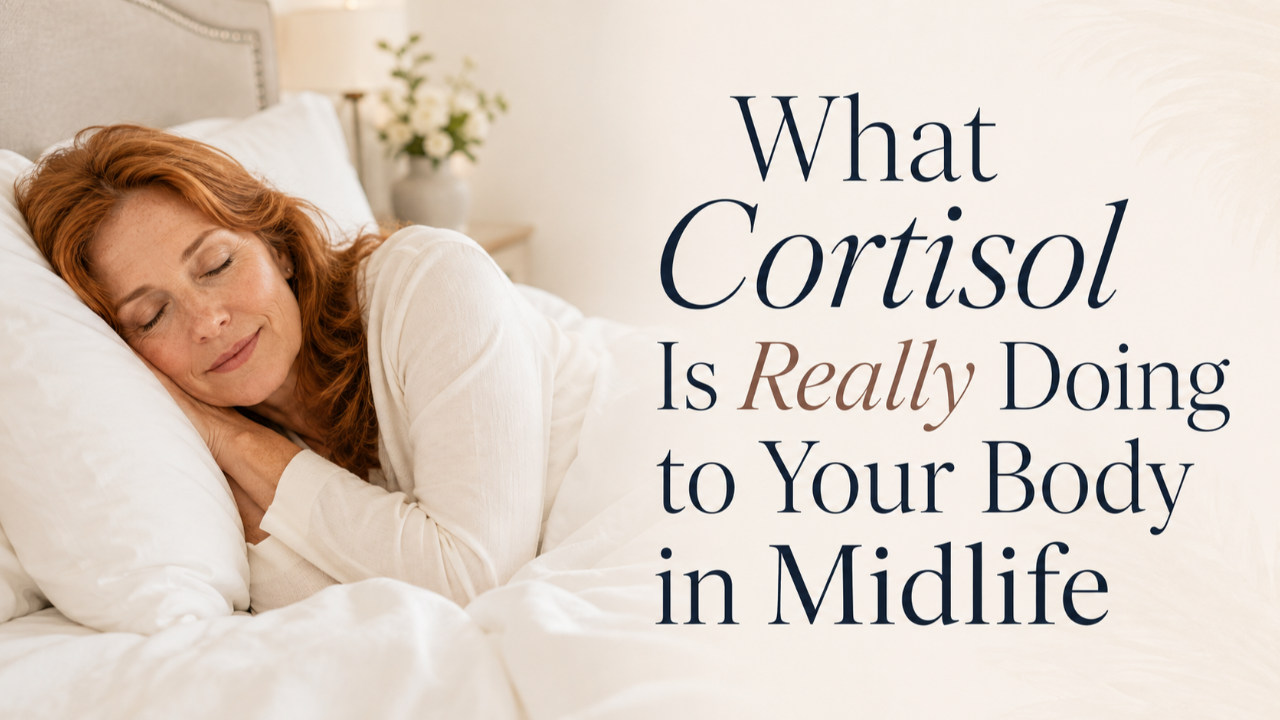
Cortisol has become one of the most talked about hormones in midlife. Scroll through social media and you could easily come away believing that cortisol is responsible for your changing waistline, your 3am wake ups, your cravings, your tiredness, your anxiety and almost anything else that starts feeling different after 40.
The reality is more interesting, and far less frightening.
Cortisol is not a hormone you need to get rid of. You could not function properly without it. It is produced by your adrenal glands and helps regulate blood sugar, metabolism, inflammation, blood pressure and the way your body responds to stress. Its production is controlled through communication between the brain and adrenal glands known as the hypothalamic pituitary adrenal, or HPA, axis.
Cortisol also naturally changes throughout the day. Levels are normally higher in the morning and fall as the day progresses, helping your body coordinate energy and activity with your sleep wake rhythm. This is one reason a single cortisol measurement cannot necessarily tell you the complete story. Clinicians sometimes use blood, saliva or urine testing at specific times when they genuinely suspect a cortisol disorder.
So cortisol itself is not the enemy.
The problem can arise when the system designed to help you deal with occasional pressure is repeatedly being asked to respond.
Imagine a normal working morning. You have slept badly because you woke hot during the night. You check your phone before you have even left the bedroom. There is an email marked urgent, traffic is heavy, your first meeting starts at nine, somebody cancels at the last minute and another deadline suddenly lands in your diary.
None of these events involves escaping an actual predator, but your brain can still interpret pressure as something requiring a response.
Harvard Health explains that when the brain perceives a threat, it activates the sympathetic nervous system, often described as the fight or flight system. Adrenaline helps increase heart rate, breathing and alertness, while the HPA axis subsequently helps coordinate the cortisol response. The purpose is simple: make energy available so you can deal with whatever your brain believes requires attention.
For a short period, this is extraordinarily useful.
You become alert. Your heart works harder. Glucose and stored energy become available. You concentrate on the immediate problem. Then, once the challenge has passed, the system is supposed to settle again. The parasympathetic nervous system helps provide the opposite signal, allowing the body to move back towards its calmer rest and digest state.
But many professional women rarely experience a clean ending to the stressful part of the day.
One meeting finishes and another begins. Work finishes and caring responsibilities start. You answer an email while cooking dinner, check tomorrow's schedule while watching television and think about something you forgot while brushing your teeth.
Your body may be sitting on the sofa, but your brain is still at work.
This is where chronic stress becomes different from the short stress response your body is designed to manage. Harvard Health notes that repeated activation of the stress response over time is associated with effects on physical and psychological health, including blood pressure and behaviours that influence sleep, exercise and eating.
Midlife can make this more complicated because cortisol is only one part of a much bigger hormonal and lifestyle picture.
During perimenopause and menopause, changing oestrogen levels can affect sleep, temperature regulation, mood and body fat distribution. Harvard Women's Health reports that sleep disturbance is particularly common through the menopause transition, with night waking one of the most frequent complaints. Lower oestrogen is also associated with a greater tendency to store fat around the abdomen.
This distinction really matters.
If your waistline changes after 45, it does not automatically mean that you have a “cortisol belly”.
Menopause itself can change where fat is stored, while age related loss of muscle can reduce the amount of energy your body uses at rest. Stress, sleep, activity levels, nutrition, alcohol, genetics and many other factors may also contribute.
Cortisol can be part of that picture, but it is rarely the entire painting.
Where cortisol becomes particularly interesting is appetite.
Short term stress can sometimes suppress hunger because adrenaline temporarily prioritises immediate survival over eating. When stress continues, however, cortisol can increase appetite and may increase motivation to eat. Harvard Health also notes research suggesting that stress can increase preference for foods high in sugar and fat in some people.
This may sound very familiar if you can work through a frantic afternoon hardly thinking about food and then suddenly feel ravenous when you finally stop.
Picture the 6pm moment.
You walk through the door or close the laptop. You have spent the day making decisions, being responsible, solving problems and holding yourself together. Suddenly you want crisps, wine, chocolate, toast or whatever food represents instant comfort for you.
That experience is not simply a lack of discipline.
Stress influences appetite, while food itself can become psychologically associated with relief and reward. Harvard Health describes how persistent stress may drive eating and how sleep loss, reduced physical activity and increased alcohol intake can become part of the same stress related pattern.
That creates a useful question to ask before automatically reaching for food:
Am I physically hungry, or am I trying to change how I feel?
Sometimes the answer will absolutely be hunger. Perhaps you skipped lunch or ate too little during the day. In that situation, eating is precisely what your body needs.
At other times, you may discover that what you really want is a transition.
You want the working day to be over.
You want quiet.
You want somebody to stop asking you questions.
You want ten minutes in which nobody needs anything from you.
Food can easily become the fastest way to create that feeling.
Sleep is another place where stress and menopause can collide. A woman may already be waking because of hot flushes or hormonal changes, while an activated mind makes returning to sleep even more difficult. Harvard Women's Health reports that up to 70% of women experience sleep problems during the menopause transition.
Then the next day begins with less recovery.
You may feel more irritable, less motivated to exercise and more drawn towards quick energy from caffeine or food. Work still needs to happen, so you push through. By evening you are exhausted again, yet the mind is still active.
This is how stress can begin to feel less like a dramatic event and more like the background setting of everyday life.
There is also a cardiovascular reason to pay attention. Harvard experts note that chronic stress can contribute to higher heart rate, blood vessel constriction and elevated blood pressure. Midlife already brings changes in cardiovascular risk for women, so managing persistent stress is not simply about feeling calmer. It can form part of a broader approach to protecting health.
The solution, however, is not to become obsessed with “lowering cortisol”.
You do not need to spend the day trying to keep cortisol as low as possible. Cortisol is supposed to rise and fall. Exercise itself can temporarily alter cortisol, as can waking up, illness and many other normal experiences.
A far more useful goal is to give your body regular opportunities to move out of prolonged alert mode.
One of the simplest places to start is with transitions.
If you work from home, do not simply close one spreadsheet and walk straight into cooking dinner. Give yourself ten minutes. Walk outside. Change clothes. Stretch. Put some music on. Sit with a cup of tea. Your body needs a recognisable boundary between performing and recovering.
If you commute, consider using the final part of the journey deliberately. Instead of answering more emails, listen to music, walk part of the route or simply allow your attention to shift away from work.
Think about how your day begins too.
If the first thing your nervous system receives every morning is an inbox full of demands, experiment with giving yourself even ten minutes before checking messages. Drink some water, stretch, have breakfast or simply get ready without allowing everybody else's priorities into your head immediately.
Movement is another powerful tool. You do not need to punish stress out of your body with an exhausting workout. Harvard Health notes that exercise can help counter some of the negative effects of stress, while activities such as yoga combine movement with elements of relaxation and mindful attention.
A brisk walk at lunchtime, twenty minutes of strength training, swimming, yoga or mobility work can all create an important change of state.
Breathing can be useful for exactly the same reason. Your breathing is unusual because it is something that happens automatically but can also be deliberately controlled. Slowing your breathing for a few minutes can provide your nervous system with a very different signal from the short, shallow breathing that often accompanies pressure.
You also need to look at the stress itself.
Sometimes wellness advice focuses so heavily on helping women cope that nobody asks whether the load could actually be reduced.
Look at your calendar.
Which commitments are genuinely necessary?
Which have remained there simply because you have always done them?
Where are you automatically saying yes?
Which responsibility could be shared?
Which expectation would nobody else place on you if you stopped placing it on yourself?
You cannot breathe your way out of an impossible workload indefinitely.
Nutrition matters too, but again, the answer is not perfection. Eating regular meals containing protein, fibre and nourishing carbohydrates can make it easier to distinguish genuine hunger from the point where stress, exhaustion and under eating collide at the end of the day.
If you routinely survive on coffee until lunchtime and eat something small because you are busy, the evening craving may not require a complicated hormonal explanation. Your body may simply be asking for the energy you failed to give it earlier.
Sleep deserves the same respect. If hot flushes, night sweats or persistent insomnia are regularly disrupting your nights, do not simply assume this is something you need to endure because you are going through menopause. Harvard Women's Health advises discussing symptoms that significantly affect quality of life with a healthcare professional because other conditions can sometimes contribute and treatment options may be available.
And be cautious about home cortisol tests and online diagnoses.
True disorders involving excessive cortisol, such as Cushing syndrome, are medical conditions with characteristic features and require appropriate clinical testing. The Endocrine Society describes Cushing disease as rare, and diagnosis can involve carefully timed saliva testing, 24 hour urine testing and other investigations rather than simply interpreting a random cortisol result.
If you develop unusual or significant symptoms such as rapid unexplained weight gain accompanied by muscle weakness, easy bruising, wide purple stretch marks, marked changes in blood pressure or blood sugar, discussing them with a clinician is much more appropriate than trying to “detox cortisol” yourself.
For most women, the more valuable question is not:
“How do I get rid of cortisol?”
It is:
“How often does my body get the opportunity to genuinely recover?”
Not scrolling while half watching television.
Not answering emails from the sofa.
Not organising tomorrow while supposedly resting.
Real recovery.
A walk without your phone.
Dinner eaten without working.
Ten minutes of yoga.
A conversation with somebody who makes you feel lighter.
A protected lunch break.
Going to bed instead of finishing one final job.
Closing the laptop and actually being finished.
Cortisol is not trying to sabotage your midlife body. It is part of an ancient system designed to help you respond to challenge.
The difficulty is that modern life can provide the challenge without providing the recovery.
And perhaps that is one of the most useful shifts we can make in midlife.
Instead of asking your body to become better at tolerating endless pressure, start becoming more deliberate about what happens between the pressures.
Because your body does not need a life without stress.
It needs enough moments of safety, nourishment, movement, sleep and genuine recovery to remember that stress is not supposed to be the permanent setting.
Stay connected with news and updates.
Join our mailing list to receive the latest news and updates from our team.
Don't worry, your information will not be shared.
We hate SPAM. We will never sell your information, for any reason.