Too Busy to Lift Weights? How to Build Strength Around a Working Day
Jul 31, 2026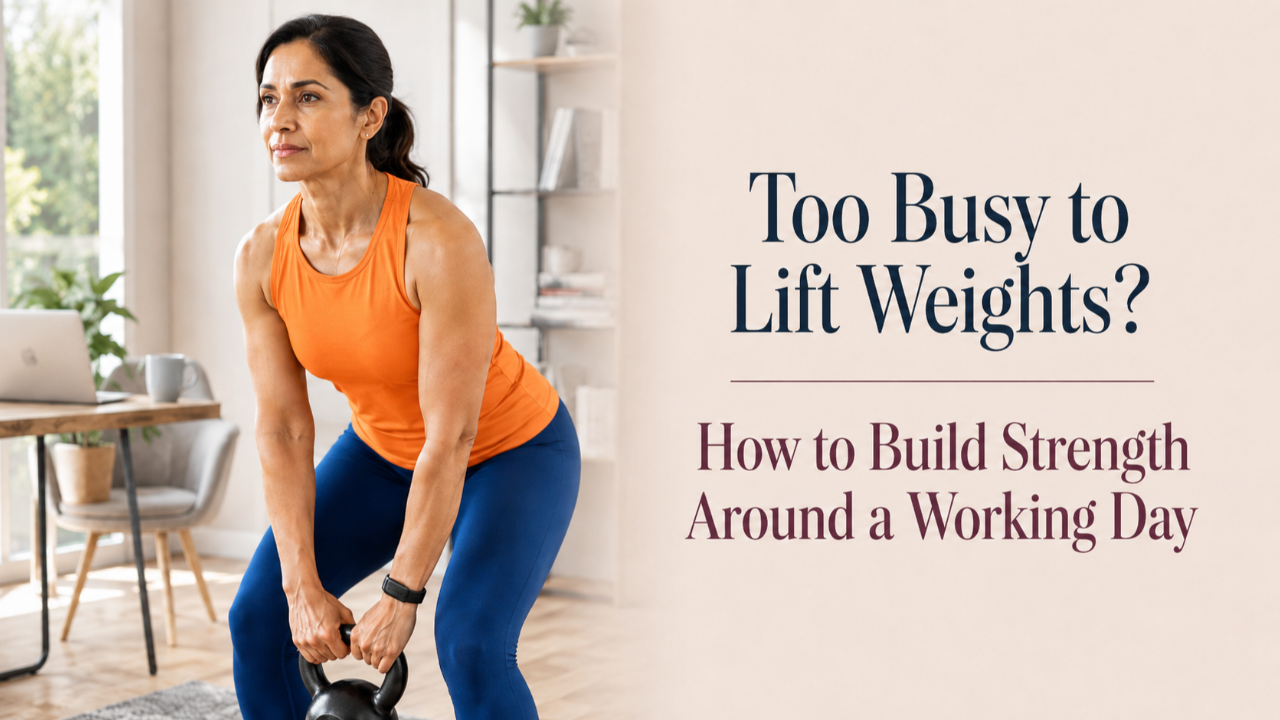
You know strength training would probably be good for you. You may even have a pair of dumbbells tucked away somewhere, a resistance band in a drawer or a gym membership you genuinely intended to use more often. But between early meetings, commuting, deadlines, family commitments, meals and everything else that needs your attention, another hour devoted to exercise can feel almost impossible.
For many professional women in midlife, lack of motivation is not really the problem. Lack of uninterrupted time is. The mistake is believing that strength training only counts if you change into gym clothes, drive somewhere, complete a 60 minute workout and return home exhausted.
It does not.
Harvard Health points out that current guidance recommends resistance training at least twice a week and that it can be performed using dumbbells, kettlebells, resistance bands, machines or your own body weight. It does not have to be complicated, and importantly for busy women, it does not have to consume large sections of the week.
This becomes increasingly important through perimenopause, menopause and the years beyond. Harvard Women's Health notes that adults are advised to include at least two strength training sessions each week, yet the proportion of women meeting combined exercise recommendations falls with age. Fewer than one in five women aged 50 to 64 in the figures cited by Harvard were meeting those guidelines.
That matters because midlife is precisely when preserving muscle deserves more attention.
Muscle does far more than change the appearance of your arms or legs. It helps you climb stairs, carry bags, protect your joints, maintain balance, support your posture and remain capable as you get older. Harvard Health also notes that strength training can help maintain muscle and strength, support bone health, improve balance and contribute to better blood sugar control.
So rather than asking, “Where am I going to find an hour to work out?”, it may be more useful to ask, “Where could strength fit into the day I already have?”
Imagine a typical working day. Perhaps you spend the first hour checking emails, travel to work or move straight into online meetings, sit for much of the morning, grab lunch between commitments and finally finish the day feeling mentally tired. By the evening, the idea of starting a lengthy workout is understandably less appealing.
This is where shorter bouts of strength work can become extremely useful. Harvard Health has previously suggested that rather than thinking strength exercise must always be completed as one long workout, shorter sessions can be an alternative. One Harvard article gives the example of performing around 30 minutes twice weekly or breaking that work into sessions as short as 10 minutes across the week.
Ten minutes suddenly feels very different from an hour.
Before your first meeting, you might complete squats, rows with a resistance band, a pressing movement and some core work. Another day, you might spend 15 minutes working your legs, back and shoulders before your evening meal. At the weekend, when you have more breathing space, you could complete a longer full body strength session.
You do not necessarily need every session to look the same.
What matters is that your muscles regularly experience enough resistance to challenge them. A squat using your body weight may be an appropriate starting point. As you become stronger, you might hold a kettlebell or dumbbell. A resistance band row may eventually progress to a stronger band or heavier dumbbells.
That gradual increase in challenge is important because muscles adapt to what you repeatedly ask them to do. If an exercise becomes very easy and remains unchanged month after month, it provides less stimulus for further improvement. Harvard's 2026 review of updated resistance training guidance emphasises regularly training the major muscle groups and making the work sufficiently challenging.
This does not mean every workout needs to leave you aching the following morning. In fact, for a woman balancing work, menopause symptoms and everyday life, creating a programme that repeatedly exhausts you is unlikely to be the most sustainable approach.
There may be weeks when you have slept badly, experienced night sweats or simply feel depleted. On those days, your training can adapt. Perhaps you use slightly lighter weights, concentrate on technique or combine gentle strength work with mobility rather than deciding that anything less than your normal workout is pointless.
Midlife exercise works far better when you move away from an all or nothing mentality.
You can also look for small opportunities to interrupt sitting during the working day. Harvard Health has recently discussed the value of what it calls “exercise snacks”, encouraging people to get up periodically to stand, stretch and move rather than remaining seated for hours at a time.
For strength specifically, that could mean performing a few controlled squats while the kettle boils, doing wall or desk push ups between meetings, completing calf raises while taking a phone call or using a resistance band for several rows when you have five minutes between appointments. These small movements should not necessarily replace your more structured strength sessions, but they can help make movement part of the working day rather than something that only happens afterwards.
Your environment can make this considerably easier.
If your weights live in the garage behind six boxes, using them requires effort before the exercise has even started. If a resistance band sits beside your desk or your dumbbells are somewhere accessible, the decision becomes much simpler. Removing small obstacles is one of the easiest ways to make a new behaviour more realistic.
The same applies to your diary. We tend to protect work meetings because another person is expecting us to attend them, yet exercise is often moved whenever something else appears. Try treating two short strength sessions like genuine appointments rather than something you will hopefully squeeze in if the day goes perfectly.
For example, Tuesday morning might become a 20 minute full body session before work, while Saturday morning becomes a slightly longer workout. Add one short strength session during the week when possible, and suddenly you have created a meaningful routine without training every day.
There is also no rule saying strength training must happen after work.
If your energy is better in the morning, use it. If lunchtime works because you work from home, use that. If you have children or caring responsibilities and Saturday afternoon is your least complicated period of the week, that can become your training time.
The best exercise schedule is not the one somebody on social media tells you is optimal. It is the one you can repeat when work becomes busy.
And repetition matters enormously.
Harvard Health has reported that two or three resistance training sessions per week can be effective for building strength and muscle, with twice weekly training providing a sensible starting point for many people. That is an important message for women who assume they need to be exercising intensely every day to see any benefit.
You do not need seven perfect workouts.
You need enough regular stimulus for your body to adapt.
There is another reason this approach matters in midlife. Harvard Women's Health has discussed how women may begin losing more muscle around the perimenopause years and how muscle plays an important role in healthy metabolism. Preserving muscle is therefore not simply about looking more toned. It becomes part of protecting your strength, function and metabolic health for the decades ahead.
And the long term picture is becoming increasingly interesting. In July 2026, Harvard Health reported on a Harvard led study that associated regular resistance training over many years with a lower risk of premature death, particularly when strength work was combined with aerobic activity. As with observational research, this does not prove that resistance training alone caused the difference, but it adds to a growing body of evidence supporting strength as part of healthy ageing.
This is why the woman with a demanding career does not need another reason to feel guilty about exercise.
She needs a better strategy.
Keep walking. Keep doing yoga. Swim, cycle or attend the classes you enjoy. But create two protected spaces in your week where your muscles are deliberately asked to work against resistance.
Start with what fits.
Twenty minutes before work. Fifteen minutes between finishing your laptop and starting dinner. A kettlebell beside your exercise mat. A resistance band within reach. A longer session at the weekend when your diary allows.
Then build from there.
Because successful strength training in midlife is not about finding endless amounts of spare time.
It is about using the time you already have more deliberately.
And when you stop waiting for the perfect hour, you may discover that becoming stronger fits into your working life far more easily than you thought.
Stay connected with news and updates.
Join our mailing list to receive the latest news and updates from our team.
Don't worry, your information will not be shared.
We hate SPAM. We will never sell your information, for any reason.