Tired but Still Wired? Your Nervous System May Need a Different Kind of Rest
Aug 06, 2026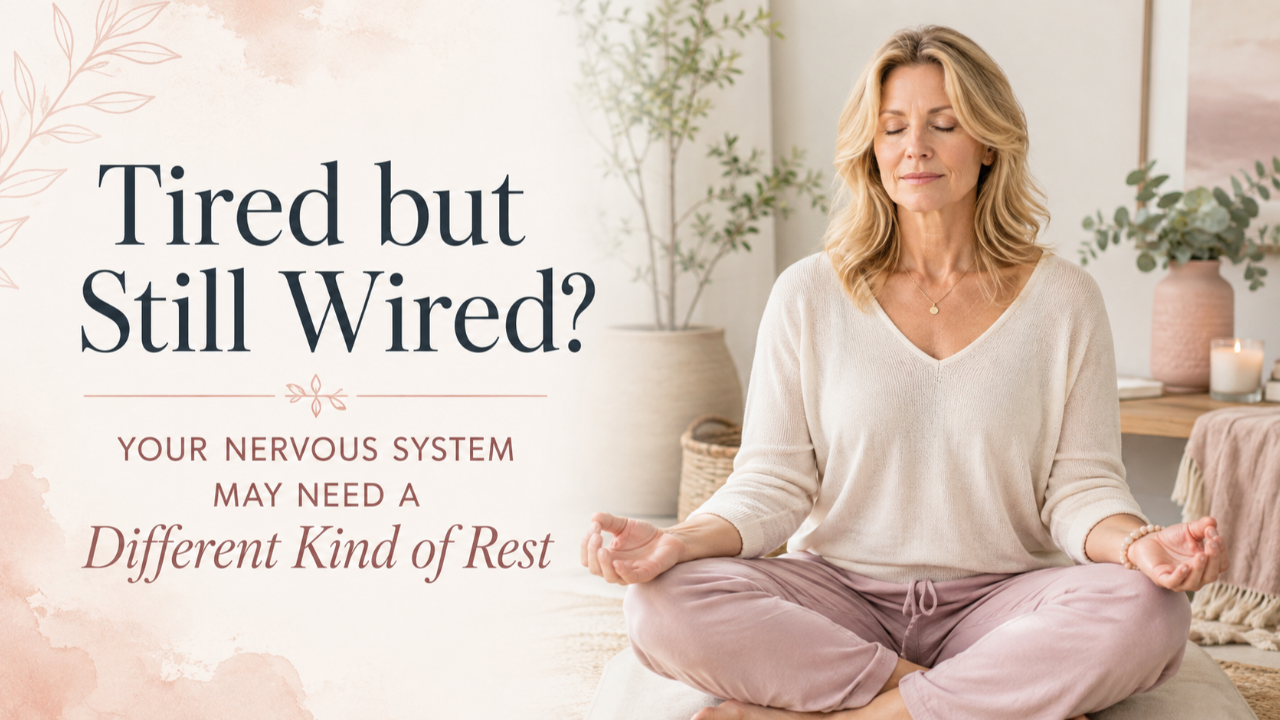
You have been tired since lunchtime. By six o'clock, you are counting down the hours until bed and telling yourself that tonight you will finally have an early night. Yet when the house becomes quiet, something strange happens. Instead of drifting naturally towards sleep, you seem to wake up again. You sit on the sofa scrolling, remember something you need to do tomorrow, replay a conversation from earlier in the day or check an email that could easily have waited until morning. Eventually you go to bed physically exhausted, yet your brain seems determined to start another shift.
This feeling of being tired but still wired is extremely familiar to many professional women in midlife. It can be tempting to assume that you simply need more rest, but the type of rest you are getting may not be giving your body what it actually needs. Lying on the sofa is technically resting, and watching television is not work, but your brain can still be processing information, responding to stimulation and thinking about what comes next. Your muscles may have stopped moving while your nervous system remains remarkably busy.
The autonomic nervous system helps regulate processes such as heart rate, breathing, digestion and blood pressure without requiring you to consciously control them. One part, the sympathetic nervous system, helps mobilise the body when challenge or threat is perceived. Another, the parasympathetic nervous system, helps bring the body back towards a calmer state once the challenge has passed. Harvard Health describes these two systems rather neatly as an accelerator and a brake.
The sympathetic response is not something you should try to eliminate. You need it. It helps you concentrate during an important presentation, react quickly when something goes wrong and mobilise energy when action is required. The problem comes when one demand follows another so consistently that your body gets very little opportunity to properly settle between them.
Think about an ordinary working day rather than an obvious crisis. The alarm goes off after a disturbed night, you check your phone while getting ready, traffic is slow, the first meeting begins before you have properly arrived and emails accumulate while you are talking. Lunch may happen beside your laptop, another meeting runs late and you finish work still thinking about something that happened during the day.
Then home life begins. There may be food to prepare, messages to answer, family to speak to, an ageing parent to check on, washing to sort or tomorrow's schedule to organise. None of these individual events necessarily feels dramatic enough to call stress, yet your body may have spent much of the day responding to one demand after another.
This is why rest sometimes needs to involve more than simply stopping work. Your body may need help changing state.
Midlife can make this particularly relevant because sleep itself often becomes less reliable. Harvard Women's Health reports that sleep problems are extremely common during the menopause transition, with night waking particularly frequent. Hot flushes and night sweats can disrupt sleep, but hormonal changes may affect sleep even in women who are not regularly waking with obvious symptoms.
This can create an exhausting cycle. You sleep badly, so the next working day requires more effort. Because you are tired, ordinary demands feel harder to manage. You may rely more heavily on caffeine, work through breaks and have less energy for exercise. By evening you are depleted, yet your mind has spent the day operating at full speed.
Then you expect yourself to go from full speed to asleep simply because you turned the bedroom light off. Bodies do not always change gears that quickly.
This is why the hour before bed deserves to be understood as a transition rather than simply leftover time at the end of the day. If you are still answering emails at 9.45pm, reading the news at 10pm and checking social media at 10.15pm, it may be unrealistic to expect your mind to feel completely quiet at 10.30pm. You may not be bad at relaxing. You may simply not have created enough space between stimulation and sleep.
A calming routine does not need to be elaborate. You do not need candles, expensive supplements and forty minutes of meditation. It might simply mean closing the laptop at the same time each evening, preparing what you need for tomorrow, putting your phone on charge away from the bed, having a shower, stretching for five minutes and reading for a while. The details matter less than the repetition. Over time, those familiar behaviours can become cues that the active part of the day is ending.
One practical technique that can be especially useful is writing down the things you are trying to remember before you go to bed. Many women lie down and immediately begin thinking about tomorrow because bedtime is the first quiet period in which unfinished tasks have space to surface. Rather than trying to force yourself not to think, write down appointments, priorities and loose ends earlier in the evening. The aim is not to reorganise your life at bedtime, but to give your brain reassurance that what matters has been captured.
It can also help to create a proper transition after work instead of waiting until bedtime to recover from the entire day. When work finishes, give yourself ten minutes before moving into the next set of responsibilities. If you work from home, leave the room where you work, change your clothes, step outside, stretch or sit quietly somewhere else. If you commute, use at least part of the journey as a decompression period rather than an extension of the office.
This may sound too simple to make a difference, but the point is not to create a perfect wellness routine. It is to stop asking your body to remain in work mode until the moment you try to sleep.
Movement can be particularly useful. Physical activity is associated with improvements in sleep and reductions in anxiety, and it does not always need to be intense. A walk after work, swimming, yoga, mobility work or a short strength session may offer something that collapsing onto the sofa does not: a deliberate change in physical and mental state.
This is worth thinking about because we often define rest as doing nothing. Yet different types of tiredness can require different responses. If your legs are tired after a long hike, sitting down makes sense. If your mind is saturated after eight hours of meetings, another two hours of passive screen time may not create the same kind of recovery.
Sometimes what feels like physical exhaustion is actually mental overstimulation. At the end of the day, ask yourself which part of you is tired. If your body feels stiff from sitting, perhaps it needs movement. If your brain feels overloaded, perhaps it needs fewer inputs. If you have spent all day dealing with people, perhaps you need quiet. If you have been making decisions constantly, perhaps you need an evening with fewer choices.
Breathing can also offer a simple way to change pace. Slow, controlled breathing has been shown to influence measures linked with autonomic function, including heart rate variability. You do not need a complicated technique. Simply breathing more slowly and comfortably for a few minutes can create a deliberate contrast with the pace at which you have spent the rest of the day.
The same principle applies to relaxation more broadly. Harvard Health includes techniques such as breath focus, body scanning, mindfulness, yoga and guided imagery among approaches that may help counter the stress response. The important thing is that different methods work for different people. If meditation makes you irritated rather than calm, there is no prize for forcing yourself to continue.
Walk, stretch, garden, listen to music, take a warm shower, read or sit outside. The best form of recovery is the one that genuinely changes how your body and mind feel.
There is another pattern many women recognise. You can be completely exhausted and still resist going to bed because late evening feels like the only part of the day that belongs entirely to you. You have spent the day working for other people, responding to other people's priorities and perhaps caring for other people afterwards. At ten o'clock, nobody wants anything from you, so going to bed can feel strangely like giving up the only free time you had.
The solution is not simply to tell yourself to go to bed earlier. You may need to reclaim small pieces of your day before you reach that point. Take the lunch break. Walk for fifteen minutes. Sit with your coffee instead of carrying it into another meeting. Protect half an hour after work. Do something enjoyable before you are completely depleted. Rest works better when it is woven into the day rather than saved until the very end.
Caffeine habits are also worth noticing. When sleep deteriorates, it is understandable to compensate with more coffee, but caffeine later in the day can make falling asleep more difficult for some people. Alcohol can be deceptive too. A glass of wine may make you feel sleepy initially, but it can contribute to disrupted sleep later in the night.
If you regularly wake in the early hours, it can be useful to notice whether alcohol, caffeine, late meals or late evening screen use seem to make the pattern worse. Personal observation can sometimes reveal very practical changes.
Your bedroom environment matters too. If hot flushes or night sweats are part of your menopause experience, keeping the room comfortably cool and using breathable bedding may help. Persistent or troublesome symptoms are also worth discussing with a healthcare professional rather than simply assuming poor sleep is something you have to tolerate during menopause.
It is important not to explain every sleep problem as a dysregulated nervous system either. Persistent insomnia can have many causes, including menopause symptoms, anxiety, depression, medications, pain and sleep apnoea. If you regularly struggle to sleep despite being exhausted, wake repeatedly for long periods, experience significant daytime sleepiness, snore heavily, wake gasping or find that poor sleep is affecting your ability to function, speak to your GP or another qualified healthcare professional.
There is another trap worth avoiding. We can turn relaxation into another project. Suddenly we are trying to complete ten thousand steps, strength training, drink enough water, eat enough protein, meditate, journal, breathe correctly and achieve eight hours of sleep. Reducing stress then becomes another demanding task we feel we are failing to complete.
A simpler approach is often more sustainable.
For one week, try creating three deliberate downshifts in your day. Take a genuine break away from your screen at lunchtime. Create a visible boundary when work finishes. Then reduce stimulation before bed and repeat the same few calming behaviours each evening.
Notice what changes. You may find that you reach for food differently after work, that your shoulders feel less tense or that you become sleepy earlier instead of getting a sudden second wind late in the evening. You may notice that your mind races less when your head reaches the pillow.
You are not trying to achieve permanent calm. A healthy nervous system needs to be able to respond when life requires it. The goal is flexibility: being able to accelerate when you need to and then slow down again when the challenge has passed.
That may be one of the most useful ways to think about nervous system regulation in midlife. You do not need to spend your life in a perfectly peaceful state. You simply need enough opportunities for recovery that your body is not endlessly being asked to perform.
Sometimes you are tired because you need sleep. At other times you may be tired because you have had too much input, too many decisions, too little movement, too few boundaries and almost no space between one responsibility and the next.
In those moments, another hour collapsed in front of a screen may not be the kind of rest you need. Your body may need movement before stillness, your mind may need fewer inputs rather than more entertainment, and your working day may need a proper ending instead of simply fading into your evening.
Thriving in midlife is not about becoming better at functioning while depleted. It is about learning how to recognise when your body has had enough stimulation, enough responsibility and enough doing, and giving it a genuine opportunity to come back down again.
Stay connected with news and updates.
Join our mailing list to receive the latest news and updates from our team.
Don't worry, your information will not be shared.
We hate SPAM. We will never sell your information, for any reason.