The Strength You Build Now Could Shape How You Age
Aug 01, 2026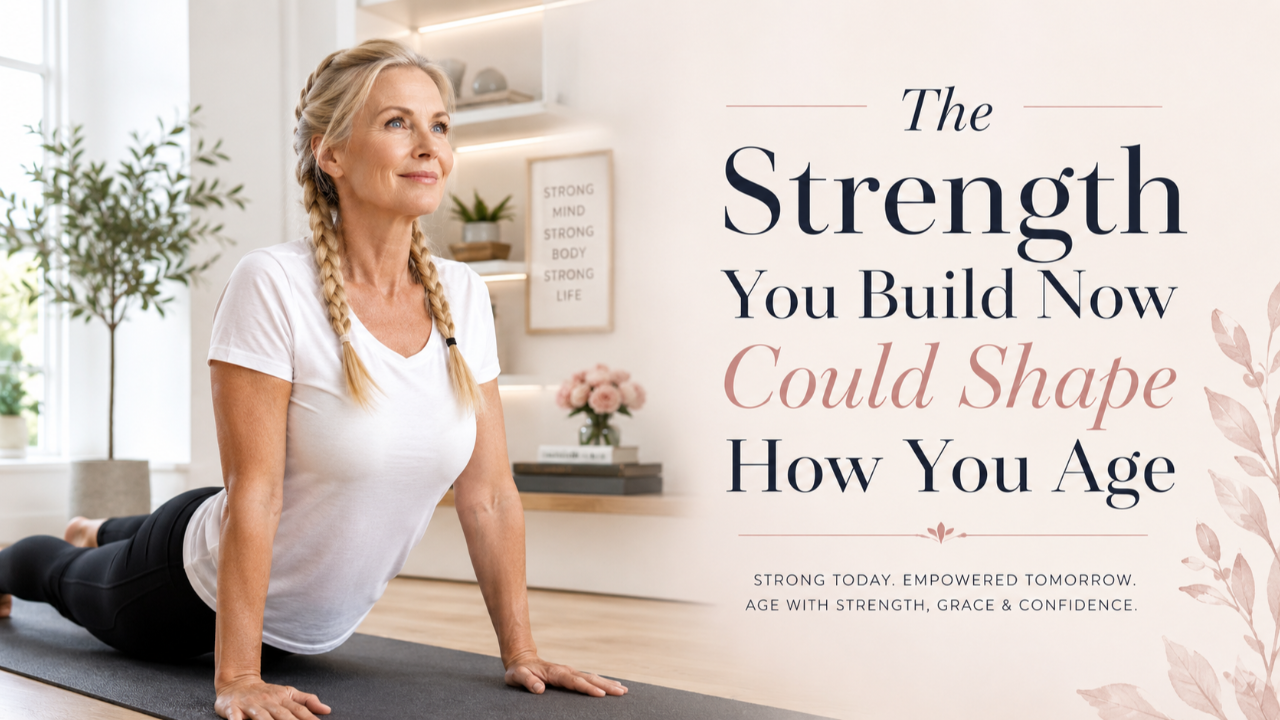
When you think about ageing well, you may picture staying mentally sharp, travelling, remaining independent and continuing to enjoy the life you have worked hard to create. What you may not immediately picture is yourself doing squats with a kettlebell or pulling against a resistance band.
Yet the strength you build in your 40s, 50s and beyond could play an important role in how capable you feel later in life.
Strength training is often presented to women as something we do to tone our arms, change our shape or lose weight. Those can be perfectly valid goals, but they miss a much bigger story. Muscle is what helps you climb stairs without thinking about it, lift a suitcase into an overhead locker, carry your shopping, get up from the floor, maintain your balance and continue moving confidently through the world.
As we get older, maintaining that strength becomes increasingly important. Harvard Health explains that muscle mass and strength naturally decline with age, particularly when muscles are not regularly challenged. We may not initially notice this happening because the early changes can be subtle. One day it simply feels a little harder to get out of a low chair, climb several flights of stairs or carry something heavy.
For women, the menopause years add another layer. Harvard Women's Health highlights that women begin progressively losing muscle from their late 30s onwards and that maintaining muscle becomes particularly important during perimenopause and beyond. Current exercise recommendations include strength training at least twice a week, yet Harvard reports that fewer than 18% of women aged 50 to 64 meet combined aerobic and muscle strengthening guidelines.
That makes midlife an important moment to change the way we think about exercise.
Instead of asking only, “How many calories did I burn?”, try asking, “What am I helping my body remain capable of doing?”
A squat helps strengthen the muscles you use every time you stand from a chair. A deadlift pattern teaches your hips and legs to help you pick something up safely. A rowing movement strengthens the muscles that support your upper back and posture. Carrying a kettlebell or dumbbell challenges your grip, core and whole body stability.
These movements are not simply exercises. They are rehearsals for everyday life.
There is also strong reason to think about your bones. Bone mass decreases as we age, and the menopause transition is particularly important for women because declining oestrogen accelerates bone loss. Harvard Health explains that strength training creates mechanical stress on bones as muscles pull and push against them. This stimulates processes that can help maintain stronger, denser bones and may help slow age related bone loss.
That means picking up a weight can be doing something far more valuable than changing the shape of your arm.
You are giving your bones a reason to remain strong.
Strength also matters because muscles support joints. Harvard Women's Health recently highlighted strength training as an important strategy during menopause because maintaining and building muscle helps support the joints. That can be particularly relevant for women who begin noticing more stiffness, aching or discomfort during the menopause transition.
And then there is balance.
Balance problems often appear to be something that suddenly becomes relevant when somebody reaches their 70s or 80s. In reality, the foundations of good balance are being built much earlier. Strong legs, hips, ankles and core muscles all contribute to your ability to stabilise yourself when you stumble, step off a kerb or walk across uneven ground.
This is why your strength programme should not simply focus on the muscles you can see in the mirror. Your glutes, back, core, calves and grip strength deserve attention too.
The encouraging news is that building strength does not require an extreme training programme. Updated guidance discussed by Harvard Health in 2026 recommends resistance training at least twice weekly, working the major muscle groups. Resistance can come from dumbbells, kettlebells, resistance bands, machines or your own body weight, so effective strength training can happen at home as well as in a gym.
A very practical place to start is to think about five basic patterns: sit or squat, hinge, push, pull and carry.
Your squat could simply be sitting down onto a chair and standing again without pushing yourself up with your hands. As this becomes easier, hold a dumbbell or kettlebell against your chest.
Your hinge could begin with learning how to push your hips backwards while maintaining good posture, eventually progressing to a kettlebell or dumbbell deadlift.
A push could be a wall push up before progressing to a kitchen counter, bench or floor. A pull might involve a resistance band row. Your carry could simply involve walking while holding a moderately challenging dumbbell or kettlebell securely by your side.
Together, movements like these train your body for far more than the gym.
If you are new to strength training, start with weights that allow you to learn the movement confidently. Harvard guidance recommends gradually increasing resistance as you become stronger rather than beginning too aggressively.
This gradual progression is one of the most important parts of strength training.
Your body adapts to what you repeatedly ask it to do. If the same exercise with the same weight feels easy month after month, there is little reason for your muscles to become stronger. Progress might mean moving from a 4 kg kettlebell to a 6 kg kettlebell, performing another repetition with good technique or moving from a wall push up to a lower surface.
Progress does not have to be dramatic to count.
One of the simplest practical habits is to keep a small strength record. Write down the exercise, the weight you used and how many controlled repetitions you completed. A month later you may discover that the kettlebell that once felt heavy now feels surprisingly manageable.
That is progress you can feel, not simply measure on a bathroom scale.
Try measuring other improvements too. Can you climb the stairs more easily? Can you carry your shopping without changing hands constantly? Does getting out of a chair feel effortless? Can you hold a plank slightly longer? Are you more confident lifting your suitcase?
These are powerful measures of fitness because they reflect what your body can actually do.
Recovery deserves a place in the conversation as well. You do not become stronger simply by completing more workouts. Training provides the stimulus, but your body needs adequate recovery and nutrition to adapt to that stimulus.
Protein is particularly relevant because the amino acids in protein provide building blocks for muscle. Harvard Health notes that combining adequate protein intake with resistance exercise appears more effective for maintaining and building muscle than focusing on protein alone. It can also be useful to spread protein rich foods across your day rather than saving most of them for your evening meal.
For a working woman, that might mean adding Greek yoghurt or eggs at breakfast, beans, lentils, fish, chicken or tofu at lunch, and another useful protein source with dinner. The aim does not need to be obsessive tracking. It is simply becoming more intentional about giving your muscles the nutrients they require.
Sleep matters too. If menopause symptoms are disrupting your nights, there will inevitably be days when your energy is lower. That does not mean abandoning strength training altogether. You can reduce the weight, perform fewer sets, work on mobility or move your harder session to another day.
Consistency over months and years matters far more than forcing yourself through one exhausting workout.
There is also interesting evidence emerging around strength and longevity. Harvard Health reported in August 2026 on a Harvard led study published in the British Journal of Sports Medicine. The study linked regular strength training over several decades with a lower risk of premature death, including deaths from cardiovascular and neurological diseases. Because the research was observational, it cannot prove that lifting weights itself caused people to live longer, but it adds to the wider evidence connecting muscle strengthening with healthier ageing.
Perhaps even more relatable is research in older women looking at physical strength itself. Harvard Health reported in 2026 that greater grip strength and better performance on repeated chair stands were associated with greater longevity in older women. Again, an association does not prove cause and effect, but it reinforces an important idea: the ability to produce strength remains meaningful as we age.
So begin thinking of strength as something you are putting into your future health account.
Every squat is a small investment.
Every weight you progressively learn to lift is an investment.
Every time you strengthen your back, legs, arms and core, you are giving the future version of you more physical capacity to work with.
And you do not need to train like an athlete to benefit. Start with two strength sessions each week. Work your legs, hips, back, chest, shoulders, arms and core. Choose resistance that feels challenging while allowing you to maintain good technique. As you become stronger, gradually increase the challenge.
Keep walking because cardiovascular movement matters. Keep practising yoga or mobility work because being able to move comfortably matters. But alongside flexibility and cardiovascular fitness, deliberately build strength.
Then start noticing what changes.
Perhaps the heavy supermarket bag no longer feels particularly heavy. Perhaps you suddenly realise you carried your suitcase upstairs without asking anyone for help. Perhaps you can get up from the floor easily after playing with a child or grandchild. Perhaps you feel more stable when hiking on uneven ground.
Those small moments may tell you far more about the success of your exercise programme than the scales ever will.
Midlife does not have to become a period when you slowly accept becoming physically less capable.
It can be the point at which you become much more deliberate about protecting your strength.
Because ultimately, the goal is not simply to be a strong 50 year old.
It is to give yourself the best possible chance of becoming a strong, capable and independent 60, 70 and 80 year old too.
The strength you build today is not just for the body you have now. It is for the life you still want to be living decades from now.
Stay connected with news and updates.
Join our mailing list to receive the latest news and updates from our team.
Don't worry, your information will not be shared.
We hate SPAM. We will never sell your information, for any reason.