The After Work Eating Habit That May Have Nothing to Do With Hunger
Aug 05, 2026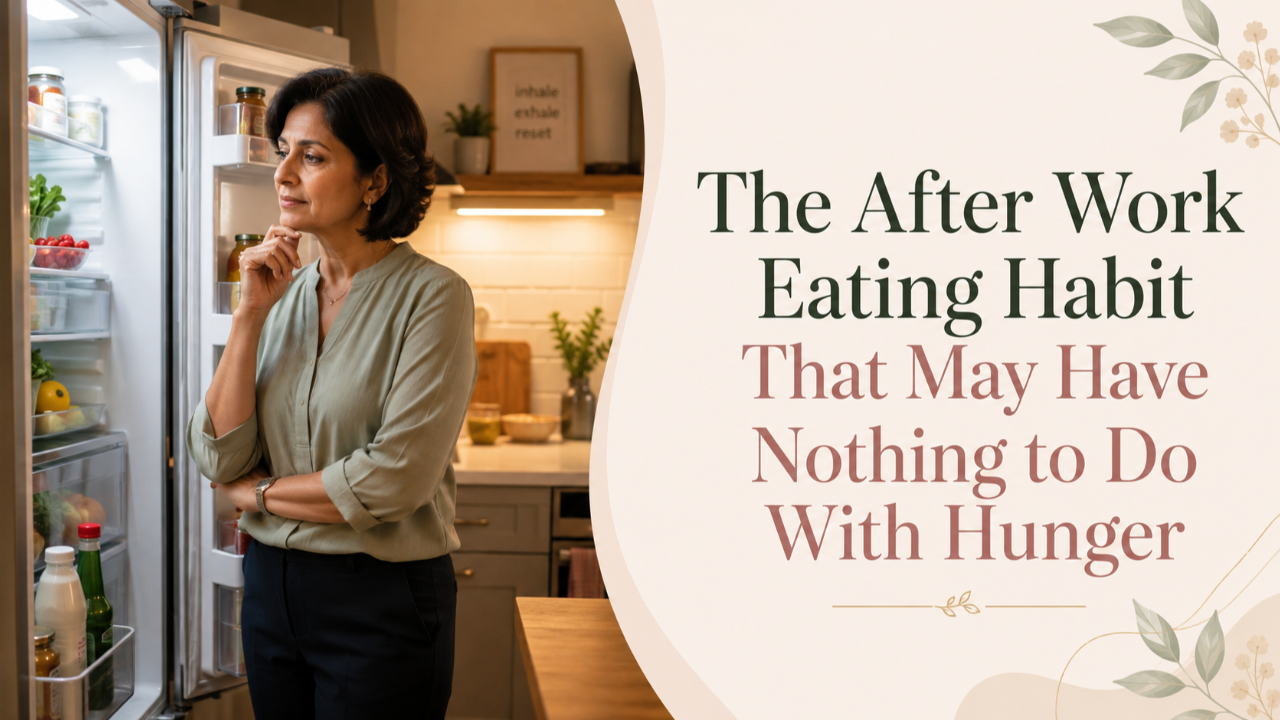
You close your laptop, walk through the front door or finally finish the last call of the day, and almost automatically head towards the kitchen. Perhaps you pour a glass of wine while making dinner, eat a handful of crisps while deciding what to cook, break off a piece of cheese every time you open the fridge or reach for chocolate before you have even taken your work clothes off. You might tell yourself that you are hungry, but sometimes there is something else happening.
After a day spent concentrating, solving problems, responding to other people and holding everything together, food can become the quickest and easiest way to signal that the working day is finally over. For many professional women in midlife, this is not really an eating problem. It is a transition problem.
All day you have been in performance mode. You have deadlines to meet, conversations to manage, decisions to make and responsibilities that cannot simply be ignored because you feel tired. If you are also navigating perimenopause or menopause, disrupted sleep, changing energy levels, hot flushes, brain fog or increased emotional sensitivity can make an already demanding working day feel considerably heavier.
Yet we often expect ourselves to move directly from that environment into the evening without any kind of recovery. The laptop closes and dinner begins. The commute ends and family responsibilities start. One role finishes and another immediately takes its place. Food can easily become the bridge between the two because it offers comfort, pleasure and a sense that you are finally allowed to stop.
There is a good reason why this habit can feel so powerful. Stress does not only influence how you feel emotionally. It can also affect appetite, food choices and the brain's reward systems. Cortisol, one of the hormones involved in the stress response, may influence appetite when stress continues over time, while highly palatable foods can provide a quick experience of pleasure and relief.
That does not mean cortisol is forcing you to eat chocolate at six o'clock. Human eating behaviour is much more complex than that. Stress, tiredness, habit, hunger, sleep and emotional reward can all combine to make certain foods particularly appealing at precisely the point when your mental energy is lowest.
Timing matters too. While you are busy at work, you may barely notice hunger. You are concentrating on what needs to be done, perhaps postponing lunch, drinking another coffee or telling yourself you will eat properly later. Once the immediate pressure disappears, all the signals you have been ignoring during the day can suddenly become much louder.
This is why the first question to ask is not, “Why can't I control myself after work?” A more useful question is, “Have I actually eaten enough today?” A woman who has had coffee for breakfast, soup at her desk for lunch and nothing substantial since midday may not have an emotional eating problem at six o'clock. She may simply be genuinely hungry.
That distinction is enormously important because trying to control real hunger with willpower usually leads to frustration. Before analysing your psychology, look at the basics. Did breakfast contain enough food to satisfy you? Did lunch include protein, fibre and carbohydrates? Did you eat anything between lunch and dinner if there was a long gap?
A proper afternoon snack can completely change the experience of arriving home. Something as simple as yoghurt with fruit, an apple with nuts, hummus with vegetables, eggs, a small sandwich or another combination that suits you can prevent you reaching the kitchen in a state of total depletion. There is no prize for arriving at dinner starving.
But what if you have eaten properly and still find yourself searching for food the moment work finishes? This is where it becomes useful to look at what the food represents. Perhaps it means, “I have done enough today.” Perhaps it means, “This is finally my time.” Perhaps the chocolate is not really about chocolate at all. It may be the first small piece of pleasure you have given yourself since breakfast.
This is particularly relevant for women who spend much of their lives looking after other people. At work you may be available to colleagues, customers, patients or employees. At home there may be partners, children or ageing parents who also need your attention. By the time the evening arrives, food can feel like something that requires nothing from you. It comforts without asking questions.
That does not make the behaviour weak or irrational. It makes it understandable. The more useful strategy is not necessarily to remove the food, but to create other ways of meeting the need that has become attached to it.
One of the most effective places to start is by creating an after work landing zone. Give yourself ten or fifteen minutes between work and the rest of the evening. If you work from home, physically close your laptop and leave the room where you work. Change your clothes, step outside, make a cup of tea, stretch or simply sit quietly somewhere else.
If you commute, the journey can become part of that transition. Instead of spending the entire trip answering messages or mentally continuing your working day, use the final ten minutes to change state. Listen to music, walk part of the journey or simply allow yourself to stop thinking about what needs to happen tomorrow. The aim is to create a clear signal that work has finished.
Without that boundary, the brain can start looking for another way to produce the same feeling. Food happens to be fast, available and effective. Creating even a small pause before heading into the kitchen can interrupt that automatic sequence.
This is not about telling yourself you cannot eat. If you are hungry, you should. The purpose is simply to create enough space to work out what you actually need. Go upstairs and change first. Walk around the garden. Put your bag away. Take a few slow breaths. Do ten minutes of yoga or mobility. Then decide whether you still want something to eat.
A useful question to ask is, “What do I need before dinner?” Sometimes the answer will be food. Sometimes it will be quiet, movement, space, connection or simply a few minutes in which nobody expects anything from you. The point is not to find the perfect answer, but to recognise that different needs require different responses.
It can also help to pay attention to where you eat. Standing beside the kitchen counter while picking at food can make it surprisingly difficult to register how much you have actually eaten. A piece of cheese here, a spoonful while cooking, a few crisps and several bites of something else may feel like nothing because none of it looked like a proper meal.
If you genuinely want an afternoon or early evening snack, put it on a plate and sit down. That small action changes the experience from unconscious grazing into eating. You see the food, taste it properly and know you have eaten it. More importantly, you have made a decision rather than simply responding to whatever happens to be within reach.
Your environment matters too. Many eating habits are triggered by what we repeatedly see rather than by deliberate decisions. If chocolate, biscuits or crisps are always visible when you walk through the door, they become part of the routine. This does not mean banning them from the house, but it can help to make foods you tend to eat automatically slightly less visible while keeping satisfying options easily available.
Sleep also deserves attention. Perimenopause and menopause can make sleep considerably more difficult for some women, and after several nights of poor sleep the working day can require much more effort. Tiredness can influence appetite, food reward and decision making, which can make quick energy and comfort foods particularly attractive by late afternoon.
This is another reason not to respond to a difficult evening by restricting food the following day. If poor sleep, inadequate meals and stress are already increasing your vulnerability to cravings, eating less simply adds another pressure. Feed yourself properly the next morning and return to your normal routine.
One of the most valuable things you can do is study your own pattern for a week. Instead of writing, “I was bad and ate chocolate,” record what happened before you wanted it. Perhaps the craving followed a meeting that left you angry. Maybe it appears every Wednesday when you work late. Perhaps it only happens on days when lunch was inadequate. You might discover it is strongest at seven o'clock when the house finally becomes quiet.
Those details tell you where the real opportunity for change lies. If stressful meetings trigger your eating, create a short decompression ritual after them. If arriving home ravenous is the issue, eat more during the afternoon. If the pattern appears when you finally sit down at night, consider whether you have allowed yourself any pleasure or rest earlier in the day.
Sometimes the solution to evening eating is surprisingly far removed from food. It may be taking a proper lunch break, leaving work on time, going for a walk before dinner, sharing more responsibility at home, protecting your sleep or saying no to something that does not need to be in your diary.
It may also involve finding something genuinely enjoyable to look forward to that does not live inside the kitchen cupboard. Food does not need to stop being pleasurable, but it helps when it is not carrying the entire responsibility for helping you feel better at the end of the day.
The goal is not to create a life in which you never eat because you are tired, stressed or emotional. Human beings have always used food for pleasure, celebration, comfort and connection. What matters is whether food has become your only strategy.
If every demanding day ends with eating that you did not particularly want, followed by guilt and promises to start again tomorrow, it is worth becoming curious about the moment before the food appears. That is where the real habit often lives.
You do not necessarily need another set of food rules. You may need to understand the transition between the woman who has been carrying the day and the woman who arrives home exhausted from carrying it.
Feed yourself properly during the day. Give yourself somewhere to put the working day down. Allow yourself a small period of recovery before you reach complete depletion. Create simple rituals that tell your body that responsibility has finished for a while.
Then food can return to being what it should be: nourishment, pleasure and something you consciously choose rather than the only signal your body recognises as permission to stop.
Sometimes that after work craving is telling you that you are hungry. But sometimes it is saying something much more revealing: “I have been giving all day. I need something for me now.” Learning how to answer that need in more than one way can change far more than what happens in your kitchen.
Stay connected with news and updates.
Join our mailing list to receive the latest news and updates from our team.
Don't worry, your information will not be shared.
We hate SPAM. We will never sell your information, for any reason.