Could Stress Be Affecting Your Body More Than You Realise?
Aug 02, 2026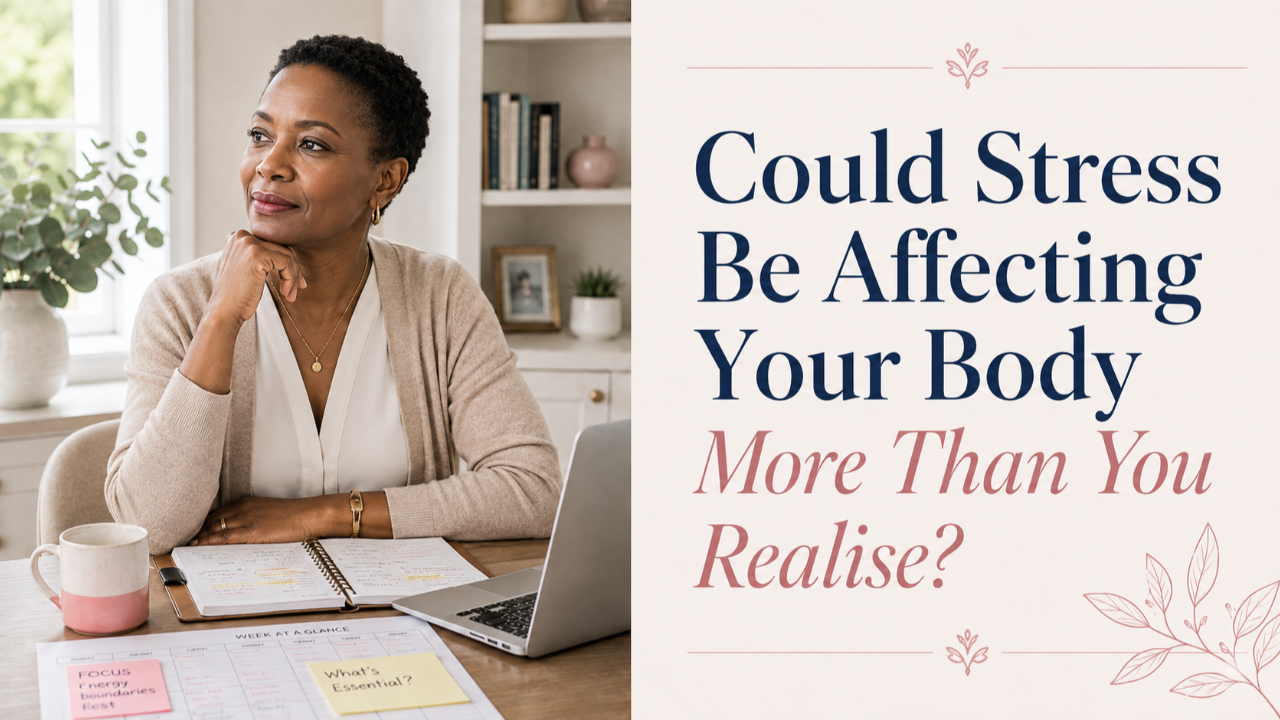
You are getting everything done. The meetings happen, the emails are answered, the family is organised and somehow you keep all the plates spinning. From the outside, you probably look perfectly capable. You may even tell yourself that you are coping because there has been no dramatic breakdown, no moment when everything stopped. Yet your body may be telling a rather different story.
Perhaps you wake tired despite going to bed at a sensible time. Your shoulders seem permanently tense. Your patience is shorter. You find yourself wanting something sweet at four o'clock, grazing while making dinner or reaching for food once everyone else has stopped needing you. You might feel exhausted in the evening yet strangely unable to switch off when your head finally reaches the pillow. Stress does not always announce itself as panic or overwhelm. Sometimes it appears as a collection of small physical and emotional changes that gradually start to feel normal.
This can be particularly confusing during perimenopause and menopause because several things may be happening at once. Hormonal changes can affect sleep, body composition, temperature regulation and mood, while this stage of life often coincides with significant responsibilities at work and at home. Harvard Women's Health notes that sleep problems are extremely common during the menopause transition, with night waking among the frequent complaints. When poor sleep, hormonal change and a demanding life overlap, it can become difficult to know where menopause ends and stress begins.
The important thing to understand is that stress itself is not automatically harmful. Your stress response is a sophisticated survival system. When your brain perceives a challenge, your body mobilises resources to help you deal with it. Stress hormones including adrenaline and cortisol help make energy available, increase alertness and prepare you to respond. In a short burst, that response can be useful. It can help you deliver the presentation, react quickly to a problem or meet an important deadline.
The difficulty comes when the challenge ends but your body rarely gets the message that it is safe to stand down.
Modern stress is often not one enormous event. It is the 7.30am email you answer before breakfast, the motorway traffic, the meeting that overruns, the ageing parent you are worried about, the deadline that has moved forward, the child who needs something, the WhatsApp notification, the financial concern you have not resolved and the mental list still running while you brush your teeth at night. None of these necessarily feels catastrophic on its own. Together, they can create a body that spends far too much time on alert.
Harvard Health describes chronic stress as very different from short, manageable periods of stress. When the stress response remains activated repeatedly or for prolonged periods, it can affect numerous aspects of health. The American Psychological Association similarly notes that prolonged activation of the stress response can contribute to problems involving sleep, mood, metabolism and cardiovascular health.
Cortisol often gets blamed for almost everything in midlife, particularly on social media. You may have seen claims about “cortisol face”, “cortisol belly” or special routines designed to “flush cortisol” from your body. The reality is much more nuanced. Cortisol is not a bad hormone that needs to be eliminated. You need it. The issue is how your stress system is functioning over time, not the existence of cortisol itself.
There is, however, a genuine connection between prolonged stress and appetite. Harvard Health explains that cortisol can increase appetite and may increase motivation to eat. Research has also linked stress with a greater preference for foods high in fat or sugar in some people. This helps explain why the desire for biscuits after an impossible afternoon at work can feel remarkably different from ordinary physical hunger.
That does not mean every craving is caused by cortisol. Nor does it mean that eating chocolate after a difficult day represents some kind of hormonal failure. Food can provide pleasure, comfort and a pause, and that is part of being human. The more useful question is whether food has quietly become your most reliable method of coming down from the day.
Think about the transition between work and evening. Perhaps you have been making decisions, dealing with people and managing problems since early morning. You arrive home, close the laptop or finish your commute and suddenly notice an urge to eat. You may not even be particularly hungry. What you want is relief. The food creates a small gap between the woman who has been performing all day and the woman who is finally allowed to stop.
Understanding that distinction can change the conversation completely. Instead of asking, “Why don't I have more willpower?”, you can begin asking, “What am I actually needing at this moment?”
Sometimes the answer will still be food because you genuinely need nourishment. At other times you may realise that you need ten minutes without conversation, fresh air, a shower, music, movement, a cup of tea, an earlier dinner or simply permission to do absolutely nothing for a short while.
Stress can also show itself through sleep. You may be physically tired but mentally alert, replaying conversations or planning tomorrow while lying in bed. Menopause can complicate this further because hot flushes, night sweats and hormonal changes can themselves disturb sleep. Harvard reports that sleep disruption is common during the menopause transition, which means a stressed midlife woman can find herself caught in a particularly frustrating cycle: stress interferes with sleep, poor sleep makes the following day harder, and another demanding day makes switching off even more difficult.
Then there is the way stress feels physically. A clenched jaw, headaches, tight shoulders, a racing heart, digestive changes, difficulty concentrating and irritability can all accompany stress. The NHS also lists feeling overwhelmed, constant worrying, difficulty making decisions, changes in sleep and changes in eating among common signs. It is easy to become so accustomed to these sensations that you stop recognising them as signals.
One of the most useful exercises you can do this week has nothing to do with measuring your cortisol. Instead, start noticing your stress fingerprints.
Ask yourself what happens to you when life becomes too full. Perhaps you stop taking lunch away from your desk. Maybe your workouts disappear first. You become unusually impatient in the evening. Your sleep deteriorates. You snack more frequently. Your shoulders creep towards your ears while you are typing. You stop doing the small activities that normally make you feel like yourself.
Those patterns contain valuable information.
You can also begin creating tiny moments when your body is given a different signal. This does not require an elaborate morning routine or another wellness task to fit into an already overloaded schedule. It could mean taking your lunch outside instead of eating beside your laptop, walking for ten minutes after a difficult meeting or simply slowing your breathing before moving from one part of your day into another.
Movement is particularly valuable. The National Institute on Aging notes that physical activity can reduce feelings of anxiety and improve sleep, alongside its many longer term health benefits. You do not need an intense workout every time you feel stressed. A walk, some mobility work, yoga or a short strength session can give your mind and body a genuine change of state.
Transitions matter too. Many professional women move directly from work mode into home mode without any decompression between the two. If possible, create a small boundary. Close the laptop properly. Change your clothes. Walk around the block. Stretch for five minutes. Sit outside with a drink before starting dinner. The activity itself is less important than giving your brain a clear signal that one part of the day has finished.
Protecting sleep also deserves more attention than trying to function indefinitely on less of it. Harvard and the National Institute on Aging both highlight regular sleep habits and good sleep routines as useful foundations for better sleep. If sleep problems are persistent, particularly if they are affecting your ability to function during the day, it is worth discussing them with a healthcare professional rather than assuming they are simply something women have to tolerate during menopause.
Most importantly, do not turn stress management into another performance target.
You do not need to meditate perfectly, breathe perfectly, eat perfectly and exercise perfectly while simultaneously managing everything that made you stressed in the first place. Sometimes improving wellbeing means adding something helpful. At other times it means removing something unnecessary.
Look at your week and ask where the pressure genuinely comes from. Which commitments are essential? Which expectations have you placed on yourself? Where are you saying yes automatically? What are you continuing to do simply because you have always done it? Those questions can sometimes reveal more than another supplement, tracker or morning routine ever could.
Midlife can be an important moment to reconsider what coping actually means. Getting everything done is not always evidence that your current pace is sustainable. Being capable of carrying a heavy load does not necessarily mean you should continue carrying it indefinitely.
Your body is constantly giving you information. Tiredness, disrupted sleep, tension, cravings, irritability and feeling permanently “switched on” are not diagnoses, and they can have many different causes. But they are worth noticing rather than automatically pushing through.
The aim is not to remove every stressful situation from your life. That would be impossible. It is to create enough recovery between the demands that your body is not permanently living as though the next emergency is about to arrive.
Perhaps thriving in midlife is not about becoming better at tolerating more and more pressure.
Perhaps it starts with noticing how much you are carrying, understanding what it is doing to you and becoming much more deliberate about giving yourself somewhere to put it down.
Stay connected with news and updates.
Join our mailing list to receive the latest news and updates from our team.
Don't worry, your information will not be shared.
We hate SPAM. We will never sell your information, for any reason.