Calm Is a Skill: How to Build More Emotional Resilience in Midlife
Aug 08, 2026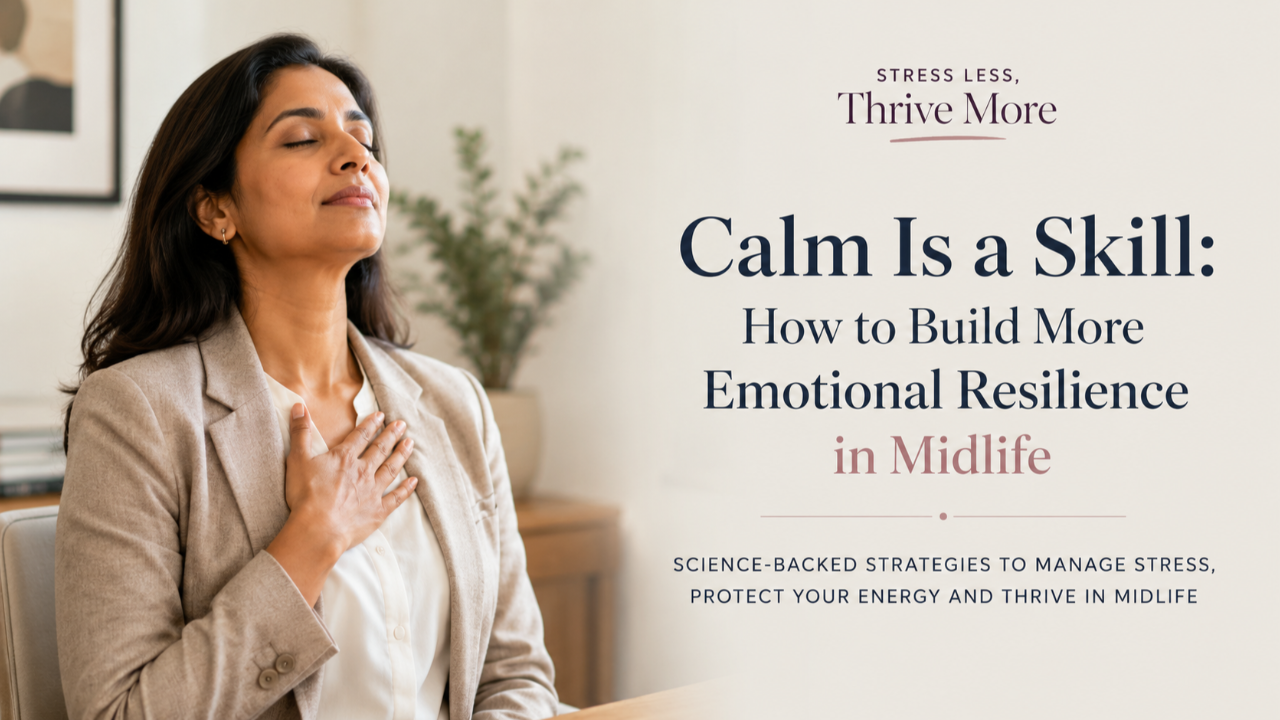
There are days when something relatively small seems to hit much harder than it used to. An email arrives with the wrong tone, a meeting does not go as planned, or someone asks you for one more thing when you already have too much to do. You hold yourself together at work, but later find yourself unusually irritated, tearful or completely overwhelmed by something that normally would not have affected you quite so much.
If this has happened during perimenopause or menopause, you may have wondered what has changed. Perhaps you used to feel more patient, confident or emotionally steady. Now there are moments when you barely recognise your own reaction. That does not necessarily mean you have become less resilient. Midlife can bring together hormonal changes, disrupted sleep, career pressure, relationships, caring responsibilities, ageing parents and concerns about your own health and future, all of which can reduce the amount of emotional space you have available.
Harvard Women's Health notes that the menopause transition can involve mood changes, and women with previous episodes of depression may be particularly vulnerable during this stage. Psychological experiences can also vary across different phases of the menopause transition. This context matters because emotional resilience is often misunderstood. We tend to imagine a resilient woman as someone who remains calm whatever happens, never becomes overwhelmed and simply keeps going.
That is not really resilience. The American Psychological Association describes resilience as the ability to adapt successfully to difficult or challenging experiences through mental, emotional and behavioural flexibility. In other words, resilience is not about preventing yourself from feeling stress. It is about what happens during and after it.
A resilient woman can still have a terrible day. She can become angry, cry, need help or feel frightened by change. The difference is that those moments do not have to become her permanent state. Importantly, resilience is not simply something you either possess or you do not. Research looking specifically at perimenopausal women has linked resilience with better adjustment to menopausal symptoms, greater wellbeing, lower perceived stress and fewer depressive symptoms.
That makes midlife a particularly valuable time to practise calm rather than simply hoping you will feel it. One of the first skills is learning to create a small gap between feeling something and reacting to it.
Imagine receiving an email that immediately irritates you. Your instinct may be to respond while your frustration is still at its highest. Perhaps you type quickly, reread the message, add another sentence and press send. Ten minutes later, your emotional temperature has fallen and you wish you had waited. Emotional regulation does not mean pretending you were not annoyed. It means recognising the emotion without automatically allowing it to decide what happens next.
Harvard Health describes self regulation as the ability to manage thoughts, emotions, impulses and behaviour rather than simply reacting automatically. For a working woman, one of the most useful practical rules can therefore be remarkably simple: when the emotional intensity is high, delay the response when you can.
Leave the email in drafts, walk away for a few minutes, get some water, take a few slower breaths or return to it after another task. Even a short pause can completely change the message you send. The same principle applies at home. If you arrive exhausted and somebody immediately asks you to solve another problem, recognising that you are depleted can prevent tiredness becoming an argument. Asking for ten minutes before dealing with something is not avoidance. It is regulation.
Another important resilience skill is learning to distinguish between the event itself and the story your mind immediately attaches to it. Your manager asks to speak to you tomorrow. The event is simply that a meeting has been requested. Your stressed brain may instantly create a very different story: something is wrong, you have made a mistake, they are unhappy with you, and the meeting will be awful.
Those thoughts can produce a strong emotional response to something that has not actually happened. A useful question is, “What do I know, and what am I assuming?” That question creates space between information and interpretation. You may still feel uneasy, but you are less likely to spend the entire evening responding to an imagined outcome.
This kind of psychological flexibility sits close to the heart of resilience. The aim is not forced positive thinking. Sometimes difficult things genuinely happen. The skill is being able to consider more than one possible interpretation before your mind automatically settles on the worst one.
Sleep also deserves far more attention in conversations about emotional resilience. It is much harder to be patient, thoughtful and flexible when you are exhausted. Perimenopause itself can interfere with sleep, with night waking, hot flushes and other symptoms affecting many women. This means that on some days your emotional bandwidth may genuinely be smaller.
Recognising this can be incredibly useful. If you have slept badly, that may not be the best day to schedule every difficult conversation, skip lunch, work until seven and then expect yourself to remain endlessly patient at home. When possible, reduce unnecessary pressure on the days when your reserves are already depleted. That is not lowering your standards. It is working intelligently with your capacity.
Movement is another powerful resilience tool. Regular physical activity can help reduce stress and anxiety, and it can influence both psychological and physiological pathways involved in mood. This does not mean every stressful experience requires an intense workout. Sometimes the most useful response to a difficult afternoon is twenty minutes of walking.
You finish the meeting, put on your shoes and go outside. Your environment changes, your body moves and your attention is no longer fixed on the same screen where the stressful experience happened. Strength training can provide a different form of release, yoga may help you slow down, and swimming can provide a period in which very little competes for your attention. The best movement for emotional resilience is usually the movement you will genuinely use.
Another useful skill is learning your own early warning signs. Stress rarely goes from zero to overwhelming without leaving clues. Perhaps your shoulders start creeping towards your ears, you become impatient with people you normally enjoy, your breathing becomes shallower or you start rushing even when there is no real reason to hurry. You may stop taking lunch away from your desk, begin scrolling more, sleep later or look for comfort food every evening.
Those signs are useful information. Do not wait until you are completely overwhelmed before deciding you need recovery. When you recognise your personal warning signs, intervene earlier. Cancel something unnecessary, leave the laptop for fifteen minutes, walk, eat lunch, ask for help or move a non essential job to tomorrow. Resilience is not simply becoming better at surviving the breaking point. It is becoming better at recognising that you are approaching it.
Relationships matter too. Emotional resilience is sometimes portrayed as a solitary skill, as though the strongest person is the one who manages everything independently. Humans do not work particularly well that way. The National Institute on Aging highlights social connection, mental wellbeing and the management of loneliness, stress and mood as important parts of healthy ageing.
Think about the people in your life around whom you do not need to perform. The friend you can call and say, “Today was awful.” The colleague who understands the pressures you are facing. The partner who can take something off your plate. Strong relationships do not remove difficult circumstances, but they can change the experience of carrying them.
One practical resilience habit is therefore to stop waiting until you are overwhelmed before reaching out. Make connection part of ordinary life. Arrange the walk, send the message, have lunch with somebody, tell someone when the week is difficult and accept help before you desperately need it. There is strength in allowing your support system to actually support you.
Self compassion also deserves a place in this conversation, particularly for women with very high expectations of themselves. Harvard Health describes self compassion as responding to your own difficulties with some of the kindness and understanding you would naturally offer another person. This does not mean making excuses. It means recognising the difference between accountability and attack.
Imagine you missed two workouts because work became chaotic. Accountability says, This week got away from me. How can I protect my sessions next week? Self attack says, I never stick to anything. I have failed again. Only one of those responses is likely to help you move forward.
Try listening to the language you use internally when you make a mistake, become emotional or have a difficult day. If you would never speak to a friend that way, question why that tone has become acceptable when speaking to yourself.
Another important skill is knowing when to stop solving. Professional women spend much of their working lives being rewarded for solutions. There is a problem, so you analyse it. Something is not working, so you fix it. That approach is enormously valuable at work, but it is less helpful at two o'clock in the morning.
Some problems cannot be resolved tonight. When your mind begins running through an issue repeatedly, ask yourself, “Is there anything useful I can do about this right now?” If the answer is yes, decide what the action is and do it. If the answer is no, write down what needs dealing with tomorrow and deliberately return your attention to the present. You are not abandoning the problem. You are deciding when it gets access to you.
Calm also becomes easier when your days contain genuine recovery rather than simply the absence of work. Stress and recovery belong together. The stress response helps you mobilise resources when something requires action, but the body also needs opportunities to settle afterwards.
Your method of recovery does not need to look like anybody else's. Perhaps your calm comes from gardening, yoga before work, swimming, walking without your phone, reading or sitting outside for fifteen minutes after dinner. The important question is whether the activity consistently leaves you feeling more settled than you did before.
Resilience also requires boundaries. You cannot endlessly regulate yourself around an environment that demands too much without ever examining the demands themselves. Sometimes the answer is not another breathing exercise. Sometimes the answer is no.
No, I cannot take that on this week. No, I am not available tonight. No, that meeting does not need to include me. No, I do not need to respond immediately. No, everything does not have to be done perfectly.
Boundaries protect the energy that emotional resilience depends upon.
A useful exercise is to look at the coming week and identify the day that is most likely to stretch you. Perhaps Thursday contains back to back meetings, Tuesday involves travelling or Sunday always becomes stressful because you are trying to prepare everything for Monday. Instead of waiting for that day to overwhelm you, support yourself in advance.
Prepare food so you do not miss lunch, protect ten minutes between meetings where possible, avoid adding unnecessary evening commitments, decide when work will end and make bedtime easier rather than hoping you will somehow unwind. That is resilience in practice. It is not simply bouncing back afterwards. It is creating conditions that make it less likely that every difficult day empties the entire tank.
You can do something similar with emotional triggers. Think about the situations that repeatedly unsettle you. Perhaps criticism makes you defensive, uncertainty makes you anxious, conflict causes you to replay conversations for hours or being rushed makes you irritable. Knowing your trigger does not make it disappear, but it gives you a head start.
The next time it appears, you can recognise it: This is one of the situations that activates me. I do not have to respond immediately. That moment of awareness is extraordinarily valuable because you are moving from reaction towards choice, and choice is a large part of emotional resilience.
There is also value in protecting activities that give your life meaning and enjoyment. Research has associated hobbies with greater happiness, better self reported health and higher life satisfaction in older adults. The evidence is observational, so it cannot prove that hobbies directly cause those outcomes, but it is an important reminder that wellbeing is not built solely through managing symptoms and responsibilities.
You need parts of your life that are not about work, menopause, caring for people or improving yourself. Do something simply because you enjoy doing it. Garden, dance, swim, travel, read, learn something unrelated to your career or spend time with people who make you laugh. Emotional resilience becomes much harder when life consists entirely of obligations.
There is something particularly encouraging about research into resilience during the menopause transition. Women often describe menopause as involving both losses and gains, and many develop coping strategies that support emotional and physical wellbeing. Other research has similarly found that despite genuine biological, psychological and social challenges, many women demonstrate substantial resilience through perimenopause.
That is an important counterbalance to the way midlife is sometimes presented. You are not inevitably becoming less emotionally capable. This can also be a period in which you understand yourself more clearly, become more deliberate about your boundaries, stop giving energy to things that no longer deserve it and develop stronger ways of protecting your wellbeing.
For the next week, do not try to become calmer. Practise the skills that make calm more accessible. Pause before reacting when emotions are high. Ask what you know rather than automatically believing what you fear. Protect sleep and adjust your expectations after a difficult night. Move your body when your head feels overloaded. Notice your early warning signs. Reach out before you become isolated and protect some genuine recovery time.
When you do have a difficult day, do not use it as evidence that none of this is working. Resilience does not mean never being knocked off balance. It means learning how to find your footing again.
There may still be meetings that upset you, nights when sleep is terrible, conversations you replay and days when everything feels like too much. The aim is not emotional perfection. It is recovery. Over time, you begin recognising your reactions earlier, understanding what helps and becoming more protective of your attention and energy.
That is why calm can be thought of as a skill. Not because you can control everything that happens around you, but because you can become increasingly skilled at deciding what happens inside you afterwards.
Midlife will continue bringing change. Some of it will be challenging, and some of it may also be freeing. The woman who emerges does not need to be endlessly calm, endlessly productive or endlessly strong. She simply needs to know how to recognise when life has knocked her off centre, give herself what she needs and find her way back.
Perhaps that is emotional resilience at its most useful: not becoming impossible to shake, but becoming increasingly confident that when life shakes you, you know how to return to yourself.
Stay connected with news and updates.
Join our mailing list to receive the latest news and updates from our team.
Don't worry, your information will not be shared.
We hate SPAM. We will never sell your information, for any reason.