Working From Home? How Your Environment Shapes Your Eating Habits
Oct 29, 2026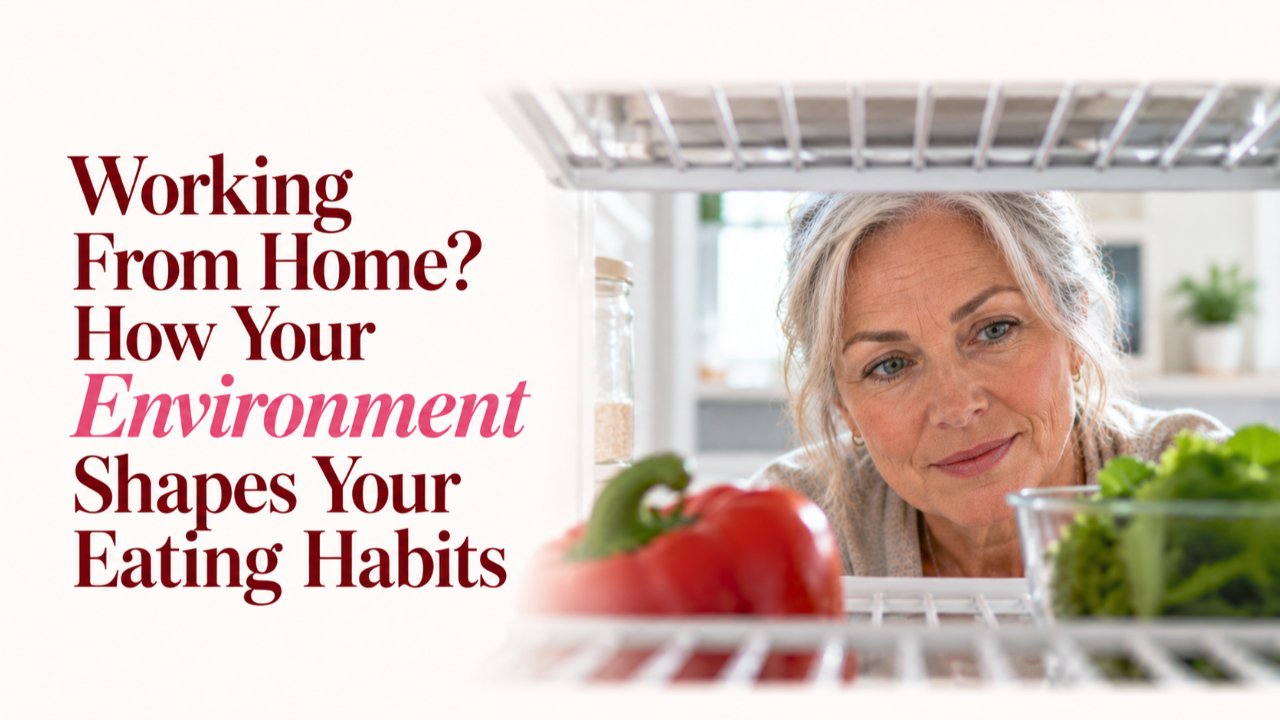
our kitchen is only a few steps away, but is your home-working routine helping you eat well? Discover how small changes to your surroundings can support your nutrition, concentration and wellbeing in midlife.
It's ten thirty in the morning, and you've been sitting at your laptop since eight. You've answered several emails, attended a meeting and made a reasonable start on your growing list of responsibilities. You decide it's time for a cup of tea, so you walk into the kitchen, open the fridge, look inside and then open a cupboard. A few minutes later, you're back at your desk with your tea and something to eat, although you hadn't particularly planned on having a snack.
By lunchtime, the kitchen has already received several visits. Perhaps you've collected another coffee, put the washing on, prepared something for somebody else or wandered in while thinking through a difficult piece of work. The kitchen has quietly become your refreshment station, thinking space, occasional meeting escape and household headquarters. And all of this happens within a few steps of your working day.
Working from home can be wonderfully convenient. There's no commute, you can wear comfortable clothes, prepare meals in your own kitchen and perhaps enjoy a little more flexibility around your day. Yet it can also create an interesting challenge: when your workplace and your home occupy the same space, the boundaries around eating, working and taking breaks can become surprisingly blurred.
The answer isn't to avoid the kitchen or introduce strict rules about when you're allowed to eat. It's to consider whether your surroundings are helping you feel nourished, comfortable and in control of how you spend your day.
And sometimes, a few thoughtful changes to your environment can make working from home feel considerably better.
The kitchen has become part of your working day
Think about how different your eating environment might have been when you worked away from home. Perhaps you brought lunch with you, stopped at a café or ate with colleagues during a designated break. Food was usually available, but accessing it involved a little planning or a decision to leave your desk.
At home, things are different. You can walk into the kitchen whenever you like, look through the fridge or prepare something without leaving the building. There may be leftovers from the previous evening, a freshly baked cake or a cupboard containing all your favourite foods. This convenience can be a real advantage, particularly when it helps you prepare nutritious meals without spending money on takeaway lunches.
But convenience also changes the number of opportunities we encounter food during the day. You might enter the kitchen to refill your water and notice something appealing on the counter. You may be preparing lunch for someone else when you realise you haven't eaten. Or perhaps you wander towards the fridge because you need a break from your screen and the kitchen happens to be the nearest place to go.
None of these experiences automatically indicates a problem. Sometimes you're hungry, sometimes you're thirsty and sometimes you simply want to move around. What matters is whether your working environment gives you enough opportunities to meet those needs comfortably, rather than leaving everything to chance.
What does research tell us about eating while working from home?
Researchers have increasingly examined how working from home influences everyday health behaviours, including eating patterns. One interesting finding is that home working does not affect everybody in the same way. Some people benefit from preparing more meals at home, while others find that access to food throughout the day changes how frequently they eat.
A United States observational study involving 9,329 adults examined changes in cooking and eating habits during the early stages of the COVID-19 pandemic. Participants who reported working more from home also reported eating more home-prepared meals and fewer meals prepared outside the home. However, the study could not establish whether those changes necessarily improved the nutritional quality of their diets.
You can explore the study here: The Impact of Work Environment on Cooking and Eating Habits for Adults in the United States.
Research involving Australian women also identified different experiences of eating at home during the pandemic. Some women appreciated having more time to cook and prepare meals, while others described increased snacking because food was readily available. The findings provide useful insight into how a change in surroundings can influence everyday routines, although the unusual circumstances of pandemic restrictions are important when interpreting them.
Read the Australian research on changes in food and drink consumption.
More recently, a 2026 Australian longitudinal analysis suggested that home working may influence weight-related outcomes through changes in physical activity and eating patterns. However, that does not mean working from home inevitably causes weight gain, and the study cannot tell us what will happen to an individual woman.
The broader lesson is that our surroundings matter. The home environment can make healthy routines easier, but it can also introduce challenges that weren't part of our previous working day.
Understanding those influences allows us to make small, practical adjustments rather than relying entirely on willpower.
Your home is full of little reminders
Have you ever walked into the kitchen to get a glass of water and suddenly remembered the chocolate sitting in the cupboard? Perhaps you noticed a loaf of freshly baked bread on the counter or saw the biscuits you left out after breakfast. You hadn't necessarily been thinking about eating until something in your surroundings caught your attention. That is an ordinary example of how our environment can influence behaviour.
Researchers refer to features such as the availability, visibility and accessibility of food when examining eating environments. Food that is easy to see or reach may present more frequent opportunities to eat, although the effects vary depending on the person, situation and type of food. Hunger, preferences and deliberate choices still matter.
A 2026 scoping review of workplace environments identified 196 observational studies examining relationships between workplace conditions and eating behaviours. This broader research reflects how food choices can be influenced by more than individual motivation, including physical surroundings, organisational practices and social circumstances.
For someone working from home, those influences might include where food is stored, whether there is a dedicated lunch space, how frequently meetings interrupt breaks and whether the kitchen also serves as a workspace.
The useful question is not whether you should hide every tempting food from view. It is whether your surroundings make it easy to eat when you need nourishment and take a proper break when you need rest.
Perhaps keeping fruit, yoghurt or ingredients for a simple lunch readily available would make the afternoon easier. Maybe storing suitable leftovers in clearly labelled containers would save time when you're busy. Or perhaps you would benefit from having a comfortable place to sit away from your laptop.
Small environmental changes can support your decisions without turning food into something that must be tightly controlled.
Are you taking a break, or simply changing rooms?
This is one of the most overlooked challenges of working from home.
Imagine you've spent nearly two hours concentrating on a difficult task. Your shoulders feel tight, your eyes are tired and you're beginning to lose focus. You stand up, walk into the kitchen and make yourself another coffee, perhaps with something to eat.
The movement is welcome, and the coffee may be enjoyable. But have you actually had a break?
If you spend the entire time thinking about the email you need to send, the meeting that's coming up or the task you haven't finished, you may return to your desk feeling almost as mentally occupied as before.
The kitchen visit has interrupted your sitting, but it may not have provided the mental pause you needed.
Try giving yourself another place to go during the working day. It could be a comfortable chair beside a window, the garden, a balcony or simply a different room where you can spend five minutes without looking at a screen.
You might step outside for some fresh air, stretch your shoulders or walk around the block. Sometimes a change of surroundings is more restorative than another drink made while checking messages on your phone.
This isn't about replacing food with movement whenever you want a snack. If you're hungry, you should eat. It is about recognising that a working day also requires genuine opportunities to rest.
The problem with working through lunch
One of the apparent advantages of working from home is that lunch should be easier. Your kitchen is nearby, you don't need to queue at a café and you have access to your own food. Yet many women find themselves working straight through the middle of the day because nobody is there to remind them to stop.
Perhaps a meeting finishes late, and you decide to answer a few messages before eating. Then somebody calls, a document needs reviewing and the afternoon has arrived before you've prepared anything. You end up eating a sandwich while typing or standing at the kitchen counter between telephone calls.
It's easy to dismiss this as an ordinary part of being busy. But when it happens regularly, it can make it harder to eat adequately and enjoy your meals.
Rather than waiting for an unexpectedly quiet moment to appear, consider giving lunch a realistic place in your working day. If you can protect twenty minutes for a meeting, perhaps you can protect some time to eat without simultaneously answering emails.
A proper lunch doesn't need to be elaborate. It might be a jacket potato with beans and cheese, leftovers from the previous evening, a wholegrain sandwich with protein and vegetables, or a bowl of lentil soup with bread.
If missed meals are part of your routine, read our related article, Skipping Lunch to Save Calories? Why It Can Backfire by Evening, which explores the importance of adequate nourishment and why reducing food during the day isn't always a helpful approach to managing weight.
Working from home offers an opportunity to improve your lunchtime routine. The challenge is to make that opportunity part of your day rather than something you only use when everything else has been completed.
Make your kitchen work for you, not against you
There is a difference between creating a supportive food environment and trying to remove every food you consider tempting.
A supportive environment makes it easier to prepare meals you enjoy, access nourishing foods and eat comfortably when you're hungry. It does not require an immaculate kitchen, expensive storage containers or a refrigerator filled exclusively with vegetables.
Start by considering what happens when you open your fridge at lunchtime. Can you quickly put together a satisfying meal, or does everything require preparation you don't have time for? Are there suitable leftovers available, or do you regularly realise at one o'clock that you haven't planned anything?
A little preparation can make a considerable difference. Washing vegetables, cooking an extra portion at dinner or keeping convenient ingredients available may reduce the amount of effort needed to prepare lunch.
You could also consider whether your desk has gradually become your permanent eating area. If you have space, try sitting somewhere different for lunch a few times during the week. Even moving to the kitchen table can help create a clearer distinction between working and eating.
And if you enjoy having tea and biscuits during the afternoon, there's no reason they cannot remain part of your routine. The aim is to create a working environment that supports both nourishment and enjoyment, rather than introducing another collection of food rules.
What about the constant interruptions at home?
Not everybody who works from home has a quiet office and an uninterrupted schedule.
Perhaps you're working at the dining table while other family members move around you. You may be responsible for answering the door, managing deliveries, preparing meals or checking on an older relative. Some women are trying to run a business while juggling household responsibilities that seem to multiply simply because they're physically present.
Being at home can create an assumption that you're always available.
You might feel guilty taking a lunch break when the washing needs doing, or find yourself preparing somebody else's food before thinking about your own. Your working day becomes a mixture of professional and domestic responsibilities, with few clear boundaries between them.
Where possible, consider communicating when you're working and when you'll be available for household tasks. You might agree that a particular period is reserved for uninterrupted work or explain that you'll be taking a lunch break without using it to complete chores.
Of course, some caring responsibilities cannot be neatly scheduled. In those circumstances, the goal may be more modest: preparing a convenient lunch in advance, asking for help when available or identifying the least interrupted part of the day for a meal.
A realistic routine should acknowledge your actual circumstances rather than assume everybody has the same flexibility.
A small home working experiment worth trying
Instead of redesigning your kitchen or creating an elaborate eating schedule, try changing three simple things over the next few working days.
Begin with your lunch space. Choose somewhere comfortable where you can eat without simultaneously working, even if it's only for fifteen minutes. Notice whether the experience feels more enjoyable or gives you a welcome sense of separation from your responsibilities.
Next, make one nourishing option easier to access. Perhaps you prepare a portion of lunch the evening before, keep suitable ingredients together in the fridge or arrange a few foods that make assembling a meal straightforward. The aim is to reduce unnecessary effort when your day becomes busy.
Finally, introduce one break that doesn't involve visiting the kitchen. Walk outside, sit somewhere quiet or simply move away from your desk for a few minutes. You can still have food or a drink when you want one, but you are creating another way to pause during the day.
At the end of the experiment, reflect on what you noticed. Did lunch feel less rushed? Was it easier to take a meaningful break? Did having food prepared reduce the pressure of deciding what to eat between meetings?
You may discover that one change makes a noticeable difference. You may also find that something you expected to help doesn't suit your routine, and that's useful information too.
The best home working routine is not the one that looks perfect. It's the one that makes your actual working day easier.
Your home working environment matters during menopause too
For some women, working from home becomes particularly valuable during perimenopause or menopause. You may appreciate being able to adjust the room temperature, change clothes after a hot flush or take a short break when you've had a difficult night's sleep.
At the same time, fatigue, disrupted sleep and concentration difficulties can make ordinary working days feel more demanding. If you're already tired, it's understandable that meal preparation, movement and breaks may receive less attention.
This is another reason why creating a supportive environment can be more useful than relying on motivation.
Perhaps you keep a water glass nearby, organise a few convenient lunches or give yourself permission to move away from your desk between meetings. You might find that a short walk outside improves how you feel during the afternoon, or that eating lunch somewhere comfortable provides a much-needed change of pace.
These adjustments won't eliminate menopausal symptoms, and persistent or troublesome symptoms deserve appropriate medical support. However, they can make everyday life more manageable.
For further ideas, explore our article How to Build a Midlife Energy Routine That Survives a Busy Working Week.
You don't need a perfect kitchen to develop healthier habits
Social media can make healthy home working look wonderfully organised. There are spotless kitchens, neatly arranged meal-preparation containers, beautiful lunches and women who appear to glide effortlessly between meetings, exercise and domestic life.
Real life is rarely that tidy.
You may be working at the dining table because there isn't space for a separate office. Perhaps your fridge contains a mixture of family favourites, leftovers and ingredients you haven't quite got around to using. There may be washing waiting to be folded, a dog asking to go outside or somebody calling just as you sit down to eat.
None of that means you cannot create a healthier routine.
Your environment doesn't have to be beautiful or perfectly organised to support your wellbeing. It simply needs to work a little better for you.
If preparing lunch in advance helps, do that. If taking a short walk makes the afternoon more manageable, make room for it when you can. If sitting down to eat away from your laptop brings a little more pleasure into your day, allow yourself that time.
These aren't dramatic lifestyle transformations. They're practical choices that acknowledge the realities of how women live and work.
Make your home a place that supports you too
There is something worth remembering about working from home.
Your house may be your office, your family's meeting place, your kitchen, your living space and the place where countless responsibilities are managed. It may feel as though every room has a purpose and every hour has something that needs doing.
But your home should also be somewhere you can look after yourself.
You deserve a proper lunch, opportunities to move, moments of rest and the freedom to enjoy food without constantly thinking about whether you've been good or bad.
Sometimes the changes that make the biggest difference are surprisingly ordinary. A chair away from your laptop, a lunch prepared before the day becomes hectic or five minutes outside between meetings can create a little more breathing space.
And perhaps that's the most encouraging thing about your surroundings. They aren't simply something you have to live with. Within the limits of your circumstances, they're something you can gradually shape to support the way you want to feel.
You don't need to keep the kitchen out of your working day. You simply need a working day that makes room for nourishment, enjoyment and looking after yourself.
Begin Your Midlife Wellbeing Reset
If you'd like to build more supportive habits around nutrition, movement, energy and everyday wellbeing, my Free 7-Day Midlife Hormone & Wellness Reset is a gentle place to begin.
Opening on 10 November 2026, the Reset is designed to help women make practical, manageable changes that fit around their real lives, without unnecessary restriction or pressure.
Whether you're working from home, managing family responsibilities or simply looking for a more balanced approach to midlife wellbeing, I would love to welcome you.
Join the Free 7-Day Midlife Hormone & Wellness Reset interest list
Warm wishes,
Monica Rafiq
Founder, Fitness Inspiration for Women
Certified Menopause Coach | Nutrition & Weight Loss Specialist | Life Coach & NLP Practitioner
Research and further reading
Knightley, E., Koutsopoulou, G. and Keyworth, C. (2023). Changes in office workers' lived experiences of their own eating habits since working from home due to the COVID-19 pandemic: An interpretative phenomenological analysis. Appetite, 188, 106760. Read the study.
The Impact of Work Environment on Cooking and Eating Habits for Adults in the United States (2022). Journal of Nutrition Education and Behavior, 54(7), S41. Read the conference abstract.
Tolhurst and colleagues (2022). Changes in the food and drink consumption patterns of Australian women during the COVID-19 pandemic. Australian and New Zealand Journal of Public Health. Read the research.
Adabor, O. (2026). The Impact of Working from Home on Obesity in Australia. Economic Papers. Read the study.
This article is intended for general education and wellbeing and does not replace personalised medical or nutritional advice.
Stay connected with news and updates.
Join our mailing list to receive the latest news and updates from our team.
Don't worry, your information will not be shared.
We hate SPAM. We will never sell your information, for any reason.