When Food Becomes Your Evening Comfort: What Are You Really Craving?
Oct 26, 2026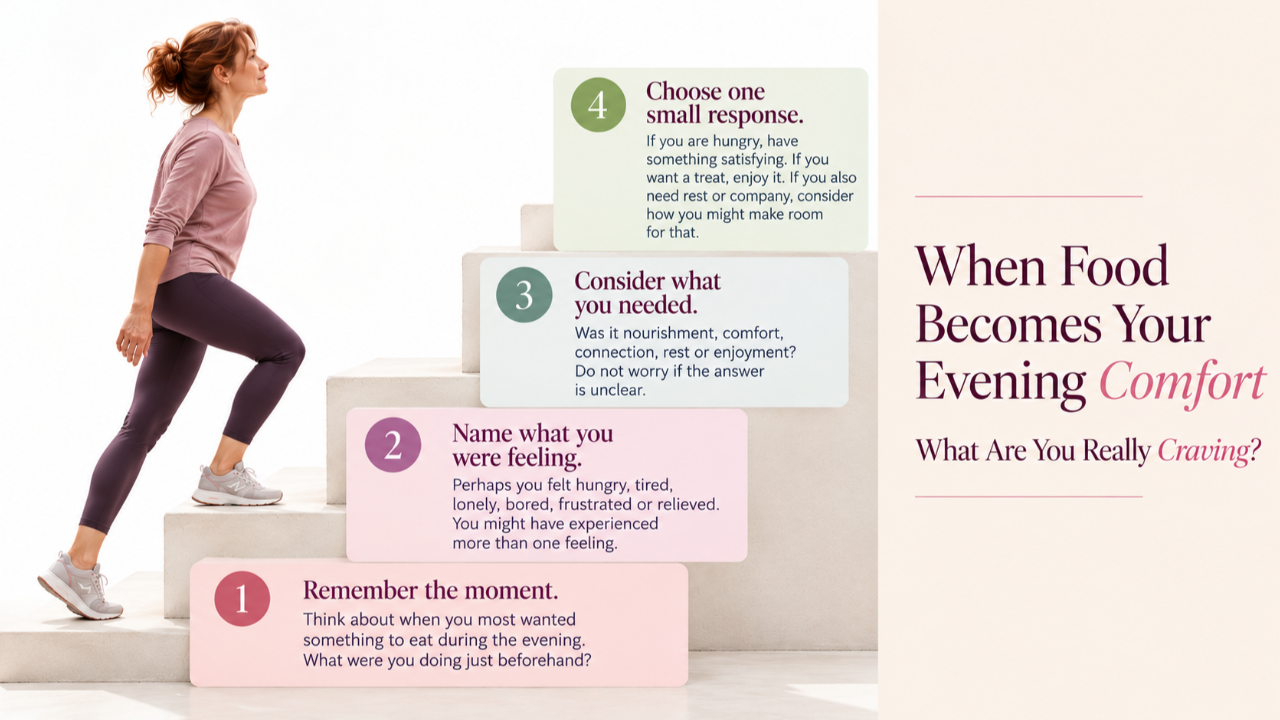
Understanding emotional eating, evening cravings and why a little comfort can feel so important in midlife.
There is a particular moment in the evening that many women will recognise. The kitchen has been tidied, the last message has been answered, the television is on and, for the first time all day, nobody seems to need anything from you.
You settle onto the sofa, perhaps looking forward to watching your favourite programme or reading a few pages of a book. Then, almost without thinking, you find yourself wandering back into the kitchen. You open the cupboard, look inside, close it, open the fridge and eventually emerge with a biscuit, some chocolate or whatever happens to catch your eye.
You might not even be particularly hungry. Yet something about eating at that moment feels comforting, almost like a reward for getting through another demanding day. Then comes the familiar thought: Why do I always do this when I've been so good all day?
Perhaps the question we should be asking is not why we keep reaching for food, but what has been missing from our day that makes those quiet moments feel so important?
For women navigating perimenopause, menopause and the years beyond, the answer may involve much more than hunger. And understanding that connection can change how we approach our eating habits without turning food into another source of guilt.
When the day belongs to everybody except you
Think about everything you might have managed before reaching the end of an ordinary Tuesday. Perhaps you spent the morning answering emails, the afternoon dealing with deadlines and the evening organising dinner. Somewhere in between, you checked on an ageing parent, remembered a birthday, arranged an appointment and listened to someone else's problems.
Or perhaps your day looked completely different. You worked from home, managed the household, cared for family members or spent much of the afternoon alone. You may be adjusting to children leaving home, retirement, divorce or a relationship that no longer looks the way it once did.
Whatever your circumstances, there may be a common thread. You have spent much of the day responding to responsibilities, with very little opportunity to consider what you actually need.
Then the evening arrives. The house becomes quiet, the demands ease and you suddenly have a little time to yourself. Food offers something familiar and immediately enjoyable, without requiring planning, effort or anybody else's cooperation.
A cup of tea and a few biscuits can represent far more than something to eat. They may signal that you have finally finished looking after everybody else and can enjoy a moment that belongs entirely to you.
And there is nothing wrong with that.
The question worth exploring is whether food has gradually become your most reliable way of finding comfort, pleasure or relief at the end of the day.
What does research tell us about emotional eating in midlife?
Emotional eating describes eating influenced by feelings rather than physical hunger alone. It can happen when we feel anxious, lonely, frustrated or overwhelmed, but it can also be associated with excitement, celebration, comfort and enjoyment.
A substantial systematic review and meta-analysis, published in the Journal of Eating Disorders in December 2025, brought together findings from 38 studies involving 13,662 adults aged 35 to 64.
The researchers estimated that approximately 16% of middle-aged adults experienced negative emotional eating, meaning eating more in response to difficult emotions such as stress or sadness. Rates differed across groups and measurement methods, with considerable variation between studies.
You can read the research here: Prevalence of Negative Emotional Eating in Middle-Aged Adults: A Systematic Review and Meta-Analysis.
Importantly, the research does not establish that menopause causes emotional eating, nor does it mean that occasionally reaching for chocolate after a difficult day indicates an eating problem.
What it does highlight is that eating in response to difficult emotions is a recognised experience among adults in midlife and deserves greater understanding.
For women experiencing hormonal changes alongside demanding work, family or personal circumstances, this is particularly relevant. Rather than interpreting every craving as a failure of discipline, it is worth exploring the combination of emotional, physical and environmental influences surrounding it.
Why perimenopause and menopause may add another layer
Midlife can bring changes that influence how you feel throughout the day. Fluctuating hormones during perimenopause may be accompanied by disrupted sleep, hot flushes, night sweats, changes in mood and difficulties concentrating.
Now imagine experiencing several broken nights of sleep while continuing to manage work, family commitments and everyday responsibilities. By late afternoon, you may feel unusually irritable, mentally drained or less patient than you would like.
You may even find yourself thinking, I just need something nice tonight.
That thought is understandable. After a difficult day, familiar food can offer a little pleasure and predictability when everything else has felt demanding.
However, it is important not to blame every eating habit on hormones. Hunger, insufficient meals, stress, established routines, food availability and emotional circumstances may all influence what and when we eat.
A woman who has barely eaten since lunchtime may genuinely need more food. Another woman may have eaten adequately but be feeling lonely or restless. Someone else may simply enjoy a particular snack while watching television.
These situations call for understanding rather than a single set of dietary rules.
If tiredness and an unpredictable daily routine are part of your experience, you may also find our article How to Build a Midlife Energy Routine That Survives a Busy Working Week helpful.
Sometimes the biscuit is not really the problem
Imagine a woman who gets up at half past six, spends the day dealing with work and family responsibilities, prepares dinner and finally sits down at nine o'clock.
She makes herself a cup of tea, takes three biscuits from the cupboard and settles onto the sofa. It is the first time all day she has felt completely free from responsibilities.
Now imagine telling her that the solution to her evening eating is to stop buying biscuits.
Would that address her exhaustion? Would it give her more time to herself, reduce her workload or help her feel less overwhelmed?
Probably not.
The biscuits may be part of a routine that provides her with a welcome moment of comfort. Removing them without understanding that routine may leave the underlying need untouched.
Perhaps she needs a little personal time before dinner. Perhaps she misses seeing friends, feels unappreciated or has gradually stopped doing the things she enjoys.
It is also possible that she simply wants biscuits, and that is perfectly acceptable.
The useful question is not How do I stop myself? but What am I hoping this moment will give me?
Comfort? Relief? Pleasure? A break? Something to look forward to?
Once you recognise what you are seeking, you can begin finding more ways to meet that need.
A practical way to understand what is happening
The next time you find yourself heading towards the kitchen in the evening, try becoming curious about what is happening rather than immediately deciding whether you should eat.
There are three useful things to consider.
First, think about your physical needs. When did you last eat? Was your dinner satisfying? Did you miss lunch or spend the afternoon rushing between commitments? You may be hungry even if the sensation does not feel like the hunger you usually recognise.
Second, notice how you are feeling. Has something upset you? Are you mentally exhausted, bored, lonely or simply relieved to have finished the day? You might discover that you are looking for comfort rather than a particular food.
Third, consider what would genuinely improve the moment. Perhaps you would enjoy your snack and a favourite programme. Perhaps you would rather telephone a friend, take a warm bath or spend twenty minutes reading without interruptions.
You may find that you want both food and something emotionally comforting.
That is entirely possible. There is no requirement to choose one over the other.
The purpose of this exercise is not to prove that you can resist food. It is to give yourself a little more freedom to choose what would be helpful.
Five practical changes that can make evenings feel different
1. Give yourself a moment before the evening begins
If you move directly from work into dinner preparation, household tasks or family responsibilities, your day may feel as though it never properly ends.
Try creating a short transition between your responsibilities and the evening. Even ten minutes can provide an opportunity to slow down and consider what you need.
If you work from home, close your laptop and take a gentle walk outside. If you have spent the day caring for others, sit somewhere comfortable with a drink before beginning the next task.
You might listen to music, stretch your shoulders or simply look out of the window.
The point is not to create another activity you must complete. It is to give yourself permission to stop being productive for a few minutes.
2. Make sure your evening meal actually satisfies you
Sometimes women describe evening eating as a lack of willpower when their earlier meals have been too small, rushed or unsatisfying.
Consider whether your dinner includes enough food to leave you comfortably satisfied. A balanced meal might include fish, chicken, tofu or lentils, alongside vegetables, potatoes, rice or another source of carbohydrate and some healthy fats.
You do not need to avoid carbohydrates in the evening or make dinner deliberately small because you are concerned about weight gain.
If you are hungry later, a snack is a reasonable option too.
Rather than concentrating on whether you can manage without food, begin by making sure you have eaten adequately throughout the day.
3. Bring back something you enjoy purely for yourself
When was the last time you looked forward to an ordinary weekday evening because something enjoyable was waiting for you?
Perhaps you used to love dancing, painting, gardening, reading or playing an instrument. Maybe you enjoyed a weekly telephone conversation with a friend or a walk after dinner.
As responsibilities increase, these pleasures can disappear almost without us noticing.
Choose one thing you would genuinely enjoy bringing back into your week. It does not have to take an hour or involve spending money.
Fifteen minutes reading a novel, practising a favourite piece of music or sitting outside can give your evening another source of satisfaction.
This is not about distracting yourself from food. It is about making your day more enjoyable.
For more ideas, explore our earlier article How to Make Space for Yourself When Life Already Feels Full.
4. Let yourself enjoy food without making it a reward for good behaviour
How often have you thought, I've been so good today, I deserve some chocolate?
Perhaps you completed a workout, avoided certain foods or managed to stick to your meal plan. By evening, something sweet feels like a reward for your efforts.
Enjoying food is not the problem. But when certain foods become prizes for being disciplined, it can encourage the idea that pleasure must be earned.
Try approaching that evening treat a little differently.
If you fancy chocolate, you can choose to have it because you enjoy it. You do not need to justify the decision through exercise or by eating less tomorrow.
Equally, you might discover that the chocolate you automatically reach for every evening is not particularly enjoyable on some nights.
Giving yourself permission to choose can help you move away from rigid rules and become more aware of what you actually want.
5. Look at what could change before the evening, not just during it
If you regularly arrive at nine o'clock exhausted, overwhelmed and desperate for a little comfort, it may be worth examining the structure of your day.
Could you take a proper lunch break twice this week? Could someone else manage a household responsibility? Is there a work boundary you have been meaning to establish?
Perhaps you could arrange a conversation with a friend or prepare an easier dinner on particularly busy days.
You may not be able to change every responsibility, particularly if you are managing demanding work or caring commitments. But identifying one pressure that could be reduced, shared or approached differently may be more useful than concentrating exclusively on your evening snack.
Sometimes improving your relationship with food begins with improving the way you are able to live your day.
Try this tonight: The five-minute evening reflection
Rather than attempting to change everything immediately, try this simple exercise once or twice during the coming week.
Step 1: Remember the moment. Think about when you most wanted something to eat during the evening. What were you doing just beforehand?
Step 2: Name what you were feeling. Perhaps you felt hungry, tired, lonely, bored, frustrated or relieved. You might have experienced more than one feeling.
Step 3: Consider what you needed. Was it nourishment, comfort, connection, rest or enjoyment? Do not worry if the answer is unclear.
Step 4: Choose one small response. If you are hungry, have something satisfying. If you want a favourite treat, enjoy it. If you also need rest or company, consider how you might make room for that.
Step 5: Notice what you learned. Did eating satisfy you? Did another activity help? Was there anything about your day that you would like to approach differently next time?
You could record a single sentence in a notebook:
I noticed I wanted chocolate after a frustrating conversation. I enjoyed some, but I also realised I needed a little time to myself.
Or:
I thought I was eating because I was bored, but I had skipped lunch and was genuinely hungry.
These small observations can be surprisingly useful.
You are not gathering evidence against yourself. You are learning about your own patterns, which can help you make choices that feel more satisfying and sustainable.
What if you find yourself eating after a difficult day anyway?
You may recognise that you are emotionally exhausted, decide that you need some comfort and still reach for the biscuits.
That does not mean the reflection failed.
Understanding a habit does not require you to change it immediately. Sometimes awareness comes first, followed by small adjustments as you begin recognising what works for you.
Try to avoid compensating the following morning by skipping breakfast, restricting food or promising yourself that you will be better.
Instead, return to eating in a way that nourishes and satisfies you.
If emotional eating regularly feels uncontrollable, causes considerable distress or involves secrecy, shame or compensatory behaviours, seek support from your GP or an appropriately qualified eating disorder professional. These experiences deserve individual attention rather than another restrictive eating plan.
The real opportunity is to make more room for yourself
There is something worth remembering as we move through midlife.
You may have spent years becoming exceptionally good at managing responsibilities, solving problems and being there for other people. You know how to keep things moving, even when you are tired, frustrated or would rather have an evening to yourself.
But being capable of doing so much does not mean that your own needs should continually come last.
Perhaps the quiet moment at the end of the day is the first opportunity you have had to notice how you are really feeling.
Perhaps the food you reach for offers a little comfort because comfort has been in short supply.
And perhaps recognising that is the beginning of a more positive relationship with both food and yourself.
You are allowed to enjoy chocolate, biscuits and your favourite evening snacks. You are also allowed to want more from your evenings than simply recovering from the demands of the day.
More laughter. More conversation. More relaxation. More opportunities to enjoy the things that make you feel like yourself.
So tonight, if you find yourself standing in front of the kitchen cupboard, resist the urge to immediately criticise the decision.
Ask yourself what you might need, then respond with a little understanding.
Because the goal is not to become a woman who never eats for comfort. It is to become a woman who has more sources of comfort, enjoyment and satisfaction in her life.
And that is a far more meaningful change than simply hiding the biscuits.
A gentle place to begin your midlife wellbeing reset
If you would like to understand your eating habits, energy and changing needs with greater confidence, I would love to welcome you to the interest list for my Free 7-Day Midlife Hormone & Wellness Reset, opening on 10 November 2026.
Together, we will explore practical, manageable ways to support your nutrition, movement and everyday wellbeing, without adding more pressure to an already busy life.
You do not need to wait until everything feels perfectly organised to begin looking after yourself.
Join the Free 7-Day Midlife Hormone & Wellness Reset interest list
Warm wishes,
Monica Rafiq
Founder, Fitness Inspiration for Women
Certified Menopause Coach | Nutrition & Weight Loss Specialist | Life Coach & NLP Practitioner
Research and further reading
Sze, K.Y.P., Donkor, E., Yang, Z. and Kim, J.H. Prevalence of negative emotional eating in middle-aged adults: a systematic review and meta-analysis. Journal of Eating Disorders. Published 5 December 2025. https://doi.org/10.1186/s40337-025-01476-8
This review included 38 studies and 13,662 adults aged 35 to 64. The pooled estimate of negative emotional eating was 16%, although differences in populations and measurement tools contributed to substantial variation. The research was not restricted to menopausal women and does not establish causation.
This article provides general educational guidance and does not replace individual medical, psychological or dietary advice.
Stay connected with news and updates.
Join our mailing list to receive the latest news and updates from our team.
Don't worry, your information will not be shared.
We hate SPAM. We will never sell your information, for any reason.