Why Does Your Body Feel Stiffer in Midlife, Even When You Are Still Active?
Sep 14, 2026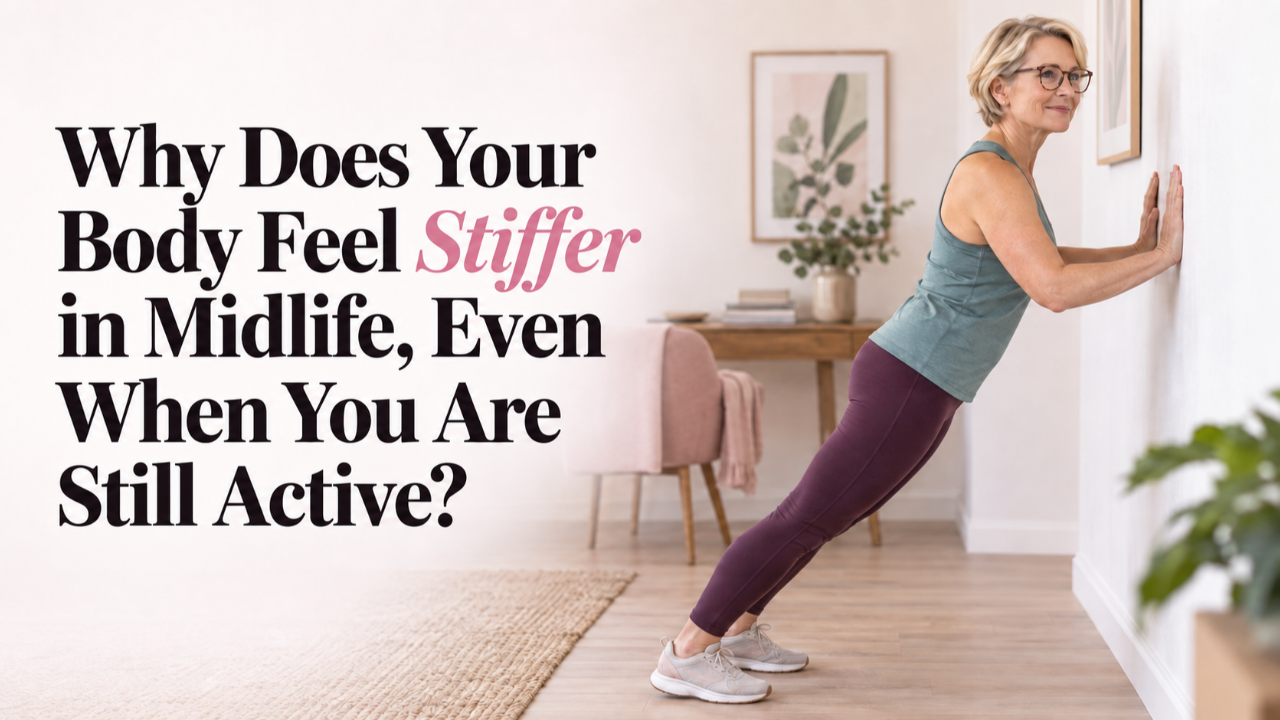
You exercise. You walk. Perhaps you practise yoga, attend a class or make an effort to keep moving throughout the week.
Yet when you stand up after working at your desk, your hips feel reluctant to straighten. Your shoulders seem to have crept towards your ears. The first few steps downstairs in the morning feel different from the way they once did.
You may find yourself wondering, “How can I be active and still feel this stiff?”
It is a frustrating contradiction, but it is not an unusual one.
Being active does not make you immune to stiffness, particularly in midlife. A structured workout is valuable, but it is only one part of your movement day. Hormonal changes, long periods of sitting, reduced strength, repetitive movement, stress, sleep disruption and underlying joint conditions can all influence how your body feels.
The answer is not necessarily to stretch harder or exercise more. It may be to understand what your body is asking for and give it a more useful combination of movement, strength and recovery.
What do we actually mean by stiffness?
Stiffness can describe several different experiences.
You may feel that a joint does not move as freely as it used to. A muscle may feel tense or resistant. Your body may feel heavy and slow after sitting, or you may experience discomfort when you first begin moving in the morning.
That feeling does not always mean your muscles have physically shortened or that something is damaged. Stiffness is a sensation, not a diagnosis. It can be influenced by the joint, surrounding muscles and tendons, the nervous system, previous injuries, pain sensitivity and how long you have remained in one position.
This is why two women can describe feeling equally stiff but require very different approaches.
One may need more regular movement during her working day. Another may need to strengthen the muscles around a joint. Someone else may have an inflammatory or musculoskeletal condition that needs clinical assessment.
Is menopause really connected with joint and muscle discomfort?
Many women report that aches and stiffness become more noticeable during perimenopause or after menopause.
A 2026 systematic review and meta-analysis included 37 observational studies involving 93,021 women across 22 countries. Muscle or joint pain was reported by approximately 40 per cent of premenopausal women, compared with 57 per cent of perimenopausal women and 59 per cent of postmenopausal women. Musculoskeletal Manifestations of Perimenopause review
Those figures show that musculoskeletal symptoms are common and appear to be reported more frequently during and after the menopausal transition.
However, the research does not prove that falling oestrogen directly causes every new ache or stiff joint. The included studies were observational, the findings varied considerably between studies, and specific diagnoses were often not reported. Ageing, activity levels, body composition, sleep, stress, previous injuries and health conditions may also contribute.
In other words, menopause may form part of the picture, but it should not become an explanation for every pain.
Why can you feel stiff when you exercise regularly?
Your workout may not reflect the rest of your day
You might complete three workouts a week and still spend many hours sitting.
There is the commute, the laptop, meetings, lunch at your desk, driving and perhaps an evening on the sofa. Your body may receive forty-five minutes of intentional exercise followed by several hours in which your hips, knees, spine and shoulders move through a very limited range.
This does not cancel the benefits of your workout. It simply means that exercise and prolonged sitting can exist in the same life.
UK physical activity guidance advises adults to minimise sedentary time, break up long periods of inactivity and perform strengthening activities on at least two days each week. UK Chief Medical Officers’ physical activity guidance
Small workplace studies also suggest that interrupting sitting with short standing or movement breaks may reduce fatigue and musculoskeletal discomfort. The evidence is not strong enough to prescribe one perfect schedule, but it supports a simple principle: your body usually appreciates being given regular opportunities to change position.
You may be fit within a narrow range of movement
Walking, running, cycling and swimming are excellent activities, but each uses familiar movement patterns.
A keen walker may still have limited upper-body mobility. A cyclist may be aerobically fit but spend considerable time with the hips and spine in a flexed position. A woman who performs the same gym routine every week may be strong in those particular exercises but rarely rotate, reach, balance or move sideways.
Fitness is specific. Being capable in one activity does not automatically prepare every joint and muscle for every other movement.
This does not mean you need complicated exercises. It means your week may benefit from a little more variety.
The area that feels tight may actually need strength
It is natural to stretch an area that feels stiff. Sometimes that is exactly what helps.
But a feeling of tightness can also appear when muscles are tired, underused or working hard to stabilise a joint. If the muscles around your hips, knees, back or shoulders lack strength, your body may respond by making movement feel guarded.
This is one reason endless stretching does not always solve the problem. The body may need greater capacity and control, not simply a larger passive range of motion.
A 2023 systematic review and meta-analysis of 55 studies found that resistance training using external loads improved joint range of motion. Across the included research, resistance training was not significantly different from stretching for improving flexibility. Resistance Training and Range of Motion review
That does not mean stretching is unnecessary. It means strength and flexibility are not opposites. When resistance exercises are performed with appropriate technique through a comfortable range, they can help you become both stronger and more mobile.
Your recovery may have changed
A workout that once felt easy may leave you feeling more tired when it is combined with interrupted sleep, work pressure, caring responsibilities or menopausal symptoms.
Poor recovery does not necessarily mean you should stop exercising. It may mean the balance between challenge and restoration needs to change.
If every session is intense, if you repeatedly train the same muscles or if you never allow easier days, your body may continue to feel heavy and resistant. Adding more exercise to an already tired system is not always the most effective solution.
An easier walk, a gentle yoga practice, a mobility session or a rest day can be a deliberate part of training rather than evidence that you have lost motivation.
What can you do about midlife stiffness?
Move more often, not only more intensely
A long workout cannot give your body the same experience as moving regularly across the day.
Choose a cue that already exists in your working routine. Stand and move while the kettle boils. Walk for a few minutes after a meeting. Mobilise your shoulders before opening another task. Take the stairs when practical. Place your water away from your desk so that you have to stand to reach it.
You do not need a perfect movement break every thirty minutes. Start with a pattern you can repeat. If an hourly reminder helps you interrupt several hours of sitting, it is a useful beginning.
The aim is not to burn a meaningful number of calories during each break. It is to give your joints and muscles a different position and your body another opportunity to move.
Warm your body before asking for greater range
A cold, stiff body may not respond well to being forced immediately into a deep stretch.
Begin with gentle movement. Walk around the room, march on the spot, circle your shoulders, bend and straighten your knees or move through a comfortable cat and cow sequence.
Once your body feels warmer, gradually explore a little more range.
Before a strength session or brisk walk, dynamic movements are often more useful than holding long stretches. Save slower static stretching for a separate mobility session or the end of your workout if it feels good for you.
Strengthen through a comfortable range
Strength training does not have to mean lifting very heavy weights in a gym.
Chair squats, wall press-ups, rows, supported lunges, hip hinges, calf raises and resistance-band exercises can all help build strength. The important elements are suitable resistance, good control and gradual progression.
Use a range that feels comfortable and stable. Over time, you may be able to squat a little deeper, reach a little further or control a slightly larger movement.
This is very different from forcing a joint into a position that produces sharp pain.
The goal is to make useful movement feel safer and easier, not to win a flexibility competition.
Stretch what needs stretching
Stretching can improve range of motion. A 2023 meta-analysis involving 77 studies found that regular stretch training produced a moderate improvement in flexibility compared with no stretching. The results also suggested that static stretching and proprioceptive neuromuscular facilitation were effective for longer-term improvements in range of motion. Stretch training and range of motion review
Stretching should create a feeling of gentle tension, not pain. Breathe normally and avoid bouncing or pushing through a pinching sensation in a joint.
Rather than stretching your entire body without a clear reason, notice where your movement is genuinely limited. If sitting leaves the front of your hips feeling restricted, a supported hip-flexor stretch may help. If your calves feel tight after walking, stretch them gently against a wall. If your chest and shoulders feel closed after working at a computer, combine a chest stretch with upper-back strengthening.
For a calm start to the day, you might also use these yoga stretches for morning stiffness.
Try this six-minute stiffness reset
This short sequence is designed to interrupt sitting and move several major areas of the body. Stay within a comfortable range and use a wall or chair for support if needed.
Begin with one minute of easy marching. Let your arms move naturally and gradually make the steps a little more purposeful.
Next, perform eight to ten controlled sit-to-stands from a stable chair. Press through your feet, stand tall and lower yourself slowly. Use your hands for support if necessary.
Move to a wall and complete eight to ten wall press-ups. Keep your body long, bend your elbows and bring your chest towards the wall before pressing away.
Place your hands on your hips and practise eight slow hip hinges. Soften your knees, send your hips backwards and keep your spine comfortably long. You should feel your hips and the backs of your legs working.
Stand tall and rotate your upper body gently from side to side five times in each direction. Keep the movement easy and let your eyes follow your chest.
Finish with a comfortable calf stretch and supported hip-flexor stretch on each side. Hold each position for twenty to thirty seconds without forcing.
This routine is not a treatment for unexplained pain. It is simply a practical way to bring movement back into a body that has been in one position for too long.
Use a weekly movement mixture
Your body may respond better to a mixture of movement than to repeating the same activity every day.
A realistic week could include two or three strength sessions, several walks, brief mobility breaks during working days and one or two yoga or stretching sessions. Some activities may overlap. A well-designed yoga practice can include strength, balance and mobility, while resistance training through a good range can also improve flexibility.
You do not have to complete every category perfectly. The aim is to expose your body to enough variety to retain the movements you want for everyday life.
Think about reaching overhead, getting down towards the floor, standing up from a chair, carrying shopping, climbing stairs, rotating to look behind you and balancing while putting on a shoe.
These ordinary actions are the real purpose of mobility.
You can read more about why flexibility after 40 is more than a fitness goal.
Do not use soreness as your measure of success
A useful session does not have to leave you exhausted or aching the following day.
Some temporary muscle soreness can occur when you begin a new activity or increase the challenge. Persistent joint pain, sharp pain, worsening swelling or a loss of function should not be treated as proof that the exercise is working.
Progress can look quieter. You stand up more easily. Your shoulders feel less tense at the end of the day. You can turn your head more comfortably while driving. The stairs feel steadier. You recover more quickly after a walk.
These changes may matter more than touching your toes.
When stiffness deserves medical attention
Not every new ache in midlife should be blamed on menopause or ageing.
Seek urgent medical advice if a joint becomes suddenly painful, swollen or hot, particularly if you feel feverish or generally unwell. Severe pain following an injury, an inability to put weight through a joint, or numbness after an injury also requires prompt assessment. NHS joint pain guidance
Arrange an assessment with your GP or a qualified musculoskeletal professional if unexplained pain, swelling or stiffness does not settle, is getting worse or is interfering with normal activities.
Morning stiffness that regularly lasts longer than around 30 to 45 minutes, particularly when accompanied by swollen joints, fatigue, fever or unexplained weight loss, can sometimes indicate an inflammatory condition and should not be dismissed. NHS rheumatoid arthritis symptoms
Your body may need more variety, not more punishment
Feeling stiffer in midlife does not mean your body is failing.
It may be responding to hormonal change, long working days, repeated positions, reduced strength, disrupted recovery or a movement routine that has become too narrow. Often, the answer is not one heroic stretching session. It is a combination of moving more frequently, strengthening consistently, exploring comfortable ranges and recovering well.
Start by noticing when you feel stiffest.
Is it first thing in the morning? After several hours at your desk? The day after a hard workout? When stress and sleep are particularly difficult?
That pattern gives you useful information.
Then choose one small response. Take a movement break. Warm up before stretching. Add two controlled strength sessions to your week. Use six minutes to move the parts of your body your usual workout misses.
You do not need to force your body back to how it felt at 25.
You can help it become stronger, more capable and more comfortable in the life you are living now.
Stay connected with news and updates.
Join our mailing list to receive the latest news and updates from our team.
Don't worry, your information will not be shared.
We hate SPAM. We will never sell your information, for any reason.