Too Busy to Build Strength? Here's How to Fit It into Your Week
Oct 23, 2026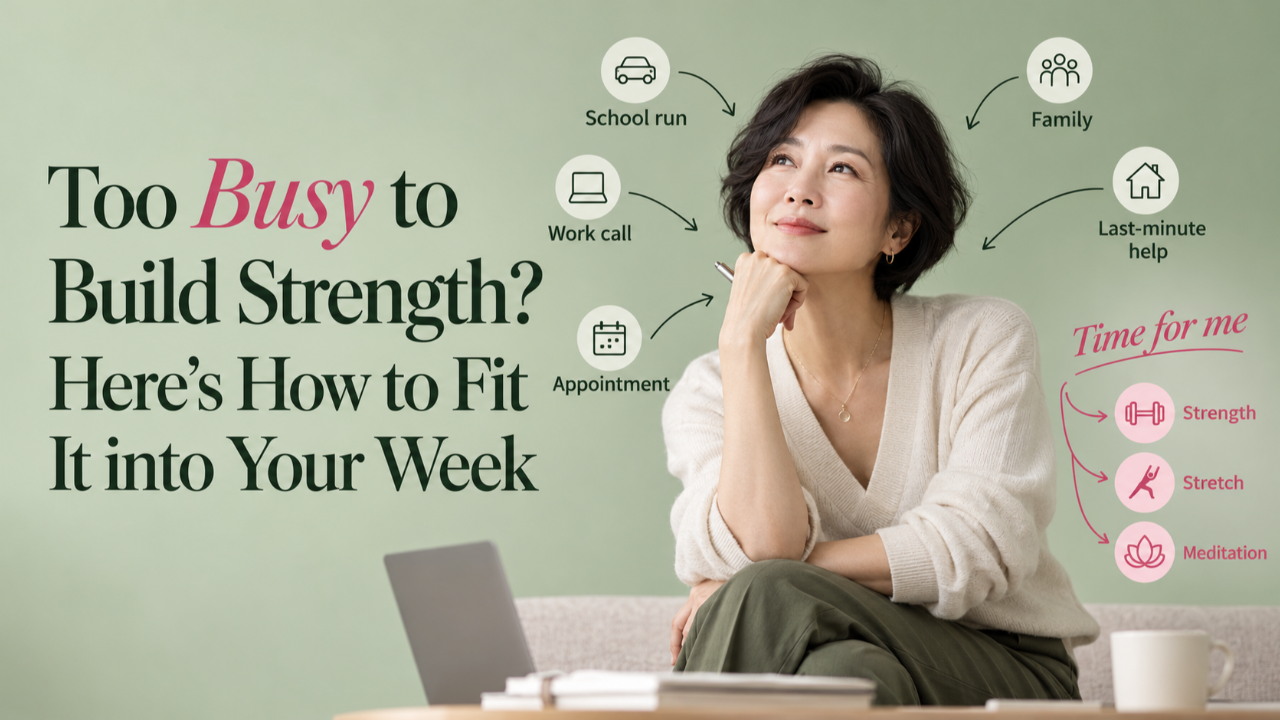
A practical guide to finding room for strength when work, family and life already fill the diary.
You have time for everyone else. Where does your strength fit?
It is 6.45 in the evening. You have answered the emails, dealt with something unexpected at work, remembered that the fridge is nearly empty and perhaps spent half your lunch break sorting out something for someone else. You get home and the idea of changing into gym clothes feels almost comical. Another task? Another thing you should be doing?
For many women in midlife, the problem is not a lack of interest in feeling healthier. It is that the day already has more demands than hours. Some of us work long days outside the home. Others work from home while juggling teenagers, caring responsibilities, appointments, household tasks or the uncertainty of changing relationships. Some are simply tired, particularly when menopause has been interrupting sleep.
So when somebody says, “Just make time for exercise,” it can sound as if they have never seen your calendar.
Here is a better question. What would strength training look like if it were designed around the life you actually have, instead of the life you think you ought to have?
First, remember what you are training for
Strength is not just a fitness goal. It is being able to lift your case onto a train, carry shopping without aching shoulders, get up from the floor, garden comfortably, climb stairs and enjoy holidays without worrying whether your body will keep up. It is also the confidence of knowing that you can still learn something physical and make progress in your 50s and beyond.
After menopause, changes in hormones can accelerate bone loss, while muscle strength can also decline with age and inactivity. Resistance exercise cannot halt every change, but it gives muscles a reason to adapt and can support bone health when the training is suitably challenging and progressive.
The NHS recommends activities that strengthen the major muscle groups on at least two days each week. The Royal Osteoporosis Society advises building towards two or three strength sessions weekly, usually allowing a rest day between them. Neither recommendation says that you must spend five evenings at the gym.
The secret is to stop waiting for an empty hour
Imagine two women. One plans an ambitious hour at the gym every weekday, but cancels whenever life gets complicated. The other protects two 25 minute appointments each week and steadily makes the exercises a little more challenging. Over months, the second woman may end up with far more consistent training.
That does not mean short sessions are always equal to longer ones. You still need enough work, appropriate resistance and progression. But a realistic starting plan is much more useful than a perfect plan that never happens.
Open your diary and look for two repeatable spaces. They might be Tuesday morning before the first call and Saturday after breakfast. They might be Monday and Thursday straight after work. Give them names that make sense to you, such as “My strength appointment,” and treat them as you would another worthwhile commitment.
A 25 minute routine you can do at home
You do not need an elaborate gym, a mirror or matching workout clothes. Start with a sturdy chair, a resistance band if you have one, and two manageable dumbbells or other suitable weights. Clear enough space to move safely. If you are unfamiliar with the exercises, begin with guidance on technique.
Minutes 1 to 4: Wake your body up
Walk around your room or march comfortably on the spot. Add gentle shoulder circles and a few slow sit and stand movements. You should feel warmer, not worn out.
Minutes 5 to 10: Sit and stand, then add a hip hinge
Perform one or two sets of around 8 to 12 controlled chair stands. Use a high, secure chair and hand support if needed. Next, practise hinging at the hips with a straight, comfortable back, as if moving your bottom towards a wall behind you. As you develop good technique, these patterns can progress to squats and suitable loaded hinges.
Minutes 11 to 16: Push and pull
Try wall press ups or an incline press up against a stable surface, followed by a resistance band row. Aim for one or two sets of around 8 to 12 repetitions of each. These movements work muscles that help you push doors, lift objects and carry everyday loads.
Minutes 17 to 21: Step and carry
Practise stepping up onto a low, stable step with nearby support, or repeat chair stands if steps are not suitable. Then carry an appropriately light weight securely at your side for a short distance. Focus on smooth movement, steady breathing and control rather than speed.
Minutes 22 to 25: Finish calmly
Walk gently to bring your breathing down, then make a note of what you completed. Finish knowing you did something worthwhile, not feeling that you have been punished.
This is a beginner example, not a universal prescription. Rest as needed, change the order if necessary and build up gradually. Once you are comfortable, add a set, a little resistance or a slightly more demanding variation. If you can repeat an exercise easily many times without effort, it may no longer provide enough challenge to improve strength.
Two versions of a real working week
Option one: Your week is predictable, even if it is busy
Monday: Take a walk at lunchtime and spend a few minutes moving after sitting at your desk.
Tuesday: Complete your first 25 minute strength session before work or immediately afterwards.
Wednesday: Enjoy a walk, swim or another activity you like. No need to squeeze in another demanding strength session.
Thursday: Complete your second 25 minute strength session.
Friday: Break up long periods of sitting with short walks or comfortable mobility.
Weekend: Enjoy time outdoors, a class or something active that feels like part of life rather than an obligation.
Option two: Your week changes at the last minute
Instead of choosing fixed days, decide that you will find two strength windows separated by at least a day. On Sunday, identify three possible slots, knowing you only need two. If Tuesday falls apart, move that session to Wednesday and aim for another on Saturday. Put the weights where they are easy to access and keep your routine written down so you do not waste time deciding what to do.
This is particularly useful if your working hours change, you care for relatives, travel regularly or find that some menopausal symptoms are unpredictable. A flexible plan is still a plan.
What about those days when you have only ten minutes?
Ten minutes can help you maintain the habit, practise technique and stay active. You might warm up, do chair stands, wall press ups and a few controlled rows. But be clear about the purpose. A few light exercises are a useful starting point, not necessarily enough on their own to produce significant gains in bone density or strength.
When life allows, return to your fuller sessions. Think of a brief session as keeping the door open, rather than replacing the whole programme indefinitely.
Make it easier to begin, not harder to avoid
One of the biggest obstacles is the transition from working mode into exercise mode. If you sit down with your phone after a tiring day, getting back up can feel like climbing a mountain. Try attaching your session to an existing routine. For example, finish your last work call, change your shoes and start your warm up before you begin dinner.
Keep your band and weights in a sensible, safe place where they are visible. Choose your exercises beforehand. If training at a gym, have a simple plan that fits within the time you can actually spend there. Reducing decisions can make starting much easier.
And give yourself permission to choose a quieter session when you have slept badly. If you feel unusually unwell, dizzy or exhausted, rest or seek advice as appropriate. Strength training should support your life, not become another reason to criticise yourself.
How can you tell that it is working?
Do not judge success only by the bathroom scales or whether your arms look different. Perhaps you can stand from a lower chair more comfortably. Perhaps you use a slightly heavier dumbbell, carry the shopping with less effort or finish a set that once felt impossible. These are meaningful signs that your body is adapting.
Write down the exercises you use, the number of repetitions and the weight or band resistance. When the last few repetitions remain controlled but feel easier than before, consider a small progression. Muscle responds to a reason to change, not simply the passage of time.
If you are uncertain about whether weight training is appropriate for you, my earlier article explores that question in more detail.
Read more: Do Women in Midlife Really Need to Lift Weights?
Your time matters, and so do you
Many midlife women have become extraordinarily skilled at finding ten minutes for somebody else. A lift, an appointment, a conversation, a last minute request. Finding the same space for yourself can feel strangely difficult.
But building strength is not a luxury reserved for women with empty calendars. It is a way of looking after the person who carries you through all those responsibilities. You do not need to prove your dedication by being exhausted. You need a plan you can repeat and gradually build upon.
This week, choose your two possible appointments. Put them in the diary. Start where you are. And when life inevitably interrupts one of them, move it rather than abandoning yourself.
The goal is not to become a different woman overnight. It is to feel increasingly capable in the life you already have, while building towards the one you want next.
A note about safety
If you have osteoporosis, previous spinal or other fragility fractures, recent surgery, significant pain or medical concerns, ask your GP or physiotherapist about suitable exercises and progression. Avoid copying challenging online workouts without considering your individual risk. Exercises should be adjusted to your ability, and sharp pain, dizziness or unusual symptoms are reasons to stop and seek appropriate advice.
Your next chapter of feeling stronger starts here
If you are ready to make more space for your own health, my free 7 Day Hormone & Wellness Reset opens on 10 November 2026. It is designed for women navigating midlife who want manageable ways to reconnect with their nutrition, movement and everyday wellbeing, without adding another overwhelming task to the week.
Join the free 7 Day Hormone & Wellness Reset interest list
Small, consistent choices are worth making. Your strength deserves some of your time.
About the author
Monica Rafiq is the founder of Fitness Inspiration for Women, a certified Menopause Coach, Nutrition and Weight Loss Specialist, Life Coach and NLP Practitioner. Drawing on 15 years of experience in pharmaceuticals and healthcare, she helps women make realistic changes to their strength, nutrition and wellbeing through midlife.
Research and further reading
NHS. How to improve your strength and flexibility. Guidance on strengthening major muscle groups at least twice weekly.
Royal Osteoporosis Society. Strength exercise to help make your bones stronger. Practical guidance for gradual, progressive resistance exercise, reviewed June 2026.
Systematic review and meta analysis of resistance training in older adults, published 2026. Trials report improvements in strength and physical performance, although study populations and programmes vary.
Stay connected with news and updates.
Join our mailing list to receive the latest news and updates from our team.
Don't worry, your information will not be shared.
We hate SPAM. We will never sell your information, for any reason.