You Walk Every Day, But Is That Enough to Keep Your Bones Strong?
Oct 21, 2026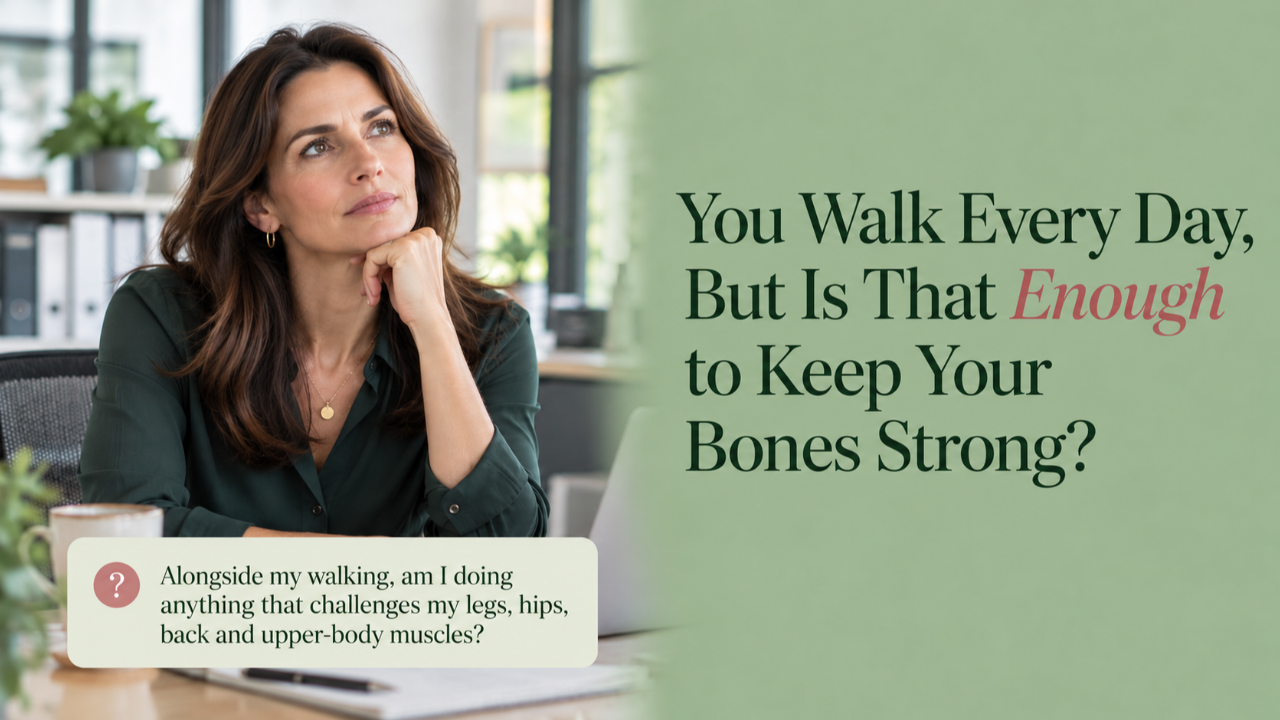
You’ve walked for years. Perhaps it’s the one part of your wellbeing routine that you can genuinely say you enjoy. You get outside, clear your head, catch up with a friend or take ten peaceful minutes away from everyone needing something from you. And when somebody suggests you should be doing more exercise, you might quite reasonably think, “But I already walk every day.”
Walking deserves its good reputation. It helps your heart, supports your mood and gives you a way to move that doesn’t require a booking, a membership or a complicated plan. Yet there is a question worth asking in midlife, particularly as oestrogen levels change: is the movement that makes you feel better also giving your bones everything they need?
The answer is reassuring rather than discouraging. Keep walking. But understand what walking does well, what it may not do enough of, and how a few extra movements can help you build a stronger future.
Why walking is such a good starting point
Each step places some force through the bones in your legs and hips. Walking is a weight-bearing activity, so unlike swimming or cycling, your skeleton helps support your body weight. A brisk walk can also improve cardiovascular fitness, while regular time outdoors can make movement easier to maintain when life feels busy.
It has other benefits that matter enormously after 50. Walking can help you manage stress, maintain mobility and stay connected with your neighbourhood or the people you enjoy spending time with. If a walk is the part of your day that allows you to exhale, I would never suggest giving it up simply because a different exercise might challenge your bones more.
But the body adapts to familiar demands. The same flat route, at the same comfortable pace, may not provide a progressively stronger stimulus to your skeleton. Being active and specifically challenging bone strength overlap, but they are not exactly the same goal.
Your bones need variety, not just more steps
Bone is living tissue. It responds to mechanical forces, which include the pull of muscles and the forces created when your feet meet the ground. To help protect bone strength, a routine may need several different forms of movement rather than one activity repeated indefinitely.
Think of movement as having three complementary jobs. Walking and other weight-bearing activities help you stay active and provide some loading. Strength training asks muscles to pull against resistance, which also loads the skeleton. Balance training helps you remain steady and may reduce your risk of falling, an especially important part of protecting against fractures.
One does not cancel out the need for another. You could be an enthusiastic walker with relatively little upper-body strength. You might be comfortable lifting weights but still benefit from balance practice. The aim is not to become brilliant at one activity. It is to create the physical confidence to keep doing ordinary, enjoyable things.
What does the research tell us?
A Cochrane review brought together 43 randomised controlled trials involving 4,320 postmenopausal women. Overall, exercise produced modest improvements in bone mineral density compared with no exercise. Programmes combining different types of exercise appeared particularly helpful for the spine, while progressive resistance exercise was among the approaches with benefits at the hip.
It is important to put those findings into perspective. Some trials were small or not reported to a high standard, and the review did not establish with certainty that exercise prevents fractures. No one should promise that a particular walking route or gym programme will guarantee stronger bones. What the evidence does suggest is that well-chosen exercise can make a worthwhile contribution to bone health.
The Royal Osteoporosis Society also distinguishes low-impact activity, including walking and stair climbing, from moderate-impact exercise such as jogging or dancing. Both can have a place, but the amount of impact that is suitable depends on your health, fitness and fracture history. More intense is not automatically better or safer.
So what can you add to your usual walk?
Rather than tearing up a routine you already love, consider adding two or three small building blocks. They do not need to happen on the same day, and they certainly do not need to leave you exhausted.
1. Two manageable strength sessions
The NHS recommends muscle-strengthening activities on at least two days each week. A beginner session could include controlled chair squats, wall press-ups, resistance-band rows and a simple hip-hinge movement. These train the muscles that help you stand, lift, carry and steady yourself.
Start with a level you can manage with good technique, then gradually increase the challenge. A movement that feels easy forever may become less useful for building strength. If you have never tried weights before, my article Do Women in Midlife Really Need to Lift Weights? explains how to begin without feeling that you need to become a gym regular overnight.
2. Appropriate weight-bearing variety
Perhaps once or twice during your week, take a route with gentle slopes or stairs if those are comfortable for you. Dancing can be another enjoyable option. Some women may safely progress towards moderate-impact activity with professional advice, but you do not need to start hopping or running because an article tells you to.
If you have osteoporosis, previous spinal fractures, a history of several fractures or other conditions affecting your joints or balance, ask your GP or physiotherapist what level of impact is appropriate. Lower-impact walking and progressive strength work may be the better starting point.
3. A little balance practice
Stand beside a sturdy kitchen worktop and practise placing one foot directly in front of the other for a few seconds, using support as needed. You can also try slowly lifting one heel or shifting your weight between your feet. As confidence improves, a physiotherapist or qualified instructor can help you choose a more challenging variation.
Balance is easy to overlook because it rarely feels like a workout. Yet being able to recover from a stumble, step confidently over uneven ground and turn without feeling unsteady can make a real difference to everyday independence.
A realistic week that still includes the walks you love
Imagine a fairly ordinary week. On Monday, you keep your lunchtime walk and add twenty minutes of strength work at home. Tuesday is simply a walk, perhaps with a few gentle hills. Wednesday includes a few minutes of supported balance while the kettle boils. Thursday brings another short full-body strength session. Friday and the weekend remain flexible for a longer walk, a dance class, gardening or whatever movement brings you pleasure.
That is not a prescription or a test of commitment. It is an example of how a more complete routine can sit alongside your existing life. If you can only begin with one strength session this week, begin there. The important thing is that your plan is realistic enough to repeat and gradually improve.
What if you already walk 10,000 steps a day?
That is a substantial amount of movement for many people, and you may be getting valuable benefits from it. But a step count is not a bone-density measurement. Neither is it a reliable substitute for strength training or a medical assessment of fracture risk.
Try asking yourself a different question: “Alongside my walking, am I doing anything that challenges my legs, hips, back and upper-body muscles in a progressive way?” If the answer is no, you have found a useful place to start. It is not evidence that you have done anything wrong.
One important note if you have osteoporosis
Osteoporosis does not mean that you should avoid all exercise. Many women can and should remain active, but the safest programme depends on individual risk, previous fractures and any limitations. Exercises involving high impact, loaded spinal bending or twisting may need modification. If you have a diagnosis, speak to a clinician or physiotherapist familiar with bone health before substantially changing your routine.
Exercise can support strength, balance and wellbeing, but it does not replace osteoporosis medication when treatment is recommended. Eating adequately, obtaining sufficient calcium and vitamin D, and discussing relevant risk factors with your GP remain important parts of the picture.
The real goal is a life you can keep enjoying
Perhaps you started walking because you wanted to lose weight. Perhaps you needed time away from your desk or a moment of peace during menopause. Perhaps it simply made you feel more like yourself. Those reasons still matter. You do not have to turn something enjoyable into another obligation.
What I would encourage you to do is see walking as the foundation of your wellbeing, not necessarily the whole building. Add a little strength. Practise your balance. Give your bones appropriate variety. Most of all, think about the years ahead and the experiences you still want to say yes to.
You do not need to choose between enjoying movement now and investing in your future. With a few thoughtful additions, you can do both.
Your next chapter of feeling stronger starts here
If you are ready to give your own wellbeing a little more attention, I would love to welcome you to the interest list for my FREE 7 Day Hormone & Wellness Reset, opening on 10 November 2026. It is designed to help midlife women explore practical changes to nutrition, movement and everyday habits without adding more pressure to already busy lives.
Join the Free 7 Day Hormone & Wellness Reset Interest List
A stronger future can begin with something as manageable as your next step.
About the author
Monica Rafiq is the founder of Fitness Inspiration for Women, a certified Menopause Coach, Nutrition and Weight Loss Management Coach, Life Coach and NLP Practitioner. Drawing on 15 years of experience in pharmaceuticals and healthcare, as well as her own wellbeing journey, she helps women approach midlife with practical guidance, encouragement and confidence.
Research and further reading
For readers who would like to explore the evidence, these carefully selected sources informed this article.
- Cochrane Review: Exercise for preventing and treating osteoporosis in postmenopausal women (2022)
- Royal Osteoporosis Society: Exercise for bones
- NHS: Osteoporosis prevention
This article offers general educational information and is not a replacement for individual medical advice.
Stay connected with news and updates.
Join our mailing list to receive the latest news and updates from our team.
Don't worry, your information will not be shared.
We hate SPAM. We will never sell your information, for any reason.