Seven Ways to Rebuild Your Confidence When You No Longer Feel Like Yourself
Sep 27, 2026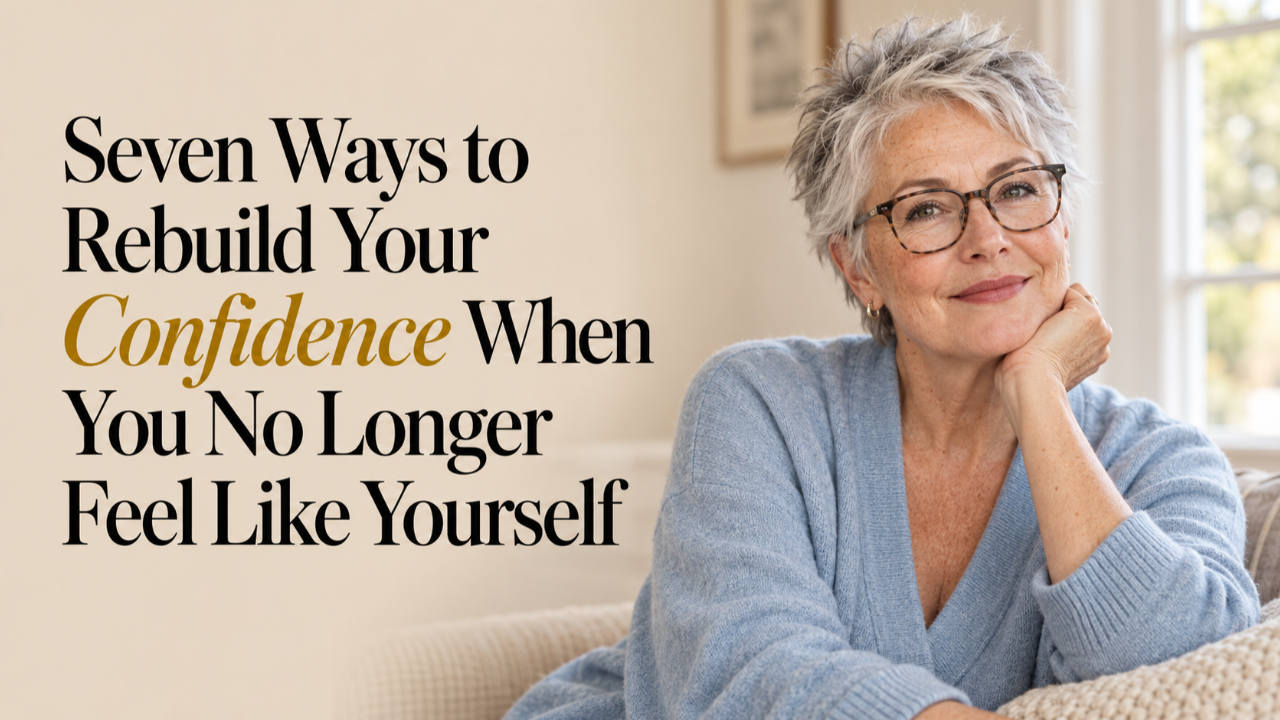
Perhaps you used to walk into a room without wondering what everybody thought of you. You trusted your decisions, wore what you liked and spoke without mentally editing every sentence first.
Now, you may stand in front of the wardrobe and feel that nothing looks right. You might prepare carefully for a meeting, then hear yourself apologising before you have even made your point. A photograph can unsettle you. A forgotten word can make you question your competence. A comment that would once have passed unnoticed can stay with you for the rest of the day.
You may wonder where the confident woman went.
The answer is that she may not have gone anywhere. She may be tired, carrying too much, adjusting to a changing body or trying to find her place within roles that no longer fit. She may have spent so long being useful to everybody else that she has stopped hearing her own preferences.
Confidence in midlife is rarely about returning to exactly who you were at thirty. It is about learning to trust the woman you are now.
Confidence is not a personality you either have or lose
We often talk about confidence as though it were a permanent quality. Some women have it, while others do not. Real life is far less tidy.
You can feel confident managing a crisis at work and uncertain in a changing relationship. You can advise everybody else wisely, then question your own choices. You can feel strong in the gym and vulnerable in a photograph. Confidence changes according to your health, experiences, environment and the amount of support available to you.
Perimenopause and menopause can add another layer. Sleep disruption, anxiety, changes in mood, hot flushes and cognitive symptoms can affect how capable you feel. If you are repeatedly waking at night or struggling to find familiar words, it is understandable that your self trust may wobble.
These experiences are not evidence that your ability has vanished. They are information about what your mind and body may need.
NICE guidance recognises the effect menopause symptoms can have and recommends discussing treatment choices according to individual circumstances. It also includes menopause specific cognitive behavioural therapy as an option for some vasomotor symptoms, sleep difficulties and depressive symptoms. If symptoms are affecting your daily life, speak to your GP or another qualified healthcare professional rather than treating them as a personal failing.
1. Stop turning a difficult phase into a verdict on who you are
When confidence is low, the mind makes broad conclusions from temporary experiences.
“I forgot her name” becomes “My brain is failing.”
“My trousers feel tight” becomes “I have let myself go.”
“I felt nervous in that meeting” becomes “I am no longer good at my job.”
Before accepting the conclusion, separate the event from the identity. A difficult presentation is an event. Feeling uncomfortable in your body today is an experience. Neither is a complete description of you.
Try replacing “I am” with “I am noticing”.
“I am useless” becomes “I am noticing that I am struggling to concentrate after several poor nights of sleep.”
“I am unattractive” becomes “I am noticing that I do not yet know how to dress this changing body in a way that feels like me.”
This is not positive thinking. It is more accurate thinking. Accuracy gives you somewhere to go. You can support sleep, seek medical advice, adjust a workload, buy clothes for the body you have or prepare differently for the next meeting. A global judgement offers no next step.
2. Build a record of evidence that you can trust yourself
Low confidence has a selective memory. It remembers the hesitation, the mistake and the moment you felt exposed. It overlooks the decisions you made well, the difficulties you handled and the quiet ways you kept going.
Create a confidence record on paper or in your phone. At the end of each day, write down one piece of evidence that you were capable, courageous or true to yourself.
It might be that you asked a useful question, cooked a nourishing meal when you were tired, attended a strength session, challenged an unfair comment, made a decision without polling five people or rested when your body needed it. The action does not have to look impressive from the outside.
After a few weeks, you will have something more reliable than your mood to consult. On a difficult day, you can read evidence of who you are rather than accepting the harshest thought in your head.
You can also write a short capability history. Name three hard periods you have already navigated. What did each experience require from you? Perhaps patience, resourcefulness, courage, humour or the willingness to ask for help. Those qualities did not expire when you entered midlife.
3. Keep one small promise to yourself every day
Confidence is partly a relationship with yourself. If you repeatedly abandon your own plans whenever somebody else wants something, self trust weakens. You learn that your intentions are always negotiable.
Begin with one promise small enough to keep on an ordinary day.
It might be a ten minute walk after lunch, eating breakfast before the first meeting, turning off your phone at ten, completing five controlled strength exercises or sitting quietly with a cup of tea before the household wakes. Choose something that supports you rather than something designed to punish or improve you.
Keep the promise for seven days. If the original plan becomes impossible, adapt it without abandoning it. A thirty minute walk can become ten minutes. A full yoga class can become three poses. Flexibility is not failure.
Each completed action becomes evidence: when I say I will care for myself, I follow through.
This is why waiting to feel motivated can keep you stuck. You do not need complete confidence before you act. Often the action comes first, and the feeling follows more slowly.
4. Rebuild trust in your body through what it can do
Body confidence can be deeply affected by midlife changes. Weight may settle differently, muscle mass can decline with age and menopause, and familiar clothes may no longer create a familiar reflection. It is easy to begin relating to your body mainly as a visual problem.
Try giving it another source of value.
Choose movement that lets you experience capability. Strength training may show you that you can lift more than you expected. Yoga can reveal improving balance, mobility and patience. Walking can remind you that your body carries you into the world. Swimming may offer freedom from mirrors and impact.
Systematic reviews suggest exercise can improve physical and psychological aspects of quality of life in women with menopausal symptoms. Research into resistance training also supports benefits for physical fitness, lean mass and menopause related quality of life. The evidence does not show that one workout cures low confidence or that exercise removes every symptom. It does support movement as one useful part of caring for physical and psychological wellbeing.
Measure something other than weight. Notice how many repetitions you can complete with control, whether the stairs feel easier, how steadily you balance or whether your shoulders feel less tense after movement.
Your body is not only an object to be viewed. It is a living part of you that can learn, adapt and become stronger.
5. Speak to yourself as someone you are responsible for helping
Many capable women believe self criticism keeps them disciplined. They worry that compassion will make them complacent.
But there is a difference between honest reflection and humiliation. “I avoided that conversation because I was frightened” gives you useful information. “I am pathetic” does not.
Research reviews and meta analyses of compassion based interventions have found improvements across measures of psychological distress and wellbeing, although results vary and self compassion is not a replacement for clinical care when that is needed. The practical lesson is not that you must love every part of yourself. It is that cruelty is not the only route to change.
When you make a mistake, try this three part response.
First, name what happened without exaggeration: “I lost my train of thought in the meeting.”
Second, acknowledge the feeling: “I felt embarrassed and exposed.”
Third, offer the next useful response: “I will send the figures in writing and prepare two prompt notes next time.”
This voice is not indulgent. It is calm, responsible and much more likely to help you recover.
6. Use your voice before you feel completely ready
Confidence shrinks when you constantly override your preferences. It grows when you see that you can express yourself and remain intact.
Start in a low risk situation. Choose the meeting time that suits you. Tell your family what you would like for dinner. Ask the question at work. Say that you are not available. Correct somebody who repeatedly interrupts you. Wear the colour you keep admiring but have decided is too noticeable.
The aim is not to become louder than everybody else. It is to stop automatically removing yourself from the conversation.
If saying what you need feels difficult, read How to Say What You Need Without Guilt, Apology or Over Explaining. It offers clear phrases for work, family, adult children, friendships and relationships.
Expect some discomfort. A new boundary can feel wrong simply because it is unfamiliar. Pause before apologising or reversing your decision. Ask whether you have been disrespectful, or whether somebody is simply experiencing the inconvenience that you usually absorb.
If expressing a need could lead to intimidation, threats or harm, prioritise safety and seek confidential specialist support. Confidence does not require you to confront someone when doing so may place you at risk.
7. Become curious about the woman you are becoming
Sometimes confidence falls because you are measuring yourself against an identity that no longer fits.
Perhaps your children need you differently now. A marriage has ended. Your parents have died or require care. Your career no longer feels as meaningful as it once did. The routines that organised your life have changed, and the empty space feels more frightening than freeing.
You do not have to fill that space with a dramatic reinvention. Begin with curiosity.
Ask yourself what you miss that has nothing to do with being younger. Was it spontaneity, creativity, friendship, sensuality, learning, travel, laughter or time alone? Those qualities are not owned by your younger self. They can be expressed differently now.
Choose one small experiment. Attend a class, visit somewhere new, return to a neglected interest, change your hair, apply for the role, eat lunch alone without hiding behind your phone or make contact with someone whose company brings you alive.
Do not ask whether the experiment proves what you should do with the rest of your life. Ask what it teaches you about yourself.
Midlife confidence is not always certainty. Sometimes it is the willingness to explore without already knowing the answer.
A seven day confidence reset
If all seven ideas feel like too much, use one week to begin.
On Monday, catch one global judgement and rewrite it as an accurate observation.
On Tuesday, start your confidence record with three pieces of evidence from the past week.
On Wednesday, keep one small promise that supports your body or energy.
On Thursday, move for capability rather than calorie burning. Notice what your body can do.
On Friday, respond to one mistake with the voice of a calm coach.
On Saturday, express one preference without an unnecessary apology.
On Sunday, choose one small experiment for the month ahead.
This is not a test to pass. If you miss a day, continue with the next one. Confidence is strengthened by returning, not by performing perfectly.
What if your confidence does not improve quickly?
There are times when practical exercises are not enough. Persistent low mood, anxiety, loss of pleasure, severe sleep disruption or a feeling that you cannot cope deserves proper support.
Talk to your GP or an appropriately qualified healthcare professional. Menopause symptoms, thyroid problems, iron deficiency, medication effects, depression, anxiety and difficult life circumstances can overlap. You do not need to diagnose yourself or assume that every change is simply part of getting older.
Therapy or coaching may also be helpful, depending on what you are experiencing and the practitioner’s qualifications and scope. Cognitive behavioural approaches can help some women work with unhelpful thoughts, behaviours and menopause related symptoms. Medical treatment and psychological support are not evidence of weakness. They are resources.
You are not starting again from nothing
At the beginning of this week, we asked, Have You Lost Your Confidence or Have You Simply Lost Sight of Yourself?.
Perhaps the answer is clearer now.
You may have lost sight of yourself beneath work, caring, changing relationships, body changes and the habit of putting everybody else first. You may have doubted your decisions, softened your voice and made yourself smaller. But none of that means your confidence has disappeared permanently.
You are not rebuilding from an empty space. You are rebuilding with experience.
You know more about what drains you. You recognise relationships that depend on your silence. You understand that your body needs support rather than punishment. You are beginning to see that a boundary can be loving, that rest can be responsible and that uncertainty does not make you incapable.
The confident woman you remember does not need to be recovered exactly as she was.
She can grow into someone steadier. Someone who does not need to be the youngest, thinnest, busiest or most agreeable woman in the room to know her value. Someone who can change her mind, ask for help, take up space and begin again.
Confidence in midlife may not feel like fearlessness.
It may feel like taking the next honest step while fear comes with you.
Stay connected with news and updates.
Join our mailing list to receive the latest news and updates from our team.
Don't worry, your information will not be shared.
We hate SPAM. We will never sell your information, for any reason.