More Than Managing Aches: Making Room for Enjoyment in Midlife
Oct 18, 2026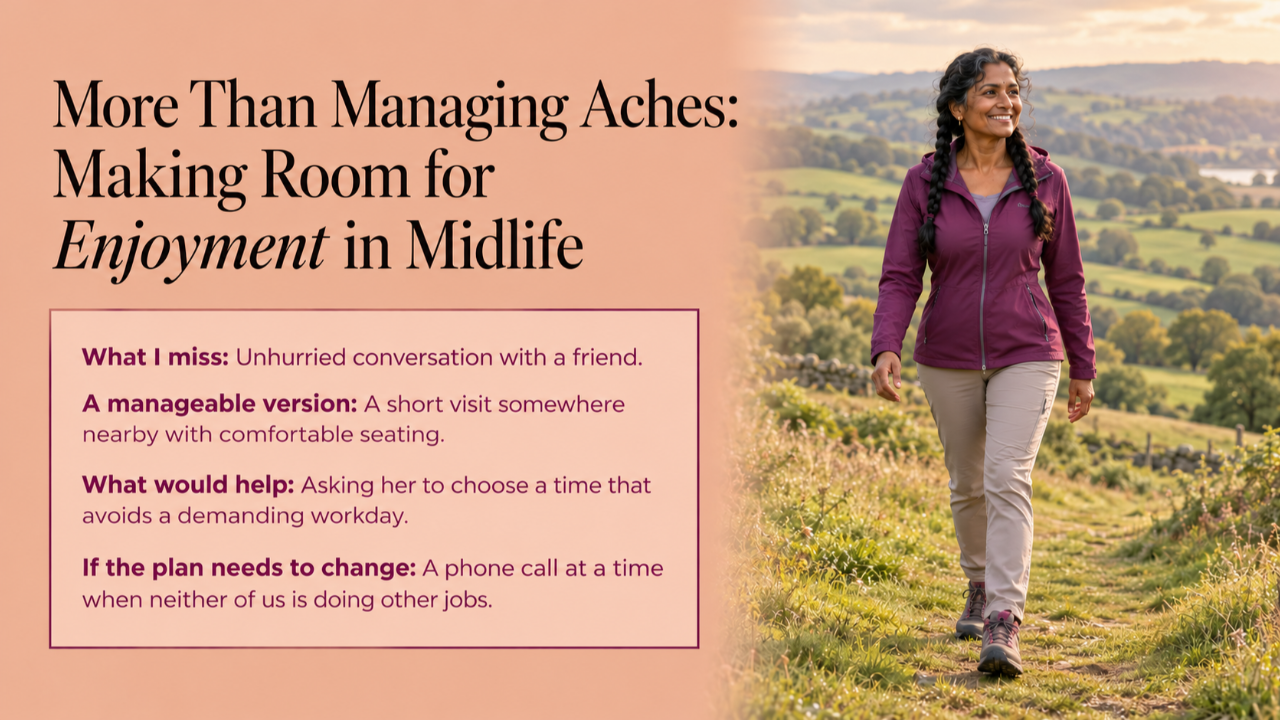
There is a song that can still take you straight back to yourself. Before the meeting reminders, the family messages and the quiet calculation of whether your knee will manage the stairs, there was a woman who knew all the words. Perhaps she danced while getting ready, lost herself in a book or thought nothing of suggesting a spontaneous afternoon out. You might hear that song now and realise how long it has been since you did something simply because you wanted to.
Pain can make the ordinary business of a day more complicated. You plan around what feels comfortable, wonder how you will sleep and weigh up whether an outing will leave you struggling afterwards. Alongside work, relationships and the needs of other people, managing yourself can become another full-time responsibility. Somewhere in all that careful organisation, enjoyment can start to feel optional.
Perhaps you have caught yourself thinking, “When I feel better, I will start again.” That is an understandable hope, especially when you are tired of making adjustments. But while you continue seeking the care and support you need, it is worth asking whether there is also room for something you enjoy now. You are a whole person with interests, humour and desires, even on a day when something hurts.
When life becomes a list of things to get through
You might still be doing an extraordinary amount. The work gets finished, people get fed, appointments are remembered and messages receive replies. Yet if someone asked what you were looking forward to for yourself, you might need a moment to think. Being busy and feeling involved in your own life are not always the same experience.
Sometimes the things we enjoy are the first to disappear because they seem the easiest to cancel. You can postpone the coffee with a friend, close the sketchbook or decide that the garden can wait. The responsibilities stay because somebody relies on them. Over time, a diary can become full of obligations and almost empty of anticipation.
This is not a reason to criticise yourself for how you have been coping. You may have been making sensible choices with limited energy, money or support. Nor is the answer to fill every spare hour with another activity you are supposed to find fulfilling. Begin by noticing what you miss, without immediately asking how to fit it all back in.
Ask what feeling like yourself actually means
“I want to feel like me again” can hold several wishes at once. You might want to feel playful, capable, attractive, interested or less preoccupied with your body. Perhaps you miss being the friend who had stories to tell, the woman who loved learning, or the person who could spend an afternoon absorbed in making something. Naming what you miss can be more useful than trying to recreate an entire earlier version of your life.
Take a moment with these three unfinished sentences:
- I feel most like myself when...
- Something I miss, even if I rarely mention it, is...
- I would like a little more... in my week.
Your answers do not have to sound impressive. “Laughing with my sister,” “wearing something I love” and “having time to read without being interrupted” are worthwhile answers. So is admitting that you are not sure, because your preferences have had very little space lately. Curiosity is enough to begin with.
Find the part you love, then consider a different way to reach it
Suppose you miss gardening. Is it the satisfaction of tending something, the colour, the fresh air or the quiet? Knowing that may open up options beyond an afternoon of digging: choosing bulbs, tending a small pot at a comfortable height or sitting outside with someone who shares your interest. A different version may preserve something that matters, even if it does not replace everything you miss.
Or perhaps you have stopped meeting a friend because your usual plan involves a long walk. The part you most want may be the conversation, the company or a reason to leave the house. A nearby café with comfortable seating, a shorter accessible outing or a visit at home could offer some of that connection. You can suggest a plan that suits you without pretending your needs have not changed.
Choose adaptations that fit your symptoms and any individual advice you have received. An activity being gentle, familiar or enjoyable does not automatically make it suitable for every injury or condition. If you are unsure about a physical activity, ask a physiotherapist or another appropriate clinician how it might be adapted. Looking after yourself and finding enjoyment can be part of the same plan.
Make room before the household is completely sorted
There may never be an afternoon when every message has been answered and every job is finished. If pleasure is allowed only after that point, it will spend a long time waiting. Consider whether one task could be shared, simplified or left until another day. You are allowed to make a practical decision about your time without turning it into a judgement about how caring you are.
For a woman working from home, this might mean closing the laptop at an agreed time and listening to music before the evening jobs begin. For someone on shifts, it might be protecting part of a day off from automatically becoming everybody else's appointment slot. For a woman caring for a parent or partner, it may begin with asking someone to cover a specific period. The useful change depends on your circumstances, and sometimes it requires help from another person.
If time for yourself keeps disappearing, my article How to Make Space for Yourself When Life Already Feels Full explores this more closely. Start with one part of your week that could be arranged differently. It does not have to become a dramatic announcement or a complete diary overhaul. A modest amount of time that is actually yours can be a meaningful beginning.
Leave some room around the thing you want to enjoy
When you finally have a better day, it can be tempting to put everything into it. You add the outing, the shopping and the jobs you have been postponing, then wonder why there was so little space to enjoy any of them. For persistent pain, Cambridge University Hospitals describes pacing as planning manageable amounts of activity rather than carrying on until pain makes you stop. Its guidance encourages finding a workable pattern instead of repeatedly doing far more on some days than others.[1]
Consider the whole plan, including travel, waiting, standing and what you expect of yourself afterwards. Could you arrive at a quieter time, choose somewhere closer or leave before you are worn out? Could the next meal be simple, or could somebody else take care of the journey? Those details can make an invitation feel more manageable without requiring you to become a different person first.
You can also give yourself permission to change the plan. An afternoon at an exhibition might become a short visit to one room, or a meal out might become lunch at home with someone whose company you enjoy. It is reasonable to feel disappointed when circumstances limit you. Making an adjustment and wishing you did not need it can both be true.
Let people know you still want to be included
Sometimes you turn things down because you cannot manage the version being offered. After a few cancellations, friends may stop asking because they think they are being considerate. Meanwhile, you may feel forgotten, even though nobody intended that to happen. A clear message can help explain the difference between not wanting company and needing a different plan.
You might say, “I would love to see you, but a long walk is difficult at the moment. Could we meet somewhere we can sit?” Or: “Please keep inviting me, even if I sometimes need to change the arrangement.” You are giving someone useful information about how to spend time with you. You do not have to apologise for making the invitation possible.
The NHS identifies connection with other people, learning and enjoyable activity among approaches that can support mental wellbeing.[2] That does not mean every social occasion will feel restorative, or that a hobby will treat the cause of pain. It is a reminder that care for your wellbeing can include companionship and interest alongside symptom management. Choose the people and activities that feel meaningful to you, rather than collecting commitments.
You do not have to become your younger self again
There may be parts of your earlier life you would gladly reclaim. There may also be things you once enjoyed that no longer interest you, whether or not pain is involved. You are allowed to have changed your mind about crowded evenings, competitive exercise or being the person who organises everything. Returning to yourself can include discovering what fits the woman you are now.
Perhaps you want to learn a language, join a small reading group or take photographs of the places you pass every day. Perhaps you would like to sing, paint, explore local history or spend more time beside water. You can try something without deciding that it must become your new identity. You do not have to be good at it before it is worth doing.
It may help to ask, “If nobody needed to be impressed, what would I choose?” There is freedom in an activity that does not need a result, a certificate or an audience. The novel can remain a pleasure rather than a reading challenge. The photograph can stay on your phone because you liked the light.
A small invitation for the week ahead
Choose one thing you would like to make room for. Then make the plan specific enough to be possible, including any support or adjustment it needs. Keep a simpler option available if your energy or symptoms change. This is an invitation to yourself, rather than another target against which to measure your worth.
For example, your plan could read:
- What I miss: Unhurried conversation with a friend.
- A manageable version: A short visit somewhere nearby with comfortable seating.
- What would help: Asking her to choose a time that avoids a demanding workday.
- If the plan needs to change: A phone call at a time when neither of us is doing other jobs.
Or you might choose something quieter: an audiobook, a favourite film, sorting through old photographs or spending a little time on a creative project. Ask afterwards what you liked, what felt difficult and what you would change next time. There is no need to grade the experience or insist that it made you feel wonderful. You are finding out what belongs in your life now.
When enjoyment feels out of reach
Sometimes the difficulty goes beyond a busy diary or adapting an activity. If you have lost interest in things you usually enjoy, feel persistently low or are finding it hard to cope, tell your GP. NHS guidance advises seeking help when low mood lasts more than two weeks, coping feels difficult or things you try yourself are not helping.[3,4] You deserve support rather than pressure to produce a more positive outlook.
The same is true of pain that continues to restrict your life. Enjoyment can sit alongside appropriate healthcare, but it cannot replace assessment of new, worsening or concerning symptoms. You do not have to choose between taking pain seriously and wanting more from your days. Both deserve attention.
Let the week end with something that belongs to you
This week has asked you to notice your aches, consider what might contribute to them, explore movement, ask for workplace support and prepare for a conversation with your GP. Those are useful ways of caring for yourself. As the week closes, there is another question worth asking: what are you hoping all that care will make room for? Your answer may be far more personal than a pain score or an exercise target.
Perhaps it is being able to say yes to a friend. Perhaps it is feeling absorbed in something you love, enjoying your own company or having a story to tell that is about more than how you have been coping. You do not need to know exactly how to get there today. You can begin by making one preference visible and giving it a little space.
Put on the song if you want to hear it. Send the message, open the book or ask someone to help make an outing possible. Let the plan be modest, flexible and yours. There is still room in your story for things you look forward to.
This article offers general wellbeing support and does not replace individual medical advice.
Make a little space for yourself with me
If this week has reminded you how often your wellbeing slips behind everything else, I would love you to join the interest list for my free 7 Day Hormone & Wellness Reset, opening on 10 November 2026. It is a gentle opportunity to pause, pay attention to your needs and explore manageable everyday habits. You can join as you are, including if you are still finding your way through symptoms and seeking the right support. We can begin with a little more care for the woman living this life.
Join the free 7 Day Hormone & Wellness Reset interest list
Warm wishes,
Monica
Stay connected with news and updates.
Join our mailing list to receive the latest news and updates from our team.
Don't worry, your information will not be shared.
We hate SPAM. We will never sell your information, for any reason.