Why Your Body Feels Stiffer in Midlife Even When You Still Exercise
Aug 23, 2026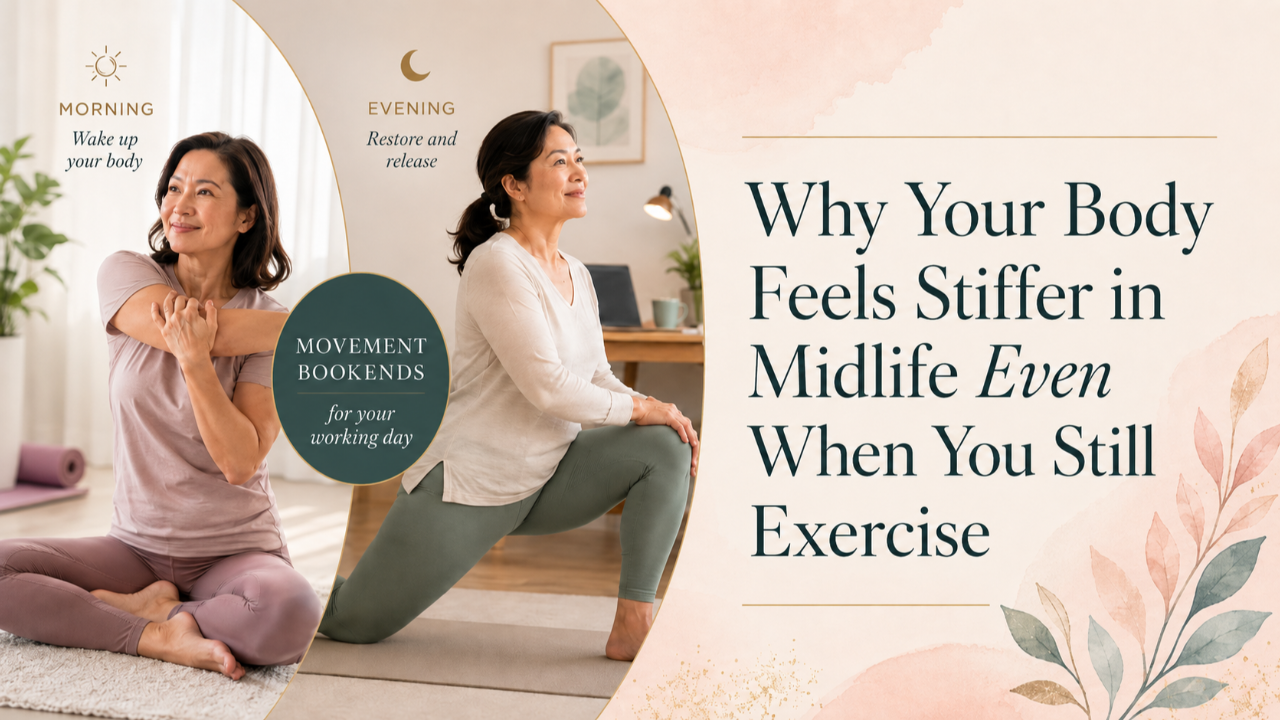
Why Your Body Feels Stiffer in Midlife Even When You Still Exercise
You can be doing many of the “right” things and still notice that your body does not move quite as freely as it used to. Perhaps you walk several times a week, go to the gym, practise yoga or make a genuine effort to stay active. Yet getting out of bed takes a few more movements before you feel loose, your hips complain after a long meeting, your shoulders feel tight by the end of the working day and getting up from the floor is not quite as effortless as it once was.
For many women, this can feel particularly frustrating because you are not inactive. You may wonder how you can possibly be getting stiffer when you are still exercising. The answer is that fitness and mobility are related, but they are not the same thing. You can be cardiovascularly fit and still have limited movement through your hips. You can be strong and still feel tight through your shoulders. You can walk every day while rarely taking some of your joints through their full available range of motion.
Some change in flexibility with age is normal. Harvard Health explains that tissues throughout the body tend to become stiffer as we get older, and that flexibility becomes increasingly important from our 50s onwards. Regular stretching can improve the ability of muscles and joints to move through their available range, but Harvard also stresses that this needs to happen consistently rather than as an occasional response when everything already feels tight. (Harvard Health)
There may also be a midlife-specific piece of the puzzle for women. Joint and muscle discomfort are increasingly recognised as common during the menopause transition. A recent systematic review involving more than 93,000 women found that muscle or joint pain was reported more frequently in perimenopausal and postmenopausal women than in premenopausal women, although the researchers were careful to point out that the studies were observational and could not prove that menopause was the sole cause. (PubMed Central (PMC))
A 2024 review in the journal Climacteric has even proposed the term “musculoskeletal syndrome of menopause” to draw attention to the cluster of muscle, joint and bone changes that may occur as oestrogen levels change. The concept is still relatively new and research is continuing, so it would be too simplistic to blame every stiff knee or aching shoulder on declining oestrogen. But it does help explain why some women begin noticing musculoskeletal changes at roughly the same time as other menopause symptoms. (PubMed)
This is important because stiffness is sometimes dismissed as, “Well, I’m getting older.” That can make women less likely to do anything about it. Ageing may influence your flexibility, but it does not mean you are destined to become progressively rigid. Harvard Health notes that regular stretching and movement can improve flexibility regardless of age, while the National Institute on Aging recommends combining strength, flexibility and balance work because each contributes something different to maintaining physical function. (Harvard Health)
Your working day may actually be playing a bigger role than you realise. Imagine that you complete a forty-minute workout before work. That is excellent. But then you sit during breakfast, sit during the commute, sit through several meetings, eat lunch at your desk and sit again during the afternoon. By five o'clock, your body may have spent far longer in a chair than it spent exercising.
Harvard Health specifically notes that too much sitting can contribute to tighter muscles around the hips, legs and calves. When you remain in the same position for hours, some joints simply do not experience much variety of movement. (Harvard Health) This helps explain why a woman can be objectively active and still stand up after an afternoon meeting feeling as though she needs a few seconds to “unfold”.
That is why one of the most effective things you can do for midlife stiffness has nothing to do with adding another workout. Change position more often during the day.
When a meeting finishes, stand up before opening the next email. Walk while taking a telephone call when possible. Go to another room to refill your water. Take the stairs. Stretch your hips after sitting. Roll your shoulders and turn your upper body gently from side to side. These tiny bouts of movement may not feel like exercise, but they give your joints something your formal workout cannot provide on its own: regular movement variety.
How you exercise matters too. If most of your activity involves the same repeated movement, some areas of the body may rarely be challenged through a broader range. Walking is fantastic for health, but walking alone does not require large amounts of shoulder mobility, spinal rotation or hip movement in multiple directions. Cycling is excellent exercise, but it also keeps the hips and knees repeatedly moving through a relatively predictable pattern.
This does not mean you should stop doing the activities you enjoy. It means you may benefit from complementing them.
Yoga can be particularly useful here because many poses move the body through ranges that are often missing from desk-based life. Reaching overhead, rotating through the upper back, extending the hips, moving the spine and working on balance all provide different movement experiences from sitting or walking. The National Institute on Aging specifically includes yoga among activities that can support flexibility and balance. (National Institute on Aging)
There is also an important distinction between flexibility and mobility. Flexibility generally refers to how far tissues can lengthen or a joint can move, whereas useful mobility requires you to control movement through that range. In everyday life, you do not simply need a flexible hip. You need enough strength and control to step upstairs, get out of a low chair, climb over something, squat down or recover your balance.
This is why stretching cannot be the entire solution.
Imagine that your hips feel stiff when you stand after sitting. Stretching the hip flexors may feel wonderful, and there is nothing wrong with doing it. But your body may also benefit from strengthening the muscles around the hip through movements such as sit-to-stands, supported squats, step-ups and bridges. Strength gives your joints support while mobility gives you options.
The National Institute on Aging recommends a combination of strengthening, balance and flexibility exercises rather than relying on one type of movement alone. Its flexibility advice is refreshingly straightforward: stretch when your muscles are warmed up, breathe normally and do not force a stretch until it hurts. (National Institute on Aging)
That final point is worth emphasising because more intense stretching is not automatically better stretching. The goal is not to see how much discomfort you can tolerate. Harvard recommends moving into a stretch until you feel mild tension rather than pain and avoiding bouncing or forcing the movement. (Harvard Health)
Think comfortable challenge rather than punishment.
You may also notice that your body feels particularly stiff first thing in the morning. Instead of immediately launching into deep stretches while your body is still cold, begin with gentle movement. Walk around the house, circle your shoulders, slowly bend and straighten your knees, move your spine comfortably and allow your body to warm up before asking for more range.
A five-minute morning mobility routine can be surprisingly effective. Start with several slow shoulder rolls followed by gentle upper-body rotations. Perform five controlled sit-to-stands from a chair to wake up the hips and thighs. Add a supported calf stretch or a few calf raises, then finish with a comfortable hip-flexor stretch or a simple yoga movement such as Cat-Cow if getting onto the floor suits you.
The exact sequence matters less than the consistency.
You could also use what I call movement bookends around your working day. Spend five minutes moving before you sit down to work and another five minutes restoring movement when you finish. In the morning, wake up the shoulders, spine and hips. At the end of the day, gently move the areas that have spent hours relatively still.
Ten minutes across an entire day sounds almost insignificant. But it is considerably more realistic than deciding you suddenly need an hour-long stretching routine every evening.
Another useful habit is to look at the places where your body repeatedly feels restricted. If your hips are always stiff, consider how long you sit and whether your exercise includes hip strength and mobility. If your shoulders feel locked after work, look at your desk posture but also at whether you ever reach overhead, pull, push or rotate during the day. If your ankles feel stiff, notice whether your training ever asks them to move beyond the range used during ordinary walking.
Your body often provides useful information if you stop interpreting every sensation as simply “getting older”.
Recovery also matters. Exercise creates a challenge for the body, and your body needs time to respond to it. If you have suddenly increased your training, started lifting heavier weights or introduced new exercises, temporary muscle soreness and stiffness can occur. That does not necessarily mean anything is wrong, but repeatedly training hard without enough recovery can leave you feeling permanently battered rather than progressively stronger.
A useful question is whether your stiffness improves when you move. If you stand up feeling tight but loosen considerably after five minutes of walking, inactivity may be playing a significant role. If an area remains painful, swollen or increasingly restricted despite sensible movement, that deserves more attention.
And this is an important distinction: stiffness is not always a fitness issue.
Persistent joint swelling, significant pain, sudden loss of movement, prolonged morning stiffness or symptoms that interfere with daily life should not simply be attributed to menopause or age. Arthritis, injuries and other musculoskeletal conditions can cause pain and restriction, and a GP or physiotherapist can help determine whether something more specific is going on.
There is no prize for stretching through pain.
For most women, however, the first step does not need to be complicated. Before adding another class or buying another piece of equipment, look at your entire day. You may already exercise four times a week, but how often do you move on the other hours?
If you work at a desk, aim to interrupt long sitting periods. Give your hips and spine different positions throughout the day. Continue walking, but add strength. Continue strength training, but include mobility. Keep yoga if you enjoy it, but do not judge your success by whether your body looks like somebody else's pose.
And remember that flexibility is not the ultimate goal.
The goal is being able to turn comfortably to reverse the car. Reach into a high cupboard. Get down onto the floor and back up again. Carry your shopping. Walk confidently over uneven ground. Travel without feeling seized up after the journey. Play with children or grandchildren. Continue doing the activities you love without your body constantly making the decision for you.
That is why this conversation about stiffness matters.
Midlife does bring physical change, and hormonal changes may be one part of that picture. But noticing that your body feels different does not mean accepting that every year from now on must involve less movement.
Instead, think of stiffness as a reminder to broaden the way you care for your body.
Keep exercising, but move between the workouts too. Stretch, but also strengthen. Use yoga to explore movement rather than chase flexibility. Give your joints regular opportunities to move comfortably through their range and pay attention when your body asks for something different.
You are not trying to recreate the body you had at 25.
You are building the body you want to rely on at 55, 65, 75 and beyond.
And perhaps that is the most useful way to think about mobility in midlife: not as a test of how flexible you are today, but as an investment in how freely you want to keep moving through the rest of your life.
Stay connected with news and updates.
Join our mailing list to receive the latest news and updates from our team.
Don't worry, your information will not be shared.
We hate SPAM. We will never sell your information, for any reason.