Why Feeling Strong Is More Powerful Than Looking Different
Jul 26, 2026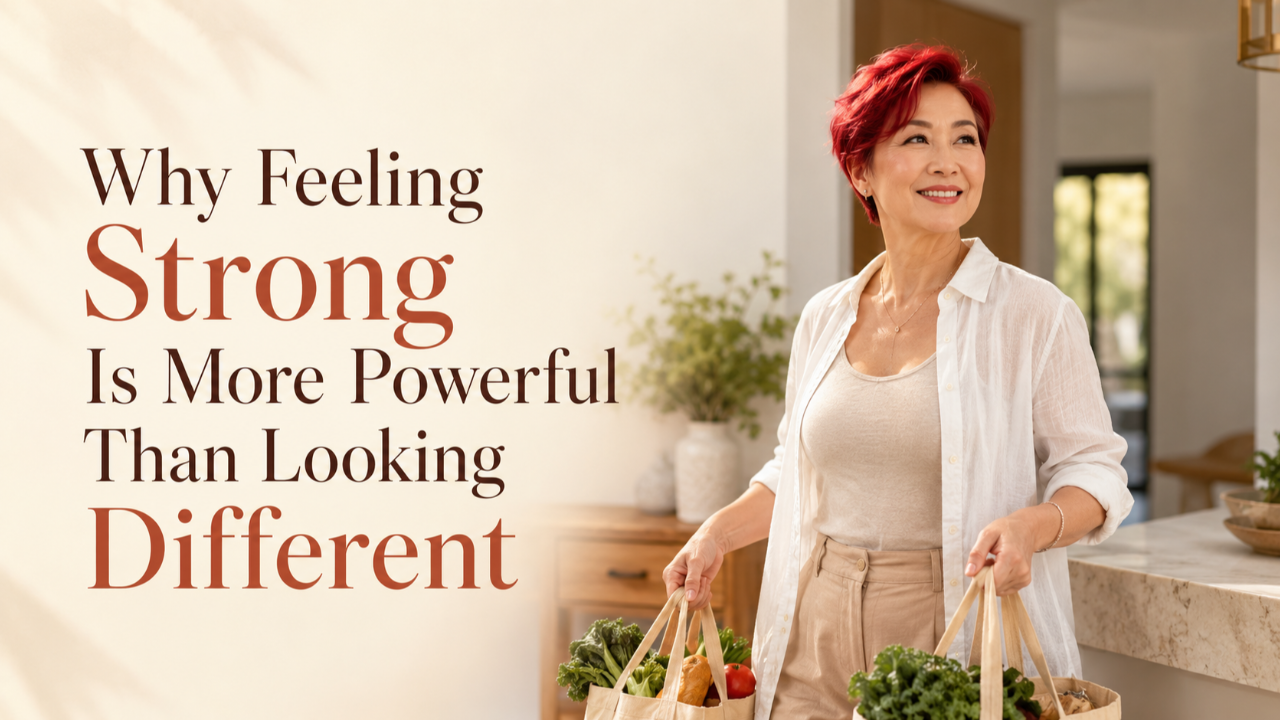
For years, many women have been taught to measure progress by what they can see. A smaller dress size, a flatter stomach, a lower number on the scales or a photograph that looks more flattering becomes proof that their efforts are working.
Yet appearance is a difficult place to build lasting confidence. Bodies change. Weight fluctuates. Ageing continues. The reflection you feel pleased with one morning may look entirely different to you after a difficult day, a poor night’s sleep or an uncomfortable comment from someone else.
Feeling strong creates something deeper. It gives you evidence that your body can support you. It changes the way you walk into a room, approach a challenge and imagine your future. Instead of depending on whether you look different, you begin noticing that you can do more.
You carry the shopping without needing to put it down. You lift your suitcase into the car without worrying about your back. You rise from the floor more easily, climb the stairs with greater confidence and finish a busy day with more physical energy left for yourself.
These changes may not attract the attention of other people, but they can transform the way you experience your own life.
Strength is not simply a fitness goal. It is a form of freedom.
This becomes particularly important in midlife, when women may notice changes in muscle tone, body composition, balance and recovery. You may still be active, yet feel less powerful than you did several years ago. Activities that once felt automatic may begin requiring more thought or effort.
Harvard Health has described a growing shift away from the idea that women should exercise primarily to become thinner. The focus is increasingly moving towards building the muscle needed to remain capable, healthy and independent with age. Strength training can support muscle, bone, balance, mental health and everyday functioning, while aerobic exercise alone cannot fully replace the benefits of resistance work.
This is a very different message from the one many women grew up hearing. Instead of being told to take up less space, you are invited to develop more capacity.
That change in perspective matters because exercising from dislike creates a very different experience from exercising through self-respect. When every workout is an attempt to correct your body, movement can begin to feel like punishment. Missing a session creates guilt, eating becomes something that must be compensated for and progress is dismissed whenever the scales fail to cooperate.
Strength gives you another reason to move. You train your legs because you want to remain mobile. You strengthen your upper body because you want to carry, lift and reach without hesitation. You train your core because it supports your posture, balance and control.
The body becomes something you are preparing for life rather than something you are continually trying to reduce.
Harvard’s discussion of body neutrality offers a helpful way to understand this shift. Body neutrality does not require you to adore every part of your appearance. It encourages you to value the functions of your body, including the strength of your muscles, the support of your bones and your ability to participate in meaningful experiences.
This can feel much more believable than forcing yourself to say you love your body on days when you do not. You may not love the way your stomach looks today, but you can appreciate that your body carried you through a demanding week. You may feel frustrated by changes in your arms, but you can also recognise that those arms are becoming stronger.
You are allowed to care about your appearance. Wanting to look good in your clothes does not make you shallow. The problem arises when appearance becomes the only evidence that your efforts matter.
Looking different may bring a temporary lift. Feeling strong can change your behaviour.
When you feel physically capable, you may be more willing to book the active holiday, join the walking group, try a new class or play on the floor with a child. You may stop worrying so much about whether you can manage the stairs, carry your own luggage or keep up with other people.
Your life becomes less organised around what your body might not be able to do.
Research supported by the National Institute on Aging has found that strength training can help older adults maintain muscle, mobility and independence. It also emphasises that many people can improve their strength with exercise even after age-related changes have begun.
That is an important message for any woman who feels she has left it too late. You do not need a long history of gym training to benefit from becoming stronger. Your starting point is simply information. It is not a verdict on what your body can become.
The first stages may feel humbling. A light weight may feel heavier than expected. Your balance may be less steady than you remember, or a simple chair squat may expose how much strength you have lost.
Try not to interpret this as failure. It is feedback. It shows you where support is needed and gives you something measurable to improve.
Confidence often grows after action, not before it. You may not feel like a strong woman when you begin, but every controlled repetition gives your brain and body new evidence. You completed the movement. You handled the resistance. You returned for another session.
Over time, the language you use about yourself may begin to change. Instead of saying, “I am terrible at exercise,” you may say, “I am learning how to train.” Instead of assuming that your body is weak, you recognise that it is becoming stronger.
This developing sense of capability is sometimes more motivating than appearance-based goals because it can be experienced immediately. The scales may not move after a week, but you may notice better control, improved posture or an additional repetition. You can feel progress before anyone else can see it.
To begin, choose movements that have a clear connection to daily life. Practise sitting down and standing up from a chair with control. Use a resistance band to strengthen your back. Perform wall press-ups, supported split squats, heel raises or a carrying exercise with a weight held safely at your side.
These movements train patterns you use every day. Squatting helps you sit and rise. Pulling supports your upper back and posture. Carrying develops grip and trunk stability. Heel raises strengthen the lower legs and can support balance.
You do not need a complicated programme or an extensive home gym. Resistance can come from dumbbells, bands, machines or your own body weight. Updated guidance from the American College of Sports Medicine indicates that consistency matters more for most healthy adults than using a particular type of equipment or an unnecessarily complex training system.
Two full-body strength sessions each week can provide a realistic foundation. Allow enough recovery between sessions and begin with resistance that challenges you without causing your technique to break down. Your final repetitions should require concentration, but you should still feel in control.
As the movement becomes easier, progress gradually. You might add a repetition, use a stronger band, increase the weight slightly or slow the lowering phase of the exercise. Your muscles need an appropriate challenge in order to adapt, but you do not need to train to complete exhaustion every time.
The latest ACSM guidance also suggests that reaching absolute muscular failure and following complicated periodisation plans are not essential for the average healthy adult seeking meaningful results. This makes strength training far more accessible than it is sometimes presented.
Your programme should support your life rather than consume it. A twenty-minute session completed regularly can be more valuable than an ambitious routine you are unable to sustain.
On especially busy days, reduce the size of the session rather than abandoning it. Complete chair squats, wall press-ups and band rows. Ten focused minutes still reinforces the identity of a woman who looks after her strength.
It is also helpful to measure progress through capability. Keep a short record of the resistance you used, the repetitions you completed and how the movement capability. Keep a short record of the resistance you used, the repetitions you completed and how the movement felt. Then record the everyday changes you notice.
Perhaps climbing the stairs feels easier. Your knees feel steadier. You can carry more shopping or stand for longer without your back becoming tired. These are not minor details. They are signs that your body is becoming more useful to you.
Harvard Health notes that strength training can make ordinary tasks easier, support joint health, help preserve bone density and contribute to blood glucose regulation. These practical benefits are part of what researchers iealthspan: the years of life spent functioning well rather than simply living longer. citeturn171125search21
Strength should sit alongside mobility, balance and cardiovascular movement rather than replacing them. Walking, swimming, cycling and other aerobic activities support heart health and stamina. Yoga and mobility work can help you move more comfortably. Balance practice supports stability and confidence.
Think of these elements as working together. Mobility gives you access to movement, while strength helps you control it. Cardiovascular fitness helps you continue moving, while balance reduces the likelihood that a small stumble becomes a serious fall.
The National Institute on Aging recommends combining aerobties because each supports a different aspect of physical function. citeturn171125search2turn171125search16
Food and recovery matter too. You cannot continually ask your body to become stronger while giving it too little nourishment or rest. Protein-rich foods support muscle maintenance and repair, while carbohydrates provide useful energy for activity. Sleep and recovery give your body time to adapt to the exercise you have completed.
This is not permission to turn eating into another rigid set of calculations. Begin by including a recognisable source of protein at your main meals. Eggs, yoghurt, fish, poultry, tofu, beans, lentils and other suitable foods can all contribute, depending on your preferences and health needs.
Notice whether your current approach to weight loss is leaving you strong and energised or tired and preoccupied with food. Becoming lighter while losing muscle, confidence and energy is not necessarily the health victory it appears to be.
Your body needs enough support to do more than become smaller.
Feeling strong also affects emotional resilience. Strength training does not remove work pressure, family responsibilities or difficult seasons, but it can create a repeated experience of meeting challenge in a controlled environment.
You choose a weight that requires effort. You remain present. You complete the movement. You rest and try again.
That experience can become a quiet reminder that discomfort is not always a sign to retreat. Some challenges can be approached gradually, practised and managed. You begin trusting your ability to adapt.
There is something powerful about watching yourself become capable through your own consistent actions. No one can give you that evidence through a compliment. It does not disappear when an outfit fits differently or a photograph catches an unflattering angle.
It belongs to you.
This does not mean physical strength solves every insecurity. You may still have days when you feel uncomfortable in your clothes or critical of your reflection. The difference is that appearance no longer holds the entire story.
You can look in the mirror and see a changing body while also knowing that it is a body becoming stronger. You can acknowledge that you do not love every change without dismissing the work you have done.
A useful weekly question is not simply, “Do I look different?” Ask, “What feels easier because I am becoming stronger?”
Perhaps you recovered your balance quickly. You moved furniture, completed a longer walk or stood taller during a presentation. Perhaps you simply kept the promise to complete two short sessions.
These experiences build a type of confidence that is more stable because it is connected to what you can do rather than how you believe you are being judged.
Midlife does not need to be the stage when your body becomes a smaller and more restricted version of itself. It can be the stage when you deliberately build the strength that supports your next chapter.
You are not training to prove that ageing has no effect. You are training because not training to prove that ageing ageing makes strength more valuable.
Feeling strong is more powerful than looking different because strength expands your life. It helps you participate rather than observe, carry rather than avoid and approach the future with greater confidence.
A different body may change what you see in the mirror. A stronger body changes what you believe is possible.
So begin where you are. Use the light weight, the chair or the resistance band. Learn the movement, practise it and allow yourself to progress. Do not wait to look like someone who exercises before giving yourself permission to become strong.
Your goal is not to impress the room. It is to build a body that helps you keep walking confidently into every room, opportunity and chapter still waiting for you.
Stay connected with news and updates.
Join our mailing list to receive the latest news and updates from our team.
Don't worry, your information will not be shared.
We hate SPAM. We will never sell your information, for any reason.