When Children, Relationships and Roles Change, What Comes Next for You
Oct 03, 2026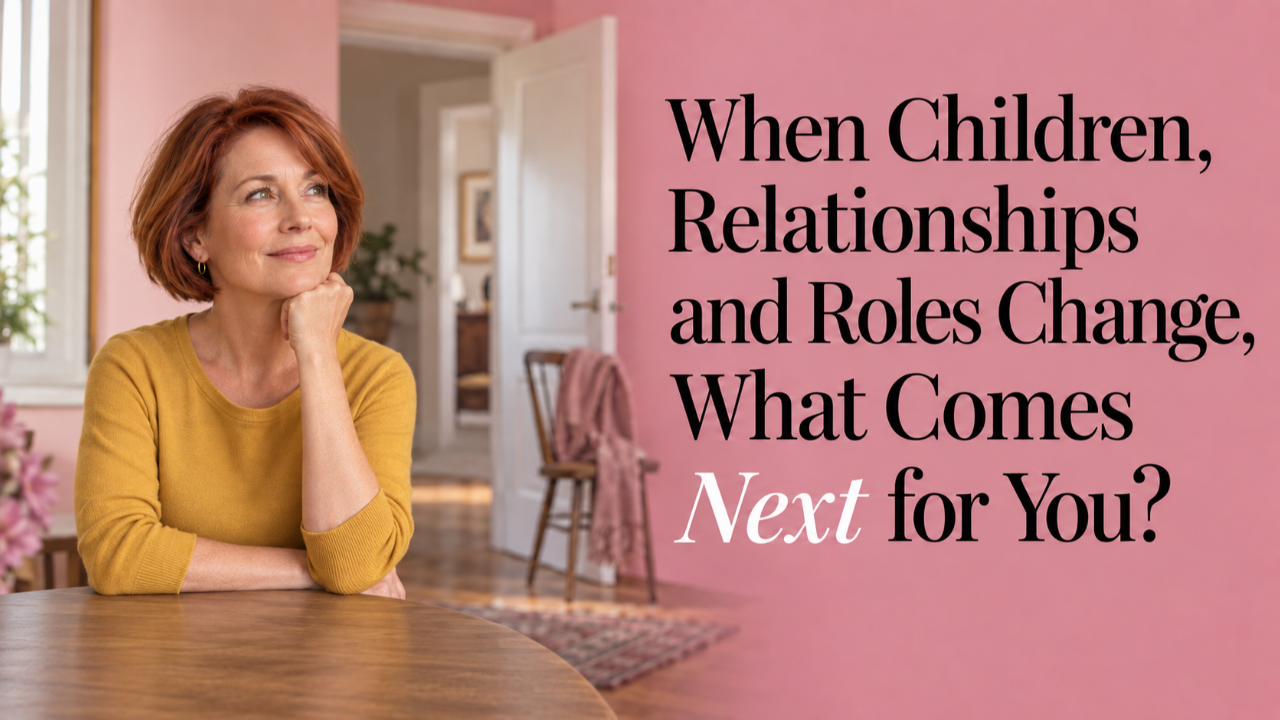
The house can feel different before you fully understand why.
Perhaps your youngest child has left home and the hallway is no longer crowded with shoes. Perhaps an adult child still lives with you but no longer needs you in the same way. A relationship has ended, a parent has died, caring responsibilities have changed or a career that once organised your week no longer feels secure.
Nothing may look dramatically wrong from the outside. You still make breakfast, answer messages and get on with the day. Yet a role that once gave your time a shape has shifted, and the space it leaves behind can feel less like freedom and more like standing in a room after the furniture has been removed.
People may tell you to enjoy the extra time or ask what exciting thing you will do next. Their optimism may be well meant, but it can make you feel as though you should already have an answer.
You do not need one immediately. What comes next is rarely discovered in a single moment of clarity. It is more often built through the way you begin arranging your days, relationships and attention after the old arrangement changes.
A changed role alters the structure of life
Roles do more than describe us. They tell us where to be, what to notice and who expects us. Parenting, partnership, caring and work create appointments, conversations, routines and reasons to get out of bed on a particular morning.
When one of those roles changes, the loss is not only emotional. It is structural. The Tuesday lift is no longer needed. Nobody asks what is for dinner. Weekends that were once organised around a partner become unexpectedly open. The absence of these ordinary demands can feel disorientating because they used to divide time into recognisable pieces.
There is no single midlife experience. Change at this stage is shaped by health, money, culture, relationships and the timing of several events. A woman whose child leaves home during a secure and happy period may feel very differently from a woman facing bereavement, divorce or caring pressures at the same time.
This article is not about asking who you are all over again. It is about something more immediate and practical: how do you build a life that has shape when an old role no longer provides it?
Do not assume the empty nest has one emotional meaning
The phrase “empty nest” suggests a single experience, but women respond to children leaving home in very different ways. One woman may feel grief and relief at the same time. Another may enjoy the quiet and then feel guilty for enjoying it. A third may have an adult child return home after university, divorce or financial difficulty and discover that the nest is not empty at all.
Research focused specifically on women does not support the idea that children leaving automatically causes a universal collapse in wellbeing. One longitudinal study of women found that the transition to an empty nest was associated with increased marital satisfaction through greater enjoyment of time with a partner. A separate prospective study followed women while children left and sometimes returned home, reinforcing that this transition can take different forms and needs to be understood within the wider circumstances of a woman’s life.
The useful message is not that you should feel positive. It is that there is no correct emotional response. Relief does not mean you were a bad mother. Sadness does not mean you are incapable of moving forward. You are responding to your own relationship, history and circumstances.
Stabilise the week before trying to reinvent your life
After divorce, bereavement, children leaving or retirement, women can feel pressure to create a bold new chapter. A dramatic plan may sound inspiring, but the first need is often a more dependable week.
Look at where the old role used to create structure. Which mornings, evenings or weekends now feel particularly empty? When do you feel the change most strongly? It may be Sunday lunch, the hour after work or the evening when you used to attend a child’s activity.
Give those vulnerable spaces a gentle anchor. Arrange a regular walk, attend the same yoga class, cook with someone once a month or make Thursday evening the time you call a friend. The activity does not have to reveal your purpose in life. It only has to make time feel inhabited again.
If work has begun filling every newly available hour, read Working From Home but Never Switching Off? How to Reclaim the End of Your Day. Creating a genuine finish to work can protect the time in which a different part of life can grow.
Structure is not the enemy of freedom. It gives freedom somewhere to land.
Rebuild relationships as a network, not a replacement
When one central relationship changes, it can be tempting to search for one person or activity to fill the entire gap. That places enormous pressure on a new partner, a friend, an adult child or even a hobby.
A healthier approach is to build a varied network. One person may be the friend you can speak honestly with. Another may enjoy walking, theatre or yoga. A sibling may understand the family history, while a newer acquaintance brings energy that is not connected to your past.
The next part of life does not have to be designed around independence alone. It can include people with whom you are known, amused, challenged and cared for, as well as people who value you for more than what you organise or provide.
This is not about collecting acquaintances or filling every evening. It is about allowing different relationships to meet different human needs, so the loss or change of one role does not leave your whole emotional life resting on a single person.
Carry out a relationship check, not a popularity count
Do not begin by asking how many friends you have. Ask what kinds of connection are present in your life and which are missing.
Who can you call when something goes wrong? Who brings lightness? Who encourages your growth rather than only remembering your past? Where do you experience regular contact, even if the relationship is not yet close? Is there anybody who may need to hear from you too?
You may discover that you have many contacts but nobody with whom you can be vulnerable. You may have one deeply supportive relationship but very little everyday companionship. You may spend time with family yet miss relationships in which you are not primarily the helper.
Choose one gap and act on it. Invite somebody for a walk, return to a group you once enjoyed or become a regular somewhere. Familiarity matters because closeness is often built through repeated ordinary contact, not one perfect heart-to-heart conversation.
Redesign the relationship instead of clinging to the old role
When children become adults, the relationship may need to move from management towards connection. If you continue reminding, organising and advising as though they are still sixteen, they may pull away. If you withdraw completely to avoid interfering, both sides can feel the loss.
Try asking different questions. Instead of “Have you booked the appointment?” ask, “How are you feeling about it?” Instead of immediately offering a solution, ask, “Would you like ideas, practical help or just somebody to listen?” This allows care to remain while responsibility changes hands.
A partnership may also need redesign after children leave. Years of coordinating family life can disguise how little time a couple spends relating as two adults. Do not assume that more time together automatically creates closeness. A study of women in long-term marriages found that enjoyment of time together, rather than simply the quantity of time, helped explain improvements in marital satisfaction after children left.
If you are single after divorce or bereavement, redesigning relationships may mean strengthening the people and systems that used to sit behind the partnership. Who is your emergency contact? Who joins you for celebrations? Who can help with a practical problem, and whose practical problem would you willingly help solve? These questions are not pessimistic. They create security as well as connection.
Turn experience into contribution without giving yourself another burden
Midlife can reveal how much knowledge you have accumulated. You may understand people, organisations, family life, food, movement, finance, grief, recovery or simply how to remain steady when things are difficult.
Contribution gives experience somewhere to go. It might involve mentoring a younger colleague, helping at a local group, supporting a cause, teaching a skill or becoming the person who welcomes newcomers. It does not need to be unpaid, public or impressive.
The point is not that every woman should start volunteering or turn her experience into another responsibility. Contribution can feel meaningful when it creates connection without recreating the same exhausting role in which everybody needs something from you. Choose a form of usefulness that also leaves room for your own life.
Build a purpose portfolio rather than searching for one grand purpose
The language of purpose can make women feel that they need a new mission powerful enough to replace motherhood, marriage or a long career. That is a great deal to ask from one decision.
Think instead about a purpose portfolio. One part may involve caring relationships. Another may involve paid work or learning. A third could be creativity, faith, community, physical health, travel, nature or service. No single part has to carry the entire meaning of your life.
If your family role has changed, you do not have to replace it with a business, qualification or ambitious project. Your next chapter may need stronger friendships, a healthier body, financial confidence or more beauty and calm in ordinary life. Purpose can be distributed across several areas, and those areas can change as you do.
Use one season instead of making a lifetime decision
Ask what you want to build during the next twelve weeks, not what you will do with the rest of your life. A season is long enough to create momentum but short enough to change direction.
Choose one relationship to strengthen, one weekly rhythm to establish and one area in which to contribute or learn. For example, you might walk with a friend every Wednesday, attend a Saturday strength class and spend two hours a month helping a community project. Another woman may begin counselling after divorce, organise her finances and join a book group.
Notice that these plans create contact, structure and movement. They do not require you to announce a new identity or feel completely confident before beginning.
At the end of twelve weeks, ask what gave you energy, what created belonging and what felt like an obligation wearing the clothes of self-improvement. Keep what feels alive. Release what merely fills time.
Reclaim resources that belonged to the old arrangement
A changing role can release resources as well as remove them. There may be a bedroom, an evening, a portion of income, a school-run hour or mental attention that was previously committed elsewhere.
List what has genuinely become available. Be realistic, because an adult child leaving may reduce daily tasks while increasing financial support, and divorce can create time while placing pressure on money. The purpose is not to force a positive interpretation. It is to see the full change.
Then decide whether one released resource can support the woman you are becoming. A room might become a place to work, stretch or create. One former school-run hour could become a walk. A small part of the budget could fund a class, a train journey to see a friend or professional financial advice.
Resources that are not deliberately redirected often disappear into errands, scrolling or additional work. Give at least one of them a meaningful destination.
Allow pleasure to return without requiring it to be productive
Women who have spent years organising life around other people may feel strangely uncomfortable doing something with no measurable outcome. Even leisure becomes a project: the walk must improve fitness, the hobby should become a side business and the holiday needs to be educational.
What comes next does not have to justify itself through productivity. Read the novel because you enjoy it. Grow flowers that nobody will eat. Learn to dance badly. Sit in a café without solving a problem.
Pleasure is not a shallow substitute for purpose. It is part of being present in a life that is no longer organised entirely around duty.
Know when emptiness needs more than a new routine
Sadness, uncertainty and grief can be understandable responses to major change. They do not need to be hurried away. However, persistent low mood deserves proper attention.
The NHS advises seeking help if low mood lasts for more than two weeks, you are struggling to cope or the things you are trying are not helping. Loss of enjoyment, hopelessness, changes in sleep or appetite and thoughts of self-harm should not be dismissed as simply an empty nest, divorce, menopause or getting older.
Speak to your GP or a qualified mental health professional if you are concerned. If you are in immediate danger or experiencing thoughts of harming yourself, seek urgent help. Building a new chapter is not a substitute for appropriate care.
What comes next is a life with a different shape
You may always miss the noise in the hallway, the person who used to sit opposite you or the role that made your place in the world feel obvious. Moving forward does not require you to become grateful for every loss.
It asks something quieter. Can you give the week a new rhythm? Can you allow relationships to change form? Can you invest in people who know you beyond what you provide? Can you use your experience without becoming consumed by another duty?
What comes next may not arrive as a revelation. It may begin with Wednesday’s walk, a conversation that feels more equal, a room used differently or a commitment that gives you somewhere to be.
The old role mattered. The next part of your life can matter too, not because it replaces what has changed, but because it is allowed to become real in its own right.
Tomorrow, we will bring the week together by looking at how to make space for yourself when life already feels full.
Stay connected with news and updates.
Join our mailing list to receive the latest news and updates from our team.
Don't worry, your information will not be shared.
We hate SPAM. We will never sell your information, for any reason.