The Impact of Movement on Emotional Stability in Midlife
Jul 27, 2026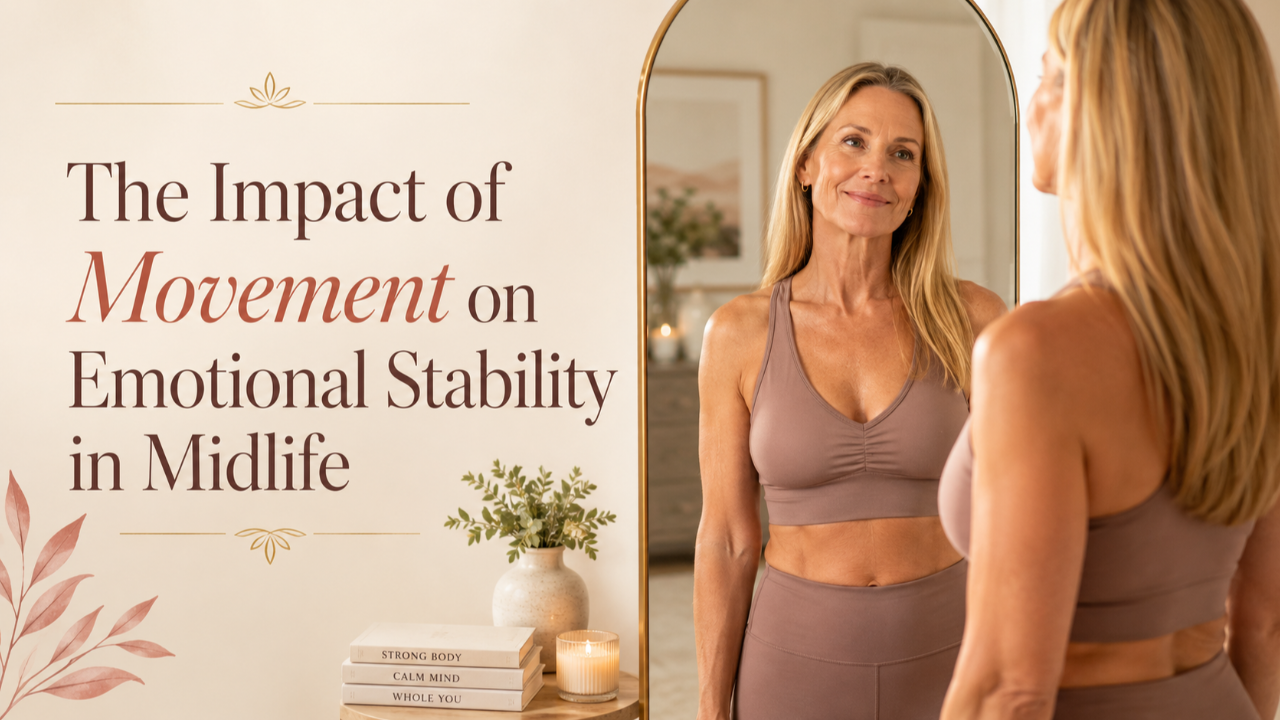
There are days in midlife when your emotional reactions can feel unfamiliar. A minor interruption feels disproportionately irritating. A demanding email follows you long after work has finished, or a conversation that you would once have brushed aside continues circling in your mind.
You may wonder whether you have become less resilient, more sensitive or simply less capable of coping. Yet emotional stability is not about remaining calm and positive at all times. It is your ability to experience an emotion, understand what it may be telling you and return to a steadier place without being consumed by it.
Midlife can make that recovery more difficult. Hormonal fluctuations, interrupted sleep, professional pressure, caring responsibilities, physical symptoms and the accumulated demands of adult life can all arrive at the same time. When your emotional resources are already stretched, even a relatively small challenge can feel like the final demand your system cannot absorb.
This is where movement can become far more valuable than a method of burning calories. It can give stress somewhere to go. It can interrupt repetitive thinking, create a sense of control and help your body move out of a state of constant tension.
Harvard Health reports that regular physical activity can improve symptoms of mild to moderate depression, anxiety and psychological distress. A large review discussed by Harvard included walking, resistance training, Pilates and yoga, with all of these forms of movement associated with improvements compared with remaining sedentary. Yoga and other mind and body activities appeared particularly helpful for anxiety, while resistance exercise showed strong benefits for depressive symptoms.
This does not mean a walk will remove every difficult emotion or that exercise should replace counselling, medication or medical care when those are needed. Movement is not a demand to cheer yourself up. It is one way to support the physical systems involved in stress, mood and recovery.
When you are under pressure, your body prepares to act. Your heart rate may rise, your muscles tighten and your breathing becomes faster or shallower. This response is useful when you need to respond to an immediate threat, but it becomes exhausting when the perceived threat is an overflowing inbox, a difficult colleague, a family concern or a mind that will not switch off.
Harvard Health explains that aerobic exercise can reduce levels of stress hormones such as adrenaline and cortisol while stimulating chemicals associated with pain relief and improved mood. Exercise can also create a sense of mastery, control and confidence, which may be particularly valuable when other parts of life feel uncertain.
You may have experienced this without thinking of it as emotional regulation. You begin a walk feeling tense and return with a clearer perspective. You arrive at a yoga class carrying the day in your shoulders, then notice that your breathing is deeper and your thoughts feel less crowded.
The original problem may still be there, but you are meeting it from a different physical state. That change matters because a regulated body gives the mind more room to think, choose and respond.
Many working women spend most of the day living from the neck upwards. You move from meeting to meeting, solve problems, answer messages and hold multiple responsibilities in your mind. Your body may remain almost completely still while your nervous system works as if you have been running for hours.
A short period of movement reconnects you with physical sensation. You notice your feet meeting the ground, your arms moving, your breath changing and your muscles beginning to warm. Attention shifts away from the endless internal conversation and towards something immediate and tangible.
This is one reason walking can be so useful after a difficult meeting or before returning home from work. The walk creates a transition rather than allowing one role to spill directly into the next. Even ten minutes can mark the difference between carrying the entire working day through your front door and arriving with slightly more space around it.
Research focused specifically on women during and after menopause also supports the relationship between movement and psychological wellbeing. A 2024 analysis of 26 randomised trials involving 2,170 postmenopausal women found that exercise was associated with improvements in depressive symptoms, with mind and body exercise, aerobic activity and programmes combining several forms of movement showing benefits. The authors also reported improvements in anxiety, although they cautioned that the quality of the evidence ranged from very low to moderate.
That caution is important. Exercise is helpful, but it is not a guaranteed cure, and research cannot tell every individual woman exactly how she will respond. Your emotional wellbeing is influenced by your health, sleep, relationships, circumstances, medical history and the support available to you.
What the evidence does suggest is that movement deserves a serious place in the conversation. It should not be treated as a superficial lifestyle extra that you attempt only after everything else is under control. It can form part of the foundation that helps you manage everything else more effectively.
The type of movement matters less than finding something you can repeat. You do not need the perfect workout to benefit emotionally. A brisk walk, a strength session, gentle stretching, swimming, dancing, cycling or a yoga practice can each create a different kind of support.
Aerobic movement can be particularly helpful when you feel restless, agitated or mentally stuck. Walking at a purposeful pace, swimming or cycling gives the body a rhythmic activity through which some of that restless energy can be expressed. You may finish feeling physically tired but mentally quieter.
Strength training offers a different emotional experience. It asks you to focus on the movement in front of you, manage a challenge and discover that you can do something today that once felt difficult. The benefit is not only stronger muscles but the repeated experience of capability.
A controlled squat, press or pull gives you immediate feedback. You meet resistance, remain present and complete the movement. Over time, this can strengthen the belief that discomfort is something you can work with rather than something that always has to overwhelm you.
Yoga, mobility work and slower forms of movement may be more appropriate when you already feel overstimulated. They combine attention, breathing and physical sensation, helping you slow down without expecting yourself to become completely still. For women who find traditional meditation difficult, mindful movement can provide a more accessible route into the same kind of present-moment awareness.
The 2024 review of exercise in postmenopausal women found that mind and body exercise was among the most promising approaches for reducing symptoms of depression and anxiety. The researchers suggested that the combination of movement, attention and awareness of internal physical sensations may contribute to these effects, while also noting limitations in the available studies.
Movement can support emotional stability indirectly through sleep as well. When sleep is repeatedly interrupted, your capacity to tolerate frustration and make measured decisions may become noticeably reduced. You may feel more tearful, impatient or anxious because your brain and body have had too little opportunity to recover.
Regular activity may support sleep quality for some people, although intense exercise too close to bedtime can feel stimulating for others. Notice how different forms of movement affect you. An energetic session may work well earlier in the day, while gentle stretching or slow yoga may be more appropriate in the evening.
Movement can also interrupt the emotional effects of prolonged sitting. A woman may finish a working day feeling drained despite barely moving from her desk. This is not imaginary tiredness. Concentration, decision-making and constant low-level stress consume energy, while physical stillness can leave tension trapped in the shoulders, jaw, back and hips.
Try placing small movement breaks inside the day rather than relying entirely on one workout at the end of it. Stand and walk for a few minutes between meetings, stretch your chest and shoulders after working at a screen or walk outside while making a call that does not require notes.
These breaks are not a failure of productivity. They may help you return to your work with greater concentration and less accumulated tension. The aim is not to turn the working day into a fitness class, but to stop asking your body to remain motionless while your mind handles continuous demand.
One of the most effective strategies is to match the movement to the emotion you are experiencing. When you feel angry or restless, a brisk walk, a short cycle or a more energetic strength session may help discharge some of that intensity. When you feel anxious and overstimulated, slower movement with steady breathing may feel more supportive.
When you feel flat or unmotivated, begin with an activity that requires very little preparation. Put on one song and move around the room, walk for five minutes or complete a few sit-to-stands from a chair. The goal is not to transform your mood instantly, but to create enough momentum to change your state slightly.
When you feel emotionally exhausted, remember that harder is not always better. A demanding workout can be energising on one day and depleting on another. Emotional stability grows partly from learning to distinguish between the movement that challenges you appropriately and the movement that asks more from an already depleted system.
Before exercising, ask yourself what you need from the session. Do you need energy, release, confidence, connection or calm? That answer can help you choose movement more intelligently rather than following the same routine regardless of how you feel.
You might decide that today calls for strength because you need to feel capable. Tomorrow may require a quiet walk because you need space to think. Another day may call for music and dancing because you need to remember that movement can also be joyful.
Enjoyment is not a trivial benefit. Women are more likely to return to activities that feel meaningful, satisfying or socially connecting. A form of exercise that looks ideal on paper but repeatedly fills you with dread may not be the best foundation for emotional wellbeing.
Group movement can offer an additional layer of support. A walking group, dance class, yoga session or strength class can provide routine and human connection at a stage when many women feel they are carrying too much alone. You do not have to discuss every problem for the experience to be valuable.
Simply moving beside other people can reduce isolation and create a sense of belonging. It also gives you an appointment that is not centred on work, caregiving or solving someone else’s difficulty.
Begin with a realistic weekly rhythm rather than an ambitious transformation. Two strength sessions, several purposeful walks and one session of mobility, yoga or stretching can create a balanced foundation. The exact combination should reflect your health, preferences and current capacity.
On especially busy weeks, maintain a smaller version of the habit. A ten-minute walk, five minutes of stretching or one round of strength exercises keeps the relationship with movement alive. Consistency does not mean performing at full capacity every day.
It means continuing to return.
A useful daily practice is the ten-minute emotional reset. Begin with two minutes of gentle walking or marching to reconnect with your body. Continue with five minutes of movement that suits your emotional state, then finish with three minutes of slower breathing and stretching.
This short routine is not intended to solve a serious problem. Its purpose is to help you pause before stress gathers enough momentum to control the rest of your day. It can be used after work, before an important conversation or whenever you notice that your thoughts are becoming repetitive.
Keep track of emotional changes rather than only physical results. After moving, ask whether you feel more settled, clearer, more energised or better able to make a decision. You may discover that the emotional benefit is subtle but consistent.
Perhaps your problem no longer feels as personal. You are less tempted to send the reactive email, or you feel able to have the conversation without immediately becoming defensive. These are meaningful forms of progress.
Movement can support emotional stability, but it should never become another reason to blame yourself. There will be days when low mood, anxiety, pain or fatigue make exercise difficult. Missing a session does not mean you have failed, and emotional distress is not proof that you have not moved enough.
Persistent low mood, severe anxiety, loss of interest in life, panic, significant sleep disturbance or thoughts of harming yourself require proper support. Exercise may complement treatment, but it is not a replacement for speaking to a GP, therapist or other qualified healthcare professional. Harvard Health makes the same distinction, noting that the benefits of movement do not mean people should abandon established mental health care.
The role of movement is not to make you emotionally convenient for everyone around you. You are still allowed to feel angry, disappointed, frightened or overwhelmed. Emotional stability does not mean suppressing those reactions and returning as quickly as possible to being the woman who copes with everything.
It means developing enough internal steadiness to listen to what an emotion is telling you without allowing it to make every decision. Movement can help create that space because it works with the body as well as the mind.
Midlife asks a great deal of women. It brings physical change, shifting identities, professional responsibility and questions about the years ahead. You do not need to meet every part of it with perfect composure.
You need reliable ways to return to yourself.
Movement can be one of those ways. It can steady your breathing, release tension, rebuild trust in your body and remind you that you are capable of changing your state, even when you cannot immediately change the situation.
You do not have to exercise harder, become smaller or prove that you are coping. Begin by moving in a way that helps you feel more present in your own life.
Sometimes emotional stability begins with something as simple as standing up, stepping outside and allowing your body to carry you forwards.
Stay connected with news and updates.
Join our mailing list to receive the latest news and updates from our team.
Don't worry, your information will not be shared.
We hate SPAM. We will never sell your information, for any reason.