The Long-Term Benefits of Building Strength and Stability
Jul 29, 2026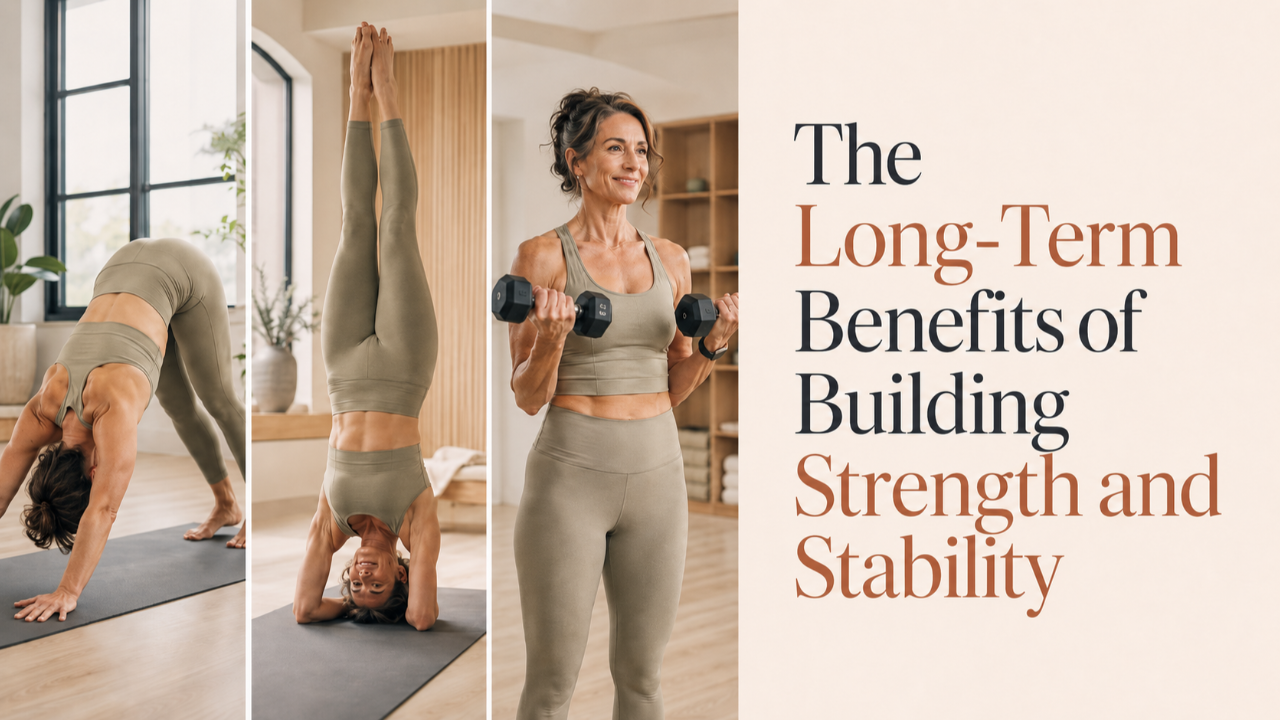
There is a difference between being able to move and feeling secure in the way you move. You may still walk regularly, attend an occasional yoga class and manage a demanding working life, yet notice that your body no longer feels quite as dependable as it once did. Your legs tire sooner on stairs, your back becomes uncomfortable after sitting, or you hesitate before lifting something heavy.
These changes often arrive gradually. There is rarely one dramatic moment when a woman suddenly feels less strong. Instead, everyday tasks begin requiring slightly more effort. You use your hands to rise from a chair, avoid getting down onto the floor or become more cautious on uneven ground.
It is tempting to dismiss these experiences as an inevitable part of ageing. Yet your strength and stability are not fixed qualities that simply disappear with time. They are physical abilities that can be practised, protected and improved.
Strength gives your body the capacity to produce force. Stability gives you the control to use that force safely. Together, they support almost everything you want your body to do, from carrying shopping and climbing stairs to travelling, gardening, exercising and remaining independent.
This is why the combination of resistance training and yoga can be so valuable in midlife. Strength training challenges your muscles to become more capable. Yoga develops body awareness, mobility, balance and control. One helps you create strength, while the other teaches you to organise and use it through a wider range of movements.
Neither has to replace the other. They offer different benefits and can form a more complete approach when practised together.
Strength is about far more than muscle tone
For many women, the word strength still carries an image of heavy barbells, intense gym sessions or training designed for athletes. Yet strength is present in the most ordinary moments of your day.
You need it to stand up, push open a heavy door, carry luggage, lift a saucepan and recover your balance when you stumble. You use it when you reach overhead, move furniture or get out of a low chair.
The National Institute on Aging explains that resistance training can help protect against age related losses of muscle mass, strength and function. Harvard Health also emphasises that strength becomes increasingly important from the fifties onwards because it supports everyday activities and an active, independent life.
Muscle is living tissue that adapts to the demands placed upon it. When you repeatedly ask your muscles to work against appropriate resistance, they receive a reason to become stronger. When they are rarely challenged, some of that capacity can gradually be lost.
A recent systematic review and meta analysis found that resistance training improved strength and aspects of physical fitness in postmenopausal women. Another review found that women can make meaningful strength gains across adulthood, including after menopause.
This is an encouraging message because it means your current starting point does not define your future ability. Feeling weak today does not mean that weakness is now permanent.
Stability is the strength you can control
Stability is sometimes confused with remaining completely still. In reality, it is your ability to control your joints and body position while you move, change direction or respond to an unexpected challenge.
When you step off a kerb, reach into a cupboard or walk across an uneven surface, your brain, muscles, joints, vision and inner ear work together to keep you upright. Stability helps you make small adjustments before a loss of balance becomes a fall.
This becomes more important with age because changes in muscle strength, reaction time, vision, sensation and some medications can affect balance. The National Institute on Aging recommends combining strength and balance exercise and notes that yoga, Pilates and tai chi can help improve both muscular strength and balance.
You do not need to wait until you feel unsteady before practising stability. Balance is far easier to protect when it remains part of your regular movement routine.
A systematic review of trials involving women during perimenopause and early postmenopause found that exercise improved different measures of balance. Resistance exercise and specific balance training were among the approaches associated with improvement.
This matters because strong muscles are not fully useful if you cannot coordinate them confidently. The goal is not simply to possess strength. It is to be able to access it at the moment you need it.
Why strength training and yoga belong together
Strength training is highly effective for developing muscular force, but it can sometimes be practised through a limited range of movement. Yoga asks you to move, stabilise and breathe through a variety of positions. It can reveal where you have strength and where you are compensating.
A yoga pose may show that your legs are powerful but your balance is uncertain. It may reveal that your shoulders are mobile but lack control, or that you can reach a position but cannot remain there comfortably.
This feedback is useful. Mobility without stability can leave a joint feeling unsupported, while strength without sufficient mobility can make movement feel restricted. The aim is not to become as flexible as possible. It is to develop enough movement to perform daily activities while retaining the muscular control to support each position.
Harvard Health describes yoga as a practice that can develop strength and flexibility while supporting balance and mobility. Evidence from adults aged 60 and over also suggests that yoga based exercise can improve balance and physical mobility, although researchers note that more work is needed to confirm how directly this translates into fewer falls.
Yoga therefore offers much more than stretching. Holding a warrior pose requires leg strength and endurance. Moving slowly into a lunge asks the hips and trunk to stabilise. A controlled balance pose challenges the feet, ankles, hips and nervous system.
However, yoga does not always provide enough progressive resistance to preserve or develop every major muscle group. This is where weights, resistance bands and other forms of strength training become important.
The strongest long term approach is not choosing between yoga and resistance exercise. It is allowing them to complement one another.
Stronger muscles can protect everyday independence
The benefits of strength are often first noticed outside exercise. You realise you can carry a heavier bag without straining, walk up a hill without your legs becoming as tired or stand for longer without your back aching.
These improvements may seem modest, but they shape your freedom. A body that feels physically dependable allows you to make plans without constantly calculating whether you will cope.
Harvard Health recently highlighted evidence linking stronger legs with better function and health outcomes in older women. Strong lower body muscles are particularly important because they support walking, stair climbing, balance and the ability to rise from a chair.
This is why exercises such as squats, step ups, split squats and heel raises deserve a place in a midlife routine. They are not random gym movements. They prepare you for actions you perform every day.
Upper body strength matters too. Pulling exercises support the muscles around your shoulders and upper back. Pressing movements help with pushing doors, moving objects and getting up from the floor. Carrying exercises develop grip and trunk stability.
You are not training merely to complete the exercise. You are training for the life outside it.
Bones also respond to appropriate challenge
Bone health can be difficult to prioritise because bone loss does not usually create early symptoms. Yet the reduction in oestrogen associated with menopause can accelerate changes in bone density.
Bones respond to mechanical loading. Resistance exercise creates tension where muscles pull on bones, while suitable weight bearing and impact activities create additional stimulus. A 2025 systematic review and meta analysis reported that resistance training can support bone mineral density in postmenopausal women, although results depend on factors including programme design and training intensity.
Yoga can support posture, balance and body awareness, which may help reduce the chance of falling. It may also offer some bone loading through weight bearing positions, but it should not automatically be treated as a complete osteoporosis prevention programme.
A woman who enjoys yoga may still benefit from adding progressive resistance training. Similarly, a woman who lifts weights may benefit from yoga or mobility work that helps her move with greater control.
Women who have osteoporosis, a history of fractures or significant spinal problems should seek individual advice before starting high impact exercise, heavy lifting or strong spinal twisting and bending movements. The safest programme is one that reflects your health rather than copying someone else’s routine.
Stability supports healthier joints
A joint relies partly on the muscles around it for support. When those muscles are stronger and better coordinated, they can help distribute forces and control movement.
For example, the muscles around your hips influence how your knees track during walking, climbing and squatting. Your trunk muscles help stabilise the spine when you lift, reach or carry. The muscles of the upper back and shoulders help support posture during long periods at a desk.
This does not mean every ache can be solved by strengthening. Joint pain can have many causes and persistent or worsening symptoms deserve proper assessment. However, a well designed programme can often improve the support your joints receive.
Yoga can add valuable awareness here. It teaches you to notice how weight is distributed through your feet, whether one hip is shifting or whether your shoulders are rising unnecessarily. That awareness can then improve the quality of your strength exercises.
Strength provides support. Yoga helps you feel where that support is needed.
The nervous system benefits from practising control
Strength and stability are not produced by muscles alone. Your nervous system must recruit the right muscles, in the right order, with an appropriate amount of force.
This is why a movement can feel awkward when it is new, even when you are physically strong enough to perform it. Repetition allows your nervous system to become more efficient and confident.
Slow yoga transitions are useful because they give you time to feel your position and make small corrections. Controlled resistance training provides clear feedback because the weight or band responds immediately to changes in your technique.
Over time, this practice can improve your sense of where your body is in space. You begin to trust your feet, legs and trunk rather than moving cautiously through every challenge.
That confidence matters. Fear of falling or injury can cause people to reduce activity, which may then lead to further loss of strength and balance. Gradual, appropriately supported movement can help interrupt this cycle.
The World Health Organization recommends that adults include muscle strengthening activity involving the major muscle groups on at least two days each week. It also advises older adults to include varied activity that emphasises functional balance and strength.
You do not have to wait until you are 65 to begin following this principle. The strength and stability you build in your forties and fifties become part of the foundation you carry forwards.
Strength can change your emotional relationship with your body
There is also a psychological benefit to feeling physically capable. Strength training gives you direct evidence that your body can adapt.
You begin with a movement that feels difficult. You practise, recover and return. Eventually, the same exercise feels more controlled or you can use greater resistance.
This creates a type of confidence that does not depend entirely on appearance. Your body may not look dramatically different, but you know it can do something it could not do before.
Yoga offers a similar lesson. A balance pose may be unsteady at first, but gradually you learn where to place your attention, how to breathe and how to respond when you wobble.
The aim is not to eliminate the wobble. It is to become less frightened by it.
These experiences can influence life beyond exercise. You learn that progress can be gradual, that discomfort is not always danger and that confidence often follows practice rather than preceding it.
A practical weekly structure
A useful routine does not need to dominate your week. For many working women, two focused strength sessions combined with one or two yoga or mobility practices can create a strong foundation.
Your strength sessions might include a squat or sit to stand, a pulling exercise, a pressing exercise, a hip movement, a heel raise and a carrying exercise. Begin with one or two sets and use a resistance that feels manageable while still requiring concentration.
Your final few repetitions should feel challenging, but your posture and control should remain steady. When the exercise becomes consistently easy, increase the resistance slightly, add repetitions or improve your range of movement.
A yoga session can then focus on mobility, balance, breathing and controlled transitions. Include standing poses that challenge the legs, gentle spinal movement, hip mobility and positions that support the shoulders and upper back.
Yoga should not become a competition to create the deepest stretch. Move to the point where you feel useful sensation while remaining able to breathe and maintain control.
On busy days, shorten the routine rather than cancelling it. Ten minutes of chair squats, wall press ups, band rows and balance work still counts. A brief yoga flow can help release stiffness after a day at a desk.
The body responds to what you repeat, not to the plan you intended to complete.
Practise balance deliberately
Balance improves when it is challenged safely. Standing on one leg while brushing your teeth may be convenient, but a more focused practice can provide better quality.
Stand near a stable worktop or chair. Shift your weight slowly from one foot to the other, then lift one foot slightly. Keep your gaze on a fixed point and notice whether you can remain tall without gripping your toes or holding your breath.
You can progress by reducing hand support, moving your arms, turning your head or standing on a slightly less stable surface. Progress only when the current version feels controlled.
Yoga poses such as tree pose, warrior three variations and supported lunges can challenge balance, but they should be adapted to your current ability. Using a wall or chair is not cheating. It allows you to practise the position safely enough to improve.
Recovery is part of becoming stronger
Exercise creates the stimulus for change, but your body adapts during recovery. Training harder every day does not necessarily produce better results.
Allow time between demanding strength sessions for the same muscle groups. Protect sleep where possible and notice whether your programme is helping you feel more capable or leaving you repeatedly exhausted.
Protein rich foods support muscle repair, while a balanced intake of carbohydrates provides energy for training and daily life. Hydration also matters, particularly if you are exercising in a warm room or experiencing hot flushes.
You do not need a perfect diet or a cupboard full of specialist products. Begin by including a recognisable protein source at your main meals and eating enough to support the activity you are doing.
If your exercise routine leaves you constantly hungry, depleted or unable to recover, the answer may not be more willpower. You may need more rest, nourishment or a better balanced programme.
Measure what matters
The scales cannot tell you whether your balance has improved or whether your legs are stronger. They cannot measure how confidently you get up from the floor or how easily you carry your luggage.
Track the abilities that matter to your life. Notice how many controlled chair squats you can complete, how long you can balance with light support or which resistance band you can use with good form.
Also pay attention to daily evidence. Stairs may feel easier. Your posture may remain supported for longer, or you may feel steadier when stepping off a pavement.
These changes are not secondary benefits. They are the purpose of the work.
Build for the woman you are becoming
The long term value of strength and stability is not found only in exercise performance. It is found in having more freedom to choose how you live.
A stronger and more stable body may allow you to travel, hike, swim, work, garden and remain socially active. It can support recovery after illness and give you more physical reserve when life becomes demanding.
Strength training helps build the force you need. Yoga helps you move that strength with awareness, balance and control. Together, they can create a body that does not merely perform exercises but supports a full and active life.
You do not need to become the most flexible woman in the yoga class or lift the heaviest weight in the gym. The goal is to become more capable than you were before.
Begin with the body you have today. Challenge it enough to create change, support it enough to recover and practise consistently enough to build trust.
The woman you will be in ten or twenty years is being supported by what you practise now. Every controlled repetition, steady balance and intentional breath contributes to that foundation.
Strength allows you to meet life with greater capacity. Stability helps you remain grounded while you do it. Together, they give your next chapter something invaluable: a body you can continue to rely upon.
Stay connected with news and updates.
Join our mailing list to receive the latest news and updates from our team.
Don't worry, your information will not be shared.
We hate SPAM. We will never sell your information, for any reason.