How to Start Again Without Feeling as Though You Have Failed
Sep 03, 2026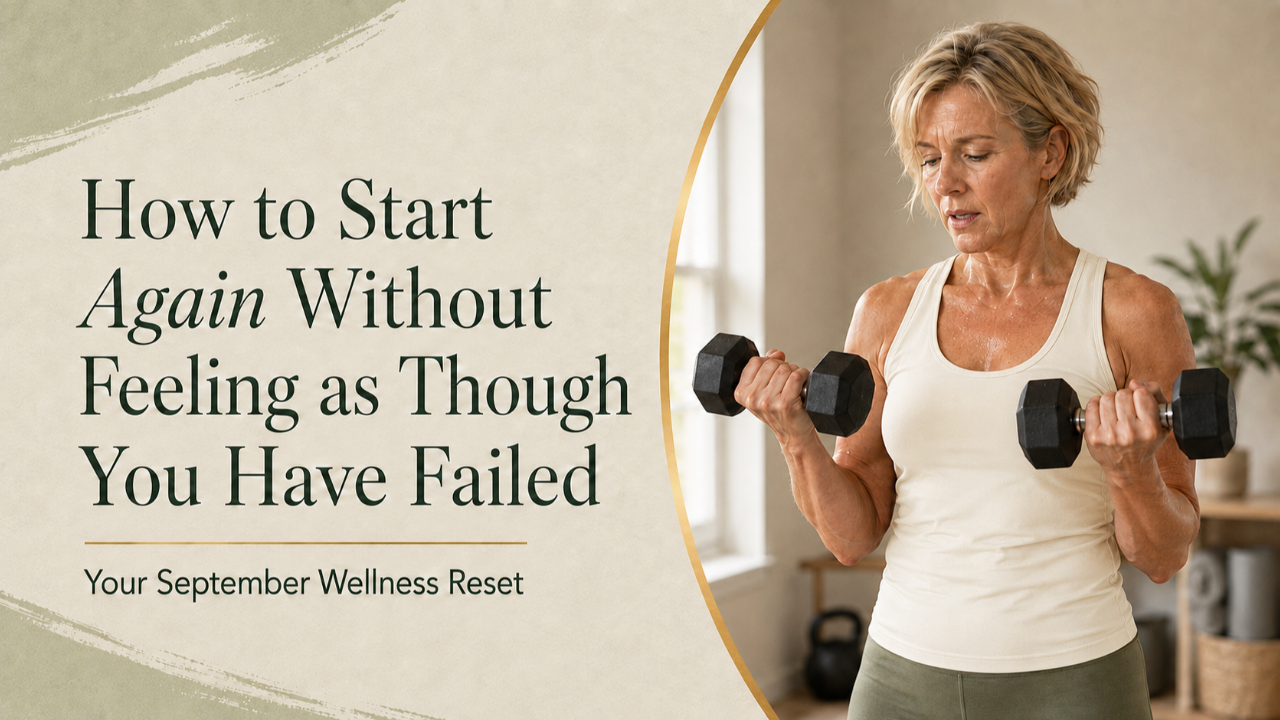
You hover over the booking button for the class you used to enjoy. You would like to go, yet you are already rehearsing an explanation for where you have been. Before you have even put your trainers on, you can hear yourself saying, “I've been so bad. I need to start again.”
It is a familiar little apology, and it can carry more weight than we realise. Somewhere between missing a few sessions and finding the courage to return, an interrupted routine has become a judgement about the woman trying to follow it. You begin wondering why you cannot seem to get this part of your life right.
That feeling can be particularly uncomfortable in midlife. You may be experienced and dependable at work, the person other people turn to when something needs sorting out. Struggling to maintain a routine for yourself can leave you asking why something that sounds so straightforward feels so difficult.
Yet your working life has probably taught you that plans need revising when circumstances change. You would take new information into account before deciding what a project needed next. Your own wellbeing deserves that same thoughtful assessment.
Start by separating what happened from what you are saying about yourself. “I missed my exercise sessions during a difficult fortnight” describes something you can examine. “I always give up” turns that fortnight into a prediction about your future, before you have had a chance to do anything differently.
Write down the situation as plainly as you can. Perhaps you were travelling for work, or your evenings became occupied with caring for someone. Include the choices you would like to change, too: an honest account can acknowledge that you kept postponing the walk without declaring yourself incapable of looking after your health.
Your physical experience belongs in that account. The NHS recognises that perimenopause and menopause can involve sleep difficulties and changes in mood or concentration. If those symptoms are affecting everyday life, discussing them with a healthcare professional can be part of your return to looking after yourself. NHS guidance on menopause and perimenopause symptoms.
This context helps you decide what support is needed. If broken nights contributed to your routine slipping, that deserves attention alongside the exercise plan. It is hard to make a useful adjustment while leaving out the circumstances that made the original arrangement difficult.
Harvard Health Publishing offers a helpful approach through self-compassion: responding with care when you feel inadequate or disappointed in yourself. Drawing on the work of Harvard psychologist Christopher Germer, it suggests considering how you would encourage a friend in the same situation, then offering yourself that response. Harvard Health: The power of self-compassion.
Think about what you would say to a friend who had stopped swimming while helping her mother recover from an operation. You would probably want to know how she was coping and whether she would like some company on her first visit back. Try allowing that same warmth into the conversation you are having with yourself.
There is research behind learning this skill. In a small randomised trial published in the Journal of Clinical Psychology, Kristin Neff and Christopher Germer, a psychologist affiliated with Harvard Medical School, studied an eight-week Mindful Self-Compassion programme. The trial compared 25 participants taking the programme with 27 on a waiting list; participants were mostly women, with average ages around 50. Those taking the programme reported greater improvements in self-compassion and wellbeing. Neff and Germer: Mindful Self-Compassion trial.
The study was small and relied on self-reported outcomes, and a waiting-list comparison cannot tell us how the programme would compare with another supportive activity. It also did not test whether women resumed exercise or maintained a particular eating routine. Its relevance here is more modest: a kinder way of responding to yourself is something you can practise and develop.
Perhaps you worry that kindness will make it easier to keep putting things off. A separate series of four experiments by Juliana Breines and Serena Chen explored that concern. In one experiment, participants encouraged to respond with self-compassion after doing poorly on a difficult test spent more time studying afterwards than those in the comparison groups. These were short experiments, rather than trials of midlife health habits, but they suggest that self-compassion can coexist with an active wish to improve. Breines and Chen: Self-compassion and motivation to improve.
You can put that idea into practice with a response that feels believable. “I'm disappointed that I stopped, and I would like to make returning easier” may be enough. You do not have to feel pleased about the interruption before taking a useful next step.
Let your first action help you return without having to make up for the past. After a break, it can be tempting to plan a much harder workout to prove that you are serious. Choose a session appropriate to your current ability, with room to build gradually, so that returning is an experience you feel able to repeat.
The same principle can make restarting a food routine less fraught. If you have eaten differently from the way you intended, your next meal can be an ordinary, nourishing meal. You can prepare something familiar and give yourself time to eat it, without attaching a punishment or a new set of strict rules to the occasion.
Bring the decision close enough to act on. “I will sort myself out next month” leaves a long gap in which to worry about beginning. “I will check the swimming timetable this evening and choose one suitable session” gives you a clear first step, without asking you to promise a perfect month.
If embarrassment is keeping you away from a class, a short message beforehand may help. You could write, “I'd like to come back after a break. Could you help me choose a suitable session?” That gives the instructor useful information and opens the door to support, without requiring an apology for having a life outside the class.
Then look for one thing that would make this return different. If getting home first meant you rarely went out again, you might take your kit to work. If preparing every lunch became too demanding, you could choose a dependable alternative for the days when cooking does not happen.
Some interruptions require more than a practical adjustment. If you have been grieving or carrying a heavy caring responsibility, returning may need to happen slowly, with help from other people. A conversation about sharing a responsibility can be a meaningful part of starting again.
Remember what your earlier efforts have already taught you. A break may mean you need to rebuild some physical capacity, but you still bring experience to the next attempt. You may know which class you enjoy, which meals work on busy evenings, or what made your previous routine difficult to sustain.
Use that knowledge to make the next attempt more informed. You can return to something that suited you, or decide that you would prefer a different approach now. Continuing to care about your wellbeing leaves room for the way you care for it to change.
For today's September reset, take a few minutes to finish this sentence: “What interrupted me was…” Then ask, “What would make returning easier?” Use your answers to choose one manageable next action, including any support you need to make it possible.
You may still feel a little disappointed when you book that class. Let the feeling be there while you prepare your bag and make space for the visit. You are allowed to come back exactly as you are, with everything you have learnt and no apology required.
Stay connected with news and updates.
Join our mailing list to receive the latest news and updates from our team.
Don't worry, your information will not be shared.
We hate SPAM. We will never sell your information, for any reason.