Flexible but Still Achy? What Your Joints May Be Missing After 40
Aug 24, 2026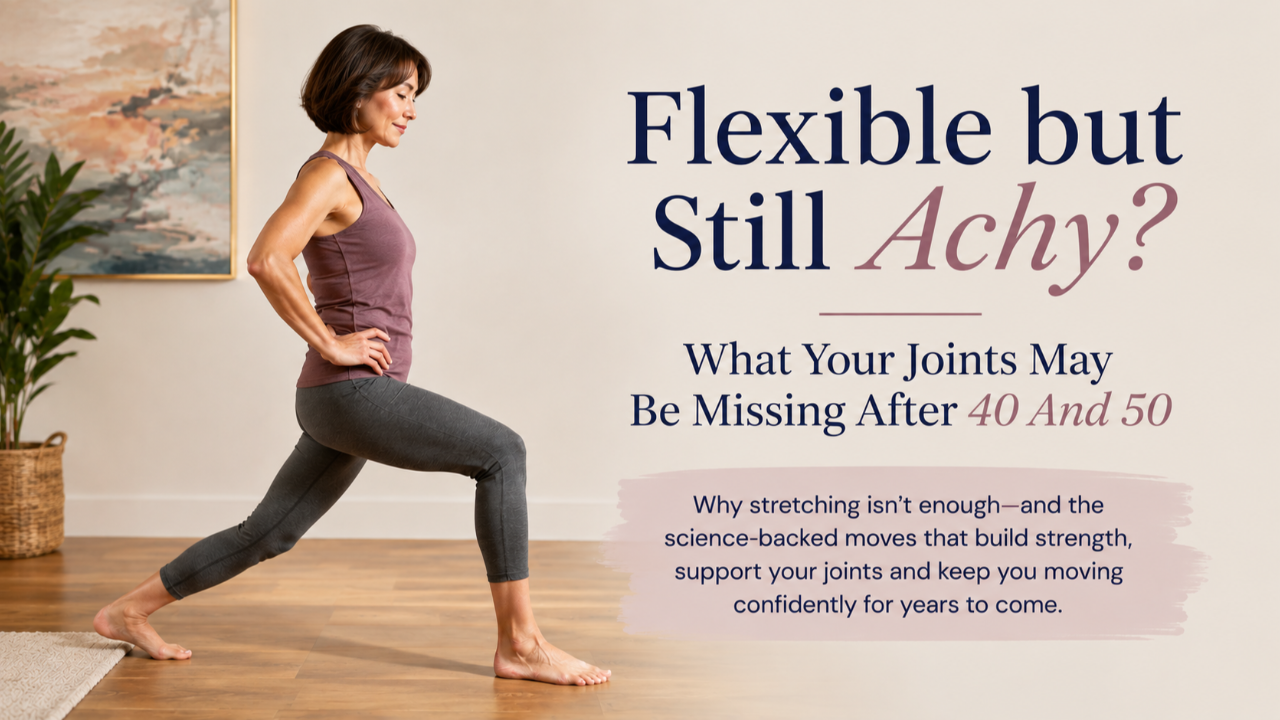
You stretch. You go to yoga. You can still touch your toes, perhaps quite comfortably. Yet your knees complain when you get out of a low chair, your hips feel stiff after sitting through meetings, your shoulders grumble when you reach overhead and the first few steps after getting out of the car feel surprisingly awkward. It can be confusing because you may think, “But I am flexible. Why do I still feel achy?”
The answer is that flexibility is only one part of how well a joint functions. Your joints also rely on the muscles around them to produce strength, control movement and tolerate the forces of everyday life. You need enough mobility to move through a useful range, but you also need enough strength to control that range. Harvard Health describes mobility as a combination of strength, stamina, flexibility and balance, with strong muscles and supporting tissues helping us move confidently through everyday life.
That distinction becomes increasingly important in midlife. A woman can be very flexible but still lack strength around a particular joint. She may be able to fold deeply into a yoga pose but find climbing several flights of stairs tiring. She may have excellent hamstring flexibility but lack the leg strength needed to lower herself comfortably into a chair. She may be able to stretch her shoulders extensively yet still experience discomfort carrying shopping or lifting a suitcase. In other words, being able to move somewhere is not quite the same as being strong there.
This is why I do not want women in their 40s and 50s to respond to every sensation of tightness by simply stretching harder. Stretching has genuine value and flexibility does tend to change with age, but strength training, mobility work, cardiovascular exercise and balance all contribute something different. Your body needs the combination rather than one element performed in isolation.
This becomes especially relevant during the menopause years because muscle and joint symptoms are common. The Menopause Society has highlighted research showing that muscle stiffness and musculoskeletal discomfort can occur around the menopause transition. Researchers are still working to understand exactly how hormonal changes, ageing, activity levels, body composition and other factors interact, so it would be too simplistic to blame every painful knee or shoulder on declining oestrogen. What it does mean is that if your body begins to feel different in midlife, you are certainly not imagining it.
The mistake is assuming that the only answer is greater flexibility. Consider your knees. When you stand from a chair, climb stairs or walk downhill, the knee does not work alone. The muscles of the thighs, hips and calves help control and support the movement. If those muscles are not sufficiently strong, everyday tasks can begin to feel harder even if your flexibility is perfectly reasonable.
For a working woman, the practical implication is important. You may benefit more from doing controlled sit-to-stands than from spending another ten minutes stretching your quadriceps. Sit towards the front of a stable chair with your feet comfortably underneath you. Lean forwards slightly, press through your feet and stand tall, then lower yourself back down slowly and with control. Begin with five repetitions and gradually build towards eight to twelve if that feels comfortable.
Notice what you are actually training. This is not simply a “leg exercise”. You are practising something you perform every day: getting out of a chair. That is functional strength, and it is one of the reasons strength work can make such a difference to how capable your body feels.
Your hips tell a similar story. After hours at a desk, it is perfectly understandable that the front of the hips may feel tight. A gentle hip-flexor stretch can feel wonderful, but your hips may also benefit from strengthening the gluteal muscles that help extend and stabilise them. Bridges, controlled sit-to-stands, supported squats or step-ups can all help, depending on your ability and what feels comfortable.
The question then becomes less, “How far can I stretch my hip?” and more, “Can my hip support me well through the movements I need?” That is a much more useful way of thinking about mobility after 40.
The same applies to your shoulders. Professional women can spend hours with their hands positioned in front of them at a keyboard. By late afternoon, the shoulders and upper back may feel tight and uncomfortable. Stretching the chest and moving the shoulders can certainly help, but strengthening the upper back is equally valuable.
Resistance-band rows are a simple option. With a securely anchored band, draw your elbows backwards while keeping your shoulders relaxed rather than shrugged, pause briefly and return with control. Combine this with gentle shoulder circles and comfortable overhead reaching. One gives you movement while the other develops the muscular support needed to control that movement.
This is what healthy mobility begins to look like: range plus control.
Your ankles are another frequently neglected area. Stiff or weak ankles can affect walking, climbing stairs, balance and the way forces travel upwards through the knees and hips. Yet many women rarely train them directly. A simple calf raise is an excellent starting point. Stand behind a chair or kitchen counter for support, rise slowly onto the balls of your feet and lower yourself with control. Eight to twelve repetitions can be enough to begin.
You can then give the ankle some movement by placing one foot slightly behind you and gently bending forwards while keeping the heel comfortably down. You should feel mild tension rather than pain. The combination of calf strength and ankle mobility is often more useful than simply stretching repeatedly.
Balance also belongs in this conversation because your joints do not merely need strength. Your nervous system also needs to know where your body is in space. This awareness helps you make constant small adjustments when stepping off a kerb, walking across uneven ground or changing direction unexpectedly.
Try standing beside a kitchen counter and lifting one foot slightly from the floor. Hold for ten to twenty seconds while keeping something sturdy within reach, then change sides. If this becomes easy, gradually reduce the amount of support you use rather than immediately attempting something dramatic. Balance training does not need to look impressive to be valuable.
Yoga remains incredibly useful within this picture, but I would encourage women to reconsider what they are trying to achieve from it. The goal does not need to be getting deeper into a pose. Yoga can support flexibility, balance, body awareness and strength, but if you are already naturally flexible, repeatedly pushing further into your end range may not be what your body needs most.
Try slowing the pose down instead. Take Warrior II, for example. Rather than concentrating on how deeply you can bend the front knee, notice how steadily you can hold the position. Feel the muscles of the legs working, keep the movement controlled and breathe normally. Suddenly the pose becomes less about achieving a shape and more about building capacity within it.
The same idea applies to a lunge. You may once have thought, “How far can I stretch the front of my hip?” A more useful question might be, “Can I enter this position slowly, control it comfortably and come back out again with confidence?” This can be especially important for women who describe themselves as naturally bendy yet still feel unstable, vulnerable or achy in certain joints.
Greater range is not automatically better if you do not have the strength and control to manage it comfortably.
There is also an important distinction between normal stiffness and pain that deserves investigation. Mild tightness after sitting that disappears after a few minutes of movement is very different from a joint that is repeatedly swollen, hot, locking, giving way or becoming progressively more painful. Do not try to stretch your way through persistent joint pain.
If discomfort is significant, worsening or affecting everyday activities, speak with a physiotherapist, GP or another appropriate healthcare professional. Joint pain can have many causes, including osteoarthritis, inflammatory conditions, previous injuries and tendon problems. Menopause should not become a convenient explanation for every musculoskeletal symptom.
For women with osteoarthritis, however, movement is generally not the enemy. Appropriate aerobic and resistance exercise can help maintain function, while stronger muscles can provide greater support around affected joints. This can be reassuring because aching joints sometimes make women afraid to move. They begin avoiding stairs, strength training or getting down onto the floor because they worry that using the joint will make matters worse.
For many people, the more helpful approach is appropriate movement that is gradually progressed. The word appropriate matters. Your exercise should suit your current health, fitness and symptoms. Starting with bodyweight movements may be enough. You may need a chair for support. You might begin with five repetitions rather than fifteen. If you already have a joint condition, a physiotherapist can help you identify suitable movements.
Progress does not require pain.
A useful midlife formula is therefore simple: move the joint, strengthen around it, practise controlling the movement and repeat regularly. For a busy professional woman, this does not need to involve an hour in the gym every day.
You could create a ten-minute joint-support routine at the end of the working day. Begin with five to eight sit-to-stands, followed by ten calf raises. Add some controlled shoulder circles and a few resistance-band rows if you have a band. Include a gentle hip-flexor stretch on each side and finish with a short single-leg balance beside a stable surface. In a few minutes, you have included strength, mobility and balance.
On another day, yoga might provide more of the mobility component while two dedicated strength sessions during the week build muscular support. Walking remains valuable too. It supports cardiovascular health, keeps you moving and gets you away from your desk, but one form of movement cannot provide everything your body needs. Walking, yoga, strength work, balance and ordinary movement throughout the day complement one another.
There is another surprisingly useful habit: change position before you become uncomfortable. Most people wait until their hips, back or knees are already complaining before they move. Instead, use the end of a meeting as your cue to stand. Walk during a telephone call when possible. Perform a few calf raises while waiting for the kettle. Reach your arms overhead before sitting down for the next task.
You do not need to spend the entire day worrying about perfect posture. Your body generally appreciates variety more than perfection. The best posture is rarely one position held beautifully for eight hours. It is the ability to change position frequently and comfortably.
Recovery matters too. If you have recently increased your exercise, started strength training or returned to yoga after a long break, some temporary muscle soreness is normal. Give your body time to adapt. Strength develops when challenge and recovery are allowed to work together, not when every workout leaves you feeling increasingly battered.
Over the following weeks, look for improvements in function rather than expecting every sensation to disappear. Does standing from a chair feel easier? Can you climb stairs more confidently? Do your hips loosen more quickly after sitting? Can you carry your shopping without your shoulders complaining? Do you feel steadier on uneven ground? Can you get down onto the floor and back up with greater confidence?
Those are meaningful measures of progress.
Midlife fitness becomes much more liberating when the goal shifts away from simply trying to look fit or become increasingly flexible. You begin training for the movements you want to keep. You strengthen your legs because you want stairs to remain easy. You practise balance because you want to feel confident on uneven ground. You maintain shoulder mobility because you want to reach overhead comfortably. You practise getting off the floor because you want that movement available to you for decades.
Stretching still has an important place, but it becomes part of a bigger picture. You stretch because comfortable range of motion matters, not because touching the floor or achieving the deepest possible yoga pose proves anything about your health.
So if you are flexible but still achy, resist the temptation to assume your body simply needs more stretching. It may be asking for something different: stronger muscles around the joints, better control through the range you already have, more movement variety during the working day and enough recovery for those tissues to adapt.
Your joints do not just need to move further. They need to help you move well.
And that is the real opportunity of midlife. You are not training for a flexibility contest. You are building a body that can reach, lift, climb, balance, bend, carry, travel and move confidently through ordinary life.
Because the most valuable measure of mobility is not how impressive a stretch looks today. It is how much freedom your body continues to give you tomorrow, next year and in the decades ahead.
The goal is not simply to be flexible.
It is to remain strong enough, mobile enough and confident enough to keep saying yes to the life you want to live.
Stay connected with news and updates.
Join our mailing list to receive the latest news and updates from our team.
Don't worry, your information will not be shared.
We hate SPAM. We will never sell your information, for any reason.