Before You Cut Out Another Food, What Could You Add to Your Plate?
Sep 13, 2026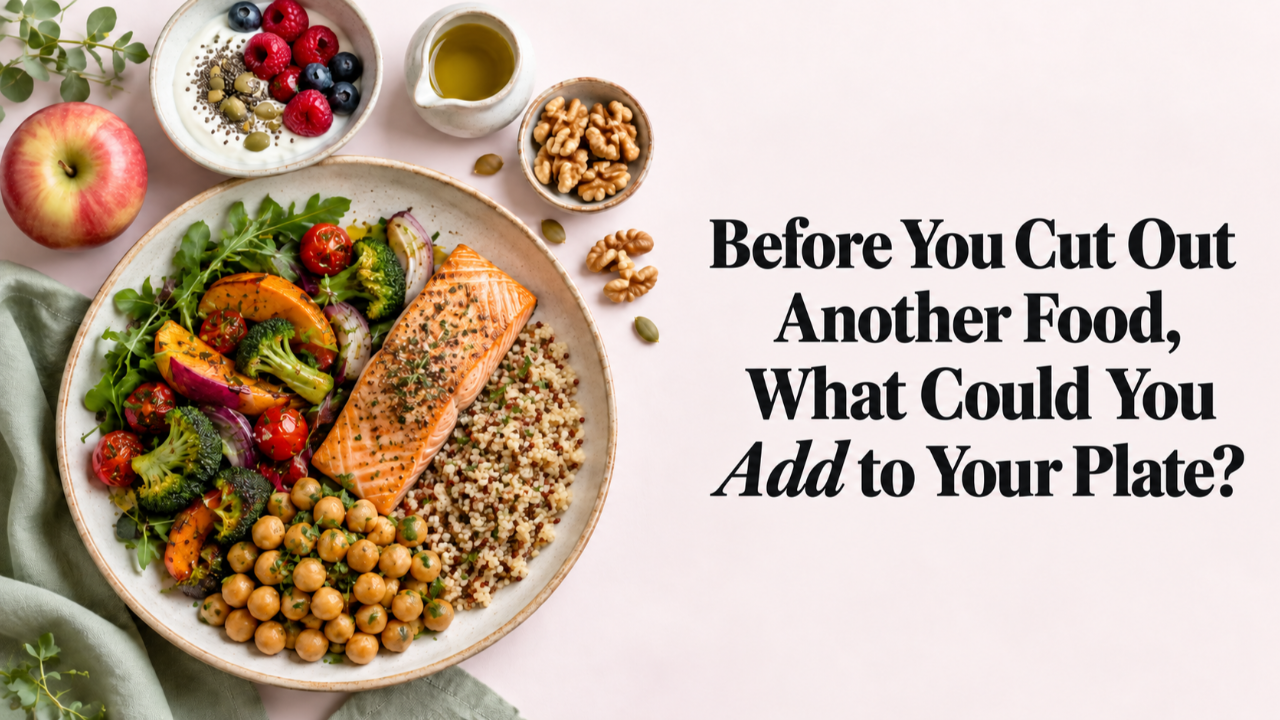
Perhaps you have promised yourself that Monday will be different.
You will stop eating bread, avoid chocolate, reduce carbohydrates, give up cheese or finally become disciplined enough to resist the biscuits in the office kitchen.
For many women, trying to eat well has become an exhausting process of subtraction. There is always another food to remove, another rule to remember and another reason to feel that you have failed.
But what if your next helpful change did not begin with taking something away?
What if you looked at your plate and asked a gentler, more useful question: What could I add that would help this meal support me better?
That might mean adding protein to breakfast, vegetables to lunch, beans to a casserole, seeds to yoghurt or a nourishing afternoon snack before you become ravenously hungry.
This is not permission to add unlimited quantities of food without considering your appetite or needs. It is a way of shifting your attention from restriction to nourishment. When you add foods that provide protein, fibre, healthy fats and useful micronutrients, they often naturally take up some of the space previously occupied by less satisfying choices.
Why adding can be more powerful than another food rule
The Harvard Healthy Eating Plate does not begin with a list of foods you must ban. It offers a flexible pattern: roughly half the plate made up of vegetables and fruit, one quarter containing whole grains and one quarter providing a healthy source of protein, with modest amounts of unsaturated plant oils.
Its central message is that the quality of your overall diet matters more than obsessing over one individual nutrient or food. It can also be adapted to soups, packed lunches, curries, pasta dishes and meals drawn from different cultures. It is not limited to a perfectly arranged dinner plate. Harvard T.H. Chan School of Public Health
There is meaningful research behind this broader approach. A Harvard-led study followed 119,315 women and men for up to 36 years. Those whose diets most closely reflected one of four healthy eating patterns had a 14 to 20 per cent lower risk of dying during the study than those with the lowest adherence. Each pattern was slightly different, but they shared an emphasis on vegetables, fruit, whole grains, nuts and pulses. JAMA Internal Medicine study
This was an observational study, so it cannot prove that the diets alone caused the difference. People who eat well may also differ in other ways, even after researchers adjust for known factors. Nevertheless, its size, length and consistency across several dietary patterns make the findings important.
Randomised evidence also supports looking at the whole dietary pattern. In the PREDIMED trial, 7,447 adults aged 55 to 80 who were at high cardiovascular risk were assigned to a Mediterranean-style diet supplemented with extra-virgin olive oil, a Mediterranean-style diet supplemented with nuts, or advice to follow a lower-fat diet. The Mediterranean groups experienced roughly a 30 per cent lower relative risk of the combined outcome of heart attack, stroke or cardiovascular death.
Importantly, this result applied to a particular higher-risk population. It does not mean that adding nuts or olive oil alone will reduce every woman’s risk by 30 per cent. PREDIMED randomised trial
The useful message is not that you need a perfect Mediterranean diet, or any other named diet. It is that consistently building meals around nourishing foods can matter more than repeatedly removing one food and hoping it changes everything.
1. Add a recognisable source of protein
Look at your next meal and ask: where is the protein?
At breakfast, it might be Greek yoghurt, eggs, cottage cheese, tofu, milk, fortified soya yoghurt or a spoonful of nuts and seeds alongside another protein source. At lunch, it could be tuna, salmon, chicken, lentils, chickpeas, beans, tempeh or eggs. At dinner, you may already include protein but could vary the source across the week.
Protein contributes to the maintenance of muscle, and protecting muscle becomes increasingly important as we grow older. It may also help a meal feel more satisfying. However, “more protein” should not automatically mean oversized portions of meat or relying on highly processed protein products.
Harvard researchers make a useful distinction between protein quantity and the protein “package”. Lentils, for example, bring protein and fibre. Salmon provides protein and omega-3 fats. Nuts offer protein alongside unsaturated fats.
In a Harvard analysis of more than 130,000 adults followed for up to 32 years, total protein intake was not associated with mortality in the same way as the source of that protein. The wider evidence favoured regularly choosing foods such as beans, nuts, fish and poultry over processed meats. Harvard Nutrition Source
If your breakfast is toast, you do not necessarily need to ban the toast. Add eggs or cottage cheese. If lunch is soup, add beans, lentils, chicken or a yoghurt on the side.
If you tend to save almost all your protein for dinner, explore how to include protein across the day.
2. Add one fibre-rich plant
Instead of beginning with “I must stop eating carbohydrates”, ask whether the meal contains a meaningful source of fibre.
Fibre is found in foods such as beans, lentils, chickpeas, vegetables, fruit, oats, barley, wholegrain bread, brown rice, nuts and seeds. These foods do not all affect the body in exactly the same way, and fibre is only one part of their value, but including a variety can support digestive health and contribute to a more satisfying dietary pattern.
A practical approach is to add one fibre-rich ingredient to something you already eat. Stir lentils into mince, add chickpeas to a salad, mix frozen vegetables into a curry, add berries to yoghurt or choose wholegrain bread for a sandwich.
You do not have to transform your diet overnight. If your current fibre intake is low, increase it gradually and drink enough fluid. A sudden dramatic increase may leave you feeling uncomfortably bloated.
You can explore more everyday ideas for including fibre-rich foods.
3. Add colour before chasing perfection
“Eat more vegetables” can sound uninspiring, particularly when you are tired, busy and trying to prepare dinner between everything else.
Think about colour instead.
Could you add frozen peas to your pasta, spinach to your eggs, tomatoes to your sandwich or berries to your breakfast? Could a beige lunch gain some crunch from peppers, carrots or cucumber? Could you add a piece of fruit rather than promising yourself you will prepare elaborate salads every day?
Harvard’s plate model suggests making vegetables and fruit approximately half of what you eat, with an emphasis on colour and variety. This is a visual guide, not a rigid calorie formula, and every meal does not need to match it perfectly.
Frozen, tinned and pre-prepared vegetables can all be useful. Tinned vegetables and pulses may be rinsed if you want to reduce some of the added salt, while fruit tinned in juice is generally a more helpful everyday option than fruit in syrup.
The best vegetable is not the fashionable one you buy with good intentions and throw away a week later. It is one you enjoy, can afford and will actually eat.
4. Add a carbohydrate that does more for you
Carbohydrates are often the first foods women feel pressured to remove when weight, energy or blood glucose becomes a concern. But “carbohydrate” describes a large and varied group of foods.
Oats, lentils, chickpeas, barley, fruit and wholegrain bread are not nutritionally interchangeable with sweets, pastries and sugary drinks. Harvard’s guidance emphasises that the type of carbohydrate matters more than simply declaring all carbohydrates good or bad.
Instead of asking whether you should eliminate carbohydrates, consider whether you could improve the source. You might add oats to breakfast, use wholegrain or seeded bread more often, mix brown and white rice while your taste adjusts, or add beans to a smaller portion of rice.
You do not need to pretend that cauliflower is rice if you enjoy actual rice. A more sustainable meal might include rice alongside vegetables and a protein source. The goal is a better-balanced plate, not a food substitution that leaves you dissatisfied and looking for something else an hour later.
5. Add a little healthy fat
Many women spent years hearing that fat was the enemy. As a result, they may build a very low-fat lunch and then wonder why it feels joyless or fails to carry them through the afternoon.
A drizzle of olive or rapeseed oil, a small handful of nuts, some seeds, avocado or oily fish can add flavour, texture and valuable unsaturated fats. Fat also helps the body absorb the fat-soluble vitamins A, D, E and K.
This does not mean portions cease to matter. Oils, nuts, seeds and avocado are energy-dense, so “healthy” does not mean unlimited. The helpful question is whether a measured amount improves the nutritional quality and satisfaction of the meal.
The Harvard Healthy Eating Plate specifically includes unsaturated plant oils and explains that “low-fat” is not automatically synonymous with healthy. The PREDIMED trial is also an important reminder that a beneficial dietary pattern can contain fats from foods such as olive oil and nuts.
Try adding a teaspoon of seeds to yoghurt, a small handful of walnuts to fruit or a little olive oil to roasted vegetables. It is a thoughtful addition, not an instruction to pour freely.
6. Add something that supports your bones
Bone health deserves greater attention in midlife because the reduction in oestrogen around menopause can accelerate bone loss.
Calcium is one part of the picture, alongside vitamin D, adequate protein, resistance exercise, impact activity where appropriate, not smoking and limiting excessive alcohol. No single yoghurt, supplement or glass of milk can protect your bones by itself.
Useful calcium-containing foods can include milk, yoghurt, cheese, calcium-fortified plant alternatives, calcium-set tofu, tinned sardines or salmon with edible bones, and some green vegetables.
Check plant-milk labels because calcium levels vary, and shake the carton since added calcium can settle at the bottom.
Rather than automatically buying a supplement, first notice whether calcium-rich foods appear regularly in your day. Supplements are not suitable for everyone and high doses are not necessarily better. Speak to a pharmacist, dietitian or healthcare professional if you are unsure about your intake, have osteoporosis, take medication or have a condition that affects calcium, vitamin D or kidney health.
7. Add an emergency option for your busiest days
The most nutritionally impressive plan is not useful if it collapses the moment your diary becomes busy.
Create one or two “good enough” meals that require almost no thought. This might be microwave wholegrain rice with tinned lentils, frozen vegetables and a spoonful of yoghurt. It could be wholegrain toast with eggs and tomatoes, soup with added beans and a piece of fruit, or Greek yoghurt with berries, oats and nuts.
Keep a small supply of dependable foods at work or at home. Tinned fish or pulses, oatcakes, nuts, long-life milk, fruit, frozen vegetables, wholegrain wraps and soup can all help.
The purpose is not to create a perfect emergency menu. It is to prevent “I have nothing suitable” from becoming the point at which you skip lunch and arrive at the evening depleted.
If you regularly find yourself trying to assemble lunch between appointments, discover how to build a meal that carries you through the afternoon.
When time is limited, start with the simplest formula you can remember. Choose a protein, add a fibre-rich carbohydrate or plant, include some colour and finish with a little healthy fat if the meal needs it.
Try the addition check
Before your next meal, pause for ten seconds.
Rather than judging the food or calculating everything you should remove, ask four questions.
Where is the protein? Where is the fibre? Could I add some colour? Will this meal satisfy me until I next have a realistic opportunity to eat?
You do not need to address every gap at once. Choose the addition that would make the greatest difference.
Breakfast might need protein. Lunch might need vegetables. Dinner might need a greater variety of plants. Your afternoon might need a planned snack containing protein and fibre, rather than another promise to rely on willpower.
Notice how the meal feels afterwards. Were you comfortably satisfied? Did it support you through the afternoon? Did you enjoy it? What would make it easier to repeat?
Your body is not a nutrition project that must be corrected through endless restriction. Nor does midlife require a perfect diet assembled from expensive “menopause” products.
Often, the next helpful step is much more ordinary.
Add the yoghurt. Add the lentils. Add the vegetables. Add the olive oil. Add the fruit. Add the meal you can prepare even when Tuesday has not gone according to plan.
Before you take another food away, give your body something useful first.
Stay connected with news and updates.
Join our mailing list to receive the latest news and updates from our team.
Don't worry, your information will not be shared.
We hate SPAM. We will never sell your information, for any reason.