Stiff When You Stand Up? Gentle Ways to Ease Back into Movement
Oct 14, 2026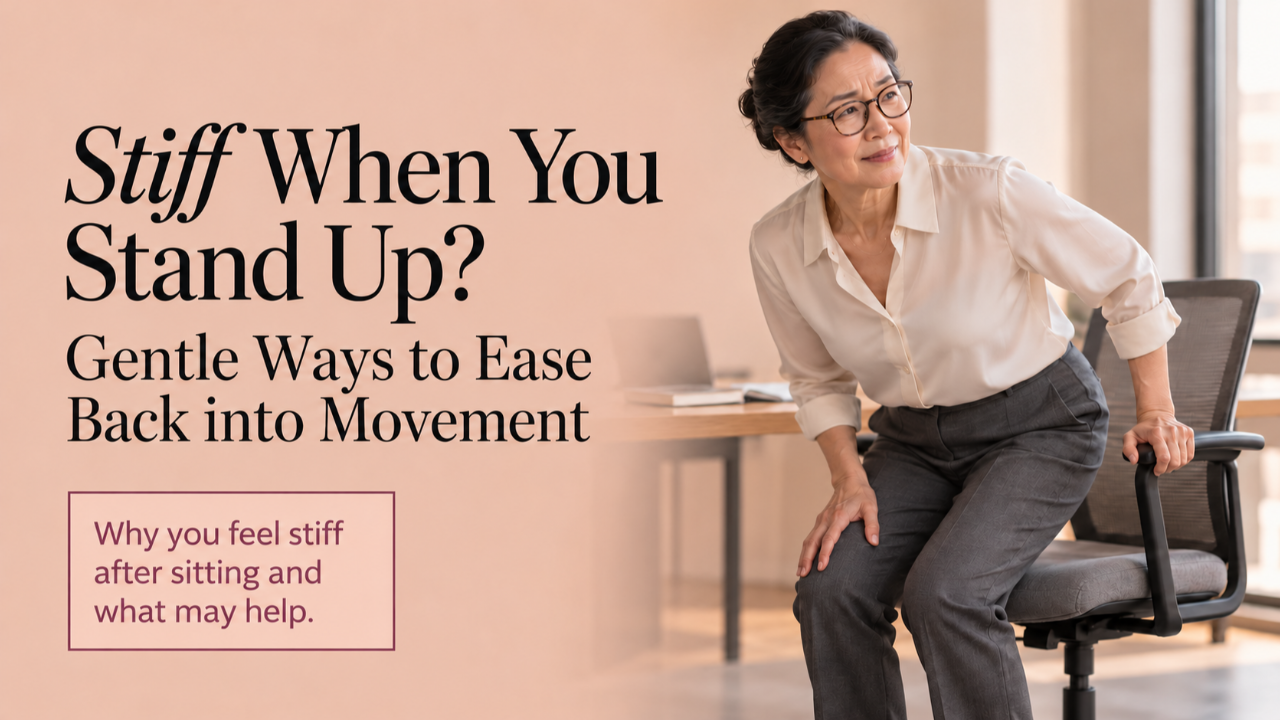
You have only been sitting down to answer a few messages. Then you stand, take a cautious first step and realise your hips, knees or ankles need a moment to catch up. After a little movement, things may begin to feel easier, but the experience still leaves you wondering why getting out of a chair has become an event. You might even make a joke about it while quietly thinking, “Surely I am too young to feel this stiff?”
It can happen after a long drive, an absorbing afternoon at your desk or an evening curled up on the sofa. What makes it frustrating is how ordinary the moment is: you were simply trying to get on with your day. You do not necessarily need an ambitious stretching programme to start exploring what feels better. Sometimes a gentler transition, a few changes to your sitting habits and the right advice are more useful places to begin.
Why might you feel stiff after sitting?
Stiffness describes a feeling, rather than a diagnosis. You may mean that movement feels restricted, that the first steps are uncomfortable, or that getting upright takes more effort than it used to. These experiences can have different explanations, so the pattern matters. Notice where you feel it, how long it lasts and whether there is pain or swelling alongside it.
Osteoarthritis is one condition that can cause joint pain and stiffness, but feeling stiff does not establish that you have it. Joint and muscle symptoms can also occur around menopause, while an injury or another musculoskeletal problem may need consideration. If this is new, recurring or increasingly limiting, it is worth discussing rather than assuming it is an inevitable part of midlife. Feeling easier once you move is useful information for a clinician, but it does not rule out a problem that deserves assessment.[1,2]
Before you try these movements
The sequence below is a gentle starting option for mild stiffness, rather than a treatment for unexplained pain or a tested rehabilitation programme. It is intended for someone who can already stand and walk safely. If you have a recent injury or operation, significant pain, recurrent dizziness, balance difficulties or restrictions from your clinician, ask for individual guidance first. A hot, swollen joint, inability to bear weight or other warning signs need assessment rather than this routine.
Choose a firm, stable chair without wheels, with your feet able to rest on the floor. For getting up, secure armrests can be useful if you normally need your hands for support. Clear the space around you and wear footwear that feels secure. You can try just one movement, skip anything uncomfortable and stop whenever you need to.
A gentle transition from sitting to standing
1. Begin with your feet and ankles
While seated, gently move one foot a little forwards and point your toes away, then bring them back towards you. Keep the movement easy, supporting the leg as needed rather than straining to hold it up. Try about five comfortable repetitions before changing feet. If this position bothers your knee or hip, skip it rather than trying to make the movement bigger.
2. Add a small seated march
Sit comfortably upright and lift one foot a short distance, keeping the knee bent. Lower it with control, then try the other side. You might begin with three to five lifts on each side, using a smaller movement if that feels easier. Stop if you feel pinching, sharp pain or increasing discomfort.
These two options draw on ankle movement and hip marching included in NHS seated-exercise guidance, with a modest starting amount suggested here. The aim is to explore comfortable movement, not reach a particular height or stretch. They may suit some readers better than others. A smaller movement is a perfectly reasonable choice.[3]
3. Set yourself up before rising
Move towards the front of the seat while keeping yourself securely supported. Place your feet about hip-width apart, with your heels on the floor and your feet slightly back towards the chair. Lean forwards from your hips so your body weight comes over your feet. Use the armrests to push up if needed, rather than pulling on an unstable table or chair nearby.
4. Stand, then pause
Rise at a comfortable pace, without rushing straight into your first step. Take a moment to find a balanced, upright position and keep your usual support within reach. You do not need to force your knees backwards or exaggerate an upright posture. If you feel dizzy or unsteady, sit back down safely rather than walking through it.
5. Take a short, easy walk
When you feel steady, walk a comfortable distance across the room or along a clear hallway. Start slowly and allow your steps to settle into their usual rhythm. A brief walk is enough to see how you respond; there is no need to turn the moment into a workout. Stop if pain increases, a leg gives way or you cannot walk safely.
The useful question afterwards is, “Did that make the transition feel easier?” You may notice a difference, no difference, or that one part does not suit you. None of those responses is a test of your motivation. They help you decide what to adapt and what to discuss with a professional.
Make movement easier to remember
One challenge with advice to “move more” is that it has to compete with everything else asking for your attention. A long meeting runs over, a family member needs you, or you become absorbed in something you are enjoying. Instead of relying entirely on memory, connect a change of position with a moment that already happens. The end of a call, finishing a task or getting a drink can become your cue.
You could try a brief movement break roughly every 30 to 60 minutes when practical, adjusting it to your comfort and circumstances. That interval is a reminder strategy, not a proven prescription for relieving stiffness. NHS guidance encourages reducing prolonged sitting alongside being physically active. A few movement breaks support that aim, while longer-term strength and activity still have their place.[4]
There is no need to replace every seated hour with standing still. If your job already keeps you on your feet, a seated pause may be the change you need. Look for opportunities to vary your position and the demands on your body. The most useful habit is one you can repeat without making your day harder.
Consider the chair as well as your body
A low, deep sofa can make getting up more demanding than a firmer, higher seat. Before deciding that your body is failing, notice whether standing feels different from another chair. Try a seat that supports you comfortably and lets your feet reach the floor, without adding loose cushions that slide as you rise. Secure armrests are there to be used when they help.
This is especially worth considering if you work at the kitchen table, spend evenings on a soft sofa or regularly sit in a low car seat. Your aim is to make everyday transitions manageable. You do not need to turn getting up into a hands-free fitness test. If rising from ordinary chairs is becoming consistently difficult, ask a physiotherapist or other appropriate clinician to assess it.
Why stretching may be only part of the answer
When you feel stiff, stretching can seem like the obvious solution. Yet everyday movement also depends on strength, coordination and confidence, and those needs may not be addressed by stretching alone. For people with osteoarthritis, NICE recommends exercise tailored to the individual, including local muscle strengthening and general aerobic activity. It also advises that some discomfort can occur when starting prescribed exercise, which is different from a recommendation to push through new or unexplained pain.[5]
A 2024 Cochrane review of 139 randomised trials involving 12,468 people with knee osteoarthritis found that exercise may improve pain and probably improves physical function compared with no treatment, usual care or limited education. The evidence was of low to moderate certainty, and the importance of the average improvements to patients remained uncertain. These findings support a measured, individual approach rather than a promise that one routine will remove stiffness. They also concern knee osteoarthritis, not every possible cause of difficulty standing up.[6]
If you need a longer-term plan, a physiotherapist can help you decide which movements to practise and how to progress them. That might include an adapted sit-to-stand exercise or strengthening around the affected joints. The right starting amount depends on your symptoms and current abilities. A plan should help you build capacity without turning each session into an ordeal.
If your first steps feel particularly restricted around your feet or ankles, my guide to supporting your feet and ankles in midlife explores this area in more detail. It includes everyday habits, mobility and signs that warrant professional advice. Choose what is appropriate for you rather than adding the whole guide to your to-do list. One useful adjustment can be a more manageable beginning.
Know when stiffness needs a closer look
Arrange a GP appointment if joint symptoms interfere with sleep or normal activities, worsen, recur or have not improved after two weeks of home care. Morning joint stiffness lasting longer than 30 minutes is another reason to seek advice. You can seek help sooner if you are concerned. Explain how standing or walking has changed, rather than simply saying you feel older.[2]
Seek urgent GP advice or contact NHS 111 for a hot, swollen painful joint, or joint pain with fever, shivering or feeling generally unwell. Go to A&E or call 999 for severe joint pain after injury, inability to walk or bear weight, a joint out of position, or tingling or loss of sensation around a joint after injury. Do not keep trying the sequence if these symptoms are present. Getting assessed is the appropriate next step.[2]
Give yourself a kinder first step
There can be a surprisingly emotional moment in discovering that a movement you once took for granted now needs attention. You may feel impatient, embarrassed or worried about what it means for the years ahead. Allow yourself to notice those feelings without treating them as a forecast. What matters now is finding out what helps and seeking support where it is needed.
The next time you stand, you might begin with a little comfortable movement, position your feet and give yourself a moment before walking. Notice the response rather than demanding an instant change. If stiffness keeps returning, bring that information to someone who can assess it. You deserve to move through your day with support, rather than silently working around growing discomfort.
This article provides general wellbeing information and does not replace individual medical advice or a personalised exercise programme.
A gentle place to begin
If you would welcome support with building manageable wellbeing habits, join the interest list for my free 7 Day Hormone & Wellness Reset, opening on 10 November 2026. It is an opportunity to make a little space for yourself in the middle of a full life. The Reset supports general wellbeing and does not replace assessment or treatment for pain and stiffness. I would love to welcome you when we begin.
Join the free 7 Day Hormone & Wellness Reset interest list
Warm wishes,
Monica
Stay connected with news and updates.
Join our mailing list to receive the latest news and updates from our team.
Don't worry, your information will not be shared.
We hate SPAM. We will never sell your information, for any reason.