Why Your Middle Can Change Even When the Scales Barely Move
Aug 10, 2026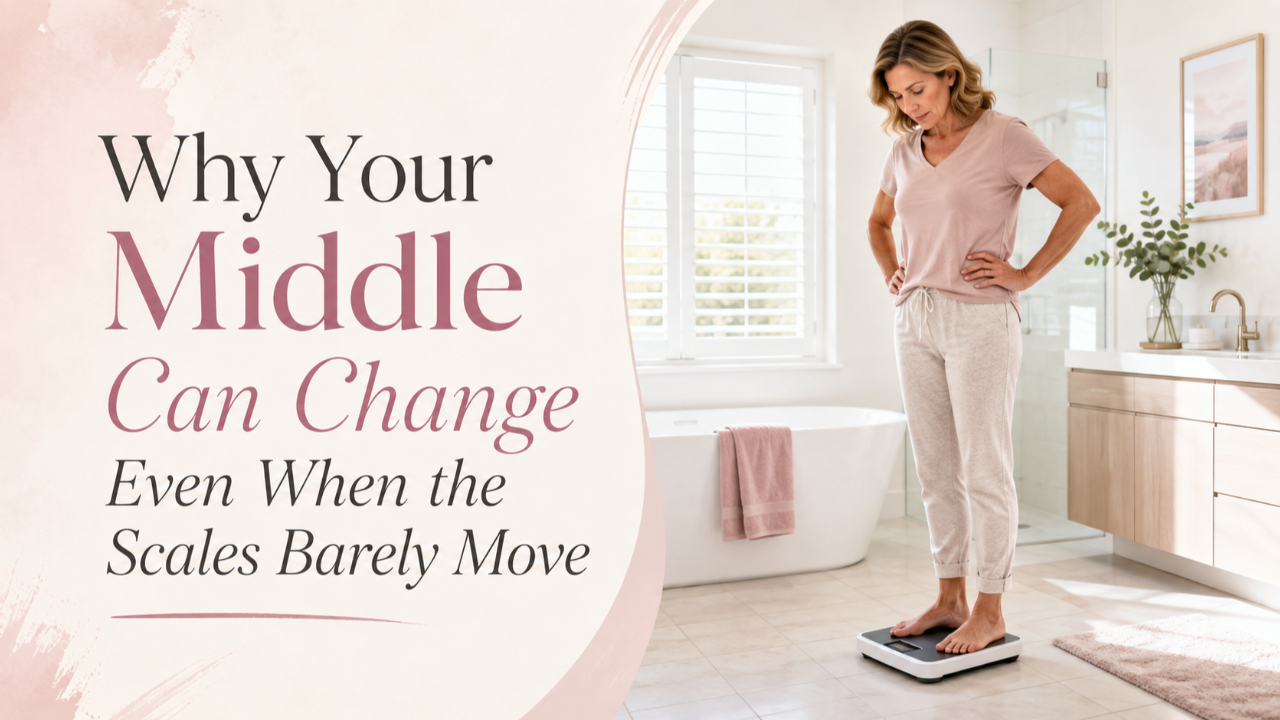
You step onto the scales and the number is almost the same as it was a few years ago. Yet your favourite trousers feel tighter, the waistband of your work clothes sits differently and there seems to be more softness around your stomach than there used to be. It can be particularly confusing when your overall weight has hardly changed. You may wonder whether you are imagining it, whether you need to lose weight, or whether something really is changing beneath the surface.
Something can be changing, and this is one of the most important things to understand about body composition in midlife. Body weight and body composition are not the same thing. Two women can weigh exactly the same while carrying very different amounts of muscle and fat, and an individual woman's body composition can change over time without producing a dramatic change on the scales.
Harvard Health explains that as women move through their middle years, the proportion of body fat can increase and fat storage becomes more likely to favour the upper body rather than the hips and thighs. This means a woman's waist can increase even when her overall weight does not change very much.
For many women, this is one of the less talked about aspects of perimenopause and menopause. You may still weigh roughly what you weighed before, yet your silhouette begins to change. The jeans that once fitted comfortably around your waist are harder to fasten. Dresses sit differently. You may notice more fullness around your abdomen while your legs or arms do not appear particularly different.
Hormonal changes are part of the explanation. As oestrogen declines through the menopause transition, fat distribution tends to shift towards the abdomen. Research using imaging techniques has repeatedly found greater central and intra abdominal fat after menopause, although ageing, lifestyle and total body fat also contribute.
This does not mean menopause automatically causes every woman to gain a significant amount of weight. In fact, it is useful to separate two different processes. Ageing is an important driver of overall weight gain, while menopause appears particularly influential in where fat is stored. Harvard Women's Health also notes that inactivity may predict weight gain and abdominal obesity more strongly than menopause itself.
That is encouraging because it means there are aspects of this change you can influence.
Another part of the picture is muscle. Muscle mass tends to decline as we age unless we deliberately work to maintain it. If you lose some muscle while gaining a similar amount of fat, your bathroom scales may barely move at all. Yet your body can look and feel noticeably different because muscle and fat occupy the body differently.
This is why the scales can sometimes give you an incomplete story.
Imagine that over several years you lose a few kilograms of muscle and gain approximately the same amount of fat. Your weight may remain relatively stable, but your waist measurement could increase, your clothes may feel tighter and everyday activities may begin to feel harder. You might assume that nothing has changed because the scales say the same number, when in reality your body composition has shifted.
This is one reason I would encourage women in midlife to stop allowing the bathroom scales to become the only measure of progress.
Your waist measurement can provide useful information too. Abdominal fat matters not simply because of appearance but because a greater amount of fat around the waist is associated with higher cardiometabolic risk. NIDDK notes that waist circumference provides information about abdominal fat and that having a larger waist can increase the risk of conditions including type 2 diabetes and cardiovascular disease, even when BMI is not particularly high.
For women, NIDDK identifies a waist measurement of 35 inches or more as a point associated with increased risk of obesity related health problems. This is a population level screening threshold rather than a personal diagnosis, and ethnicity, body build and individual health factors can influence risk, but it illustrates why waist measurement can sometimes tell us something the scales cannot.
If you want to monitor your waist, you do not need to measure it every morning. Once every few weeks is plenty. Use the same tape measure, measure under similar conditions and look for the overall trend rather than becoming concerned about tiny fluctuations.
More importantly, use the information to guide your habits rather than judge your body.
One of the most effective things you can do for changing body composition is build and preserve muscle.
Resistance training gives your body a reason to maintain muscle as you move through midlife. Research examining exercise in postmenopausal women has found that aerobic training is effective for reducing fat, resistance training is particularly useful for improving muscle mass, and combining the two can be an effective strategy for improving overall body composition.
This is why your exercise programme after 40 may need to look different from the one you followed in your 20s and 30s.
If most of your exercise is walking, walking is absolutely worth keeping. It supports cardiovascular health, provides regular movement and can help increase overall activity. But walking alone does not provide the same resistance stimulus as deliberately challenging your muscles.
Try adding two or three strength sessions across the week. You do not need an elaborate gym programme. Squats, rows, presses, lunges, bridges, deadlift patterns and appropriately modified push ups can create an excellent foundation. Dumbbells, kettlebells, resistance bands or gym machines can all work.
The key is that the exercises gradually become challenging enough to require your muscles to adapt.
Your working day matters just as much.
A woman may exercise for 30 minutes in the morning and then spend most of the remaining day sitting in meetings, commuting or working at a screen. Harvard Women's Health specifically highlights sedentary behaviour and inactivity as important contributors to midlife weight gain and abdominal obesity.
That means you do not necessarily need another intense workout. You may need more movement distributed throughout the day.
Take the ten minute walk after lunch. Stand while making a phone call. Walk to speak to a colleague rather than sending another message. Get outside between meetings. If you work from home, create a short walk before work, at lunchtime or when you finish.
These small decisions can transform a day that would otherwise involve nine or ten hours of almost continuous sitting.
Food matters too, but perhaps not in the way you expect.
When women notice their middle changing, the instinctive response is often restriction. You cut the bread, skip breakfast, make lunch smaller and try to survive until dinner. The problem is that severe restriction becomes increasingly difficult to maintain when it sits alongside a demanding working day, poor sleep and normal hunger.
A more useful goal is to create meals that support both muscle and appetite control.
Start with protein. Eggs, Greek yoghurt, fish, chicken, tofu, beans, lentils, cottage cheese and other protein rich foods can help you distribute protein throughout the day rather than leaving the majority of it until dinner.
Then add fibre. Vegetables, fruit, legumes, whole grains, nuts and seeds create more satisfying meals and help you build an eating pattern that supports long term metabolic health.
You do not have to eliminate carbohydrates to reduce abdominal fat, and insulin itself is not an enemy. Insulin is essential for regulating blood glucose. What becomes important is insulin sensitivity, and excess abdominal fat is one of the factors associated with a greater risk of insulin resistance.
This is another reason strength training is so valuable. Muscle is metabolically active tissue and plays an important role in glucose disposal, while regular movement and resistance exercise form part of the lifestyle approach used to support metabolic health.
If your goal is reducing abdominal fat, think less about finding one food to remove and more about creating a week your body can respond well to.
Strength train.
Walk.
Break up prolonged periods of sitting.
Eat meals that contain protein and fibre.
Sleep as well as your circumstances allow.
Keep alcohol in perspective.
Reduce the number of evenings when stress determines what happens in the kitchen.
Repeated consistently, these ordinary behaviours become powerful.
Sleep deserves particular attention because a woman who is sleeping badly is operating under a different set of circumstances from one who is well rested. Perimenopause and menopause can disrupt sleep, and persistent tiredness can make physical activity, food planning and appetite management considerably more challenging.
After a poor night's sleep, you may not need stricter food rules. You may need a proper breakfast, a planned lunch and an afternoon snack so that exhaustion does not collide with extreme hunger at six o'clock.
Your body's shape is influenced by the whole pattern of your life, not one supposedly perfect meal.
Stress belongs in that picture too. A demanding career does not automatically cause abdominal fat, and the popular idea that every changing waistline is simply “cortisol belly” is far too simplistic. However, chronic stress can affect sleep, appetite, alcohol consumption, eating behaviour and how much energy you have available for exercise. Those indirect pathways can make maintaining healthy habits considerably harder.
So rather than asking only, “How do I lose my stomach?”, ask a broader question.
What is happening across my week that is shaping my body?
Perhaps you are strength training twice a week but sitting for ten hours every working day. Perhaps your nutrition is excellent until late evening, when stress eating begins. Perhaps you are exercising regularly but sleeping five or six broken hours because of menopause symptoms.
The answer is rarely one thing.
This is also where measuring progress differently can become incredibly freeing.
For the next month, consider following four things rather than simply your body weight. Notice your waist measurement, how your clothes fit, how strong you are becoming and how your energy feels through the working day.
Can you lift a heavier kettlebell?
Can you perform more controlled squats?
Can you walk upstairs without feeling breathless?
Does your waistband feel more comfortable?
Are you arriving home less ravenous because you have started eating a proper lunch?
Those are meaningful changes even if the number on your scales has barely moved.
And if your weight decreases slowly while your strength improves, that may be far more valuable than losing weight rapidly while sacrificing muscle.
There is another important point. Not every increase in abdominal size is body fat. Persistent bloating, digestive symptoms, constipation, ovarian or uterine conditions and other medical problems can also change the appearance of the abdomen. If you develop persistent or unexplained abdominal swelling, significant pain, changes in bowel habits, unexplained weight loss or other new symptoms, speak with a healthcare professional rather than assuming everything is menopause related.
For most women experiencing gradual midlife body composition changes, however, the message is reassuring.
Your changing middle is not evidence that you have failed.
It is not proof that you need to eat as little as possible.
And it does not mean your body has stopped responding to exercise.
It means that body composition deserves more attention than body weight alone.
The woman you are becoming may need more strength training than the woman you were at 30. She may need more movement during the working day, more attention to sleep and meals that support muscle rather than simply being as small as possible.
That is a very different approach to weight management.
Instead of trying endlessly to make your body smaller, you begin deliberately making it stronger, healthier and more metabolically resilient.
And when that happens, the bathroom scales become what they should always have been: one small piece of information rather than the final judgement on how well you are doing.
Stay connected with news and updates.
Join our mailing list to receive the latest news and updates from our team.
Don't worry, your information will not be shared.
We hate SPAM. We will never sell your information, for any reason.