Why Your Energy Can Feel Unpredictable in Midlife
Aug 19, 2026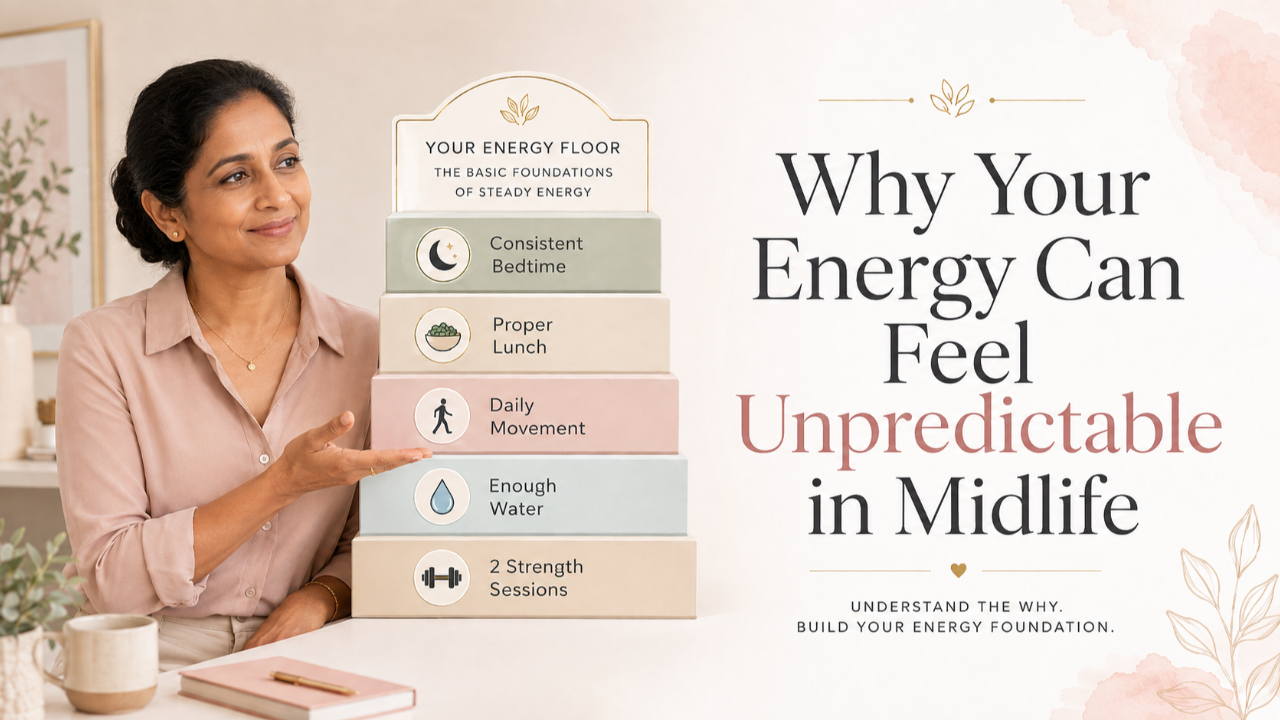
One of the more frustrating changes many women notice in midlife is not simply feeling tired. It is not knowing which version of your energy you are going to wake up with.
One day you can manage a full working day, fit in a workout, cook dinner and still feel reasonably capable in the evening. Two days later, the same commute, the same workload and the same exercise session can feel disproportionately difficult. You may begin questioning what you did wrong. Did you eat something different? Are your hormones “out of balance”? Are you becoming less fit? Or are you simply getting older?
Often, there is no single explanation. Midlife energy can become more variable because several systems that influence how you feel — sleep, hormonal symptoms, stress, nutrition, movement and recovery — can fluctuate at the same time. Harvard Women's Health describes perimenopause itself as an unpredictable hormonal transition and notes that symptoms such as low energy, sleep disturbance, irritability and difficulty concentrating may not follow an obvious pattern.
That unpredictability matters because it changes how we should respond to tiredness. If you assume every low-energy day means you need to push harder, exercise more or drink more coffee, you may miss what your body is actually telling you. Equally, if you assume every difficult day is “just menopause”, you may overlook something practical that could be improved.
The more useful approach is to stop judging your energy and start becoming curious about it.
During perimenopause, levels of oestrogen and progesterone do not simply decline in a smooth, predictable line. Hormonal activity can fluctuate, which helps explain why symptoms may appear, disappear and return. Harvard experts point out that this can make sleep quality and other symptoms unpredictable during the menopause transition.
But hormones rarely work in isolation. Perhaps one night you experience a hot flush but sleep reasonably well afterwards. Another night you wake repeatedly, start thinking about work at 3am and never properly settle again. The following morning might technically look identical on your calendar, but physiologically you are beginning it from a very different place.
This is why one of the first questions to ask on a low-energy day is not, “What is wrong with my body?” It is, “How restorative was my sleep?”
Harvard Health notes that sleep is fundamental to recovery and energy, with deeper stages of sleep playing an important role in the body's repair processes. Poor sleep can affect much more than whether you feel sleepy the following morning. It can make concentration, emotional regulation and everyday effort feel harder.
For a professional woman, this may show up in subtle ways. You can still attend your meetings and complete your work, but everything takes more effort. You reread the same email three times. A conversation that would normally wash over you feels irritating. Your usual strength workout feels unusually heavy. By late afternoon you are convinced you have “lost all your energy”.
You may not have lost anything. You may simply be functioning with an energy debt created the night before.
The useful nugget here is to stop judging today's capacity using yesterday's standards. If you had a poor night, adjust the day rather than trying to overpower it. That might mean keeping the planned walk but shortening a hard workout, protecting your lunch break, avoiding a late-afternoon caffeine rescue and giving yourself a better opportunity to sleep that night.
That is very different from giving up. It is intelligent recovery.
Stress adds another layer. Midlife often coincides with an extraordinary concentration of responsibility. Professional demands may be at their highest just as women are also managing teenagers or young adults, ageing parents, financial commitments, changing relationships and their own health. Harvard Health notes that chronic stress itself can contribute to fatigue and can interfere with sleep, creating another route through which an intense period of life drains energy.
This means your diary can affect your energy even when the number of hours you have slept looks reasonable.
Think about the difference between two working days. On one, you spend the morning quietly completing focused work. On another, you move through six meetings, resolve a conflict, answer urgent messages and switch between competing priorities every twenty minutes. Both days may involve sitting at a desk, but they do not place the same demand on your brain.
Mental energy is still energy.
If you regularly reach the afternoon thinking, “Why am I exhausted? I haven't even done anything physical,” look at the amount of cognitive and emotional work you have done. Sometimes your body is not asking for a harder workout or a stronger coffee. It is asking for fewer inputs for a little while.
A ten-minute walk without your phone can be surprisingly effective here. Leave the building if you can. Allow your eyes to focus into the distance instead of another screen. Move your shoulders and arms. Do not turn the walk into another conference call.
The benefit is not merely calorie burning. You are giving the nervous system a change of environment and your brain a break from continuous processing.
Food can also make energy feel inconsistent, particularly when your eating pattern changes according to how busy you are. Perhaps on Monday you eat breakfast and take a proper lunch break. On Tuesday you have coffee, rush into meetings and discover at 2pm that lunch has not happened. It is hardly surprising if your energy feels completely different on those two afternoons.
This is where the previous question of being tired versus under-fuelled becomes important. Under-fuelling does not always announce itself as a growling stomach. It can feel like difficulty concentrating, irritability, food preoccupation or a sudden inability to continue at the same pace.
The solution is not to spend the entire day eating. It is to make your food pattern more predictable so that your body does not continually have to compensate for your calendar.
Try protecting lunch as though it were a meeting. A proper meal containing a meaningful source of protein, vegetables or fruit, fibre-rich foods and enough overall energy to support the afternoon can do far more for productivity than eating something tiny at your desk because you are trying to manage your weight.
And do not automatically fear carbohydrate. Foods such as whole grains, beans, lentils, fruit and vegetables can contribute carbohydrate alongside fibre and important nutrients. The quality and quantity of your overall diet matter much more than declaring an entire macronutrient responsible for midlife fatigue.
Blood glucose deserves a little nuance too. It is tempting to describe every moment of tiredness as a “blood sugar crash”, but that is not scientifically accurate. Blood glucose naturally changes after eating, and feeling tired does not automatically mean that you have hypoglycaemia or diabetes.
The American Diabetes Association describes true low blood glucose, or hypoglycaemia, as something that may cause symptoms such as shakiness, sweating, hunger, dizziness, weakness, confusion and a rapid heartbeat. It is particularly relevant for people using insulin or certain glucose-lowering medicines.
If you simply feel slightly flat at three o'clock after a busy morning, that is not enough to diagnose a glucose problem.
What is useful is paying attention to your overall pattern. If certain meals leave you hungry again very quickly, experiment with increasing protein, fibre and overall meal substance rather than automatically removing more food. If you have persistent symptoms that concern you, particularly alongside increased thirst, frequent urination or unexplained weight change, speak with a healthcare professional rather than trying to diagnose yourself through wellness content.
Your movement pattern can also explain why one day feels energetic and another does not. A strength session, long walk or particularly active weekend places a recovery demand on the body. That is a positive stimulus, but it still requires recovery. If you train hard after a poor night's sleep, eat very lightly and then have another demanding day, feeling tired is not evidence that exercise “isn't working”.
It may simply mean the recovery side of the equation needs more attention.
This is particularly important for women who have absorbed the idea that successful midlife fitness means constantly doing more. More steps. More classes. More cardio. More fasting. Less food.
Your body does not become stronger during the workout itself. Exercise provides the stimulus; adaptation happens afterwards. Strength training is extremely valuable in midlife, but it works best when it is supported by appropriate nutrition and recovery.
One practical shift is to have different versions of your exercise rather than an all-or-nothing plan. On a high-energy day, complete the full strength session. On a moderately tired day, you might still train but reduce the volume or intensity. On a genuinely depleted day after very poor sleep, a walk and mobility work may be more appropriate.
The important part is that the habit remains intact without treating every day as though your physiology is identical.
Hydration can create surprisingly variable days too. Busy people frequently drink according to opportunity rather than need. A quiet work-from-home day may include regular water without much thought, while a travel or meeting-heavy day can pass with little more than coffee. By mid-afternoon the difference can become noticeable.
There is no need to turn hydration into another perfectionistic target. Keep water visible. Drink with meals. Have some after exercise. If you know you are going into a long meeting block, drink before it begins rather than discovering four hours later that you have barely had anything.
Then there is something many women overlook completely: heavy or changing periods.
The Menopause Society reported in 2025 that heavy or prolonged bleeding during the menopause transition is associated with greater fatigue, and highlighted evidence showing that abnormal uterine bleeding is common during this stage of life.
That matters because a woman may assume that her sudden exhaustion is simply hormonal when heavy bleeding may also be contributing to iron deficiency or anaemia.
If your periods have become significantly heavier or more prolonged and your energy has dropped, particularly if you are also experiencing breathlessness, dizziness, palpitations or unusual weakness, that deserves medical assessment. It is not something you should simply “push through” because you are in perimenopause.
And this brings us to an important distinction: midlife can explain fatigue, but it should not become an excuse to ignore persistent fatigue.
Harvard Health identifies a number of medical causes of ongoing tiredness, including anaemia, hypothyroidism, sleep disorders such as sleep apnoea, medication effects and mental health conditions. If your fatigue is persistent, severe, getting progressively worse or not improving despite adequate sleep and nutrition, speak with your GP or another healthcare professional.
The most useful thing you can do before that appointment is often to arrive with information rather than simply saying, “I'm always tired.”
For two weeks, create a simple energy pattern map. You do not need an elaborate spreadsheet or another app demanding your attention. At the end of each day, note how you slept, your energy in the morning and afternoon, whether you exercised, whether meals were regular, whether you experienced hot flushes or night sweats, whether your workload was unusually stressful and, if you are still menstruating, where you were in your cycle.
You are not trying to monitor yourself obsessively. You are looking for relationships.
You may discover that your worst energy days consistently follow broken sleep. Perhaps Tuesday fatigue follows Monday evening's intense workout. Perhaps your lowest afternoons occur on the days you skip lunch. Perhaps you feel significantly worse during heavier menstrual bleeding. Perhaps your energy is actually quite good until you spend four consecutive hours in online meetings.
Once you see the pattern, you can change the pattern.
This is often far more useful than trying random supplements.
Another valuable habit is creating an energy floor for your working week. These are the basics you protect even when everything becomes busy. A reasonably consistent bedtime. A proper lunch. Some daily movement. Enough water. A couple of strength sessions across the week rather than trying to train intensely every day.
The goal is not to engineer perfect energy. No human being feels exactly the same every day.
The goal is to reduce the avoidable extremes.
That may mean no longer scheduling your hardest workout after your longest office day. It may mean carrying an afternoon snack when you know dinner will be late. It may mean protecting twenty minutes at lunch rather than eating while typing. It may mean admitting that a night of hot flushes requires a slightly gentler day rather than trying to prove you can function as though nothing happened.
It also means using high-energy days wisely.
One of the traps of unpredictable energy is doing absolutely everything on the days you feel good. You wake energised, so you work longer, train harder, run errands, catch up on housework and stay up late because you finally “feel like yourself again”. Then the next day you are depleted and wonder why your energy has vanished.
A better approach is not to spend all of today's energy simply because it is available.
Think of those good days as opportunities to maintain your rhythm rather than compensate for every difficult day that came before them. Finish your workout while you still feel capable. Go to bed at your normal time. Leave something for tomorrow.
Consistency is usually more valuable than repeatedly swinging between overdoing it and recovering from it.
There is also an emotional side to unpredictable energy that deserves acknowledgement. When you have always been capable, it can feel uncomfortable to discover that your body sometimes asks you to modify the plan. Women may interpret that as weakness or ageing.
It is neither.
The menopause transition looks different for every woman, and The Menopause Society emphasises that symptoms and their impact vary considerably from person to person. Your experience does not need to look like your friend's, your colleague's or even your own experience six months ago.
Midlife is often less about forcing your body to behave predictably and more about becoming better at responding intelligently when it does not.
That is why your energy deserves to be treated as information rather than a performance score.
On a difficult day, ask what has changed. How was last night's sleep? Have you eaten properly? Has work been unusually demanding? Are you recovering from exercise? Have your periods changed? Have you been sitting all day? Are hot flushes waking you? Is there a pattern that has been repeating for several weeks?
Then act on what you can influence.
Sometimes that will mean eating.
Sometimes it will mean moving.
Sometimes it will mean training less intensely.
Sometimes it will mean getting to bed earlier.
And occasionally, it will mean recognising that this no longer looks like ordinary tiredness and arranging a proper medical review.
The aim is not to wake every morning with exactly the same amount of energy. Midlife biology, working life and ordinary human life make that unrealistic.
The aim is to build enough stability around your body that the fluctuations no longer control your week.
When you sleep as well as you reasonably can, fuel yourself consistently, protect your muscle, move during the working day and allow recovery to count as part of your health rather than an interruption to it, you create a stronger baseline.
Some days will still feel easier than others.
But instead of wondering, “Why can I cope one day and not the next?”, you begin to understand what influences your capacity and what genuinely helps you recover it.
And that may be one of the most useful changes of all in midlife: not demanding that your body gives you exactly the same energy every day, but learning how to support it well enough that even the lower-energy days no longer make you feel as though you have lost yourself.
Stay connected with news and updates.
Join our mailing list to receive the latest news and updates from our team.
Don't worry, your information will not be shared.
We hate SPAM. We will never sell your information, for any reason.