Why Stretching More Is Not Always the Answer to Feeling Tight
Aug 26, 2026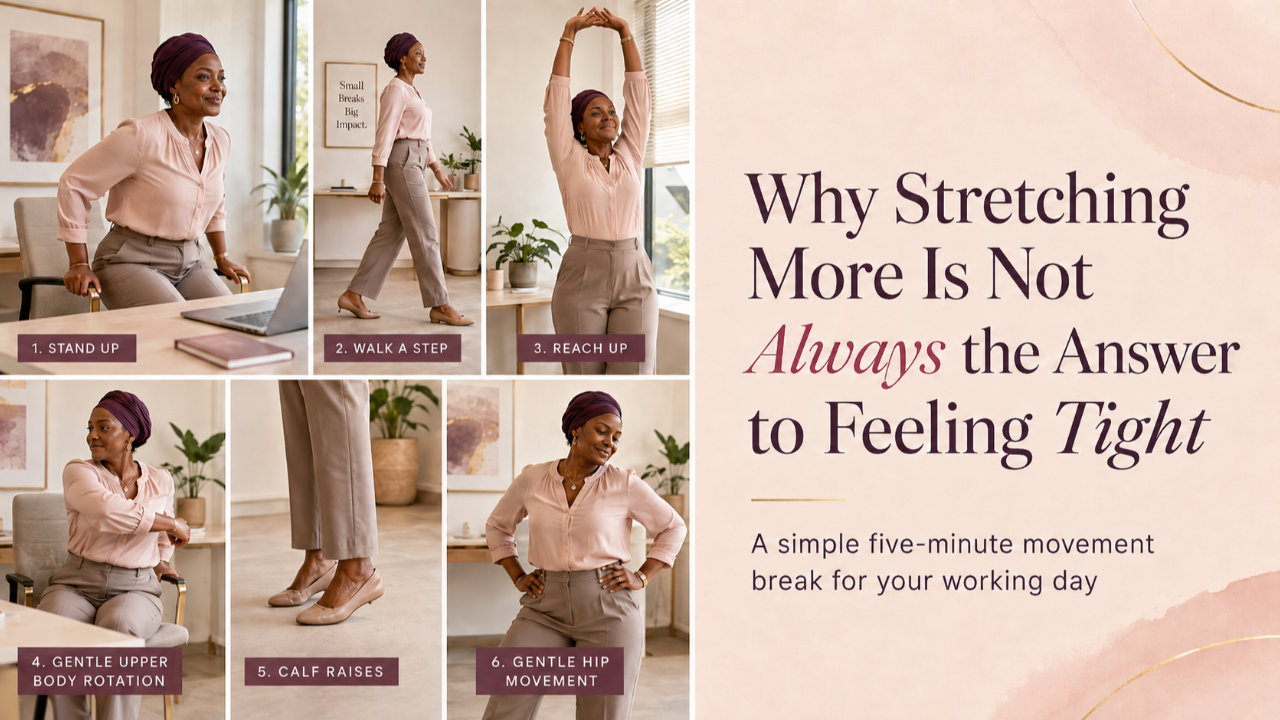
There is a familiar moment many women recognise. You stand up after a long meeting and immediately reach for the back of your thighs. You get out of the car and instinctively stretch your hips. Your shoulders feel tight after a day at the laptop, so you pull one arm across your chest and hope it will loosen. Stretching feels like the obvious answer because the sensation itself seems to be saying, “I need to be lengthened.”
Sometimes that is exactly what helps. But not always.
One of the most useful things to understand about midlife mobility is that feeling tight and actually needing more flexibility are not always the same thing. A muscle can feel uncomfortable because it has been held in one position for hours. It may be fatigued because it lacks strength for the job you keep asking it to perform. Your joints may simply need more movement variety. And sometimes the sensation improves far more after walking or strengthening than it does after holding another stretch.
This does not mean stretching has suddenly become unnecessary. Research continues to show that regular stretching can increase range of motion, and Harvard Health notes that flexibility naturally becomes more important as tissues become stiffer with age. A 2023 systematic review and meta-analysis also found that several weeks of static stretching can reduce measured muscle stiffness. Stretching genuinely has a place. The problem comes when we assume it is the only tool available.
This distinction matters particularly for women who already exercise. Perhaps you attend yoga every week and have good hamstring flexibility, yet your hips still feel tight. Maybe you can comfortably reach the floor in a forward bend but your lower back aches after a day at work. Or perhaps your shoulders are mobile enough to move overhead but become tired and tense after several hours at a computer.
The body is telling you something, but the message may not be, “Stretch further.”
One reason is that strength itself can improve range of motion. A systematic review comparing strength training with stretching found that resistance training performed through a useful range of movement could improve joint range of motion to a similar degree to stretching in many of the studies reviewed. This does not make stretching obsolete. It tells us that mobility and strength do not have to live in separate boxes.
Think about your hips after a long desk day. The front of the hips may feel stiff, and a gentle hip-flexor stretch may be relieving. But if your gluteal muscles and thighs are relatively weak, your body may also be asking for more muscular support. Five slow sit-to-stands, a few controlled bridges or supported squats may leave your hips feeling more comfortable because the surrounding muscles have finally been asked to work.
This is why I like the phrase move it, then strengthen it.
If an area feels tight after prolonged sitting, first give it some gentle movement. Walk for a few minutes. Slowly rotate your hips. Bend and straighten your knees. Move your spine. Then add a small amount of strength. That combination is often far more useful than immediately trying to pull the area into its deepest possible stretch.
Your shoulders provide another good example. A woman who spends much of the day working at a laptop may feel tight across her chest and shoulders. Stretching the chest can feel wonderful, but if the muscles of the upper back fatigue easily, those shoulders may continue to feel uncomfortable by late afternoon. A few resistance-band rows, wall push-ups or controlled shoulder-blade movements can build the endurance needed to support your upper body through a working day.
This changes the question from, “How can I make this muscle less tight?” to, “What does this area need to do its job better?”
That is a far more useful question.
The National Institute on Aging recommends a combination of strength, flexibility and balance activity because each contributes something different to physical function. Stretching can help maintain joint range of motion, but strengthening helps muscles support and control those joints, while balance work improves stability and confidence.
For a working woman, this means your mobility plan should not consist entirely of stretches performed after everything already hurts. It should include small amounts of movement and strength throughout the week.
Start with your working day itself. If your hips, back or shoulders repeatedly feel tight at four o’clock, ask how many hours they have spent in the same position. Harvard notes that prolonged sitting can contribute to tightness around areas such as the hips, legs and calves. The most obvious solution is not necessarily a longer evening stretching routine. It may be changing position earlier and more often.
Try standing whenever a meeting ends. Walk while taking a phone call when possible. Refill your water somewhere that requires you to leave the desk. Spend two minutes moving before lunch and another two minutes during the afternoon. These tiny interruptions may appear insignificant, but they prevent your body from remaining in one position for an entire block of the day.
You can also create what I call a tightness test.
When an area feels tight, do not immediately stretch it. First walk or move gently for two to five minutes. Then reassess.
If the sensation improves dramatically, your body may have needed movement more than a prolonged stretch. If it still feels restricted, try a gentle stretch. If the same area repeatedly becomes tight despite regular stretching, consider whether strength or work habits need attention.
Your hamstrings are a perfect example. Many women repeatedly stretch them because they feel tight, especially after sitting. But if the hamstrings and gluteal muscles lack strength or endurance, the sensation may continue returning. Instead of performing another long forward fold, try five slow hip hinges or a few controlled bridges, then see whether your legs feel different.
The aim is not to make this complicated. It is to experiment.
A useful lower-body reset might begin with a one-minute walk around the room, followed by five slow sit-to-stands. Add a gentle hip-flexor stretch on each side and ten calf raises. Finish with a few slow hip circles or controlled leg swings while holding something sturdy for support.
You have just combined movement, strength and flexibility in a few minutes.
For the upper body, begin by rolling your shoulders slowly backwards and forwards. Reach your arms overhead within a comfortable range, then gently rotate your upper body from side to side. Follow with eight to ten resistance-band rows or wall push-ups if those exercises suit you. Finish with a gentle chest stretch.
Again, the order matters less than the principle: do not ask stretching to solve everything on its own.
Yoga can be an excellent part of this approach. But if you are already quite flexible, you may get more benefit by focusing on how you control the pose rather than how deeply you enter it.
Take a lunge. Instead of driving forwards into the deepest hip stretch possible, try holding a slightly smaller lunge and feeling the muscles of the legs working. Keep your trunk tall, breathe steadily and come out of the pose slowly. You are still working on mobility, but you are also developing strength within that range.
The same applies to Warrior II. Do not judge the pose by how low you can go. Ask whether you can hold the position with control, keep the front knee comfortable and step out smoothly. That is a much more useful form of mobility for everyday life.
Midlife women can sometimes become caught in the belief that more flexibility must always be better. It is not.
You need enough range to perform the movements that matter to you. You also need enough muscular control to use that range confidently.
That might mean being able to turn comfortably when reversing the car, reach into a cupboard, squat to pick something up, step onto a train, climb stairs or get up from the floor. You do not need to perform the splits to do any of those things.
There is also value in understanding that range of motion can improve through repeated, well-controlled strength exercises. When you squat to an appropriate depth, perform a split squat, reach overhead with resistance or complete a controlled hip hinge, you are strengthening the body while also taking joints through useful movement ranges. This is why strength work can be such an important part of a mobility programme.
That is particularly important as we get older because muscle strength and mobility become increasingly connected. National Institute on Aging-supported research shows that maintaining an active lifestyle and performing strength exercise can substantially slow age-related declines in muscle strength and physical performance.
So instead of adding another twenty-minute stretching routine, consider whether two short strength sessions across your week might make a bigger difference.
You could start very simply. Sit-to-stands for the legs. Calf raises for the ankles. Resistance-band rows for the upper back. Wall push-ups for the chest and arms. Step-ups for the hips and thighs. A short single-leg balance beside a kitchen counter.
These are not glamorous exercises, but they train the movements your body actually uses.
Recovery matters too. Sometimes feeling tight is simply the result of doing more than your body is accustomed to. If you have recently started strength training, increased your walking or tried a new class, temporary stiffness may be part of the normal adaptation process. Stretching may make you feel better for a while, but recovery, sleep and gradually building training volume are equally important.
Harvard has also pointed out that stretching is unlikely to completely prevent post-exercise soreness or injury, despite the common belief that it does. Its most consistent benefit is improving flexibility and helping maintain range of motion.
That is another reason to use the right tool for the problem.
If you are sore because you trained harder than usual, gentle movement and recovery may be more useful than forcing a deep stretch. If you genuinely lack range of motion, regular stretching can help. If an area feels tired because it is weak, strength may be part of the solution.
And if you feel tight because you have spent four hours almost completely still, start by standing up.
One of the easiest habits you can introduce is a five-minute movement break twice during the working day. You do not need a yoga mat. Stand from your chair several times. Walk for a minute. Reach overhead. Rotate through your upper back. Perform calf raises. Gently move your hips.
The National Institute on Aging encourages a mix of physical activity rather than relying on one type alone, and this is exactly what that looks like in everyday life.
If you enjoy a dedicated stretching routine, keep it. Stretching is not the enemy here. Harvard recommends regular stretching and notes that flexibility can improve at any age when it is practised consistently.
Just make your stretching intelligent.
Warm up first rather than forcing a cold muscle into its end range. Stretch until you feel mild tension rather than pain. Breathe normally. Avoid bouncing. And if you continually stretch the same area without lasting improvement, take that as useful information rather than assuming you simply need to stretch harder.
Your body may need something else.
Perhaps it needs stronger hips.
Perhaps it needs more movement during the day.
Perhaps your shoulders need pulling strength rather than another chest stretch.
Perhaps your ankles need calf strength as well as mobility.
Perhaps your body needs a day to recover.
This is where midlife mobility becomes less about chasing flexibility and more about developing a better relationship with movement.
Instead of automatically labelling your body “tight”, become curious about when the sensation appears. Is it after hours at the desk? After exercise? First thing in the morning? Does walking improve it? Does strengthening improve it? Does stretching help temporarily but the feeling returns quickly?
Those patterns tell you far more than the sensation alone.
Persistent or unusual tightness should, of course, be treated differently. If you develop significant pain, joint swelling, numbness, weakness, a sudden loss of movement or stiffness that is progressively worsening, do not simply stretch through it. Speak with a physiotherapist, GP or appropriate healthcare professional. A symptom that repeatedly interferes with normal activity deserves proper assessment.
For most women, however, the opportunity is much simpler.
You do not need to wage war on every tight muscle.
You need a body that moves regularly, is strong through useful ranges and is given enough variety to avoid spending entire days in the same few positions.
Stretch where stretching helps. Strengthen where strength is missing. Walk when sitting has taken over the day. Rest when recovery is needed.
And remember that the goal is not to feel endlessly loose.
The goal is to feel capable.
Capable of turning, reaching and bending without hesitation. Capable of getting down onto the floor and back up again. Capable of walking, travelling, lifting and moving through your working week without constantly negotiating with stiffness.
Midlife movement does not need to be about becoming more and more flexible.
It can be about something much more valuable: building a body that feels supported, responsive and ready for the life you still want to move through.
Stay connected with news and updates.
Join our mailing list to receive the latest news and updates from our team.
Don't worry, your information will not be shared.
We hate SPAM. We will never sell your information, for any reason.