Why Rest Is Not Always the Answer When You Feel Drained
Aug 21, 2026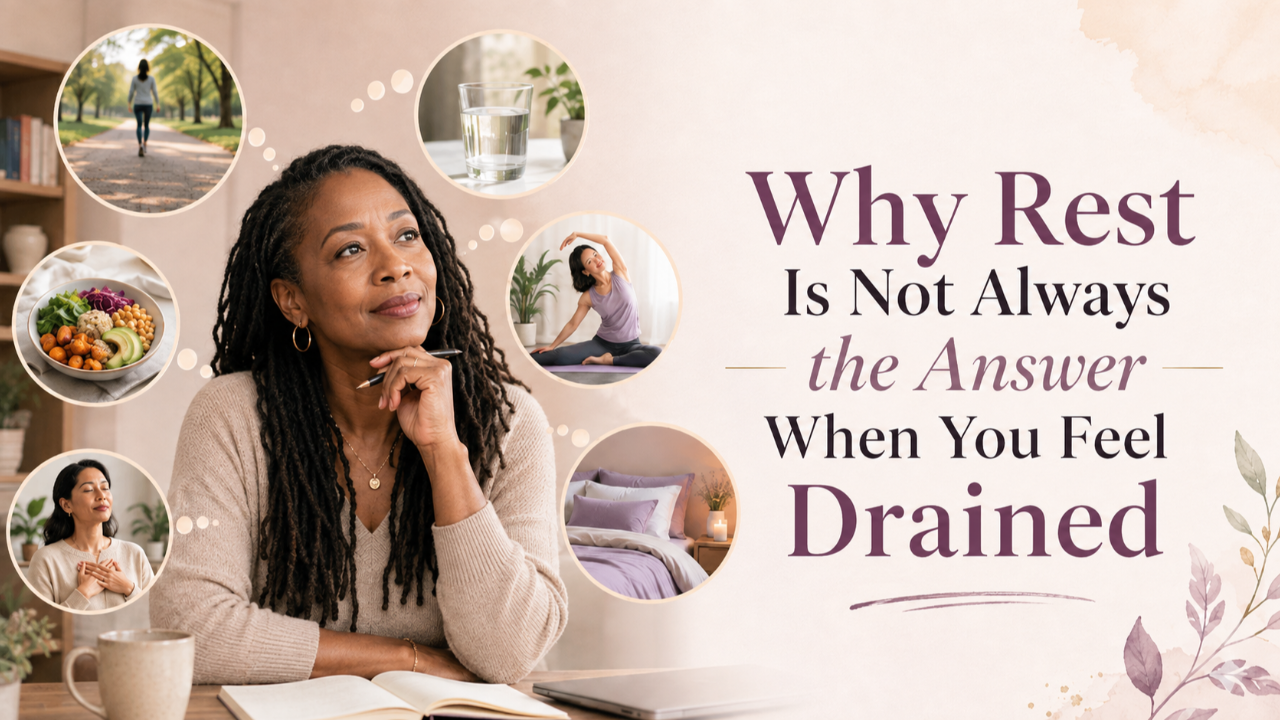
There are days in midlife when the moment you finish work, all you want to do is sit down. You close the laptop, move to the sofa and tell yourself you are too tired to walk, stretch or exercise. Yet an hour later, you do not necessarily feel restored. You may actually feel flatter, stiffer and even less inclined to move. This can be confusing because we are taught to respond to tiredness with rest, and sometimes that is exactly what the body needs. But there is another kind of drained feeling that does not always improve simply by becoming more still.
Harvard Health explains that fatigue can have physical, mental and emotional components, and that its causes can range from poor sleep and stress to inadequate nutrition and a sedentary lifestyle. This matters because the sentence “I feel exhausted” does not necessarily tell us what the body actually needs next. For a professional woman in her 40s or 50s, a day spent sitting through meetings may leave her mentally exhausted but physically under-stimulated. A poor night’s sleep may leave her genuinely sleepy. A hard training session may leave her muscles needing recovery, while a day filled with difficult conversations may leave her emotionally depleted. These experiences can all feel like tiredness, but they do not all respond to the same solution.
One of the most useful questions you can ask yourself is therefore: what kind of tired am I? Imagine a typical working day. You have spent hours concentrating, problem-solving, switching between emails and conversations and perhaps worrying about deadlines, yet physically you have barely moved. When five o’clock arrives, your brain may feel completely drained even though your muscles have had very little activity. That combination can create the strange experience of feeling both tired and restless at the same time.
Harvard Women’s Health has reported that regular exercise can actually increase energy rather than simply use it up. Exercise encourages adaptations in muscle, including increases in mitochondria, the structures within cells involved in producing usable energy, while physical activity also improves circulation and oxygen delivery. This does not mean that the answer to exhaustion is a punishing workout. In fact, the opposite can be true. Sometimes five or ten minutes of gentle movement is enough to tell you whether you needed rest or simply needed a change of state.
The next time you finish a desk-heavy day feeling depleted, try delaying the sofa by ten minutes. Put on comfortable shoes and walk outside. There is no need to power-walk or count steps. Let your arms swing, allow your hips to move and give your eyes something to look at beyond a computer screen. When you return, notice how you feel. If your head feels clearer and your body feels more awake, your tiredness may have contained a significant element of mental fatigue and inactivity. If you still feel profoundly exhausted, heavy-eyed and physically depleted, that is useful information too. You may genuinely need recovery.
This is not about overriding your body. It is about learning to read it more accurately. There is evidence to support the idea that movement can reduce fatigue. Harvard has highlighted research showing that regular exercise can improve feelings of energy and vitality, while the National Institute on Aging (NIA) notes that moderate activity may improve energy and outlook. It also recognises that yoga, stretching and other mind-body activities may support stress management and recovery. Importantly, however, the NIA also warns that too much exercise without sufficient recovery can contribute to fatigue.
That balance becomes especially important in midlife. The answer is not always “do more”, just as it is not always “rest more”. The skill is knowing which side of the equation needs attention. A woman who has completed several hard training sessions, slept poorly and feels unusually sore probably does not need another demanding workout. In that situation, a gentle walk, mobility work or a rest day may be the smarter choice. But the woman who has spent nine hours moving only between a desk, a meeting room and a car may feel drained partly because she has moved too little.
This is where active recovery can be especially helpful for professional midlife women. Active recovery does not mean secretly turning a rest day into another workout. It means using low-intensity movement to help the body transition out of the position and mental state it has occupied for hours. That might mean a fifteen-minute walk after work, a gentle yoga sequence, a few mobility exercises while dinner cooks, an easy swim, some gardening or simply putting on music and moving around the house. The aim is not performance. It is restoration through movement.
A simple after-work reset can begin with the areas that have spent much of the day relatively fixed. Stand tall and slowly reach both arms overhead, then lower them with control. Repeat this several times while breathing comfortably. Follow with a few slow sit-to-stands from a chair to wake up the thighs and gluteal muscles, then roll your shoulders backwards and gently rotate your upper body from side to side. Finish with five to ten minutes of walking. It does not need to look impressive. It simply needs to help your body feel different from how it felt at your desk.
There is another reason going outside can help. Light is one of the strongest signals regulating our internal body clock. Harvard Health explains that daylight helps tell the brain when it should feel awake, while darkness helps prepare us for sleep. A short outdoor walk during an afternoon lull therefore gives you two things at once: movement and natural light. For someone who has spent most of the day indoors, that can be more restorative than moving directly from one chair to another.
Sleep, however, still deserves enormous respect. There is a danger in the wellness world of making tired women believe that every problem can be solved with exercise. It cannot. Harvard Health continues to emphasise that deeper sleep is an important period of physical renewal and repair. During perimenopause and menopause, this becomes particularly relevant because sleep may be disrupted by hot flushes, night sweats, waking in the night or difficulty falling back asleep.
The Menopause Society recognises sleep disturbance as a common feature of the menopause transition, alongside symptoms such as hot flushes and mood changes. Harvard Women’s Health has also highlighted how unpredictable hormonal changes during perimenopause can make sleep more difficult and leave women tired, irritable and less able to concentrate the following day. So if you slept five fragmented hours, forcing yourself through a difficult workout because someone told you exercise gives you energy may not be helpful.
A better question is: what is the minimum amount of movement that would help me today without taking more from me? Perhaps that means a twenty-minute walk instead of an hour-long class. Perhaps it means gentle mobility instead of heavy lifting. Perhaps it genuinely means a rest day because your body is clearly asking for one. That is not weakness. It is intelligent training, especially during a stage of life when recovery, sleep and stress all deserve more attention.
The same principle applies to emotional exhaustion. You can be physically rested and still feel completely depleted after a day of difficult conversations, caregiving responsibilities or constant decision-making. The National Institute on Aging notes that emotional stress, anxiety, grief and feeling overwhelmed can all contribute to fatigue. Resting on the sofa while continuing to answer messages, scroll through news or mentally rehearse tomorrow’s problems may therefore not be particularly restorative.
Sometimes what your nervous system needs is not stillness but a reduction in demand. This is why a walk without your phone can feel very different from simply “going for a walk”. You are giving yourself ten or fifteen minutes in which nobody can ask you a question, your screen cannot present you with another problem and your brain does not have to keep switching tasks. Yoga can work in a similar way. A short sequence with slow breathing, rather than an athletic practice, may be enough to create a transition between the demands of work and the rest of your evening.
Even breathing deserves a place here, although it should not be presented as a cure-all. If your working day has kept you in a constant state of urgency, try two minutes of slower breathing, allowing the exhalation to be slightly longer than the inhalation. Sit or stand comfortably and let the breath slow naturally. There is no need for complicated ratios or dramatic breath-holding. The purpose is simply to stop rushing for two minutes and give the body a clear signal that the working day is shifting into something quieter.
Nutrition can also masquerade as tiredness. If you ate breakfast at seven, grabbed something small for lunch and have spent the afternoon running on coffee, you may not need a nap at five-thirty. You may simply need food. Before deciding that your energy has collapsed, ask when you last ate and whether your meals contained enough nourishment. Women trying to manage their weight can easily create a pattern in which daytime food becomes progressively smaller while evening fatigue and hunger become progressively larger.
Hydration deserves the same basic check. Harvard Health notes that fatigue can be an early sign of inadequate hydration. If you have had several coffees and very little water since breakfast, drinking some water before deciding that something is seriously wrong with your energy is a sensible place to start. Water will not solve every form of fatigue, but it can remove one unnecessary contributor.
This is why it helps to separate different types of tiredness rather than treating them all as the same thing. Sleepiness usually needs sleep. Under-fuelling needs food. Dehydration needs fluid. A body that has been sitting all day may need movement. An overloaded brain may need fewer demands. A body that has trained hard may need genuine recovery. We often call all of these states “tired”, which is why we sometimes choose the wrong response.
A useful midlife habit is to develop a short energy check-in whenever you feel drained. Think back over the previous twenty-four hours. How was last night’s sleep? When did you last eat? Have you had enough water? How long have you been sitting? Have you exercised hard recently? Has the day been emotionally demanding? Then choose the response that best matches the likely cause rather than simply defaulting to the sofa.
If you have spent the day sitting and slept well, try ten minutes of walking before you rest. If you trained hard yesterday and your body feels heavy, choose gentle mobility or a true rest day. If you are hungry, eat something nourishing. If your brain feels saturated, step outside without your phone. If menopause symptoms kept you awake repeatedly through the night, give sleep and recovery the attention they deserve instead of trying to push through with more caffeine.
This approach can also help prevent another common midlife pattern: using high-energy days to compensate for low-energy ones. Perhaps you rested yesterday because you were depleted. Today you feel better, so you decide to catch up by doing a hard workout, adding extra steps and completing everything you did not manage yesterday. That can create a cycle of overdoing and recovering rather than building stable energy.
A steadier approach usually works better. On good days, use your energy without emptying the tank. On lower-energy days, keep a smaller version of your routine where appropriate. Your full strength session might become twenty minutes, a long walk might become a shorter one, and a full yoga class might become ten minutes of mobility. The habit remains, but the dose changes.
This can be particularly powerful for professional women because life rarely provides perfectly controlled conditions. There will be late meetings, disturbed nights, travel, family responsibilities and stressful periods. A health routine that only works when you feel fantastic is not especially useful. The more valuable routine is the one that can flex with your actual life without disappearing altogether.
It is equally important to recognise when rest really is the answer. If you are unwell, feverish, dizzy, unusually breathless, experiencing significant pain or recovering from a demanding physical event, movement should not be used as an energy hack. Persistent exhaustion that does not improve with sleep or sensible lifestyle changes also deserves proper investigation.
The National Institute on Aging advises speaking with a healthcare professional when fatigue continues for several weeks, because ongoing tiredness can sometimes be linked with conditions such as anaemia, thyroid problems, sleep disorders, anxiety, depression and other health issues. Midlife should not become a convenient explanation for every symptom.
The Menopause Society has also highlighted another issue worth knowing about: heavy or prolonged menstrual bleeding during the menopause transition can be associated with greater fatigue. If your periods have become significantly heavier and tiredness is accompanied by weakness, dizziness, palpitations or breathlessness, it is worth discussing with a healthcare professional whether iron deficiency or anaemia could be part of the picture.
The goal is not to become suspicious of every tired afternoon. It is to become better at recognising patterns. For the next week, pay attention to what happens when you feel drained. If your instinct is to sit down, try five or ten minutes of gentle movement first on days when you have been sedentary. Notice whether your energy improves, remains unchanged or worsens.
You may discover that your five o’clock exhaustion is often desk fatigue. You may notice that your worst days consistently follow broken sleep. Perhaps gentle movement restores you after mentally intense days but feels dreadful after a demanding workout. Maybe the days you get outside at lunchtime feel noticeably different from the days you never leave the building. These are useful clues because tiredness is not a single physiological state.
Midlife is not the stage of life when you need to become better at forcing yourself through exhaustion, nor is it the stage when every low-energy moment requires you to withdraw from activity. It is the stage when learning the difference becomes incredibly valuable.
Some days, respecting your body will mean cancelling the workout and going to bed earlier. On another day, respecting your body may mean getting off the sofa, putting on your shoes and walking gently outside for ten minutes. Both decisions can be forms of recovery because both are responses to what your body actually needs.
The most useful question is no longer, “Should I push through or should I stop?” It is, “What would genuinely restore me today?” Sometimes the answer will be sleep. Sometimes food. Sometimes stillness. Sometimes daylight, stretching, a walk or twenty quiet minutes in which nobody needs anything from you.
When you start responding to the type of tiredness rather than simply the word “tired”, energy becomes something you can understand rather than something you constantly battle. And that may be one of the most valuable changes you can make in midlife: not learning how to push harder, but learning what truly helps you come back stronger.
Stay connected with news and updates.
Join our mailing list to receive the latest news and updates from our team.
Don't worry, your information will not be shared.
We hate SPAM. We will never sell your information, for any reason.