The Midlife Balance Skill You May Be Losing Without Realising It
Aug 27, 2026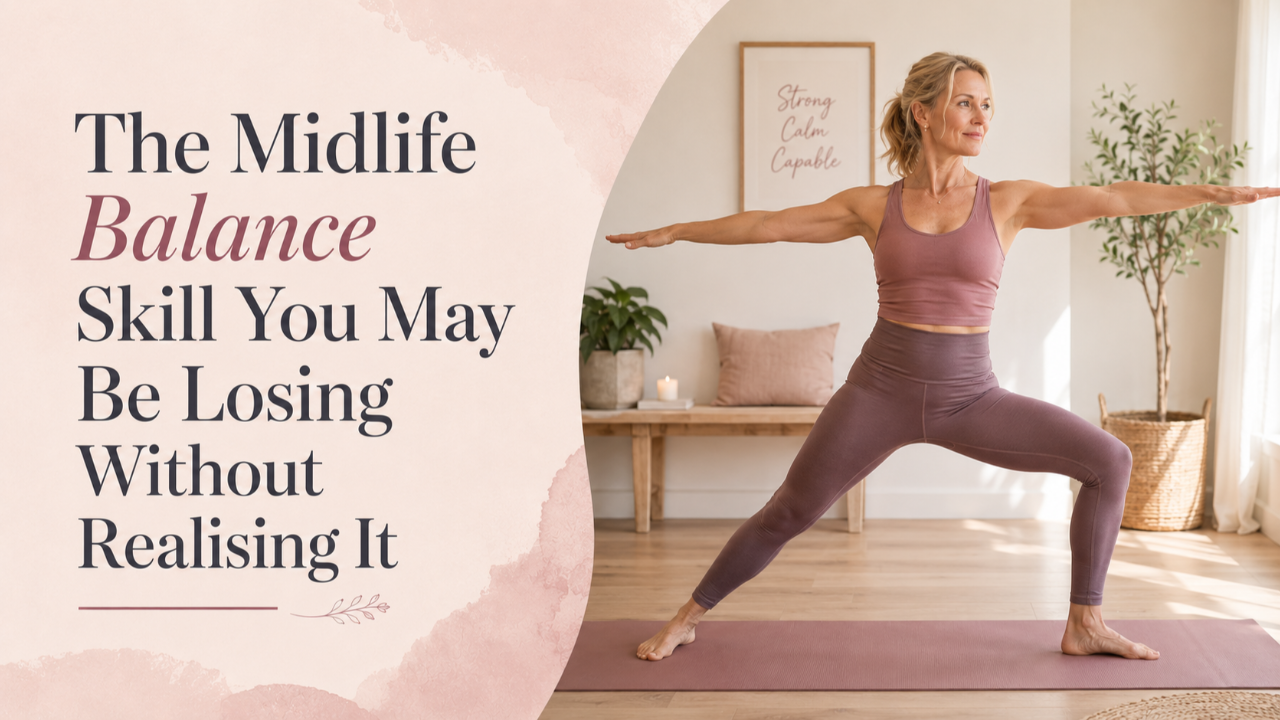
You probably do not think very much about your balance when it is working well. You step off a kerb while talking, pull on a pair of trousers standing on one leg, reach into a high cupboard, turn quickly when somebody calls your name and walk across uneven ground without consciously calculating any of it. Your body makes hundreds of tiny corrections in the background and you simply get on with your day.
That is precisely why changes in balance can be so easy to miss.
Unlike strength, where you may suddenly notice that a suitcase feels heavier, balance can begin changing quietly. Perhaps you put a hand on the wall when taking off your shoes. You feel slightly less confident stepping over something. You wobble when holding a yoga pose you once found easy, or find yourself looking down more often when walking over uneven ground. None of these necessarily means you have a balance disorder. They can simply be useful signals that one of the physical skills we often take for granted deserves a little more attention.
And there is an important reason to start paying attention in your 40s and 50s rather than waiting until balance becomes a problem later. Harvard Health's May 2026 guidance on maintaining balance makes the point very clearly: balance training is something we ideally begin before older age and continue throughout life. Harvard also emphasises that strong legs and a strong core are important components of maintaining balance when walking, turning and rising from a chair. (Harvard Health)
Balance is far more sophisticated than simply “not falling over”. Every time you move, your brain is combining information from several systems. Your eyes tell you where you are relative to your surroundings. Your inner ear helps detect changes in head position and movement. Sensors in your muscles, joints and skin provide information about where different parts of your body are, even when you are not looking at them. Your brain then combines this information with muscle strength and reflexes to keep you upright.
That body-position sense is called proprioception. You use it constantly without noticing. Close your eyes and touch your nose with your finger and you have just used proprioception. Step onto an uneven path and your ankle makes tiny adjustments before you have consciously thought about what the foot is doing. A 2024 systematic review found that proprioceptive and sensorimotor exercise programmes could improve several measures of balance, although the researchers judged the overall certainty of the evidence to be low and called for better-quality studies. The important message is not that proprioception is a magic system to “hack”, but that balance responds to practice. (PubMed)
Age is part of this picture, but menopause deserves a more nuanced explanation than it is sometimes given online. A 2026 systematic review and meta-analysis looking at menopausal status and physical function found that premenopausal women often appeared to perform better on measures including strength and balance than postmenopausal women. However, many of those differences became much smaller once chronological age was taken into account. In other words, ageing itself appears to explain a substantial proportion of the change rather than menopause being solely responsible. (PubMed)
That does not mean menopause is irrelevant. Changes in muscle mass, muscle strength and bone health during and after the menopause transition are important, particularly because strength contributes to balance. The Menopause Society has highlighted evidence that declining oestrogen is associated with reductions in muscle mass and strength as women move beyond menopause. (The Menopause Society) The useful conclusion is not “my hormones have ruined my balance”. It is that midlife is an excellent time to actively train the physical qualities that help protect it.
There is some very encouraging research here. A 2025 randomised study involving women in their 40s and 50s found that twelve weeks of low-impact resistance training improved hip strength and dynamic balance. Importantly, the improvements occurred in premenopausal, perimenopausal and postmenopausal women. The researchers concluded that women retained the ability to improve strength and balance regardless of menopausal status. (PubMed)
That is a wonderful midlife message: balance is not simply something you lose. It is something you can train.
Walking is valuable, but walking alone does not challenge balance in every way your body needs. Most everyday walking happens on fairly predictable surfaces, with both eyes open and your body moving forwards. Balance becomes more demanding when the base beneath you becomes narrower, you change direction, move sideways, stand on one leg or have to control your body while reaching.
This is why a woman can comfortably walk five miles yet still wobble when she tries to stand on one leg.
A simple place to begin is the single-leg stand. Stand beside a kitchen worktop or sturdy chair so that support is immediately available. Shift your weight onto one leg and lift the opposite foot only slightly from the floor. You do not need to pull your knee dramatically towards your chest. Try holding the position comfortably for around ten to twenty seconds, then change sides.
The interesting part is not whether you can perform it perfectly. Notice what happens. Does one side feel considerably steadier? Do your toes grip the floor? Does your ankle make lots of small corrections? Do you immediately hold your breath? This is useful information rather than something to judge.
As it becomes easier, progression does not have to mean performing circus-like exercises. You could use slightly less hand support, increase the duration a little, or gently move the lifted foot forwards and backwards while keeping something sturdy nearby. The National Institute on Aging (NIA) recommends exercises such as single-leg standing, heel-to-toe walking and walking sideways or backwards as ways of practising balance. It also specifically advises having a stable chair, wall or person available if you feel unsteady. (National Institute on Aging)
Your feet and ankles deserve more attention than they usually receive. They are the first point of contact between your body and the ground, and the muscles around the ankle continually make small adjustments to maintain stability. Yet many professional women spend much of the working week with their feet barely being challenged beyond walking on flat floors.
One very useful exercise is the slow calf raise. Stand behind a stable chair or counter, rise gradually onto the balls of your feet and lower yourself with control. Instead of rushing through twenty repetitions, notice whether you can move smoothly and keep your weight evenly distributed. Calf strength contributes to walking and ankle control, and strengthening the legs and trunk is also recognised by the CDC as part of improving balance. (CDC)
You can make this more relevant to everyday life by practising a heel-to-toe walk. Place one foot directly in front of the other as though walking along a narrow line. Take several slow steps with a wall or countertop nearby. This narrows your base of support and forces the body to make different corrections from those required during ordinary walking.
Your hips are equally important. Every time you stand on one leg during walking, the muscles around the hip help keep your pelvis controlled. This is one reason the recent resistance-training study showing improvements in hip strength alongside improvements in balance is so interesting. (PubMed)
Simple movements such as sit-to-stands, supported squats and step-ups can therefore contribute indirectly to balance because they strengthen the muscles you rely upon when catching yourself, climbing stairs and controlling your body through changes in position.
Try five to ten slow sit-to-stands from a stable chair. Stand without using your hands if that feels safe, pause tall and lower yourself with control. Instead of thinking of this only as a leg exercise, recognise that you are training your body to shift its centre of mass from sitting to standing and control that transition.
Your core matters too, although “core strength” does not mean spending twenty minutes doing abdominal crunches. Your trunk helps control your position as your limbs move around you. Exercises such as a controlled bird-dog, supported marching, loaded carries or carefully performed resistance exercises can all ask your trunk to stabilise while the rest of the body moves.
Yoga has a particularly useful role here. Tree Pose, Warrior III variations and lunges can challenge balance, but many standing yoga poses also train hip strength, foot awareness, concentration and controlled weight shifting at the same time. The National Institute on Aging includes yoga and tai chi among activities that can combine balance with other forms of physical training. (National Institute on Aging)
But there is an important principle I want women to remember: do not turn balance practice into a test of how long you can avoid wobbling.
Wobbling is part of balance training.
The small corrections your ankle, hip and trunk make are the practice. You are teaching the nervous system to respond to changing information. If you lose your position, put your foot down, reset and try again. That is far more useful than becoming frustrated because the pose does not look perfectly still.
Vision can also disguise how much balance work your body is doing. Your eyes provide powerful information about your environment, and we tend to rely increasingly on vision when other balance systems become less efficient. Harvard describes balance as a complex interaction between visual information, body sensation, reflexes, muscular strength and other neurological processes. (Harvard Health)
This does not mean you should immediately start practising balance with your eyes closed. Removing vision makes balance considerably harder and increases the risk of falling. If you want to progress balance work, start by changing safer variables such as reducing hand support or narrowing your stance while remaining close to something stable. More challenging sensory work is better done with professional guidance when appropriate.
Your working environment can quietly reduce the amount of balance practice you get too. A desk-based day gives your body very few reasons to balance dynamically. You sit, stand, walk along flat corridors and sit again. Contrast that with gardening, dancing, hiking or even moving around a busy kitchen, where you step sideways, reach, turn, bend and continually reposition your weight.
That means adding balance work does not always require another workout. Build it into ordinary life.
While the kettle boils, stand on one leg with the counter beside you. When brushing your teeth, practise a narrower stance rather than automatically leaning against the sink. Take the stairs when appropriate. Step sideways during a movement break. Practise walking heel-to-toe for a few careful steps along a hallway.
Thirty seconds repeated frequently can be more realistic than waiting for a perfect twenty-minute balance session.
You can also create a simple five-minute balance reset for the end of your working day. Begin with five slow sit-to-stands, follow with ten calf raises and then practise ten to twenty seconds of single-leg standing on each side. Walk heel-to-toe for several steps beside a wall, then finish with a few controlled sideways steps.
That is enough to begin.
Do it two or three times during the week and notice what changes over a month. You may find one leg becomes steadier. You may stop gripping the floor so intensely with your toes. A yoga balance may feel calmer. Stepping into trousers without sitting down may become easier.
These small improvements matter because balance is not really about standing still on one leg in your kitchen. It is about what happens when life unexpectedly moves you.
You miss a kerb.
The pavement is uneven.
You turn quickly.
Your dog pulls the lead.
You step sideways to avoid somebody.
You climb onto a stool.
In those moments, balance becomes your body's ability to organise itself quickly enough to keep you in control.
This is also why strength and balance should not be separated too rigidly. The CDC's current guidance for adults aged 65 and over specifically recommends balance activity alongside aerobic and muscle-strengthening exercise, and lists activities such as one-leg standing and heel-to-toe walking. (CDC) Although those formal balance recommendations target older adults, Harvard's 2026 advice is clear that maintaining balance is something worth beginning much earlier rather than waiting until your 60s or 70s. (Harvard Health)
For a woman in her 40s or 50s, this makes balance training a form of preparation rather than rehabilitation.
And there is another reason this matters in women: bone health. The Menopause Society continues to highlight the increased importance of protecting bone after menopause as oestrogen decline accelerates bone loss. (The Menopause Society) Strong bones matter, but so does reducing the likelihood of the fall that could fracture them. Strength, balance and bone health therefore belong in the same long-term conversation.
There are, of course, times when wobbliness is not simply something to train. Persistent dizziness, vertigo, repeated falls, sudden changes in balance, new weakness, fainting, hearing changes or neurological symptoms should be medically assessed. The National Institute on Aging notes that balance problems can arise from medications, inner-ear disorders, blood-pressure changes and a variety of medical conditions. (National Institute on Aging)
Do not dismiss a genuine change as “just menopause” or “just getting older”.
But if your balance is simply something you have never trained, the opportunity is wonderfully straightforward.
Start before you need to.
Keep walking, because cardiovascular fitness matters. Keep strength training, because strong legs and hips give you more capacity to control your body. Continue yoga if you enjoy it, but let some poses become exercises in control rather than flexibility. Train your ankles. Practise changing direction. Give your body moments during the week when it has to organise itself rather than simply sit or move forwards.
And make balance part of your definition of strength.
A strong midlife body is not only one that can lift a heavy weight. It is a body that can step off a kerb confidently, recover from an unexpected wobble, walk over uneven ground, turn quickly and continue moving without fear.
You may never notice the thousands of tiny corrections that keep you upright.
That is the point.
The best balance is the balance that quietly allows you to keep saying yes: to hiking somewhere beautiful, carrying luggage through an airport, trying a new yoga class, climbing a hillside, dancing, travelling and moving through the world without having to think twice about whether your body can manage it.
So do not wait until balance becomes something you have lost before you decide it matters.
Train it now, while life still gives you every reason to use it.
Because one of the most valuable skills you can build in midlife is not simply the ability to stay on your feet.
It is the confidence to keep moving wherever those feet still want to take you.
Stay connected with news and updates.
Join our mailing list to receive the latest news and updates from our team.
Don't worry, your information will not be shared.
We hate SPAM. We will never sell your information, for any reason.