The Hidden Energy Cost of Sitting at a Desk All Day
Aug 20, 2026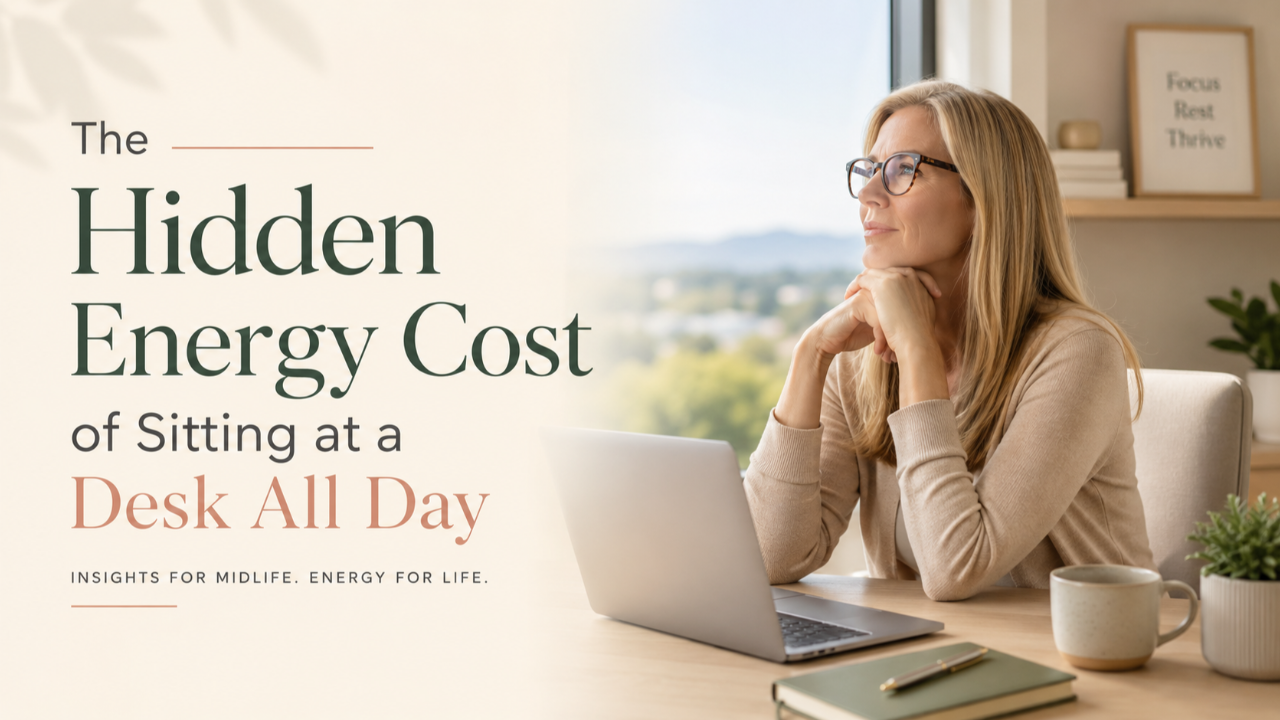
You can spend eight hours sitting at a desk and still arrive home feeling as though you have run a marathon. It seems contradictory. You have not been lifting, running or doing anything obviously physical, yet by five o’clock your shoulders ache, your hips feel stiff, your eyes are tired and the idea of exercising feels almost impossible. You may assume you are simply exhausted from work, or that midlife has reduced your energy, but there is another part of the picture worth understanding: sitting still for most of the day does not necessarily leave the body feeling rested.
For professional women in their 40s and 50s, this matters because a typical working day can involve breakfast at the kitchen table, sitting in the car or on a train, several hours at a computer, lunch at the desk, more meetings, another commute and finally the sofa. You might exercise for forty minutes in the morning and still spend the majority of the remaining day almost completely inactive. The body does not interpret that long stretch of inactivity in the same way as restorative rest.
When you sit for prolonged periods, the large muscles in your legs and hips become relatively inactive. Harvard Health has explained that when these muscles are used less, they also take up less glucose from the bloodstream, which is one reason long periods of sedentary behaviour have been linked with poorer metabolic health. This does not mean that sitting at a desk immediately causes a blood sugar problem, but it does reinforce an important point: your muscles are metabolically active tissue, and using them regularly throughout the day matters.
A 2026 systematic review and meta-analysis of more than 50 studies found that regularly interrupting prolonged sitting with physical activity reduced post-meal glucose and insulin responses, with walking breaks appearing particularly effective. That is useful for a busy working woman because it means the answer does not have to be another lengthy workout. Short periods of movement scattered across the day can offer benefits of their own.
The Centers for Disease Control and Prevention (CDC) recommends at least 150 minutes of moderate-intensity physical activity each week, together with muscle-strengthening activity on at least two days. But there is another part of the message that can easily be overlooked: move more and sit less. Your morning strength session is valuable, but it does not mean the remaining ten hours of the day should become completely motionless.
The effects of prolonged sitting are often noticeable physically before we ever think about metabolism. Your hips remain in roughly the same position, your knees stay bent, your gluteal muscles are relatively inactive and your head can gradually drift towards your screen. Over time, the shoulders round forward and stiffness creeps into the hips, neck and lower back. Harvard Health notes that prolonged sitting can contribute to tightness around the hips and hamstrings, joint stiffness and discomfort in areas such as the lower back and knees.
That familiar feeling of having to “unfold yourself” from the chair at the end of the day is therefore not imaginary. In midlife, it becomes even more important to pay attention because maintaining mobility and muscle strength will play an increasingly important role in how confidently and comfortably you move as you age.
One of the most useful changes you can make is to stop thinking of movement as something that only counts when you change into gym clothes. Movement at work counts too. Standing up to make a drink, walking to speak to a colleague, taking the stairs, walking between meetings or getting outside for five minutes all interrupt long periods of inactivity. These do not replace structured exercise, but they stop the working day from becoming one enormous block of sitting.
Harvard research has highlighted that even brief bouts of activity can be worthwhile. This is encouraging because it makes movement much more realistic. You do not need to disappear from your desk for half an hour every hour. Instead, create small reasons to get out of the chair throughout the day.
A useful habit is to ask yourself a simple question approximately every thirty minutes: could I change position or move for a minute or two? Sometimes the answer will simply be standing while reading an email. Other times you might walk to refill your water bottle, take a telephone call standing up or walk down a corridor before your next meeting. If you work from home, walk upstairs and back, step outside briefly or move around the room while listening to a call.
The point is not to turn your working day into an exercise circuit. It is to prevent three or four hours passing without your lower body doing anything meaningful. This is especially useful after lunch, when many of us immediately return to the desk and remain there for the next several hours.
A short walk after lunch can be one of the simplest habits to introduce. Research suggests that breaking up sitting with movement after eating can improve post-meal glucose and insulin responses compared with remaining seated continuously. A ten-minute walk around the building, outside the office or even through the corridors can therefore have benefits beyond simply increasing your step count.
You may also notice that moving changes how you feel mentally. Desk fatigue is not purely physical. Professional work requires constant concentration, decision-making, problem-solving and switching between tasks. You may have barely moved all morning while your brain has been working intensely for hours. This is why a desk day can leave you genuinely exhausted even when your body has not been physically active.
Sometimes what feels like tiredness needs movement rather than more sitting. A ten-minute walk without your phone can be particularly useful. Allow your eyes to focus on something beyond a screen, let your arms move naturally and give your brain a break from processing information. You are not trying to burn calories. You are giving your body and nervous system a change of state.
Your eyes deserve attention too. Prolonged screen use can cause digital eye strain, which may include tired eyes, headaches, blurred vision and neck or shoulder discomfort. The American Optometric Association recommends the 20-20-20 approach: around every twenty minutes, look at something approximately twenty feet away for twenty seconds. It is a remarkably simple habit that can fit into almost any working day.
You could look out of the window while someone else is speaking during a virtual meeting, focus on the other side of the room while a document loads or simply stand up and look down the corridor. We also tend to blink less when concentrating on screens, which can contribute to dry and uncomfortable eyes. Regular breaks from close-up screen work give the visual system a chance to reset.
Your workstation matters, but perfect ergonomics should not become an excuse to remain completely still. A standing desk can add useful variety, particularly if it allows you to alternate between sitting and standing, but replacing eight hours of sitting with eight hours of standing is not the goal. Movement appears to be more valuable than simply holding a different static position, so think about variety rather than finding one supposedly perfect posture.
A very simple five-minute desk reset can make a surprising difference. Begin with five slow sit-to-stands from your chair, standing tall and lowering yourself with control. Follow this with ten to fifteen calf raises while lightly holding the chair if needed for balance. Then perform a few gentle upper-body rotations, slowly turning your chest from side to side within a comfortable range. Add a simple chest opener by drawing your shoulders gently back and allowing the front of the body to lengthen, then finish by walking for two minutes.
That is enough. You do not need to be sweating or breathless for the break to count. If you repeated a short reset like this two or three times during the working day, you would have introduced considerably more movement without needing to find another hour for formal exercise.
It can also help to connect movement to things that already happen. When a meeting ends, stand up. When you take a telephone call, walk if practical. When you refill your water, do a few calf raises. After lunch, walk for five or ten minutes. When you finish your final email, stretch before you close the laptop. Attaching movement to an existing habit is often much easier than setting another reminder that eventually becomes part of the background noise.
If you work from home, deliberately making life slightly less efficient can actually help. Keep your water in the kitchen rather than beside the desk. Use the toilet upstairs. Walk to another room when taking a call. Put something away rather than leaving it beside you for later. Modern life has been designed to remove movement wherever possible, so occasionally putting a little inconvenience back into your day can work in your favour.
None of this means sitting is inherently bad. Sitting is a normal part of life. We sit to work, eat, travel, socialise and rest. The issue is not the chair itself. The issue is spending too many hours in one position without enough movement around it.
It is also important not to assume that every episode of tiredness is caused by sitting or menopause. If you are consistently exhausted despite sleeping adequately, eating well and moving regularly, or fatigue is accompanied by unusual breathlessness, dizziness, palpitations, unexplained weakness or other significant changes in your health, speak with a healthcare professional. Persistent fatigue deserves to be taken seriously.
For most working women, however, the most useful experiment is surprisingly simple. Look at the structure of tomorrow rather than waiting until the evening to decide you should move more. How many meetings will keep you sitting? Could one telephone call become a walking call? Could you stand while reading a document? Could you walk after lunch? Could you perform five sit-to-stands before your afternoon meeting? Could you give your eyes twenty seconds away from the screen several times during the day?
These actions can seem almost too small to matter, and that is precisely why they are so useful. They are realistic enough to survive a busy working week. You do not need another health routine that only works when your diary is empty. You need habits that fit inside the life you actually have.
Perhaps the biggest shift is to stop thinking about movement only as a way of changing your weight. A short walk between meetings can support your metabolic health. Standing and stretching can give stiff muscles and joints a different position. Strengthening exercises can help preserve the muscle that becomes increasingly valuable in midlife. Looking away from your monitor can reduce the strain of hours spent staring at a screen. Movement is one of the ways you help your body continue to function well while you work.
So if you regularly finish a desk day wondering why you feel so tired when you have “hardly done anything”, perhaps the fact that you have hardly moved is part of the answer. Your body may not be asking you for a punishing workout at the end of an exhausting day. It may simply be asking for more opportunities to move throughout it.
The goal is not to turn every hour into exercise. It is to stop asking your body to remain still for most of the day and then expecting it to feel energised, mobile and comfortable at five o’clock.
Stand up when you can. Walk after lunch. Move your shoulders. Use your legs. Look away from the screen. Give yourself a few minutes between the demands of one task and the next.
Because protecting your energy in midlife is not always about doing more. Sometimes it is about giving your body what it has quietly been missing all day: the chance to move.
Stay connected with news and updates.
Join our mailing list to receive the latest news and updates from our team.
Don't worry, your information will not be shared.
We hate SPAM. We will never sell your information, for any reason.