Can Ten Minutes of Yoga Really Change How Your Body Feels?
Aug 28, 2026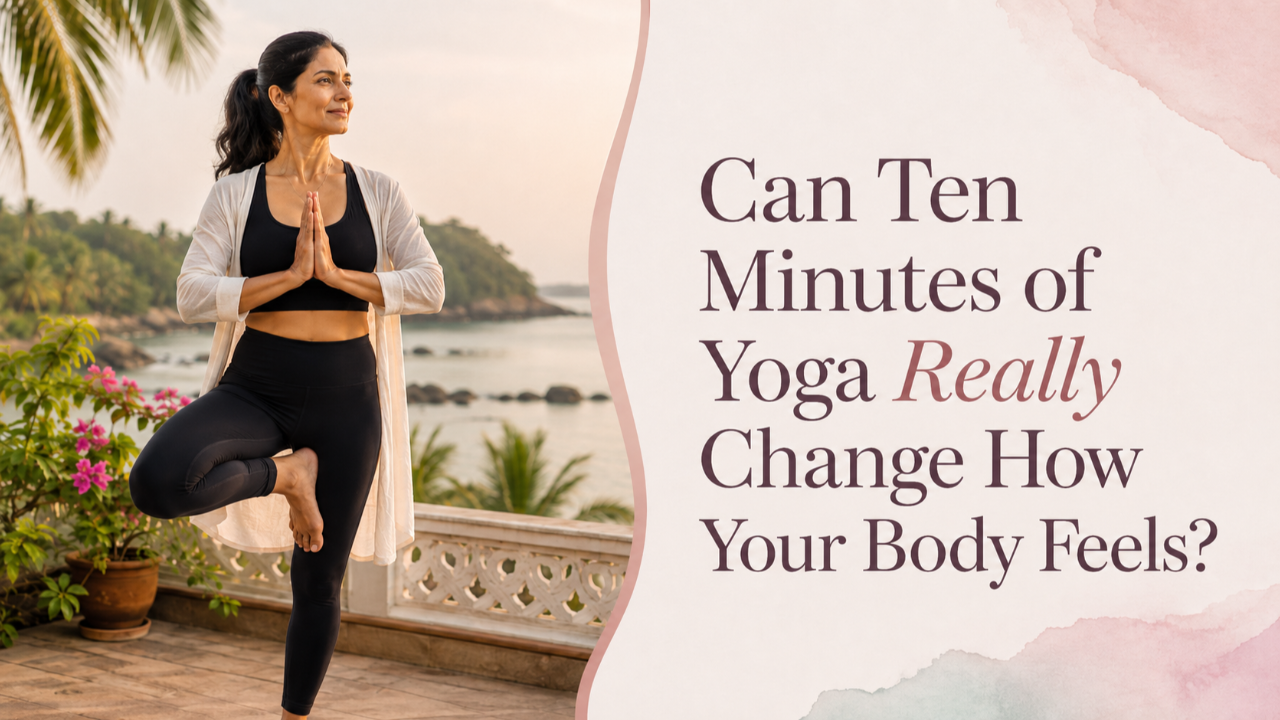
Ten minutes can feel almost too insignificant to count. By the time you have finished work, answered the last email, prepared dinner and dealt with everything else waiting for you, the idea of finding an hour for yoga can feel unrealistic. So you decide you will do it properly tomorrow instead. Tomorrow becomes next week, and before long the yoga mat is something you walk past rather than something you use. But what if ten minutes was not the compromise? What if, on a busy working day, ten minutes was exactly the amount of time that allowed you to keep moving, reconnect with your body and feel noticeably different from the woman who closed her laptop?
There is an important distinction to make from the beginning. Ten minutes of yoga will not transform your flexibility, strength or cardiovascular health overnight. Most research demonstrating lasting physical benefits from yoga involves regular practice over weeks or months rather than a single short session. But a brief practice can still be useful, and when ten minutes becomes something you repeat consistently, those small sessions begin to accumulate. Harvard Health describes yoga as unusual because it can work on several aspects of physical fitness at once, including flexibility, balance and strength, while also incorporating breathing and focused attention.
That is particularly relevant in midlife because the body you bring to your yoga mat at 48 or 55 may feel very different from the one you remember at 30. Your hips may be tighter after a day at your desk, your upper back may feel less mobile and your balance may require more concentration. A night interrupted by hot flushes may leave you with less enthusiasm for vigorous exercise, while a stressful working day can make it feel as though your shoulders have gradually moved towards your ears. Yoga cannot remove every cause of those symptoms, but it can provide something many professional women are missing during the working day: movement variety.
Think about how your body spends most of its time. Sitting involves relatively little rotation through the spine, limited hip extension, almost no reaching overhead and very little balance challenge. Then we wonder why those movements gradually begin to feel unfamiliar. Ten minutes of thoughtfully chosen yoga can take your body through positions it has barely experienced during the previous eight hours. That alone can make you feel different.
The National Center for Complementary and Integrative Health, part of the U.S. National Institutes of Health, reports that research suggests yoga may support general wellbeing through benefits including stress management, sleep, emotional health and balance. There is also evidence that yoga may help some people with low-back and neck pain, although the strength of the evidence varies depending on the condition. The first benefit you may notice from a short session, however, is not suddenly becoming more flexible. It is simply feeling less stuck.
Imagine standing after three hours at your computer. Instead of immediately moving to another chair, you spend ten minutes taking your spine through gentle flexion and extension, opening the front of your hips, reaching your arms overhead and rotating through your upper back. You have changed the movement information your body has been receiving all afternoon. This is one reason I prefer women to think of yoga as movement nourishment rather than another workout they must complete. You do not always need to sweat or dramatically increase your heart rate. Sometimes your body simply needs to move somewhere it has not been all day.
A simple Cat-Cow sequence is a good example. On your hands and knees, gently alternate between rounding and extending your spine within a comfortable range. There is no prize for creating the biggest movement possible. The value comes from allowing the spine and rib cage to move after hours spent facing forwards. If working on the floor is not suitable, you can do a standing version with your hands resting on your thighs. As you breathe out, gently round through your upper back. As you breathe in, return towards neutral and open the chest slightly. The movement should feel controlled rather than forced.
Then consider your hips. A gentle low lunge can be particularly welcome after a desk-based day because it moves the hip into extension, the opposite direction from the position it has occupied while sitting. Keep the movement modest, use blocks or a chair for support if needed, and look for a comfortable sensation rather than the deepest possible stretch. Yoga is not a flexibility competition, and you do not need to reproduce the pose performed by a much younger instructor on your screen. Your hip structure, knee anatomy, previous injuries, training history and current mobility are your own. A successful yoga pose is the one that gives your body an appropriate challenge.
Balance can also fit beautifully into a ten-minute practice. Tree Pose, for example, requires surprisingly little time but asks your feet, ankles, hips, trunk, vision and nervous system to work together. Stand beside a wall or chair if you need support. Place the toes of one foot on the floor or bring the foot higher onto the standing leg if that feels appropriate, avoiding pressure directly against the knee joint. If you wobble, that is not failure. As we explored earlier in this mobility week, those small corrections are part of what you are practising.
One Tree Pose on Tuesday will not revolutionise your balance, but a few minutes of balance work several times a week creates repeated opportunities for that system to improve. That is how physical capacity is built: not through one heroic effort, but through repeated exposure. The same principle applies to strength.
Strength can be woven into those ten minutes as well. Warrior II is not simply a stretch. Hold it for a little while and the legs begin working, the hips stabilise and the trunk has to remain controlled. A modified Plank can ask the shoulders, arms and core to support you, while Chair Pose can challenge the thighs and hips without any equipment. Yoga can therefore contribute to strength alongside flexibility and balance, although it should not necessarily replace progressive resistance training if maintaining or building muscle is one of your goals.
That distinction matters in midlife. I would still encourage women to include dedicated strength training during the week because maintaining muscle becomes increasingly important as we age. Yoga can complement strength work beautifully by adding control, balance, body awareness and movement through different ranges. Think of yoga and strength training as partners rather than competitors. Strength gives you capacity, while yoga can help you explore how you use that capacity through movement.
The mental effect of a short practice may be just as valuable as the physical one, particularly for a woman moving from a demanding working day into the rest of her evening. Work does not always end when the laptop closes. Your body may have left the meeting, but your mind is still replaying a conversation, solving tomorrow’s problem or running through everything you have not yet completed. Yoga creates a deliberate interruption because your attention has somewhere else to go. You notice your feet, your breath, the position of your arms and where your weight is moving.
Research reviewed by the National Center for Complementary and Integrative Health suggests that yoga can help with perceived stress, although studies vary in quality and the exact mechanisms are still being investigated. There is even evidence that individual yoga sessions can influence how people feel immediately afterwards. One study involving regular yoga practitioners found improvements in positive engagement, tranquillity and feelings of revitalisation after sessions, alongside reductions in exhaustion. This does not prove that every ten-minute practice will have the same effect, but it supports something many women recognise intuitively: you can walk onto a yoga mat feeling one way and step off feeling another.
That is perhaps the most realistic promise of ten minutes. It is not instant transformation, but it can create a change of state. You may begin feeling mentally crowded and finish feeling slightly calmer. You may start stiff and finish moving more freely. You may arrive disconnected from your body and leave feeling more aware of it. Those shifts may be modest, but modest shifts are often exactly what allow a healthy habit to survive a busy working week.
There may also be relevance during the menopause transition. Research suggests yoga may help reduce some menopause-related symptoms, and studies involving women with sleep difficulties have found possible improvements in sleep quality. Yoga should still be viewed as a supportive approach rather than a treatment for every menopause symptom. Persistent sleep disruption, severe hot flushes or other troublesome symptoms deserve appropriate medical advice.
This is where I would encourage professional women to stop asking, “When can I fit in a full yoga class?” and instead ask, “Where would ten minutes make the biggest difference to how my body feels?” For some women, the answer will be the morning. You wake feeling stiff through the hips and spine and spend the first hour moving slowly. A ten-minute morning practice does not need to be demanding. You might begin standing with a few slow breaths, reach your arms overhead, move into a gentle side bend and rotate your upper body comfortably from side to side.
You could then add a few slow Chair Poses or sit-to-stands to wake up the legs, followed by Cat-Cow, a gentle low lunge on each side and perhaps a simple standing balance such as Tree Pose. By the time you shower and begin work, your body has already experienced far more movement variety than if you had moved directly from bed to chair.
For another woman, the ideal time may be immediately after work. This can become your movement commute. Close the laptop and resist going directly to the sofa. Spend the first minute breathing and deliberately allowing the working day to end. Move through Cat-Cow, Child’s Pose if comfortable, a low lunge on each side and perhaps Downward-Facing Dog if it suits your shoulders and wrists. Move into Warrior II on each side, add a gentle rotation and finish with a quieter resting position.
Ten minutes later, work is behind you. Not because every problem has disappeared, but because you have created a boundary between the part of your day when everyone needed something from you and the part that belongs to you again.
For women who become stiff during the working day, ten minutes can even be divided. Five minutes at lunchtime and five minutes after work still count. There is no physiological rule stating that useful movement only begins when a session reaches sixty minutes. In fact, one of the most damaging ideas in wellness is that if you cannot do the ideal version, you may as well do nothing. That mentality turns a busy Wednesday into five days of inactivity because the next “proper” workout will happen at the weekend.
Your body does not need perfection. It needs repetition. Harvard’s guidance around short yoga practices consistently emphasises regularity, and this principle matters far more than whether today’s session lasts ten, fifteen or forty minutes.
One practical way to make this happen is to choose a ten-minute anchor. Perhaps yoga happens immediately after you shut your laptop on Tuesdays and Thursdays. Maybe it happens while dinner is in the oven. Perhaps you practise first thing on the mornings when you are not strength training. Attach it to something that already exists rather than asking yourself to remember another isolated task.
The routine itself can remain simple. Spend the first minute standing and breathing, then use the next couple of minutes to move the shoulders and spine. Give another two minutes to the hips with gentle lunges, then spend a little time building strength through Warrior or Chair Pose. Add a short balance exercise and finish with gentler movement and breathing. You do not need to perform exactly the same sequence every time.
If your shoulders are stiff after work, give them more attention. If you have been travelling, focus more on your hips and spine. If you feel mentally overwhelmed but physically comfortable, use slower movements and spend longer breathing. Let the practice respond to the woman who actually arrived on the mat rather than the routine you imagined when you planned the week.
This is one of yoga’s greatest advantages in midlife: it can flex when you need to flex. There will be days when you feel strong and energetic and want a more vigorous practice. On other days, supported poses and gentle movement will be enough. Both count.
There is also no requirement to perform every pose on the floor. Chair yoga can provide many of the same basic movement principles and can be particularly useful if wrists, knees, balance or getting down onto the floor are concerns. Safety matters more than achieving a particular shape. Yoga is generally considered safe when practised appropriately, but people with existing injuries or certain medical conditions may need modifications or professional guidance.
Pain is not evidence that yoga is working. A stretch can create mild tension, a strength pose can make muscles work and a balance pose can challenge you, but sharp, increasing or unusual pain is a reason to stop and reassess rather than push further.
Perhaps the most useful way to measure whether your ten minutes is helping is not to ask whether you have become dramatically more flexible. Look instead at ordinary moments. Does turning to reverse the car feel easier? Do your shoulders feel less locked after working? Can you get out of bed and move comfortably sooner? Does your balance feel steadier? Do you finish work feeling less physically compressed? Does ten minutes of movement make you less likely to spend the rest of the evening completely still?
Those changes are meaningful. They are also far more relevant than whether your fingertips have moved another centimetre towards the floor.
Yoga in midlife does not need to be about creating increasingly complicated shapes with your body. It can be a way of moving joints that have spent the day still, strengthening muscles without equipment, practising balance and creating a transition between work and home. It can also be a reminder to breathe when your day has been moving too quickly and a way of staying connected to your body at a stage of life when that body may sometimes feel less predictable than it once did.
So, can ten minutes of yoga really change how your body feels? Yes, it can change how you feel after those ten minutes. Lasting improvements in strength, balance, mobility and wellbeing require repetition over time, and yoga is only one part of a well-rounded approach to midlife health. But never underestimate the value of a practice that is short enough to actually happen.
Ten minutes on Monday, Wednesday and Friday becomes half an hour of movement your body would otherwise not have received. Repeat that pattern across weeks and months and those small sessions begin to build something much bigger: greater consistency, better body awareness and a routine that does not disappear every time life becomes busy.
The most valuable yoga practice is not necessarily the longest one, the hardest one or the one containing the most impressive poses. It is the one you can return to when work is busy, energy is imperfect and life refuses to make space for the ideal plan.
Because in midlife, the real power of ten minutes is not that it allows you to do everything. It is that ten minutes can be enough to help your body feel better today, and realistic enough to make you want to return tomorrow.
Stay connected with news and updates.
Join our mailing list to receive the latest news and updates from our team.
Don't worry, your information will not be shared.
We hate SPAM. We will never sell your information, for any reason.