Build a Body That Moves Well for Life: Your Midlife Mobility Blueprint
Aug 29, 2026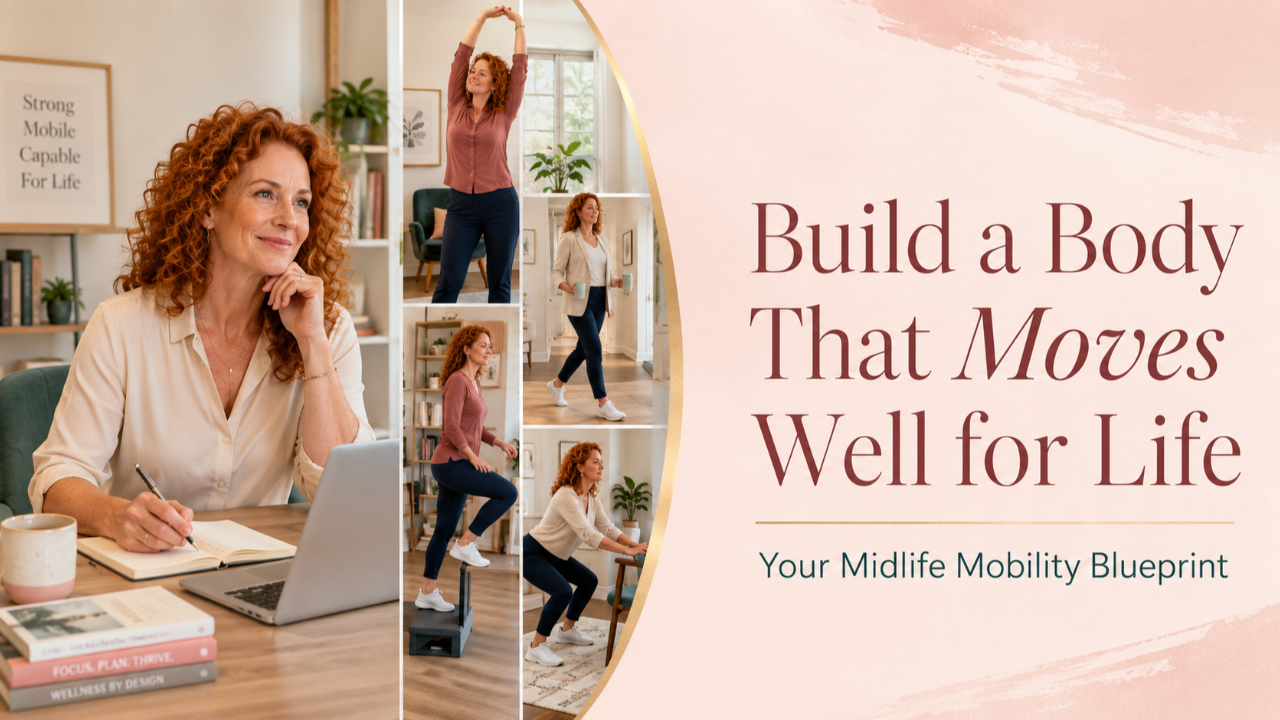
There comes a point in midlife when fitness begins to mean something different. It is no longer simply about whether you can run faster, lift heavier or fit into a particular pair of jeans. Increasingly, it becomes about whether your body allows you to live the life you want without constantly negotiating with stiffness, weakness or hesitation. Can you get off the floor comfortably, carry a suitcase through an airport, walk all day on holiday, reach into a high cupboard, climb a steep flight of stairs or turn quickly without worrying about your balance? That is mobility in the way that really matters.
Harvard Health defines mobility as the ability to move purposefully through everyday life and explains that it depends on much more than flexibility. Strength, stamina, balance, coordination and range of motion all contribute. This is an important message for women because it changes the goal completely. A mobile body is not necessarily the body that can perform the deepest yoga pose. It is the body that can respond confidently to whatever life asks it to do.
Your 40s and 50s are an important time to think about this because age-related physical changes do not suddenly begin at 70. Muscle mass and strength can begin declining gradually much earlier, and over time that can affect how capable everyday movements feel. The encouraging part is that these changes are not simply something we have to surrender to. Regular activity and resistance training can help preserve and improve strength, while mobility, balance and flexibility work can help maintain the physical options available to us.
That is why I would encourage you to stop thinking of mobility as a stretching programme. Think of it instead as a blueprint for protecting your physical freedom. The aim is not to become the most flexible woman in the room. The aim is to remain strong enough, mobile enough and confident enough to keep doing the things that matter to you.
For the professional woman, the first part of that blueprint begins outside the gym. You might train three times a week and still spend an extraordinary amount of time sitting. There is the commute, the laptop, meetings, lunch at the desk and perhaps another hour on the sofa after dinner. Public-health guidance consistently encourages adults not only to meet weekly exercise targets, but also to move more and sit less throughout the day.
Those words matter because mobility is built in the spaces between workouts too. If you exercise at seven in the morning and then remain seated for most of the next nine hours, your body still spends the majority of the day experiencing very little movement variety. A five-minute walk between meetings, standing while making a phone call or getting outside after lunch may seem insignificant, but these small moments stop movement from becoming something that happens only when you are wearing gym clothes.
So your first mobility habit can be wonderfully simple: break up stillness. Do not wait until your hips feel locked or your back complains before you stand. Use the end of a meeting as a cue. Walk to refill your water, take the stairs when practical, reach overhead and rotate gently through your upper back. If you work from home, create reasons to leave the desk rather than designing your environment so efficiently that everything you need is within arm’s reach.
The second part of your blueprint is strength, and this may be the most important shift of all for women who have spent years concentrating mainly on cardio or flexibility. The National Institute on Aging explains that muscle-strengthening activity helps maintain strength and makes everyday tasks such as getting out of a chair, climbing stairs and carrying groceries easier. That is where strength training becomes much more relevant than simply lifting weights for appearance.
You do not need stronger legs because somebody says women over 40 should lift. You need stronger legs because stairs are part of life. You need stronger hips because every step relies on them. You need a stronger back and shoulders because shopping bags, suitcases and household tasks are not going anywhere. Strength training becomes far more meaningful when you connect it with the life you want to keep living.
Two full-body strength sessions each week are a strong starting point for many women. They do not have to be complicated or last for ninety minutes. A squat or sit-to-stand practises the ability to lower and rise. A step-up strengthens the thighs and hips while rehearsing a movement used on stairs. A row works the upper back, a pushing exercise strengthens the chest and arms, and a bridge or hip hinge trains the muscles around the hips and back of the body.
Progress gradually rather than trying to prove something every time you train. Your body needs enough challenge to have a reason to become stronger, but that does not mean every session should leave you exhausted. When an exercise becomes comfortably manageable, you can gradually increase resistance, repetitions or difficulty. Long-term progress is built by repeatedly providing the body with an appropriate challenge and enough recovery to respond to it.
The third part of your blueprint is usable range of motion. Flexibility matters because your joints need sufficient range to perform the movements you ask of them. Stretching can help maintain or improve that range, particularly when it is performed consistently and without forcing the body into pain. But throughout this mobility week, we have explored an important distinction: you do not simply want range. You want control of your range.
Being able to move a leg into a certain position is useful. Being able to move into that position, control your body there and come back out confidently is even more useful. This is why yoga and strength training work so beautifully together. A lunge may give the hips more movement, while holding and controlling the lunge asks the legs and trunk to work. Warrior poses combine mobility, stability and strength. Tree Pose asks the hips, feet, ankles and nervous system to coordinate while you balance.
This is also why I would not judge your mobility by whether you can touch your toes. Some women can do this easily and still struggle to squat comfortably or stand on one leg. Other women may never touch their toes yet walk, lift, climb and move extremely well. Mobility should be measured against your life, not somebody else’s anatomy.
Your fourth component is balance. Balance can be easy to ignore in your 40s and 50s because most of us do not think about it until something becomes more difficult. Yet balance depends on strength, vision, sensory information and the nervous system working together, which is why maintaining it deserves attention before it becomes a problem.
You do not need a separate forty-minute balance workout. Practise while the kettle boils, with a kitchen counter close enough to hold. Stand on one leg for ten or twenty seconds, then change sides. Walk heel-to-toe along a clear hallway with support nearby. Add Tree Pose to your yoga practice. Perform slow step-ups rather than rushing them. The small wobbles you feel are not necessarily signs that you are doing badly. They are often part of the practice.
Your fifth component is cardiovascular capacity. Mobility is not simply having the strength to climb a flight of stairs. It is having enough stamina to keep moving once you reach the top. Walking, swimming, cycling, dancing and other aerobic activities support heart and lung health and help maintain the endurance needed for everyday life.
For a working woman, this might mean a brisk twenty-minute walk before work, ten minutes after lunch and a longer walk at the weekend. It could mean swimming twice a week or walking part of your commute rather than driving all the way. The best cardiovascular exercise is not necessarily the one somebody tells you is optimal. It is the one you enjoy enough and can fit into your life consistently enough to benefit from it.
When you put these pieces together, something important happens. Strength supports your joints, mobility gives you useful range, balance gives you control, cardiovascular fitness gives you stamina and everyday movement stops your body spending most of its life switched off between workouts. That is your midlife mobility blueprint.
You do not need to perform every part of it every day. Imagine a realistic working week. On Monday, you complete a thirty-minute full-body strength session. Tuesday is desk-heavy, so you walk after lunch and spend ten minutes on yoga or mobility after work. Wednesday includes a brisk walk and a little balance practice. Thursday is your second strength session. Friday is busy, so you simply break up your sitting and walk when you can. At the weekend, perhaps you swim, practise yoga, walk somewhere beautiful or choose an activity you genuinely enjoy.
That is a very different model from believing you need a perfect workout seven days a week. You are giving your body different reasons to remain capable, and that is much more sustainable.
It can also help to identify your own mobility priorities rather than copying somebody else’s routine. Ask yourself what you want your body to be able to do comfortably ten or twenty years from now. If travelling matters enormously to you, carrying luggage, walking for several hours and navigating stairs deserve a place in your training. If you love gardening, kneeling, squatting, lifting and getting up from the floor become important. If yoga is part of your life, hip strength, shoulder stability and balance deserve attention alongside flexibility.
Perhaps your goal is simply to remain independent. That is more than enough. One incredibly useful test is to notice how often you practise the movements you want to retain. If getting off the floor matters, practise getting down and back up regularly while you are still able to do it comfortably. If climbing stairs matters, use stairs sometimes rather than automatically choosing the lift. If carrying bags matters, build grip and upper-body strength.
We become better at what we repeatedly ask the body to do. This principle can make your workouts more interesting too. Instead of asking, “What exercise burns the most calories?”, ask, “What ability am I building?” A squat builds your ability to lower and rise. A calf raise strengthens muscles used during walking and helps ankle control. A row builds pulling strength and supports the upper body. Tree Pose develops balance. A brisk walk builds endurance. A lunge gives your hips and legs a different challenge from sitting.
Suddenly exercise becomes less about punishment and far more about preparation.
There is another habit I would build into your blueprint: a five-minute mobility check-in. After a long working day, stand up and notice how your body feels before automatically stretching everything. Move your shoulders, rotate gently through the upper back, perform several sit-to-stands, walk around for a minute and try a few calf raises or a gentle hip movement. Then ask what actually needs attention.
Perhaps your hips need stretching. Perhaps your shoulders need strengthening. Perhaps you have simply been still for too long. Perhaps you are genuinely tired and need recovery rather than another workout. This kind of body awareness becomes increasingly valuable in midlife because it moves you away from rigid routines and towards intelligent movement.
Recovery is part of the blueprint too. A body that moves well is not built by repeatedly exhausting it. Strength improves when exercise is followed by enough recovery for adaptation to occur. Sleep matters, nutrition matters, protein matters and rest days matter. A sustainable programme should challenge you, but it should also leave enough capacity for your ordinary life.
There will be weeks when your routine changes. You will travel, work late, sleep badly or simply have less energy. This does not mean your mobility programme has failed. Keep the minimum version alive. Ten minutes of movement is still movement, a shortened strength session still counts, walking still counts and five minutes of yoga still counts.
The habit of returning matters far more than maintaining a perfect streak.
Your environment can support you too. Keep a resistance band somewhere visible rather than hidden at the back of a cupboard. Leave your yoga mat somewhere accessible. Put your walking shoes near the door. Use your diary to protect strength sessions in the same way you protect meetings. Removing tiny barriers can make movement much easier to maintain when life becomes busy.
And measure progress using the things that genuinely matter. Perhaps after three months you can stand from the floor without using your hands. Your suitcase feels easier to lift. You can walk for two hours without your hips complaining. Your balance is steadier when putting on shoes. Your shoulders move more comfortably overhead and you finish a long office day feeling less physically compressed.
Those are meaningful victories. They are also a far richer description of successful midlife fitness than simply becoming smaller.
Of course, movement should not be used to ignore persistent pain. New or worsening joint pain, swelling, significant weakness, repeated falls, unexplained numbness or a meaningful loss of mobility deserves proper assessment. A physiotherapist, GP or other appropriate healthcare professional can help determine whether something specific needs treatment.
For everyone else, this is an extraordinarily hopeful area of health. Although strength and physical performance can decline with age, regular activity and appropriate training can slow those changes considerably, and many people can become stronger even later in life. That means the body you have at 70 is not determined entirely by what happens to you. Part of it is influenced by what you begin practising now.
That does not mean fearing ageing or turning every workout into an attempt to prevent decline. Quite the opposite. It means recognising that movement is one of the ways you keep expanding what life can contain. Walk because you want to keep exploring. Strengthen your legs because there are still stairs, hills and journeys ahead. Train your balance because the world is not perfectly flat. Keep your shoulders mobile because there will always be something to reach for. Practise getting off the floor because you want that option to remain yours.
Your midlife mobility blueprint does not need to be complicated. Move throughout the day, build strength twice a week, keep your joints moving through useful ranges, practise balance, maintain your stamina, recover properly and repeat. You do not need to do it perfectly. You need to do it often enough that your body keeps receiving the message that these abilities still matter.
Because the ultimate goal of midlife fitness is not to create a body that performs beautifully for an hour in the gym. It is to build a body that continues to work for you everywhere else: a body that lets you travel, work, walk, lift, bend, climb, swim, practise yoga, explore and keep saying yes without wondering whether your physical ability can keep up with the life you still want.
That is what moving well for life really means. The work you put into mobility today is not simply another exercise routine to complete. It is a way of protecting the freedom to keep doing the things that make your life feel full.
And perhaps that is the most important reason to train for mobility in midlife. You are not preparing for a fitness test. You are preparing for years of ordinary, extraordinary living.
Every walk, strength session, balance drill and ten-minute stretch is a small vote for that future.
Not just a body that lasts, but a body that keeps giving you the freedom to live.
Stay connected with news and updates.
Join our mailing list to receive the latest news and updates from our team.
Don't worry, your information will not be shared.
We hate SPAM. We will never sell your information, for any reason.