You Do Not Have to Lift Heavy to Become Stronger
Jun 26, 2026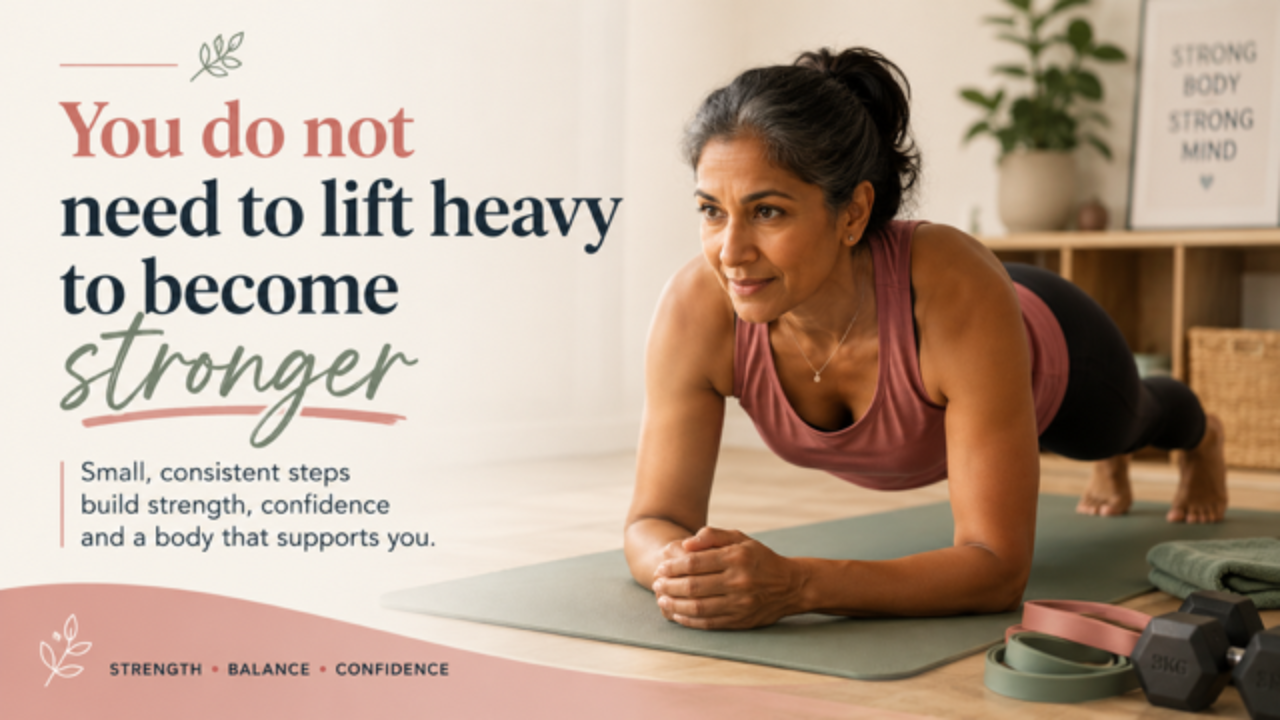
The phrase “strength training” can create a very particular picture: a crowded gym, heavy barbells and someone straining to lift a weight that looks alarmingly large.
For a woman already managing stiff joints, interrupted sleep, unpredictable energy or a body that feels different during perimenopause, that picture may be enough to make strength training feel unsuitable.
Perhaps you have quietly decided that you are not strong enough to lift weights. You may worry about damaging your knees, hurting your back or looking foolish because you do not know where to begin.
The reassuring truth is that you do not need to start with very heavy weights to become stronger.
You can begin with your own body weight, a resistance band or a pair of manageable dumbbells. What matters is not whether the weight looks impressive. It is whether the exercise asks your muscles to work harder than they are used to working.
“Heavy” is different for every woman
A 3kg dumbbell may feel light to one woman and demanding to another. Standing up from a chair may be straightforward for someone who already exercises, but a meaningful strength exercise for someone returning after illness, injury or years of inactivity.
The correct starting resistance is therefore personal.
A weight is not too light simply because someone else can lift more. It is appropriate when it challenges you while still allowing you to move with good control.
Strength training is defined by the effort your muscles produce, not by the number printed on the dumbbell. Resistance can come from weights, bands, machines, household objects or your own body weight. The NHS describes strength exercise as any activity that makes the muscles work harder than usual.
Your first goal is not to prove how much you can lift. It is to find a level from which you can safely progress.
Lighter weights can still produce meaningful results
Research comparing lower-load and higher-load resistance training gives us an important but nuanced answer.
When exercises are performed with sufficient effort, lighter and heavier loads can both stimulate muscle growth. However, heavier loads generally produce greater improvements in maximal strength—the ability to lift the heaviest possible weight for one repetition.
That does not mean lighter weights are ineffective.
A beginner can become stronger using relatively modest resistance because the exercise is new to her body. During the early weeks of training, the nervous system also becomes better at recruiting and coordinating the muscles involved in each movement.
A 2023 study involving women aged 40 to 60 found that a structured free-weight programme improved strength in both premenopausal and postmenopausal participants. The study supports the wider evidence that middle-aged women remain capable of responding positively to resistance training.
You do not have to train like a powerlifter to make carrying shopping, climbing stairs or getting up from the floor feel easier.
Lighter must not mean effortless
This is where many home strength programmes stop working.
A woman buys a pair of light dumbbells, performs the same 12 repetitions for several months and wonders why nothing changes. The weights may have challenged her at first, but her body adapted. What was once training has gradually become a comfortable movement routine.
Your muscles need a reason to adapt.
A lighter weight can be effective when you perform enough controlled repetitions for the final few to feel genuinely challenging. If you finish a set and feel certain that you could repeat it another 15 times, the resistance is probably no longer providing much of a strength stimulus.
NHS guidance suggests working the muscles to the point where you need a short rest before continuing. It recommends starting gradually, commonly using sets of around 8 to 12 repetitions and progressing over time.
You do not need to reach complete muscular failure—the point at which another repetition is impossible—particularly when you are learning an exercise. A practical approach is to finish a set feeling that you could probably complete another two or three good repetitions, but not another ten.
That is challenging. It does not have to be frightening.
There is more than one way to progress
Progressive strength training is often misunderstood as constantly adding heavier weights.
Increasing the load is one useful form of progression, but it is not the only one.
You might begin by performing eight sit-to-stands from a high chair. Later, you could complete ten repetitions, use a slightly lower chair or hold a small weight against your chest.
You might start with a wall press-up. As you become stronger, you can move to a kitchen worktop, then a sturdy bench and eventually the floor.
A resistance-band row can progress through additional repetitions, a stronger band or a position that creates greater tension.
You can also improve the range of movement, reduce the support you use or add another set. Older resistance-training guidance from the American College of Sports Medicine recommends increasing resistance gradually when a person can comfortably perform one or two repetitions beyond the planned target.
Progression is not one dramatic leap. It is a series of small adjustments that prevent your body from becoming too comfortable.
Why heavier is not automatically better
Heavy resistance has a valuable place in strength training. Current evidence indicates that heavier loads are particularly effective when the specific goal is maximising strength. The 2026 American College of Sports Medicine position stand also found that heavier loading tends to produce greater gains in muscular strength, while useful improvements can be achieved through many different forms of resistance training.
But the heaviest weight you can move is not necessarily the most appropriate weight for you today.
A load that causes you to hold your breath, lose control, shorten the movement dramatically or compensate through your back is not helping you build good-quality strength.
There is also no benefit in increasing the weight simply because you feel you “should”. Your joints, connective tissues, confidence and movement skills need time to adapt alongside your muscles.
The right resistance is heavy enough to challenge you and manageable enough to control.
Over time, today’s challenging weight may become tomorrow’s warm-up. That is how gradual strength develops.
What safe effort should feel like
Strength training should involve effort. You may notice warmth in the muscles, a slowing of the final repetitions or the feeling that the muscle is becoming tired.
Your breathing may become deeper, but you should still be able to control the movement. Exhale during the most difficult part rather than holding your breath.
Muscular effort is different from sharp, sudden or worsening pain. Pain inside a joint, numbness, dizziness, chest discomfort or pain that changes the way you move should not be ignored.
Mild muscle soreness can occur after an unfamiliar session, but being extremely sore is not evidence that the workout was more effective. The aim is to provide a stimulus from which your body can recover—not to make normal movement difficult for several days.
Women with osteoporosis, previous fragility fractures, uncontrolled health conditions or significant joint problems may need individual guidance before progressing their exercises. The programme can often be adapted, but the safest movements and loads will depend on personal circumstances.
A simple progression plan for beginners
Choose five movements that cover the major areas of your body:
- A sit-to-stand or squat
- A supported hip hinge
- A wall press-up
- A resistance-band or dumbbell row
- A calf raise or loaded carry
During the first two weeks, perform one set of approximately eight controlled repetitions of each exercise. Use a level that feels manageable while you learn the movements.
During weeks three and four, work towards 10 to 12 repetitions or add a second set.
Once you can complete both sets comfortably with good control, change one element. Add a small amount of weight, use a stronger band or choose a slightly more challenging version of the movement.
Do not increase the weight, repetitions and number of sets all at once. Change one variable, allow your body to adapt and then reassess.
Training the major muscle groups on at least two days each week is consistent with UK physical activity guidance. Sessions do not need to be lengthy; the NHS notes that a typical strength session can take less than 20 minutes.
Try the “last three repetitions” check
During your next strength session, pay attention to the final three repetitions of each set.
If they feel exactly like the first three, you may need a little more resistance.
When the final repetitions require focus but your technique remains steady, the level is probably useful.
When your posture changes, you have to swing the weight or you cannot complete the movement comfortably, reduce the resistance or stop the set.
This check is more helpful than choosing a weight according to age, appearance or what another woman is lifting.
Your body tells you whether the exercise is challenging enough.
Strength is not measured only in kilograms
It is easy to assume that progress counts only when you move to a heavier dumbbell.
But strength can appear in ordinary life first.
You may notice that you no longer use your hands to push yourself out of a chair. You carry both shopping bags from the car without stopping. You walk upstairs without pulling yourself along the bannister.
Perhaps you can hold a plank for longer, lower yourself with greater control or complete a gardening task without your back becoming tired.
These changes may matter far more than the number written in your exercise record.
Research in postmenopausal women suggests resistance exercise can improve strength and functional capacity, although researchers emphasise the importance of individualising programmes according to previous experience, physical ability and the time needed to adapt.
The purpose of strength training is not merely to become good at lifting weights. It is to make your life easier to lift, carry and move through.
You are allowed to begin gently
Many women approach midlife exercise with an all-or-nothing mindset. They believe a workout must be long, heavy and exhausting to count.
That belief often delays the very first session.
Beginning with a wall press-up instead of a floor press-up is not cheating. Using a chair for balance is not failing. Choosing lighter weights while you learn the movement is not a sign that you are weak.
It is intelligent training.
The weight should become more challenging as you become more capable, but you do not need to rush towards the heaviest option. Consistency, appropriate effort and gradual progression matter more than trying to impress yourself during one workout.
Start with a resistance you can control. Allow the final repetitions to feel challenging. Record what you do and make one small progression when the exercise becomes easy.
You do not need to lift extremely heavy weights to become stronger.
You do need to give your muscles a challenge and keep allowing that challenge to grow with you.
Stay connected with news and updates.
Join our mailing list to receive the latest news and updates from our team.
Don't worry, your information will not be shared.
We hate SPAM. We will never sell your information, for any reason.