Why Starting Again Every Monday Is Not the Answer
Jun 29, 2026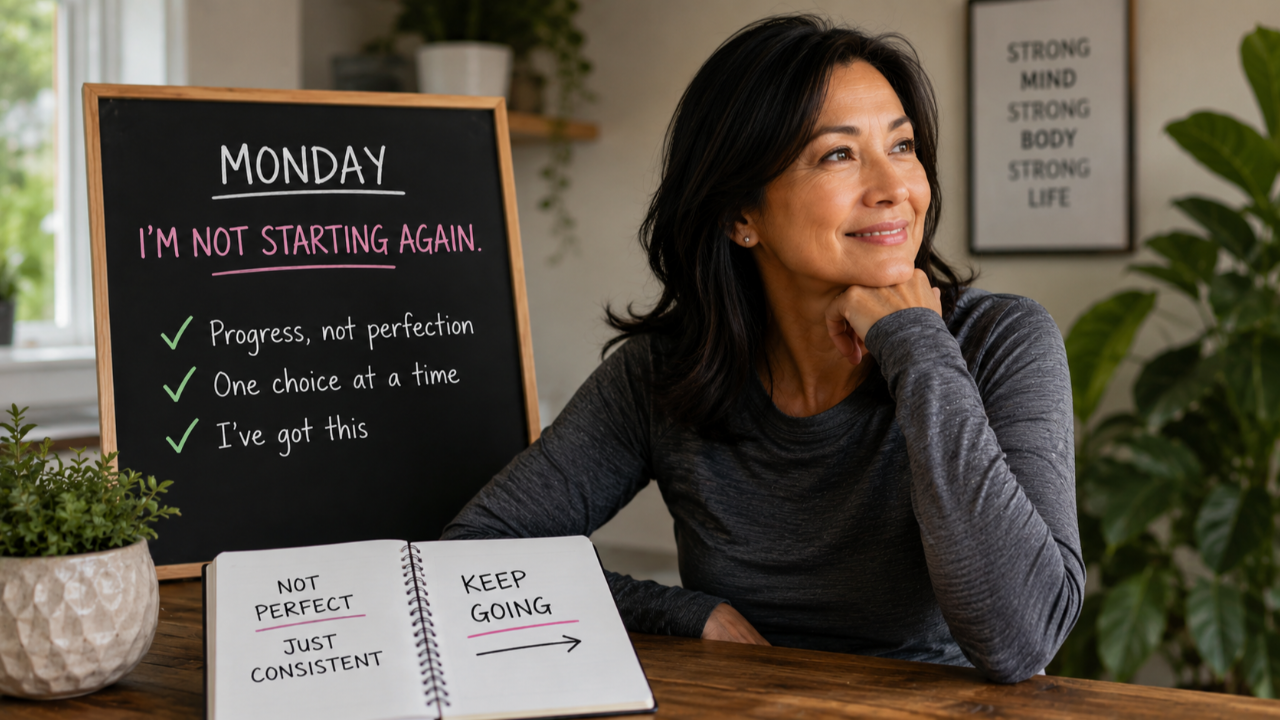
Monday morning can feel full of possibility.
This will be the week you eat perfectly, exercise every day, stop snacking, drink more water, go to bed earlier and finally become the disciplined version of yourself you feel you should already be.
You clear the cupboards, write a strict plan and promise yourself there will be no excuses.
Then real life begins.
Tuesday brings a poor night’s sleep. Wednesday runs late at work. By Thursday, you are tired, hungry and reaching for the food you had decided was forbidden. The planned workout does not happen, so you tell yourself the week has been ruined.
You will start again on Monday.
This cycle can continue for years, particularly in midlife, when the body, energy levels and responsibilities do not always behave predictably. The problem is rarely that you do not care enough or lack willpower.
The problem may be the kind of plan you keep trying to follow.
The fresh-start feeling can be deceptive
There is something psychologically appealing about beginning on a Monday, the first day of a month or after a holiday. A fresh date creates a sense of separation from past choices and gives us permission to imagine a more organised future.
That initial motivation can be useful. The difficulty comes when a fresh start is paired with an extreme plan.
You decide to change breakfast, lunch, dinner, exercise, sleep and alcohol all at once. You choose rules designed for your most motivated day and expect yourself to follow them on your most exhausted one.
For a few days, the structure may feel reassuring. It removes decisions and creates a sense of control. But a plan that requires perfect circumstances becomes fragile as soon as circumstances change.
One missed workout becomes “I have stopped exercising”. One unplanned meal becomes “I have blown the diet”. A difficult day becomes evidence that you cannot stay consistent.
This is known as all-or-nothing or dichotomous thinking: judging behaviour as either completely successful or completely unsuccessful, with very little room in between. Research suggests that this pattern can turn ordinary lapses into feelings of failure and increase the likelihood of abandoning a health plan altogether.
The meal was never the real problem.
The conclusion you drew from it was.
Your week has not been ruined
Imagine that you planned to walk for 30 minutes but only had time for ten.
The all-or-nothing response says, “Ten minutes is not enough, so there is no point.”
A more flexible response says, “Ten minutes is what fits today, and it keeps me connected to the habit.”
Perhaps you intended to prepare a balanced dinner but arrived home late and ordered a takeaway. The all-or-nothing response says you might as well continue eating whatever you like until Monday.
A flexible response recognises that one convenient meal does not determine the next one. You can enjoy it, stop when comfortably satisfied and return to your usual breakfast the following morning.
Nothing needs to be undone. You do not need to compensate by skipping meals, completing an exhausting workout or promising to be stricter next week.
You simply make the next helpful choice available to you.
This sounds less dramatic than a complete restart, but that is precisely why it is more powerful. Sustainable wellbeing is not built through repeated dramatic beginnings. It is built through ordinary returns.
Midlife does not always fit a rigid plan
Perimenopause and menopause can bring changes in sleep, mood, concentration, temperature regulation and physical comfort. Symptoms may fluctuate, and one week may feel very different from the next. NICE guidance therefore emphasises individualised information and support rather than assuming every woman will have the same experience.
At the same time, many women over 40 are balancing demanding work, family responsibilities, ageing parents, relationships and a growing awareness that their own health needs attention too.
A rigid routine ignores this reality.
It assumes you will have the same energy at 6am after a night of interrupted sleep as you do after resting well. It assumes every working day will end on time and that caring responsibilities will politely arrange themselves around your workout.
When the plan repeatedly fails to survive your actual life, it is easy to decide that you are the problem.
But a sustainable routine should be designed around the life you have—not around an imaginary week in which nothing goes wrong.
Consistency does not mean doing the same amount every day
Many women interpret consistency as perfect repetition.
They imagine that consistent exercise means completing every scheduled session in full. Consistent nutrition means never eating impulsively, missing meal preparation or choosing food simply because they enjoy it.
Real consistency is more flexible.
It means having a pattern you return to, even when the size of the action changes.
On a high-energy day, you may complete a 40-minute strength session. On a busy day, you may perform three exercises for ten minutes. On a particularly difficult day, you may complete five sit-to-stands while the kettle boils.
Those actions are not identical, but they all reinforce the same identity: you are a woman who continues to care for her strength.
The minimum version will not produce the same physical training effect as the full session. Its purpose is different. It protects the connection to the routine and prevents one disruption from becoming a month-long disappearance.
Emerging research on exercise behaviour identifies all-or-nothing thinking as a potential barrier when people reject a modified version of a planned workout and therefore do nothing at all.
Adapting your plan is not inconsistency.
It is a skill that makes consistency possible.
Healthy habits take longer than a motivational week
The idea that a new habit forms in 21 days is attractive because it gives behaviour change a tidy finish line.
In reality, habit formation varies considerably between people and behaviours. A recent systematic review found that health-related habits may begin to develop within approximately two months, but some take much longer. Consistent repetition in a similar context appears more important than completing a short, perfect challenge.
This means you are not failing because drinking more water, preparing breakfast or exercising twice a week still requires thought after three weeks.
The behaviour may simply not be automatic yet.
Every repetition helps your brain associate the action with a cue. You finish your morning coffee and take your vitamin D. You return from your Tuesday walk and complete ten minutes of strength work. You put your dinner plate in the dishwasher and prepare tomorrow’s lunch.
Over time, the cue begins to prompt the behaviour with less negotiation.
Research on habit-based health interventions commonly uses techniques such as specific goals, prompts, cues, self-monitoring and feedback. NICE also recommends goal setting, planning, feedback and monitoring as useful components of individual behaviour-change support.
The habit is not created by one heroic Monday.
It is created by many unremarkable Tuesdays, Wednesdays and Thursdays.
Stop creating plans for your best day
A useful wellbeing plan should work when motivation is average, not only when it is high.
Consider your current goals and create three versions of each one.
Your ideal version is what you do when time and energy are good. This might be a 30-minute strength session, a freshly prepared lunch or an evening walk.
Your standard version is the realistic action you can complete during an ordinary working week. It might be 15 minutes of strength work, adding protein and vegetables to a convenient meal, or walking during your lunch break.
Your minimum version is the smallest action that keeps you connected when the day has gone badly. It could be one set of squats and wall press-ups, a yoghurt and fruit instead of skipping breakfast, or five minutes outside before your next meeting.
The ideal version may create the greatest immediate result. The minimum version protects the long-term pattern.
You need both.
Make the behaviour specific enough to do
“Eat better” is an aspiration, not an action.
“Exercise more” requires you to make several additional decisions: what exercise, when, where, for how long and with what equipment.
The more decisions a habit requires, the easier it is to postpone.
Turn broad intentions into clear actions:
Instead of “I will improve my breakfast”, decide, “On workdays, I will include one protein-rich food at breakfast.”
Instead of “I will start strength training”, decide, “On Tuesday and Saturday, I will complete my 15-minute routine after my morning drink.”
Instead of “I must drink more water”, decide, “I will fill my bottle before I open my laptop and refill it at lunch.”
Goal-setting research suggests that goals are more useful when they are accompanied by an action plan explaining how the behaviour will happen. Simply wanting the outcome is often not enough.
A good plan removes uncertainty. It tells you what to do next.
Track returns, not perfect streaks
Habit trackers can be motivating, but they can also become another form of judgement.
A long row of ticks feels satisfying until you miss a day. The empty box can then appear to erase everything that came before it.
Try tracking something different: the number of times you returned.
You missed Tuesday’s workout but completed a shorter session on Wednesday. That is a return.
You ate reactively during a stressful afternoon but prepared a satisfying dinner instead of deciding the entire day was lost. That is a return.
You stopped walking for two weeks during a difficult period and then went out for ten minutes. That is a return.
The ability to restart quickly, without shame or drama, may be more valuable than maintaining a flawless streak for a short period.
Self-monitoring is widely used in behaviour-change programmes, but it is most helpful when the information guides adjustment rather than self-criticism.
Your record should help you understand your habits, not provide evidence for a case against yourself.
Replace guilt with useful curiosity
When a plan does not happen, the instinctive question is often, “What is wrong with me?”
That question rarely produces a practical answer.
Ask instead:
What made this difficult today?
Was I genuinely hungry because lunch was too small? Was the workout scheduled at a time that repeatedly becomes busy? Did poor sleep reduce my energy? Was the action too complicated? Did I rely on remembering rather than creating a prompt?
Curiosity turns a lapse into information.
Perhaps you do not need stronger willpower. You may need an afternoon snack containing protein and fibre. You might need to exercise before work rather than after it. The equipment may need to be visible instead of stored upstairs.
Self-compassion does not mean ignoring your goals or giving yourself permission to abandon them. Evidence suggests it may support self-regulation by helping people respond to difficulties without becoming trapped in shame and self-criticism, although research on specific health behaviours is still developing.
You are more likely to solve a problem when you are willing to look at it honestly.
Choose foundations before refinements
Extreme plans are often attractive because they contain many new rules. Complexity can make a programme appear more effective.
But before worrying about powders, fasting windows, perfect meal timing or advanced workouts, look at the foundations.
Are you eating regular, satisfying meals?
Are you including protein, plants and fibre most days?
Are you moving regularly and strengthening your major muscle groups?
Are you creating a realistic opportunity for sleep?
Are you drinking enough fluid and noticing how alcohol affects your sleep, energy and appetite?
You do not need to perfect all of these at once.
Choose the foundation that would make the greatest difference to your current life. Practise it until it feels more stable, then build upon it.
Long-term wellbeing is rarely created by discovering one secret you had previously missed. It comes from doing the basics more consistently, while allowing enough flexibility for them to survive.
Try a seven-day “no restarting” experiment
For the next seven days, do not begin a new regime.
Choose one nutrition action and one movement action that feel realistic.
Your nutrition action might be adding a source of protein to breakfast, preparing a balanced afternoon snack or eating one meal each day without your phone.
Your movement action might be two 15-minute strength sessions, a ten-minute walk after lunch or five minutes of mobility after work.
Decide in advance what the minimum version will be.
Then expect disruption.
Do not treat an unplanned meal, missed session or difficult evening as a surprise. Build your response into the plan: “When the full action is not possible, I will complete the minimum version or return at the next available opportunity.”
At the end of the week, do not ask whether you were good or bad.
Ask what worked, what repeatedly got in the way and what needs to become easier.
That is how an experiment becomes a routine.
You do not need another perfect Monday
You may have spent years believing that successful women are simply more disciplined.
But the women who maintain healthy routines are not necessarily the women whose weeks always go to plan. They are often the women who know how to adjust without giving up.
They do not require every meal to be ideal before the day counts as healthy. They do not need an uninterrupted hour before movement is worthwhile. They recognise that a difficult week may require a smaller version of the habit—not its complete abandonment.
Your next meaningful choice does not need to wait until Monday.
It can happen at your next meal.
It can be a glass of water before your next coffee, a short walk after your next meeting or five controlled squats before your shower.
You are not starting over. You are continuing—with more information, more realism and a plan that respects the life you are actually living.
Lasting change rarely feels as exciting as a dramatic new beginning.
It feels quieter.
It looks like returning after the imperfect meal, adapting the workout and choosing not to turn one difficult day into a reason to disappear from your own wellbeing.
That is not a lack of discipline.
That is what sustainable consistency looks like.
Stay connected with news and updates.
Join our mailing list to receive the latest news and updates from our team.
Don't worry, your information will not be shared.
We hate SPAM. We will never sell your information, for any reason.