Why Feeling Strong Changes the Way You See Yourself
Jun 28, 2026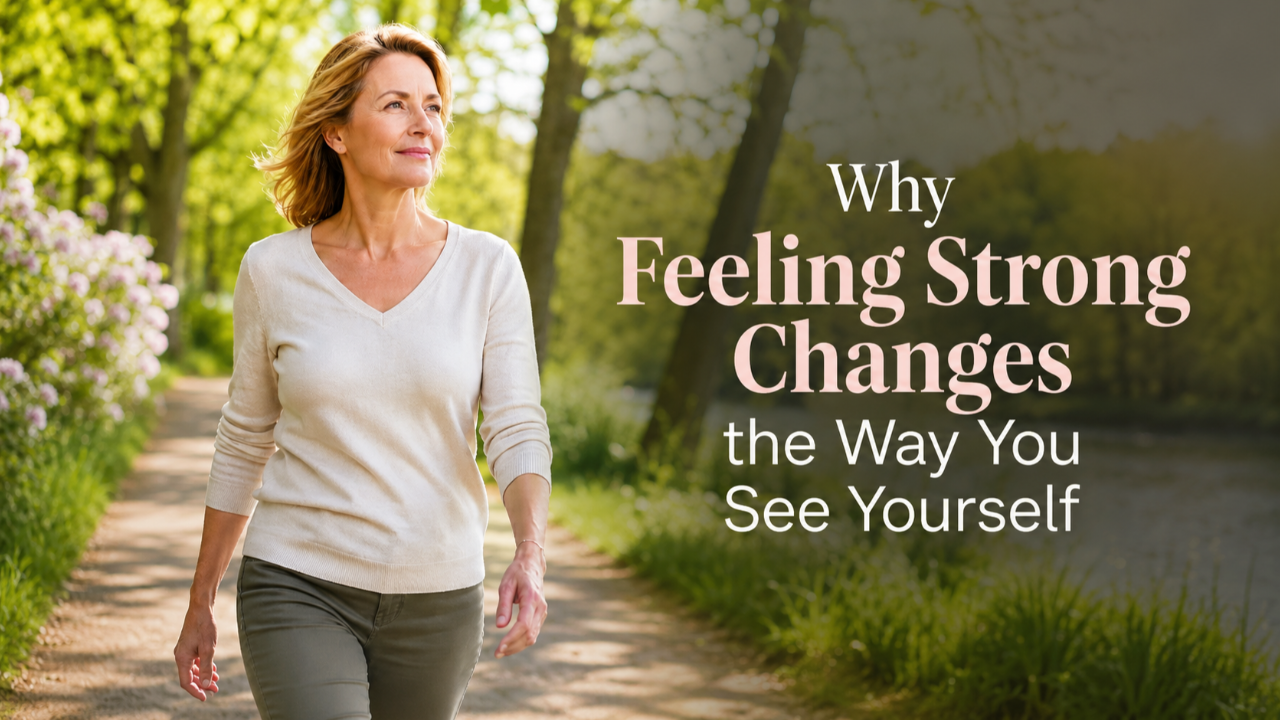
There is a particular kind of confidence that comes from lifting something you once assumed was too heavy.
It might happen when you place your suitcase into the car without waiting for help. Perhaps you carry the shopping indoors in one journey, stand up from the floor without grabbing the furniture or complete an exercise that felt impossible several weeks earlier.
Nobody else may notice the moment, but you do.
For a few seconds, you are no longer thinking about your weight, your waistline or the parts of your body that have changed. You are thinking, I did that.
This is one of the less discussed benefits of becoming physically stronger. Strength training does not only change what your muscles can do. It can gradually change the relationship you have with your body.
Midlife can quietly weaken body confidence
During perimenopause and menopause, the body can begin to feel unpredictable.
You may wake feeling stiff after sleeping well, or exhausted after barely sleeping at all. Your body shape may change despite following the same routines. A familiar workout can suddenly feel harder, while hot flushes, joint discomfort or fluctuating energy make it difficult to know what you will be capable of from one day to the next.
These changes can affect more than physical comfort. They can create a subtle loss of trust.
You may stop assuming that your body will cooperate. You hesitate before agreeing to a long walk, getting down onto the floor or lifting something awkward. You begin to think of yourself as someone who has to be careful, even when nobody has told you that you cannot do these things.
This uncertainty is understandable. It is not, however, the same as becoming incapable.
Strength training can provide something especially valuable at this stage of life: regular, measurable evidence that your body can still learn, adapt and improve.
Strength gives you proof rather than reassurance
People may tell you to feel more confident or to be kinder to your body. Those messages are well intentioned, but confidence cannot always be created through positive words alone.
Sometimes you need evidence.
You begin with eight sit-to-stands from a chair. Several weeks later, you complete twelve while holding a weight. You start with a wall press-up and eventually progress to the kitchen worktop. The dumbbell that once felt heavy becomes the one you use to warm up.
These are small physical changes, but psychologically they matter.
They show you that effort can create adaptation. You are not simply hoping that you are becoming more capable; you can see it happening.
Psychologists often use the term self-efficacy to describe a person’s belief in their ability to carry out a particular action. Successfully completing a challenge is one of the strongest ways of building that belief. Research examining resistance training has found increases in feelings of competence, while self-efficacy is also associated with continued exercise participation.
Confidence often arrives after the action, not before it.
You do not wait until you feel like a strong woman and then start lifting. You lift something manageable, repeat it consistently and gradually begin to see yourself differently.
Your body becomes more than something to look at
Many women have spent decades viewing their bodies mainly from the outside.
Is it smaller? Is it toned? Does it look younger? Does it fit the clothes it used to fit?
The body becomes something to monitor, compare and correct.
Strength training offers a different question: What can my body do now that it could not do before?
This shift from appearance to ability can be powerful. A community-based strength programme for middle-aged and older women reported improvements in body image, personal satisfaction, health-related quality of life and comfort with physical activity. A wider systematic review also concluded that resistance training may improve aspects of body image, although the researchers noted that the available studies varied in quality.
Strength training is not guaranteed to remove every insecurity. You can become stronger and still have days when you feel uncomfortable in your body.
The difference is that appearance is no longer the only information available to you.
You may not love what you see in the changing-room mirror, but you also know that those legs carried you up a steep hill. You know that your arms lifted the luggage, your back supported you through the gardening and your hands held the weights that once felt intimidating.
Capability begins to sit beside appearance—and, over time, it may become more important.
Strength changes the meaning of progress
When progress is measured only through body weight, success can feel frustratingly fragile.
The scales rise after a salty meal, a poor night’s sleep or a change in digestion. Clothes feel different. A photograph catches you at an unflattering angle, and suddenly several weeks of effort feel as though they have disappeared.
Strength gives you measurements that are harder to dismiss.
You lifted 6kg where you once lifted 4kg. You completed ten controlled squats instead of six. You can now rise from the floor with one hand rather than two.
These achievements are not undone by a number on the scales.
Research involving women has found resistance training to be experienced as particularly empowering compared with other forms of physical activity. Women in one mixed-methods study frequently described strength-based activity in terms of capability, accomplishment and growing confidence.
This does not mean that cardio, yoga, walking or swimming are less valuable. It means that lifting provides a very clear form of feedback: something that was difficult becomes possible because you practised.
You stop assuming that discomfort means danger
Strength training also changes the way you interpret effort.
At first, a muscle beginning to tire can feel alarming. A faster heartbeat may make you wonder whether you should stop. You may interpret every unfamiliar sensation as a warning that exercise is not for you.
With appropriate instruction and gradual progression, you begin to recognise the difference between productive effort and pain.
You learn that your thighs can feel tired during a squat and recover. Your arms can shake slightly during the final press and still be safe. You can find an exercise difficult without being bad at it.
This lesson can extend beyond the exercise itself.
Strength training gives you repeated opportunities to stay calm while something feels challenging. You complete the repetition, place the weight down and recover. The difficulty was temporary, and you were capable of handling it.
That is physical resilience in practice.
It is important not to romanticise pain. Sharp, sudden or worsening pain is not a test of character and should not be ignored. Trusting your body also means listening when it needs a movement modified, a lighter session or professional advice.
Real confidence is not believing that nothing will ever hurt. It is knowing that you can respond intelligently when something feels wrong.
Everyday independence begins to feel personal
Strength can appear to be a fitness goal until you notice what it changes outside the workout.
It is the ability to move a plant pot, carry a sleeping grandchild or place a heavy pan into the cupboard. It is being able to travel without worrying who will lift your case or attend an event without wondering whether the stairs will be too much.
Resistance training has been associated with improvements in muscular strength and functional capacity among postmenopausal women, although menopause-specific research still varies in quality and programmes need to reflect each woman’s health and starting ability.
These practical gains can restore something deeper than convenience: a sense of autonomy.
You rely less on other people—not because accepting help is wrong, but because help becomes a choice rather than a necessity.
That difference can be profoundly reassuring.
You begin occupying space differently
Feeling strong can subtly change how you enter a room.
You may stand more comfortably instead of folding your shoulders forwards. You might speak with more certainty because you feel less physically fragile. You become willing to try activities that you previously dismissed as being “for fitter people”.
The change is not about becoming louder or more dominant. It is about no longer treating yourself as someone who must shrink.
A 15-week resistance-training study in postmenopausal women experiencing moderate to severe hot flushes found improvements in menopause-specific quality-of-life measures, including areas related to sleep and vasomotor symptoms. The study did not find improvements across every broad quality-of-life measure, which is an important reminder that strength training is supportive rather than a cure for every midlife difficulty.
The psychological shift may be quieter.
You keep an appointment with yourself. You choose a weight that feels challenging. You take your recovery seriously. You begin treating your body as something worth investing in rather than something requiring constant criticism.
Strength helps you build a new midlife identity
Midlife can sometimes feel defined by losses.
Periods change or end. Children become more independent. Careers shift. Parents age. Energy feels less predictable, and the body no longer responds exactly as it once did.
Strength training introduces a different story: this can also be a period of development.
You are still capable of learning a new skill. You can improve your coordination, increase the load you lift and discover physical abilities that you may never have developed when you were younger.
One qualitative study exploring postmenopausal women’s experiences of resistance training found that participants described both physical and psychological benefits. Support, growing familiarity and recognising progress helped make continued training feel possible.
You are not trying to become the woman you were at 25.
You are building the strength needed by the woman you are becoming.
How to notice the change in yourself
The psychological benefits of strength are easier to recognise when you deliberately collect evidence.
After each session, record one thing your body did well. It might be using a heavier weight, controlling a movement more steadily or simply completing the session after a difficult day.
Choose one practical goal that has nothing to do with appearance. You might aim to carry your suitcase, complete ten unassisted sit-to-stands or get up from the floor confidently.
Keep an everyday strength list. Note the moment you opened the stubborn jar, moved the furniture or climbed the stairs without stopping. These moments are easy to forget because they quickly become your new normal.
Pay attention to your language too. Replace “I am terrible at press-ups” with “I am currently learning wall press-ups.” Instead of saying “My arms are weak”, try “My arms are becoming stronger.”
This is not empty positive thinking. It is more accurate language. A current ability is not a permanent identity.
Let your difficult days count too
Body trust is not created only on the days when you feel energetic.
Some of the most valuable sessions may be the ones you adapt.
You slept badly, so you reduce the weights. Your joints feel stiff, so you warm up for longer. Your concentration is low, so you choose four familiar movements instead of attempting something complicated.
You still listen, decide and act.
This teaches you that consistency does not mean forcing the same performance from yourself every day. It means staying connected to your body even when its needs change.
During perimenopause and menopause, that flexibility is not a weakness in the programme. It is a strength.
The greatest change may not be visible
You may begin strength training because you want firmer arms, a stronger core or a different body shape. There is nothing wrong with wanting physical change.
But somewhere along the way, the reason you continue may become different.
You continue because you enjoy feeling capable. You like knowing that your body can manage difficult things. You value the way strength makes ordinary life feel more secure.
The mirror may still reflect a woman going through midlife. There may be lines, softness and changes you are still learning to accept.
But it also reflects the woman who lifts the weights.
The woman who kept going.
The woman who is no longer waiting to feel confident before taking up space in her own life.
Feeling strong does not mean believing your body is perfect.
It means knowing that it is yours, that it can learn and that you can trust yourself to keep supporting it.
That is a different kind of body confidence.
And it may be the kind that lasts.
Stay connected with news and updates.
Join our mailing list to receive the latest news and updates from our team.
Don't worry, your information will not be shared.
We hate SPAM. We will never sell your information, for any reason.