You may already be doing many of the things associated with staying active. You walk when you can, attend yoga classes, stretch after sitting for too long and perhaps squeeze in the occasional workout around meetings, commuting and family responsibilities.
Yet your body may still feel less comfortable than it once did. You might be flexible enough to touch your toes but find carrying shopping surprisingly tiring. You may complete a yoga class successfully, then feel stiff again after a full day at your desk. Perhaps you can hold a deep stretch but feel unsteady when stepping off a kerb or rising from the floor.
This is where the usual advice to “stretch more” becomes too simplistic. After 40, most women do not need to choose between stretching and strength. They need to understand what each one does, identify what their body is missing and create a movement routine that supports the realities of a busy working life.
Flexibility and mobility are not the same
Flexibility describes how far a muscle can lengthen. Mobility is your ability to move a joint through a useful range with control.
You may be able to pull your knee towards your chest while lying down, yet struggle to lift that same leg comfortably when standing. The first movement demonstrates passive flexibility. The second requires strength, balance and control.
This distinction becomes increasingly important in midlife. Being able to reach a position is useful, but being able to control your body within that position is what helps you step over an obstacle, regain your balance, climb stairs and move confidently through everyday life.
Harvard Health explains that flexibility supports mobility, while practices such as yoga and tai chi can also contribute to balance, strength and control. (health.harvard.edu)
If stretching makes you feel temporarily looser but the stiffness soon returns, limited flexibility may not be the only issue. Your body may need more strength within the range you already have.
Stretching has an important but specific role
Stretching helps maintain or improve the range through which muscles and joints can move. This matters because restricted flexibility can make everyday tasks more difficult, including turning to reverse the car, reaching into a high cupboard or walking with a comfortable stride.
Harvard recommends stretching the major muscle groups regularly rather than relying on occasional, aggressive sessions. Consistency is more useful than forcing the body into an extreme position. (health.harvard.edu)
Stretching can be particularly valuable for professional women because working life repeatedly places the body in the same positions. Sitting keeps the hips and knees bent, laptop work brings the arms forwards, and driving limits movement through the spine and hips.
Gentle stretching offers the body an alternative. It allows the hips to extend, the chest to open and the upper back to rotate. However, stretching does not automatically make a joint stronger or better prepared to carry load. It may give you more movement, but it does not necessarily teach you how to use that movement confidently.
Why flexible women can still feel weak or unsupported
Women who naturally have a large range of movement are often surprised to learn that they may need more strength rather than more stretching.
A joint that moves easily still requires muscular control. Without enough strength, the body may create a sensation of tightness as a protective response. Repeatedly stretching the area may feel soothing, but it may not address the underlying lack of support.
This is one reason a woman may describe her hips as tight despite being able to perform deep yoga poses. Her body may not need more range. It may need stronger gluteal, abdominal and hip muscles to control the range she already has.
A more useful question is not simply, “How far can I stretch?” Ask, “Can I control this movement slowly and comfortably?”
Try standing on one leg near a stable surface. Can you remain steady without gripping your toes or holding your breath? Lower yourself into a chair slowly. Can you control the descent rather than dropping onto the seat? These simple tasks may reveal more about practical movement capacity than an impressive forward fold.
Strength is about capability, not appearance
Strength training is often presented as a way to change body shape. Its more important purpose is to preserve what the body can do.
Strong muscles help you rise from a chair, carry luggage, climb stairs and recover your balance when you stumble. They support the joints and allow you to use your flexibility safely.
A landmark study published in The New England Journal of Medicine found that progressive resistance training improved strength, muscle size and mobility even in very frail older adults. The participants were much older than most midlife women, but the findings demonstrate that muscle remains responsive to meaningful training later in life. (nejm.org)
The lesson is not that every woman needs an extreme programme. It is that movement must eventually provide enough resistance to challenge the muscles. A routine that never becomes more demanding may continue to feel pleasant, but it is unlikely to build strength indefinitely.
Yoga can provide both, depending on the practice
Yoga is often described as stretching, but that does not capture everything it can offer. Many poses require strength, balance, coordination and controlled mobility.
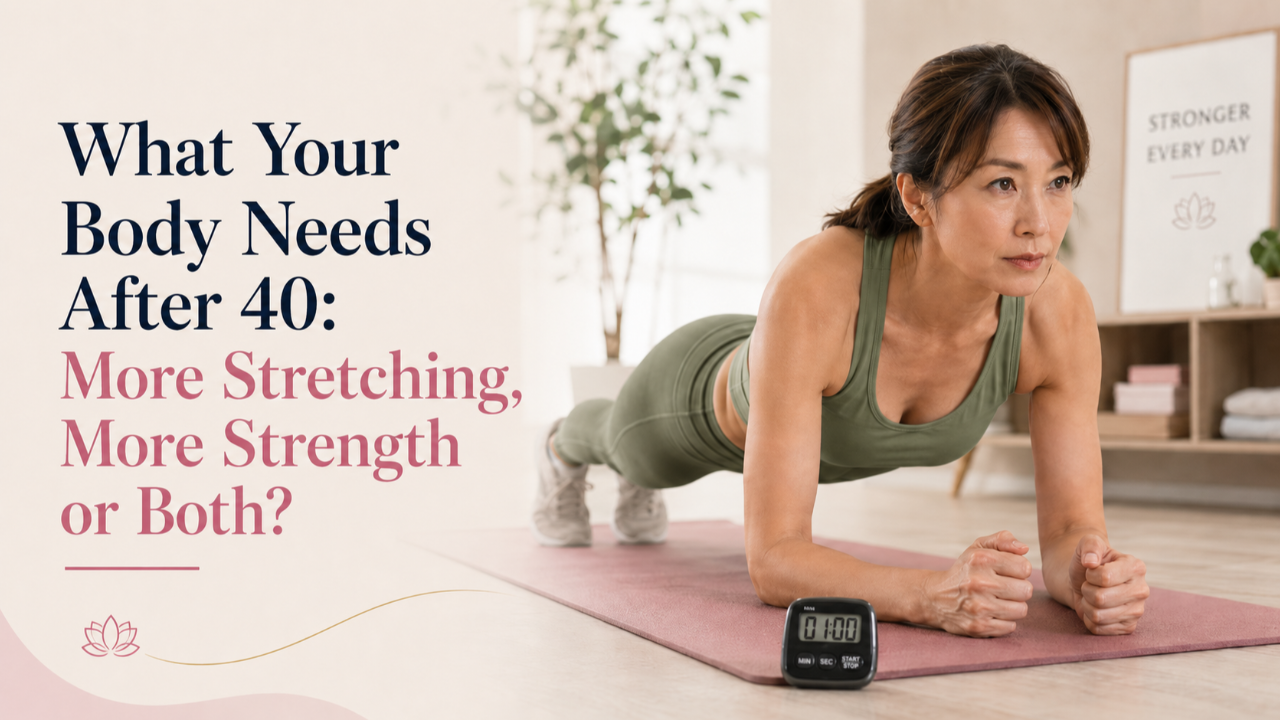
Holding a plank, maintaining a chair pose or moving slowly through a standing sequence asks the muscles to support body weight. Balancing poses challenge the hips, feet and trunk. Twists and flowing movements can improve joint control and body awareness.
Harvard notes that yoga can help build strength and flexibility while supporting balance and reducing muscular tension. (health.harvard.edu)
However, not every yoga class provides enough progressive resistance to maintain muscle strength on its own. A gentle restorative session may be excellent for recovery and stress reduction but offer relatively little muscular challenge. A stronger class may improve endurance but still become familiar over time.
Yoga can therefore be a valuable part of your routine without needing to meet every fitness requirement.
Timing your stretching matters
Many women were taught to hold long stretches before exercising. Current guidance is more nuanced.
Harvard reports that prolonged static stretching immediately before strength or power-based exercise may temporarily reduce muscular performance. Dynamic movement is usually more useful at the beginning of a workout because it warms the body while taking the joints through motion. (health.harvard.edu)
Before strength training, try arm sweeps, hip circles, marching, gentle squats and controlled rotations. Save longer held stretches for after the session or for a separate mobility practice.
Static stretching is not harmful. It simply has a different purpose and may be more useful at a different time.
Your body may need strength in the places you keep stretching
Think about the areas women most often describe as tight: the hips, lower back, shoulders and neck.
Sometimes these areas are genuinely restricted. At other times, they are working too hard because nearby muscles are not contributing enough.
Tight shoulders may benefit from opening the chest, but also from strengthening the upper back. A stiff lower back may need gentle mobility, but also stronger abdominal and hip muscles. Tight-feeling hips may improve when the gluteal muscles become stronger.
This is why a useful routine often pairs one mobility movement with one strengthening movement.
After stretching the chest, perform a resistance-band row. After stretching the hip flexors, complete a set of glute bridges. After rotating the upper back, perform a controlled rowing movement or carry a weight while walking tall.
The stretch creates space. The strength exercise teaches your body how to support it.
Balance deserves more attention after 40
Balance is often ignored until it noticeably declines.
It depends on more than the core. Vision, the inner ear, sensation from the feet and joints, reaction speed and muscular strength all contribute.
Yoga can support static balance through standing poses, while strength training helps the body respond when your centre of gravity shifts. Harvard highlights yoga’s potential to challenge both static and dynamic balance. (health.harvard.edu)
A small amount of balance practice can be added to ordinary life. Stand on one leg while holding a stable surface, practise controlled step-ups or walk heel to toe along a clear pathway.
The aim is not to prove how long you can balance without support. It is to help your body respond more confidently when life moves you unexpectedly.
The right routine depends on what your week already contains
A woman who spends five days sitting at a desk may benefit from mobility work for the hips, chest and upper back. A woman who attends several yoga classes each week but never lifts resistance may need more structured strength training.
Someone who strength-trains regularly may benefit from additional mobility to maintain comfortable joint range. A woman dealing with disrupted sleep or demanding work may need gentler yoga while keeping a smaller amount of strength work in place.
There is no perfect formula, but a balanced week might include two strength sessions, several short mobility practices, regular walking and one yoga class you genuinely enjoy.
These activities can overlap. Yoga can include strength and mobility. A good strength session should move the joints through controlled ranges. Walking supports cardiovascular health and general activity.
The goal is not to collect as many exercise types as possible. It is to make sure an essential quality is not missing.
A useful movement pairing
Begin with a gentle hip-flexor stretch. Step one foot back, keep the torso upright and lightly tuck the pelvis until you feel the front of the hip lengthen.
Follow this with eight to twelve slow sit-to-stands or glute bridges.
Next, open the chest gently by placing your hands behind you or against a doorway.
Follow this with eight to twelve resistance-band rows or wall press-ups.
Finish with a slow upper-body rotation and a short carry using weights that feel moderately challenging.
This simple sequence combines range, strength and control. It may offer more practical benefit than spending the same amount of time holding deeper stretches.
Soreness is not proof that a workout worked
A session does not need to leave you struggling to walk downstairs to be effective.
Muscle soreness is influenced by unfamiliar exercise, training volume and movement choice. It is not a reliable measure of long-term progress.
More useful signs include improved control, using a slightly heavier weight, moving with greater confidence and completing everyday tasks more easily.
Your training should challenge you, but it should also allow you to work, sleep and move normally. The goal is to build a capable body, not repeatedly exhaust it.
What to do when energy is low
Midlife energy is not always predictable. Poor sleep, hormonal symptoms and demanding working weeks may affect how much exercise feels manageable.
On lower-energy days, keep the habit but reduce the dose. Complete one set instead of three, use a lighter weight or spend ten minutes moving rather than cancelling the session completely.
A short mobility routine or gentle yoga practice may be exactly what you need that day. The mistake is assuming that because you cannot complete the full plan, no movement is worthwhile.
Consistency can include adaptation.
When stretching is not the answer
Persistent pain or stiffness should not automatically be treated with more stretching.
Seek professional advice when symptoms are severe, worsening or accompanied by swelling, heat, numbness, weakness or loss of function. Pain that repeatedly wakes you, follows an injury or significantly changes how you walk should also be assessed.
A physiotherapist can help determine whether a limitation is related to joint mobility, muscle weakness, tendon irritation or another issue. A generic stretching programme cannot make that distinction.
Stretching should usually feel like mild tension rather than sharp pain. Your body does not need to be forced into cooperation.
A realistic weekly plan for professional women
Choose two days for short, full-body strength sessions. Include a squat or sit-to-stand, a pushing movement, a pulling movement, a hip exercise and a controlled carry.
Add five to ten minutes of mobility on most working days, particularly for the areas held in one position for long periods. Use dynamic movements before exercise and longer held stretches afterwards or in a separate session.
Include yoga because it improves how you feel, move or recover, not because it must meet every fitness need. Choose a style that suits your energy and experience.
Continue walking, swimming, cycling or another activity that supports cardiovascular health and enjoyment.
Harvard guidance supports regular flexibility work alongside muscle-strengthening activity as part of a wider movement routine. (health.harvard.edu)
Your body does not need one perfect answer
After 40, the choice is rarely stretching or strength.
Stretching helps preserve freedom of movement. Strength gives you control, support and capability. Yoga can contribute to both while adding balance, breathing and valuable mental space.
The right mixture depends on what you already do, how your body feels and what daily life asks of you.
You do not need to become exceptionally flexible or impressively strong. You need enough movement to feel comfortable and enough strength to use that movement confidently.
That is what helps you reach, lift, turn, balance and continue moving through life on your own terms.
What Your Body Needs After 40: More Stretching, More Strength or Both?
You may already be doing many of the things associated with staying active. You walk when you can, attend yoga classes, stretch after sitting for too long and perhaps fit in the occasional workout around meetings, commuting and family responsibilities. Yet your body may still feel less comfortable, less supported or slower to recover than it once did.
You might be flexible enough to touch your toes but find carrying shopping surprisingly tiring. You may complete a yoga class successfully, then feel stiff again after a full day at your desk. Perhaps you can hold a deep stretch but feel unsteady when stepping off a kerb, lifting a suitcase or rising from the floor. These experiences can be confusing because they suggest that flexibility alone is not solving the problem.
This is where the familiar advice to “stretch more” becomes too simplistic. After 40, most women do not need to choose between stretching and strength. They need to understand what each one contributes, recognise what their body may be missing and create a movement routine that supports the demands of real life.
Flexibility and mobility are not the same
Flexibility describes how far a muscle can lengthen. Mobility is your ability to move a joint through a useful range while remaining in control. The difference may sound technical, but it has important practical consequences.
You may be able to pull your knee towards your chest while lying down, yet struggle to lift that same leg comfortably when standing. The first movement demonstrates passive flexibility because your hands are helping your leg into position. The second requires the muscles around your hips and abdomen to create, stabilise and control the movement.
This distinction becomes increasingly important in midlife. Being able to reach a position is useful, but being able to control your body within that position is what helps you climb stairs, step over obstacles, regain your balance and move confidently through the working day. Harvard Health explains that flexibility supports mobility, while movement practices such as yoga and tai chi may also contribute to balance, strength and control.
When stretching makes you feel temporarily looser but stiffness quickly returns, limited flexibility may not be the only issue. Your body may need greater strength within the range you already have.
Stretching has an important but limited role
Stretching helps maintain or improve the range through which muscles and joints can move. This matters because reduced flexibility may make everyday tasks harder, including turning to reverse the car, reaching into a high cupboard, taking a comfortable stride or getting down to the floor.
Professional working life can gradually reduce movement variety. Sitting keeps the hips and knees bent for hours, laptop work brings the arms forwards and driving limits rotation through the spine and hips. Gentle stretching gives the body an opportunity to move in the opposite direction by extending the hips, opening the chest and rotating the upper back.
Harvard recommends stretching regularly rather than relying on occasional, aggressive sessions. A comfortable stretch repeated several times each week is generally more useful than forcing the body into its deepest possible position once in a while.
However, stretching does not automatically make a joint stronger, more stable or better prepared to carry weight. It may give you access to a greater range, but it does not necessarily teach your muscles how to support that range during daily movement.
Why a flexible woman can still feel weak or unstable
Women who naturally have a large range of movement are often surprised to learn that they may need more strength rather than more stretching. A joint that moves easily still requires muscular control, particularly when the body is carrying weight or responding quickly.
Without enough strength, the body may create a sensation of tightness as a protective response. Repeatedly stretching the area may feel soothing for a short time, but it may not address the lack of support that causes the tight feeling to return.
This can explain why a woman may describe her hips as tight despite being able to perform deep yoga poses. Her body may not require a greater range. It may need stronger gluteal, abdominal and hip muscles to control the range she already possesses.
A more useful question is not simply, “How far can I stretch?” Ask, “Can I control this movement slowly, comfortably and without holding my breath?”
Try lowering yourself into a chair. Can you control the descent, or do you drop during the final few inches? Stand on one leg near a stable surface. Can you remain steady without gripping your toes or leaning heavily to one side? These simple tasks often reveal more about useful movement capacity than an impressive forward fold.
Strength is about preserving capability
Strength training is often presented as a way to change body shape, but its more valuable purpose is to preserve what your body can do.
Strong muscles help you rise from a chair, carry luggage, climb stairs, lift shopping and recover your balance when you stumble. They support your joints and allow you to use your available flexibility safely and confidently.
A landmark study published in The New England Journal of Medicine found that progressive resistance training improved muscle strength, muscle size and mobility even in very frail older adults. The participants were considerably older than most midlife women, but the findings demonstrate something encouraging: muscle remains responsive to meaningful training later in life.
The lesson is not that every woman needs an extreme or exhausting programme. It is that the muscles must eventually experience enough resistance to adapt. A routine that always feels easy may remain enjoyable, but it is unlikely to continue building strength indefinitely.
Progress can be simple. You might use a slightly heavier dumbbell, move to a stronger resistance band, complete another repetition or lower yourself more slowly into a squat. The change does not need to be dramatic. It needs to be gradual and repeatable.
Yoga can provide both, depending on the style
Yoga is sometimes described as stretching, but that does not capture its full potential. Many poses require strength, balance, coordination and controlled mobility.
Holding a plank, remaining in chair pose or moving slowly through a standing sequence asks the muscles to support body weight. Balancing poses challenge the feet, hips and trunk, while flowing movements can improve body awareness and joint control.
Harvard notes that yoga can help build flexibility and strength while supporting balance and reducing muscular tension. However, not every yoga class provides the same training effect.
A restorative class may be excellent for relaxation, recovery and stress management, but offer relatively little muscular challenge. A stronger class may improve endurance and control, yet become less demanding once the body adapts to the familiar sequence.
Yoga can therefore be a valuable part of your movement routine without needing to meet every fitness requirement. The useful question is not, “Does yoga count?” It is, “What is this particular practice asking my body to do?”
The timing of stretching matters
Many women were taught to hold long stretches before exercising. Current guidance is more nuanced.
Prolonged static stretching immediately before strength or power-based activity may temporarily reduce muscular performance. Dynamic movements are generally more useful at the beginning of a workout because they warm the body while taking the joints through movement.
Before strength training, try arm sweeps, controlled hip circles, gentle squats, marching and upper-body rotations. These movements prepare the muscles without asking them to relax deeply immediately before they need to produce force.
Longer held stretches can be saved for the end of a session or performed separately when your goal is flexibility and relaxation. Static stretching is not harmful; it simply serves a different purpose.
You may need strength in the places you keep stretching
Consider the areas women most often describe as tight: the hips, lower back, neck and shoulders.
Sometimes these areas are genuinely restricted. At other times, they are working too hard because nearby muscles are not contributing enough.
Tight shoulders may benefit from stretching the chest, but they may also need stronger upper-back muscles. A stiff lower back may need gentle mobility alongside stronger abdominal and hip muscles. Tight-feeling hips may improve when the gluteal muscles become more capable.
This is why pairing a mobility movement with a strengthening exercise can be so effective. After opening the chest, perform resistance-band rows. After stretching the front of the hips, complete a set of glute bridges. After rotating the upper back, practise a controlled pulling movement or carry weights while maintaining tall posture.
The stretch creates space. The strength exercise teaches your body how to support and use that space.
Balance deserves more attention in midlife
Balance is often ignored until it noticeably declines, yet it depends on several systems working together. Vision, the inner ear, sensation from the feet and joints, reaction speed and muscular strength all contribute.
Yoga can support static balance through standing poses, while strength training helps the body respond when your centre of gravity shifts unexpectedly. This matters during ordinary moments such as stepping off a pavement, walking on uneven ground or catching yourself after a stumble.
Balance practice does not need to be elaborate. Stand on one leg while holding a stable surface, practise slow step-ups or walk heel to toe along a clear pathway. The purpose is not to prove how long you can balance without assistance. It is to help your body respond more confidently when life moves you unexpectedly.
Your routine should reflect your actual week
A woman who spends five days sitting at a desk may benefit from mobility work for the hips, chest and upper back. A woman who attends several yoga classes but never uses resistance may need more structured strength training.
Someone who strength-trains regularly may benefit from additional mobility to maintain comfortable joint range. A woman experiencing disrupted sleep or an unusually demanding working period may need gentler yoga while keeping a smaller amount of strength work in place.
There is no perfect formula, but a balanced week might include two short strength sessions, several five- or ten-minute mobility practices, regular walking and one yoga class that you genuinely enjoy.
These activities can overlap. Yoga may provide strength and mobility. A well-designed strength session should move the joints through controlled ranges. Walking supports cardiovascular health, mood and general activity.
The goal is not to collect as many forms of exercise as possible. It is to make sure an essential quality is not missing.
A practical movement combination
Begin with a gentle hip-flexor stretch. Step one foot backwards, keep your torso upright and lightly tuck the pelvis until you feel the front of the hip lengthen. Hold briefly without forcing the movement.
Follow this with eight to twelve slow sit-to-stands or glute bridges. This asks the gluteal and thigh muscles to support the range you have just opened.
Next, stretch the chest gently by placing your hands behind you or against a doorway. Follow this with resistance-band rows or controlled wall press-ups.
Finish with a slow upper-body rotation and a short walk while carrying moderately challenging weights at your sides.
This short sequence combines flexibility, strength and control. It may provide more practical benefit than spending the same amount of time repeatedly stretching the same areas.
Soreness is not evidence of success
A workout does not need to leave you struggling to walk downstairs to be effective.
Muscle soreness is influenced by unfamiliar movements, exercise choice and training volume. It is not a reliable measure of progress.
Better signs include improved control, using a slightly heavier weight, completing tasks more comfortably and recovering well enough to remain consistent. You may notice that getting out of a low chair becomes easier or that lifting your suitcase no longer feels as daunting.
Your training should challenge you, but it should also allow you to work, sleep and move normally. The aim is to build a capable body, not repeatedly exhaust it.
What to do when your energy is low
Midlife energy is not always predictable. Poor sleep, hormonal symptoms, stress and demanding working weeks may influence how much exercise feels manageable.
On lower-energy days, keep the habit but reduce the dose. Complete one set rather than three, use a lighter resistance or spend ten minutes moving instead of abandoning the session altogether.
A gentle yoga practice or short mobility sequence may be exactly what your body needs that day. The mistake is believing that because you cannot complete the full plan, no movement is worthwhile.
Consistency does not mean doing the same amount every day. It includes the ability to adapt without disappearing from your routine completely.
When stretching is not the answer
Persistent pain or stiffness should not automatically be treated with more stretching.
Seek professional advice when symptoms are severe, worsening or accompanied by swelling, heat, numbness, weakness or loss of function. Pain that repeatedly wakes you, follows an injury or significantly changes how you walk should also be assessed.
A physiotherapist can help determine whether a limitation is related to joint mobility, muscle weakness, tendon irritation or another issue. A generic stretching programme cannot make that distinction.
Stretching should usually feel like mild tension rather than sharp pain. Your body does not need to be forced into cooperation.
A realistic weekly approach for professional women
Choose two days for short, full-body strength sessions. Include a squat or sit-to-stand, a pushing movement, a pulling movement, a hip exercise and a controlled carry.
Add five to ten minutes of mobility on most working days, particularly for the areas held in one position for long periods. Use dynamic movements before exercise and longer held stretches afterwards or during a separate session.
Include yoga because it improves how you move, feel or recover, not because it must meet every fitness need. Choose a style that suits your experience, energy and goals.
Continue walking, swimming, cycling or another activity that supports cardiovascular health and enjoyment. The most effective routine is not the one that appears most impressive. It is the one that gives your body the different forms of movement it needs and still fits into your life.
Your body does not need one perfect answer
After 40, the choice is rarely stretching or strength.
Stretching helps preserve freedom of movement. Strength gives you control, support and capability. Yoga can contribute to both while adding balance, breathing and valuable mental space.
The right mixture depends on what you already do, how your body feels and what everyday life asks of you.
You do not need to become exceptionally flexible or impressively strong. You need enough range to move comfortably and enough strength to use that range confidently.
That is what helps you reach, lift, turn, balance and continue moving through life on your own terms.
Stay connected with news and updates.
Join our mailing list to receive the latest news and updates from our team.
Don't worry, your information will not be shared.
We hate SPAM. We will never sell your information, for any reason.

A soulful, nurturing retreat experience for women, what might change if you gave yourself four days?
At the REVIVAL retreat, you can step away from the demands of everyday life and make space for yourself. We will walk through the Peak District, enjoy gentle yoga and guided meditation, and share gratitude sessions and fireside chats.
Personality profiling and habit transformation sessions will give you time to reflect on where you are now and what you would like to take home with you. Come as you are, alongside a small group of women who have made this time for themselves too.
21–24 June 2027 | Just 10 places
Registration opens soon.
Support Your Body
40 plus body reset anti inflammatory food balance balance hormones balancing hormones beginners strength training bloating blood sugar blood sugar balance body confidence bone density health brain fog brain help breakfast recipes breathwork building resilience core exercises creating space in midlife detox detox your body diabetic management digestion easter recipes emotional balance emotional eating energy evening routines exercise for women exercise recovery in midlife fatigue tips fibre for midlife fitness transformation fixing energy in midlife flexibility fuel guided walking uk gut health health accountability health goals health strategy healthy healthy ageing healthy foods healthy recipes heart health hormonal hormonal balance hormone balance hormone balancing breakfast hormone health hormones hot flashes hydration insulin and midlife january detox joint health joint pain lifestyle foods losing muscle through ageing losing weight low impact cardio making time meal prep meditation meditation tips menopase wellness menopause menopause and digestion menopause exercise menopause fatigue menopause moods menopause nutrition menopause supplements menopause support menopause support for career women menopause symptoms menopause wellness menopause workout mental health for menopause and perimenopause mental health wellness metabolism midlife midlife boundaries midlife energy midlife reflection midlife reset midlife weight gain midlife wellness milestones mindfulness mindset mobility morning routine morning routine for midlife movement muscle strength nature nutrition nutrition for busy women nutrition for menopause nutrition mistakes made nutriton nutritonal snacks outdoor perimenopause perimenopause nutrition perimenopause support perimenopause symptoms perimenopause wellness perimenopause yoga post menopause support protein reducing cancer risk reducing stress tips reflection for busy women resistance band training retreats 2026 self care self care for professional women self care tips set boundaries sleep sleep and menopause sleep and perimenopause sleep tips spring detox strength training strength training for women 50 plus stretching stretching routines the 30 day detox challenge for midlife women the desk job body tracking fitness vitamins walking weight gain weight loss weight training for women wellness wellness habits womens wellness freedom yin yoga yoga yoga and menopause yoga routine yoga routines yoga stretch