The Five-Minute Mobility Reset Every Working Woman Needs
Jul 14, 2026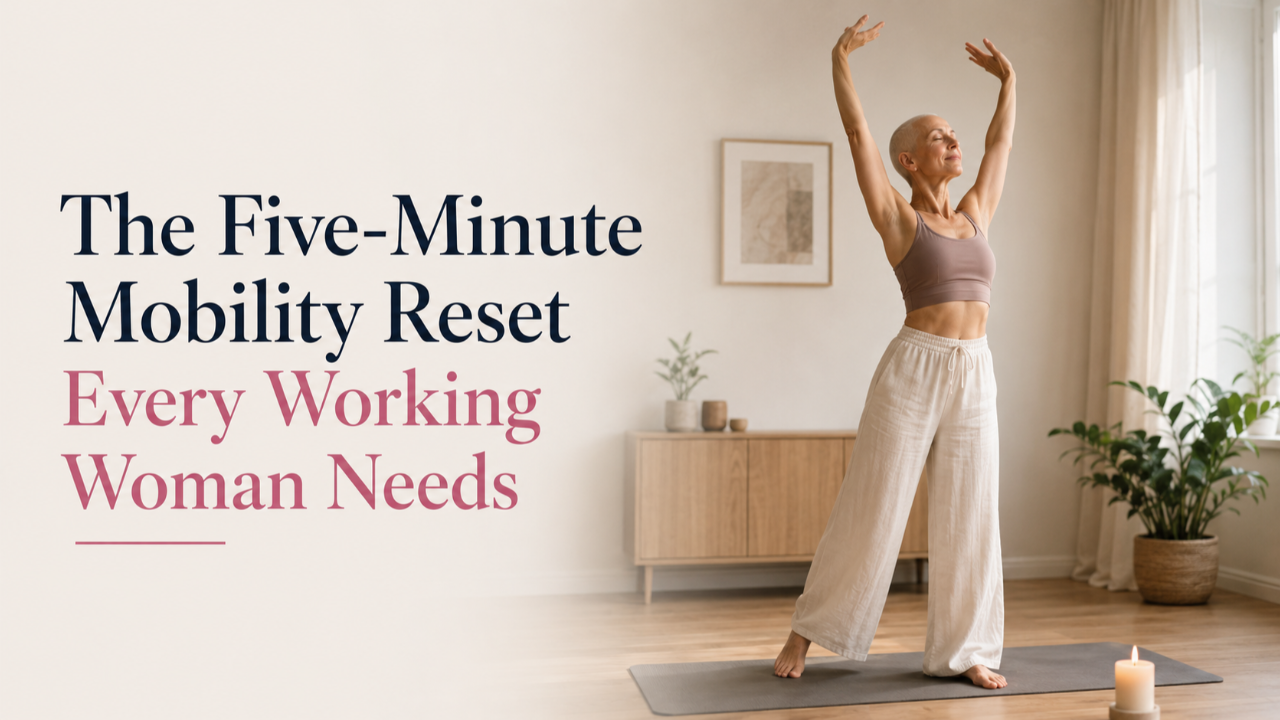
You stand up after a long meeting and your body takes a moment to catch up.
Your hips feel tight, your lower back is reluctant to straighten and your shoulders seem to have moved several inches closer to your ears. By the end of the working day, turning your head, reaching overhead or bending to pick something up can feel less comfortable than it should.
For many professional women, this stiffness is not caused by one dramatic injury. It develops quietly through hours spent at a desk, travelling in the car, looking down at a phone and moving through the same limited positions each day.
The answer is not necessarily another punishing workout.
Sometimes your body needs five minutes to move in the directions your working day has forgotten.
Why sitting leaves you feeling so stiff
Sitting is not inherently harmful. The problem is remaining in one position for long, uninterrupted periods.
When you sit at a desk, your hips remain flexed, your knees stay bent and your arms are held in front of your body. Your upper back may round as your head moves towards the screen.
Over time, the muscles around the hips, chest and shoulders can begin to feel tight, while the muscles that support the back and pelvis may become less active.
Harvard Health notes that prolonged sitting can cause the hip flexors to shorten and tighten. Because these muscles connect with the pelvis and lower back, this may contribute to stiffness and discomfort when you eventually stand and move.
Repetitive computer work may also create muscular tension and tightness that contribute to back discomfort.
You have not necessarily damaged your body. It may simply have adapted to the positions in which you spend the most time.
Why five minutes can still matter
Five minutes may sound too brief to make a difference, particularly when exercise recommendations are usually discussed in much larger numbers.
But a mobility reset is not intended to replace walking, strength training or your normal exercise routine. Its purpose is to interrupt stillness, restore movement and help you feel more comfortable before tension accumulates further.
Harvard Health reports that short activity breaks of two, five or ten minutes can help interrupt the effects of prolonged sitting.
Research highlighted by Harvard also found that taking five minutes of light walking after every 30 minutes of sitting improved some measures associated with prolonged inactivity. That particular schedule may not be practical during every working day, but it reinforces a useful principle: brief movement is worthwhile.
The five-minute reset is therefore not a complete fitness programme. It is a practical way to stop sitting from becoming the only movement pattern your body practises all day.
Your five-minute working-day mobility reset
Move gently and breathe normally. You should feel mild effort or a comfortable stretch, not sharp pain.
Minute one: stand, breathe and reach
Stand with your feet comfortably apart and allow your arms to rest by your sides.
As you breathe in, sweep both arms out and overhead. As you breathe out, lower them slowly.
Repeat five times.
Then reach one arm upwards while allowing the opposite shoulder to relax. Change sides and repeat several times.
This begins to reverse the closed, forward-facing position created by keyboards and phones. It also gives your ribs, shoulders and upper back an opportunity to move.
Harvard Health explains that stretching helps maintain flexibility and joint range of motion. Muscles that are rarely stretched may become shorter and tighter, making normal movement more difficult.
Minute two: loosen your upper back
Cross your arms lightly over your chest or place your hands on your shoulders.
Keeping your hips facing forwards, rotate your upper body gently to one side. Return to the centre and rotate to the other side.
Continue slowly for approximately 30 seconds.
Next, place your hands behind your head. Open your elbows gently and lift your breastbone without arching aggressively through the lower back.
Hold briefly, relax and repeat.
This movement can feel especially helpful after several hours spent leaning towards a screen.
Do not force the rotation. The aim is to remind your upper back that it can move, not to achieve the largest possible twist.
Minute three: wake up your hips
Stand beside your desk or chair for support.
Step one foot backwards and keep the heel lifted. Bend the front knee slightly while keeping your torso upright. You may feel a gentle stretch at the front of the rear hip.
Hold for 15 to 20 seconds, then change sides.
Afterwards, stand tall and draw one knee upwards towards your chest without rounding your back. Lower it and change sides, alternating slowly.
Prolonged sitting may make the hip flexors feel shortened and stiff, so extending the hip in the opposite direction can be a useful counter-movement.
The stretch should remain gentle. A larger step is not necessarily better.
Minute four: sit down and stand up
Stand in front of a sturdy chair with your feet approximately hip-width apart.
Push your hips backwards and lower yourself towards the chair. Touch down lightly, then press through your feet to stand.
Complete six to ten controlled repetitions.
This movement does more than loosen the hips. It activates the thighs and gluteal muscles that may have been relatively quiet while you were sitting.
Mobility is not simply flexibility. It is the ability to move through a useful range with control. Adding a little muscular work makes this reset more valuable than stretching alone.
Keep the movement comfortable. Use your hands on the chair or desk for support when needed.
Minute five: walk and reset
Spend the final minute walking.
Walk around the office, along a corridor or simply around the room. Allow your arms to swing and gradually lengthen your stride.
Harvard guidance consistently encourages replacing some sitting time with light activity throughout the day. Even small amounts of movement activate muscles and joints and are preferable to remaining completely still.
As you walk, take several slower breaths and allow your shoulders to drop away from your ears.
Return to your desk feeling reset rather than exhausted.
When should you do it?
The best time is before you become extremely stiff.
Try it:
- Between two long meetings
- Before lunch
- After a commute
- When your concentration begins to fade
- Before leaving work
- Before sitting down again in the evening
You do not need to wait until your back aches or your hips feel locked.
Scheduling the reset at a predictable point may make it easier to remember. You could attach it to a regular event, such as finishing your morning meetings, making tea or closing your laptop for lunch.
The habit becomes simpler when it is connected to something that already happens.
What to do when you cannot leave your desk
Some days do not allow five uninterrupted minutes.
Use the seated version instead.
Sit upright and perform slow shoulder circles. Reach one arm overhead and lean slightly to the opposite side. Rotate gently through your upper back. Extend one leg at a time and circle each ankle.
Then stand for 30 seconds when the opportunity appears.
Harvard recommends activity breaks every 30 to 60 minutes for people who spend long periods at a keyboard, with some breaks consisting of just two or three minutes of movement.
A shorter reset is still useful. Do not abandon the idea because the full version is unavailable.
Stretching should feel helpful, not punishing
Stretching can improve flexibility, but more intensity is not always more effective.
Move to the point where you feel a gentle pull and can continue breathing comfortably. Avoid bouncing or forcing a joint beyond its normal range.
Harvard advises warming the muscles before deeper static stretching. Light walking or gentle dynamic movement can increase blood flow and prepare the body more effectively than stretching cold muscles aggressively.
This is why the routine begins with reaching and movement rather than asking you to hold a deep stretch immediately.
Why you also need strength
A five-minute mobility routine may help you feel freer, but it cannot replace strength training.
Your shoulders, hips, knees and spine need muscles capable of controlling movement and supporting everyday tasks. If you only stretch without strengthening, the relief may be temporary.
Harvard’s office workout guidance shows that simple strength exercises can be adapted for the workplace using a sturdy desk or chair.
Aim to complement your mobility breaks with two realistic strength sessions each week. These might include squats, wall press-ups, resistance-band rows, step-ups and appropriately challenging dumbbell exercises.
Mobility helps you access movement. Strength helps you own it.
Your posture does not need to be perfect
Many women become anxious about sitting in the “correct” posture all day.
A well-arranged workstation can help, but even an apparently perfect posture may become uncomfortable when held for too long.
The most useful posture is often the next one.
Adjust your chair, stand for a while, change the position of your legs and occasionally move away from the screen. A standing desk may be helpful for variety, but standing completely still for hours is not the goal either.
Movement matters more than maintaining one flawless position.
Notice what improves in ordinary life
Do not judge this routine by whether you become dramatically more flexible in a week.
Look for smaller signs:
You stand after a meeting without needing several stiff steps.
Turning to look over your shoulder feels easier.
Your hips feel less tight at the end of the commute.
You reach overhead with less tension.
Your lower back feels more comfortable when you leave work.
These changes may seem minor, but they affect how you experience the entire day.
When stiffness needs more than a mobility reset
Five minutes of gentle movement is not appropriate for every problem.
Seek medical or physiotherapy advice when pain is severe, persistent or worsening, or when you experience swelling, redness, heat, numbness, progressive weakness, loss of balance or pain following an injury.
Prolonged morning stiffness, pain that wakes you repeatedly at night or symptoms that significantly alter how you walk or work also deserve assessment.
Do not assume every new symptom is caused by your desk, age or menopause.
Try it for one working week
For the next five working days, complete the reset once before lunch and once before finishing work.
Do not aim for perfection. Notice how your body feels when you stand, walk, reach and turn.
You may discover that your body did not need a more complicated exercise plan in the middle of the day.
It needed a reminder that the working day includes movement too.
Five minutes will not undo every effect of sitting or replace regular exercise. But it can interrupt the pattern, restore a sense of ease and help you return to your work feeling more awake and physically comfortable.
Your body is not asking you to spend the day stretching.
It may simply be asking not to spend the entire day still.
Stay connected with news and updates.
Join our mailing list to receive the latest news and updates from our team.
Don't worry, your information will not be shared.
We hate SPAM. We will never sell your information, for any reason.