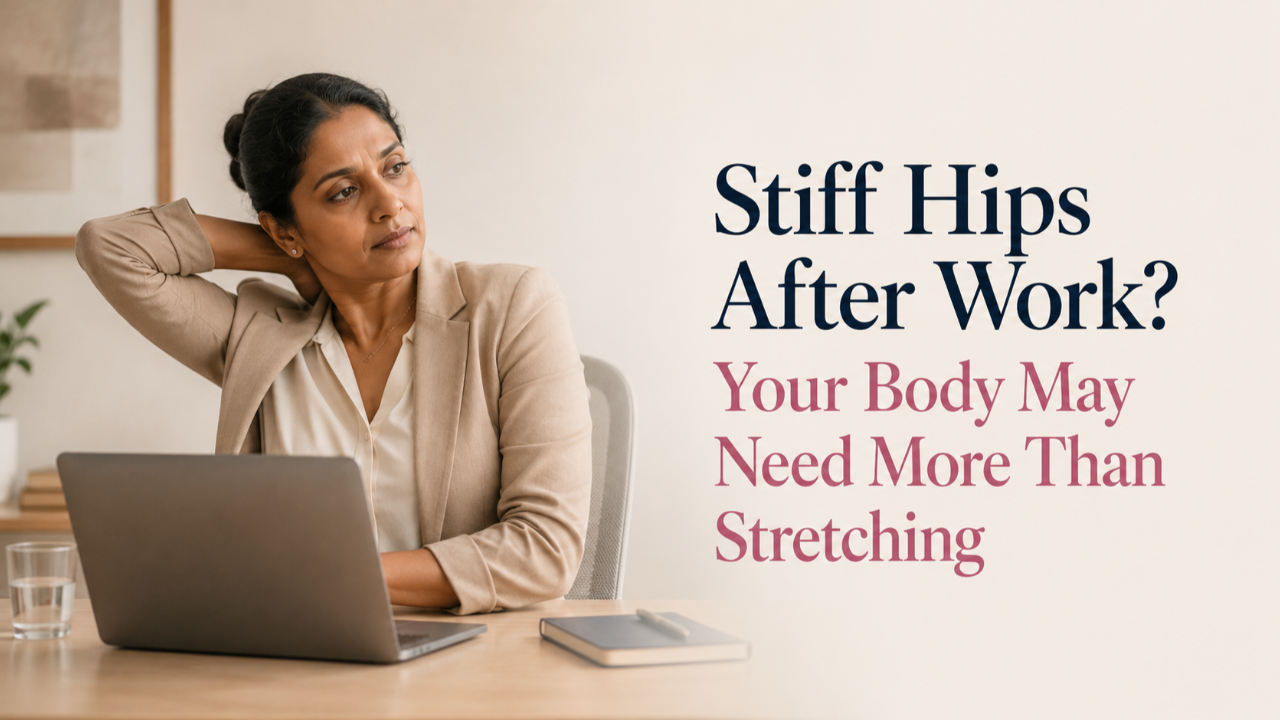
You stand up after a long day at your desk and, for a few moments, your hips seem unwilling to cooperate. The first steps feel shortened, your lower back may tighten as you straighten, and climbing the stairs or getting out of the car feels less comfortable than it did that morning.
Your instinct may be to stretch harder. Yet when the tightness returns every evening, the answer may not be another deep stretch held for thirty seconds. Your hips may need a better mixture of movement, strength and variety throughout the working day.
Why sitting can leave your hips feeling tight
Sitting keeps the hips bent for long periods. The muscles at the front of the hips remain in a shortened position, while the gluteal muscles at the back of the body do relatively little.
Research has found an association between prolonged sitting, physical inactivity and reduced passive hip extension. The researchers suggested that this may reflect an adaptation in tissue stiffness, although they also noted that more research is needed to understand its role in pain. (pubmed.ncbi.nlm.nih.gov)
Harvard Health similarly explains that sitting for extended periods may contribute to tight hip flexors and reduced flexibility around the hips. (health.harvard.edu)
This does not mean sitting has permanently shortened your muscles or damaged your hips. It means your body becomes accustomed to the positions it practises most often. When much of your day happens with the hips bent, standing tall and extending the leg behind you may begin to feel unfamiliar.
The feeling of tightness is not always a flexibility problem
A muscle can feel tight for several reasons. It may genuinely have reduced flexibility, but it may also be tired from holding one position, compensating for weakness elsewhere or responding protectively because a movement feels unfamiliar.
That is why repeatedly stretching the same area does not always create lasting relief. Stretching can improve flexibility and joint range of motion, and Harvard recommends performing it regularly rather than expecting one occasional session to undo weeks of inactivity. (health.harvard.edu)
However, your hips must also be strong enough to control the movement you gain. Flexibility without strength may leave you able to reach a position but unable to feel stable within it.
Your gluteal muscles may need more attention
The gluteal muscles help extend and stabilise the hips. They contribute when you stand from a chair, climb stairs, walk uphill and support yourself on one leg.
Harvard Health notes that spending long periods sitting can reduce gluteal activity while the hip flexors remain shortened at the front of the body. (health.harvard.edu)
This does not mean your glutes have literally “switched off”, as social media posts sometimes claim. It means they may not be receiving enough regular or challenging work. If you stretch the front of the hips but never strengthen the back and sides, the stiffness may continue to return.
Move before the end of the working day
One of the most useful changes is to stop waiting until 6pm to address eight hours of stillness. Movement does not have to mean completing a workout between meetings. It can be as simple as standing, walking briefly and allowing the hips to move out of the seated position.
Try linking movement to moments that already happen during your day. Stand and walk for two minutes after a meeting, take a slightly longer route to the kitchen, stand during a telephone call or walk for five minutes before lunch.
You could also perform five slow sit-to-stands before sitting down again. These brief breaks cannot replace regular exercise, but they reduce the amount of uninterrupted time your hips remain in one position.
Try this gentle hip-flexor stretch
Stand beside a desk or sturdy chair for balance. Step your right foot backwards and keep the heel lifted. Bend the front knee slightly while keeping your chest upright.
Gently tuck your pelvis rather than arching the lower back. You should feel a mild stretch at the front of the right hip. Hold for 15 to 30 seconds, then change sides.
Harvard’s hip-flexor guidance recommends regular stretching to reduce tightness and improve flexibility and range of motion. (health.harvard.edu)
Avoid pushing the pelvis aggressively forwards. A smaller movement performed with control is usually more useful than a large lunge created by arching your back.
Add strength immediately afterwards
After stretching, give the hip muscles a reason to work.
Sit towards the front of a sturdy chair with your feet comfortably apart. Lean forwards slightly from the hips, press through your feet and stand. Lower yourself slowly and repeat eight to twelve times.
You can also try a glute bridge. Lie on your back with your knees bent and feet on the floor. Gently tighten your abdominal muscles, press through your feet and lift your hips until your body forms a comfortable line from shoulders to knees. Pause briefly, then lower slowly.
Side steps are another useful option. Place a resistance band above your knees if you have one, keep your knees slightly bent and take several controlled steps to one side before returning.
These exercises strengthen the muscles that support and stabilise the hips. Harvard guidance on hip and knee discomfort also emphasises the value of strengthening the surrounding muscles rather than relying on stretching alone. (health.harvard.edu)
Do not forget hip rotation
Working life involves a great deal of forward-facing movement. You sit forwards, walk forwards and drive forwards, yet the hip joint is designed to rotate as well as bend and straighten.
Sit towards the front of a chair with both feet on the floor. Allow one knee to move gently inwards while the other moves slightly outwards, then reverse the direction. Keep the movement small and comfortable.
You could also lie on your back with your knees bent and slowly allow both knees to move from side to side. This gives the hips access to movement that may be largely absent during a normal working day.
Your workstation matters, but variety matters more
An adjustable chair and properly positioned screen may reduce unnecessary strain, but there is no single perfect posture that should be held all day. Even an upright posture can become uncomfortable when maintained for hours.
Changing position is usually more helpful than trying to remain perfectly still. Sit back for a while, place one foot slightly forwards, stand occasionally and move away from the screen when possible.
Research into seated posture has found that even postures intended to be neutral may become tiring or uncomfortable when held for prolonged periods. (pubmed.ncbi.nlm.nih.gov)
Your best posture is often your next posture.
Walking helps, but strength still matters
Walking is valuable for circulation, cardiovascular health and interrupting sitting. It may also help your hips feel looser after work.
However, walking alone may not provide enough resistance to maintain strength in every muscle surrounding the hip. Include two short strength sessions each week using movements such as squats, sit-to-stands, step-ups, glute bridges, side steps and light deadlifts.
Begin at a level you can control and increase the challenge gradually. The purpose is not to exhaust yourself. It is to teach your hips that they are capable of supporting more than sitting.
When hip pain is not simply desk stiffness
Not every uncomfortable hip is caused by tight hip flexors.
Pain at the side of the hip, especially when lying on that side, climbing stairs or standing on one leg, may involve the gluteal tendons. Evidence supports education and appropriate exercise as important treatments for gluteal tendinopathy, with some trials finding better long-term improvement than corticosteroid injection. (pubmed.ncbi.nlm.nih.gov)
Pain in the groin, reduced joint movement or increasing difficulty putting on shoes and socks may have another cause, including osteoarthritis.
Seek professional advice when discomfort is persistent, worsening or affecting how you walk, sleep or work. You should also arrange an assessment if the pain follows an injury or is accompanied by significant swelling, redness, heat, numbness, weakness or an inability to bear weight.
A practical after-work hip reset
Begin by walking around the room for one minute, allowing your arms to swing naturally. Follow this with a gentle hip-flexor stretch on each side.
Next, complete eight to twelve sit-to-stands, followed by glute bridges or standing hip extensions. Finish with gentle hip rotation or slow side-to-side weight shifts.
The sequence should take around five minutes and leave you feeling warmer and more mobile, not sore or exhausted.
Try it for one working week
For the next five days, set a reminder to stand and move at least once during the morning and once during the afternoon.
Complete one gentle hip-flexor stretch on each side and add one strengthening exercise after work. Notice whether standing, walking or climbing stairs feels easier by the end of the week.
You may discover that your hips were not asking for a longer stretching routine. They were asking for greater variety, more frequent movement and muscles strong enough to support the range you already have.
Stretching can be part of the solution. It simply should not have to do all the work.
Stay connected with news and updates.
Join our mailing list to receive the latest news and updates from our team.
Don't worry, your information will not be shared.
We hate SPAM. We will never sell your information, for any reason.

A soulful, nurturing retreat experience for women, what might change if you gave yourself four days?
At the REVIVAL retreat, you can step away from the demands of everyday life and make space for yourself. We will walk through the Peak District, enjoy gentle yoga and guided meditation, and share gratitude sessions and fireside chats.
Personality profiling and habit transformation sessions will give you time to reflect on where you are now and what you would like to take home with you. Come as you are, alongside a small group of women who have made this time for themselves too.
21–24 June 2027 | Just 10 places
Registration opens soon.
Support Your Body
40 plus body reset anti inflammatory food balance balance hormones balancing hormones beginners strength training bloating blood sugar blood sugar balance body confidence bone density health brain fog brain help breakfast recipes breathwork building resilience core exercises creating space in midlife detox detox your body diabetic management digestion easter recipes emotional balance emotional eating energy evening routines exercise for women exercise recovery in midlife fatigue tips fibre for midlife fitness transformation fixing energy in midlife flexibility fuel guided walking uk gut health health accountability health goals health strategy healthy healthy ageing healthy foods healthy recipes heart health hormonal hormonal balance hormone balance hormone balancing breakfast hormone health hormones hot flashes hydration insulin and midlife january detox joint health joint pain lifestyle foods losing muscle through ageing losing weight low impact cardio making time meal prep meditation meditation tips menopase wellness menopause menopause and digestion menopause exercise menopause fatigue menopause moods menopause nutrition menopause supplements menopause support menopause support for career women menopause symptoms menopause wellness menopause workout mental health for menopause and perimenopause mental health wellness metabolism midlife midlife boundaries midlife energy midlife reflection midlife reset midlife weight gain midlife wellness milestones mindfulness mindset mobility morning routine morning routine for midlife movement muscle strength nature nutrition nutrition for busy women nutrition for menopause nutrition mistakes made nutriton nutritonal snacks outdoor perimenopause perimenopause nutrition perimenopause support perimenopause symptoms perimenopause wellness perimenopause yoga post menopause support protein reducing cancer risk reducing stress tips reflection for busy women resistance band training retreats 2026 self care self care for professional women self care tips set boundaries sleep sleep and menopause sleep and perimenopause sleep tips spring detox strength training strength training for women 50 plus stretching stretching routines the 30 day detox challenge for midlife women the desk job body tracking fitness vitamins walking weight gain weight loss weight training for women wellness wellness habits womens wellness freedom yin yoga yoga yoga and menopause yoga routine yoga routines yoga stretch