How to Start Strength Training When You Feel Stiff, Tired or Unsure
Jun 25, 2026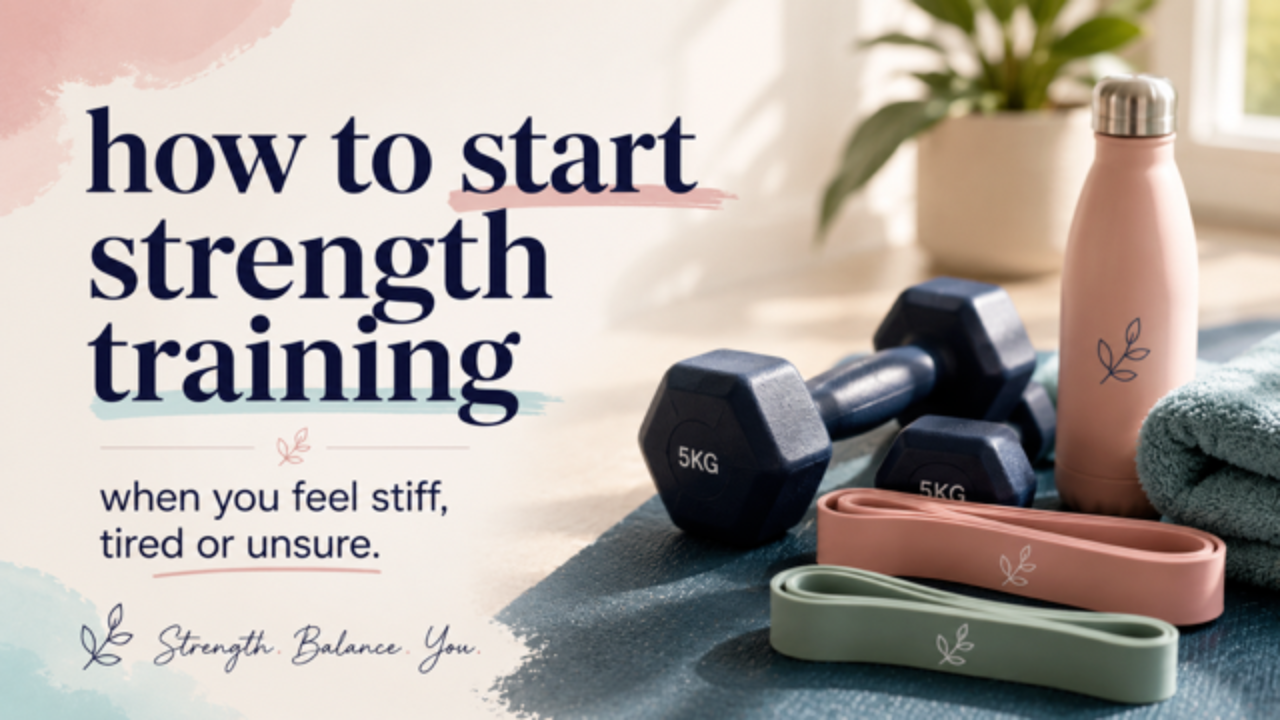
You know strength training would probably be good for you. You have heard it can protect your muscles, support your bones and help you remain active as you get older.
But knowing that does not necessarily make starting feel easy.
Perhaps your body feels stiff when you wake up. Your knees do not always feel reliable, your shoulders are tight from sitting at a desk, or poor sleep has left you with very little energy. You may worry that you are too unfit, too inexperienced or simply too late to begin.
Then you see videos of women lifting heavy barbells, completing fast circuits and making every exercise look effortless. Rather than feeling inspired, you feel as though strength training belongs to somebody else.
It does not.
Strength training is not reserved for athletic women, confident gym-goers or people who already feel strong. It is especially valuable for the woman who wants everyday movement to feel easier again.
Midlife can genuinely feel harder
Perimenopause and menopause can bring disturbed sleep, tiredness, joint discomfort, changes in mood and difficulty concentrating. Symptoms can fluctuate, which means the body you wake up with on Monday may feel quite different by Thursday.
That unpredictability can make exercise feel difficult to maintain. You may begin enthusiastically on a good week, miss several sessions when symptoms worsen and then conclude that you have failed again.
You have not failed. You may simply have been trying to follow a plan that did not leave enough room for your changing energy.
A midlife strength routine needs structure, but it also needs flexibility. The aim is not to prove how hard you can push yourself. It is to create enough challenge for your muscles while working with the body you have that day.
Some sessions will feel strong and energetic. Others may need to be shorter, slower or lighter. Both can still count.
Start with what you want to make easier
Many women begin exercise with a vague goal such as “I need to get fit” or “I should tone up”. These goals can quickly lose their meaning when you are tired.
A more useful question is: What would I like my body to help me do more easily?
You may want to climb stairs without your thighs burning. You might want to lift your suitcase into the car, carry your shopping in one journey or get up from the floor without grabbing the furniture.
Perhaps you want to feel steadier on uneven ground, protect your bones or stop feeling nervous whenever someone suggests a long walk.
These are strength goals.
They are also far more motivating than trying to punish your body into becoming smaller. Strength training is not about correcting everything you dislike about yourself. It is about improving what your body can do for you.
You do not need to begin in a gym
A gym can be useful, but it is not the entrance requirement for becoming stronger.
Strength exercise simply means asking your muscles to work harder than usual against resistance. That resistance can come from your body weight, a resistance band, a pair of dumbbells, a machine or an object you can hold securely at home.
You can begin with a chair, a wall and a small amount of floor space.
Standing up from a chair trains the muscles that help you rise from the sofa and climb stairs. Pressing against a wall begins to strengthen your chest, shoulders and arms. Pulling a resistance band towards you supports your upper back and posture.
These exercises may look simple, but simple does not mean ineffective. The latest resistance-training guidance emphasises that consistency matters more for most adults than following a complicated or supposedly perfect programme. Body-weight exercises, bands and home routines can all contribute to meaningful progress.
The best starting point is not the most impressive workout. It is the one you feel able to repeat.
Your first session should feel almost too manageable
One of the biggest mistakes beginners make is trying to compensate for years without strength training in one afternoon.
A first session does not need to exhaust you. Its purpose is to learn the movements, notice how your body responds and finish feeling that you could do it again.
Try these five movements:
Sit to stand: Sit towards the front of a firm chair with your feet comfortably apart. Lean forwards slightly and stand up, using your hands for support if needed. Lower yourself slowly.
Wall press: Place your hands against a wall at approximately chest height. Step your feet back, bend your elbows and bring your body towards the wall. Press yourself away again.
Supported hip hinge: Hold the back of a chair. Soften your knees, push your hips backwards and keep your spine comfortably long. Return to standing by pressing your feet into the floor and gently squeezing your glutes.
Resistance-band row: Secure a band safely or hold it around your feet while seated. Draw your elbows backwards without lifting your shoulders, then release with control.
Calf raise: Hold a stable surface, rise onto the balls of your feet and slowly lower your heels.
Complete five to eight controlled repetitions of each movement. Rest whenever you need to. One round is enough for your first session.
When this begins to feel comfortable, gradually work towards 8 to 12 repetitions and a second round. UK guidance recommends muscle-strengthening activity involving the major muscle groups on at least two days each week, but you do not have to achieve the full recommendation immediately.
Beginning with ten minutes is still beginning.
Learn the difference between stiffness and warning pain
Feeling stiff at the start of a session does not always mean you should avoid movement. Gentle activity often helps the body feel warmer and more comfortable.
Spend a few minutes marching slowly, circling your shoulders, moving your ankles and repeatedly sitting down and standing up from a chair. The first repetition may feel awkward. The fifth may feel much easier.
However, strength training should not involve ignoring sharp, sudden or worsening pain.
Muscle effort may feel like warmth, heaviness or fatigue. You might experience mild muscular tenderness a day or two after doing something unfamiliar. Pain inside a joint, numbness, dizziness, chest pain or discomfort that changes the way you move should not be treated as a sign that the exercise is working.
Stop and seek appropriate professional advice when something does not feel right.
Women who have osteoporosis, a previous fragility fracture or significant medical concerns may need exercise modifications. The Royal Osteoporosis Society advises starting at an appropriate level and notes that body-weight and resistance-band exercises can be suitable entry points, including for many people returning to exercise after a fracture.
Starting gently is not being overly cautious. It is how you build enough confidence to progress safely.
Use three versions of your routine
A rigid plan assumes that your sleep, symptoms and workload will remain the same every week. Midlife often proves otherwise.
Create three versions of your strength session instead.
Your full session might last 25 to 30 minutes and include two or three sets of each exercise.
Your short session might last 10 to 15 minutes and include one or two sets.
Your minimum session might consist of five sit-to-stands, five wall presses and five calf raises while waiting for the kettle to boil.
The minimum session will not provide the same training stimulus as the full routine, but it maintains the habit. It reminds you that a difficult day does not have to become a lost week.
Consistency is not doing the maximum every time. It is avoiding the belief that only the maximum counts.
Choose a resistance that requires some effort
Many women are understandably cautious when they begin, but they can remain stuck using weights that are too light to challenge their muscles.
The exercise should not feel impossible. However, the final few repetitions should require concentration and effort while your technique remains controlled.
At the end of a set, ask yourself: Could I comfortably repeat this another ten times?
When the answer is yes, you may be ready to make the movement slightly harder. You could add one or two repetitions, use a stronger band, hold a light weight or slow down the lowering phase.
Progress does not require dramatic jumps. Adding one kilogram, completing one extra repetition or using less support from the chair is progress.
The current evidence-based guidance from the American College of Sports Medicine highlights regular training of the major muscle groups and confirms that effort and consistency matter more than unnecessarily complex routines.
Your muscles need an appropriate challenge. They do not need punishment.
Train your whole body—not only the areas you want to change
It is tempting to focus on your stomach, arms or thighs, particularly when body shape begins to change during menopause.
A useful strength programme should train the movements your whole body needs. This includes sitting and standing, bending at the hips, pushing, pulling, stepping and carrying.
Training your back can improve your ability to lift and support your posture. Strengthening your legs and hips helps with stairs, walking and getting up from a chair. Pressing movements support everyday pushing and lifting, while carrying weights can challenge your grip and trunk.
The purpose is not to chase individual body parts. It is to build a more capable body.
This whole-body approach is also more realistic for women who have limited time. Two thoughtfully planned sessions can achieve far more than a collection of random exercises performed whenever you feel guilty.
Rest is not a lack of commitment
Strength training works by giving the muscles a challenge and then allowing them time to recover and adapt.
You do not need to train the same muscles hard every day. When you are starting, leaving at least a day between full-body strength sessions can help you manage soreness and fatigue.
Walking, gentle yoga or mobility work can be used between sessions, but you are also allowed to rest completely.
Poor sleep during perimenopause can make recovery feel harder. On those days, reducing the weight or shortening the session may be more sensible than forcing yourself through a demanding workout. Sleep problems and fatigue are recognised menopause symptoms, not evidence that you lack discipline.
The question is not always, “Can I push through this?”
Sometimes the better question is, “What level of movement would support me today?”
Attach strength training to something already in your week
Motivation is unreliable, particularly when work is demanding and sleep has been poor.
Choose two realistic spaces in your week and protect them. Perhaps you train for 20 minutes on Tuesday morning and Saturday afternoon. Maybe you complete your routine immediately after returning from a regular walk.
Prepare your equipment in advance. Keep your weights visible rather than hidden in a cupboard. Put your training clothes out the night before.
Reducing the number of decisions you must make can be more effective than repeatedly asking yourself whether you feel motivated.
Your routine should fit into your life before you expect it to transform your life.
Measure what the scales cannot see
Strength training may change your body composition over time, but the scales are not the best way to judge whether you are becoming stronger.
Record the exercise, weight and repetitions you complete. Notice when you move from using both hands on the chair to one hand, or from a wall press to pressing against a kitchen worktop.
Pay attention to ordinary moments. The shopping bag feels lighter. You get up from the floor with less effort. You carry a suitcase without asking for help. Your balance feels better and your posture more secure.
These improvements can appear before there is any obvious visual change.
They are not minor results. They are the reason you are training.
Your gentle two-week starting plan
During the first week, complete one short session using the five movements described above. Perform one set of five to eight repetitions and leave at least a day before repeating it.
During the second week, complete two sessions. Add a few repetitions where the exercises feel comfortable, or repeat the routine for a second round.
Continue walking, stretching or attending the classes you enjoy. Strength training does not have to replace them. It fills an important gap by giving your muscles a reason to become more capable.
Once you can complete two rounds with good control, begin increasing the resistance gradually. Progress one exercise at a time rather than changing everything at once.
This may look modest compared with an online transformation plan, but it is how sustainable strength is built: appropriate challenge, repeated consistently.
You do not need to feel confident before you begin
Confidence is often treated as something you must find before taking action.
In reality, physical confidence is usually built afterwards.
It grows when you complete your first session and realise that you can do it. It increases when a movement that once felt difficult becomes familiar. It strengthens when you lift something you could not lift several weeks earlier.
You do not have to become a gym person. You do not need to love every exercise, and you do not have to wait until the tiredness, stiffness or uncertainty has completely disappeared.
Begin with the body you have today.
Choose a few useful movements. Make them challenging enough to matter, but manageable enough to repeat. Allow your stronger days and your more difficult days to look different.
You are not too stiff to begin. You are not too unfit to learn. You are not behind.
You are simply at the start of becoming stronger.
Stay connected with news and updates.
Join our mailing list to receive the latest news and updates from our team.
Don't worry, your information will not be shared.
We hate SPAM. We will never sell your information, for any reason.