You stretch regularly, attend yoga when your diary allows and make a genuine effort to stay active. Yet your knees still complain on the stairs, your hips feel stiff after a day at your desk, or your shoulders ache after carrying a laptop bag. It can be frustrating when you are doing what you have always been told is good for your joints but still do not feel as comfortable or capable as you expected.
Flexibility remains valuable, but it is only one part of healthy movement. Joints also depend on strong muscles, good control, regular loading and enough recovery to cope with the demands placed upon them. Stretching may help you reach a position, but strength is what helps you control that position while standing, lifting, walking or reacting quickly.
Flexibility does not automatically create joint stability
Flexibility refers to the available range of movement around a joint. Stability describes your ability to control that joint while force is passing through it. A woman may have excellent hamstring flexibility yet still lack the hip and thigh strength required to descend stairs smoothly or rise from a low chair without using her hands.
The muscles surrounding a joint act as part of its support system. When those muscles are strong and coordinated, they help control movement and distribute load more effectively. Reviews of resistance exercise in people with osteoarthritis have found improvements in strength and physical function, with many studies also reporting reductions in pain.
This does not mean that every ache is caused by weak muscles, or that strength training can repair every joint condition. It means that flexibility alone cannot provide all the support your joints need during real-life movement.
The area that feels tight may not need a deeper stretch
A feeling of tightness is often interpreted as proof that a muscle is too short. Sometimes that is true, but the sensation can also appear when an area is tired, overloaded or lacking sufficient support from surrounding muscles. Stretching may provide temporary relief without changing the reason the discomfort keeps returning.
Consider the shoulders of a woman who works at a laptop for much of the day. Opening the chest may feel helpful, but if the upper-back and shoulder muscles do not have enough endurance, the familiar ache may return within hours. In the same way, repeatedly stretching the hips may not solve the problem if the gluteal muscles are not strong enough to control the pelvis while walking, climbing stairs or standing on one leg.
A useful approach is to pair mobility with support. After opening the chest, add a rowing exercise. After stretching the front of the hips, follow with glute bridges or controlled sit-to-stands.
Your joints need appropriate load
Many women assume that protecting an achy joint means avoiding resistance. In reality, avoiding movement completely can allow the surrounding muscles to weaken, making everyday tasks feel harder and sometimes increasing the strain experienced during those tasks. Guidance on arthritis management consistently includes a combination of flexibility, strengthening and aerobic activity rather than stretching alone.
Appropriate loading tells muscles, tendons and bones that they need to remain capable. The key word is appropriate. The resistance should be challenging enough to stimulate adaptation but manageable enough to perform with control and recover from comfortably.
You do not need to begin with heavy gym equipment. Body-weight exercises, resistance bands and light dumbbells can all create a useful training effect when the movement is performed well and gradually progressed.
Stronger muscles can change how a movement feels
Imagine climbing a flight of stairs when your thigh and hip muscles are already working close to their maximum capacity. Every step feels demanding because the task requires a large proportion of the strength available to you. When those muscles become stronger, the staircase has not changed, but it now requires a smaller percentage of your capacity.
This is one reason strength can improve daily life even before there is any visible change in muscle shape. Activities such as getting out of a chair, lifting luggage or carrying shopping may begin to feel easier because your body has more capacity available. Evidence on resistance training in adults with knee osteoarthritis supports its role in improving strength and physical function, although the ideal programme should be individualised.
For professional women, this matters because joint confidence influences far more than exercise. It affects how readily you take the stairs, travel for work, walk between meetings and participate in the activities that make life enjoyable.
Flexibility without control may not feel secure
Some women are naturally very flexible. They may find yoga poses easy, sit comfortably in deep stretches and assume that greater range always represents better joint health. Yet a large range of movement still requires strength and control.
If a joint moves easily but the muscles around it cannot stabilise that movement, the body may feel unsupported. In this situation, repeatedly chasing greater flexibility may be less useful than building strength in the middle and end ranges already available.
A simple test is to compare passive and active movement. You may be able to pull your knee close to your chest with your hands, but can you lift it to a similar height while standing without leaning backwards? The difference reveals how much of your range you can actively control.
Midlife changes the importance of muscle
Muscle strength gradually becomes more important as we move through midlife because it supports balance, movement efficiency and independence. Strength training also provides a loading stimulus for bone, which becomes particularly relevant for women as bone mass declines with age and hormonal change.
This does not mean your exercise routine needs to become punishing. The most effective programme is one you can perform consistently, progress gradually and fit around the demands of work and home. Two well-planned sessions each week can be more valuable than an ambitious programme that leaves you exhausted and disappears after a fortnight.
The aim is not simply to become stronger in the gym. It is to make ordinary life require less effort.
Tendons need strength as well as stretching
Pain around a joint does not always come from the joint itself. Tendons connect muscles to bones and are often irritated by sudden changes in activity, repeated loading or insufficient strength. A tendon that is sensitive may not respond well to aggressive stretching, particularly if stretching compresses or pulls on the painful area.
Progressive strengthening is often used in tendon rehabilitation because tendons need carefully managed load to regain capacity. The exact exercises depend on the location and diagnosis, which is why persistent pain deserves proper assessment rather than a generic online stretching routine.
This is especially important if pain occurs consistently at the side of the hip, below the kneecap, around the Achilles tendon or in the shoulder. Continuing to stretch harder because the area feels tight may aggravate rather than resolve the problem.
Your workday may be reducing movement variety
Professional women often spend long periods moving through a limited set of positions. You sit at a desk, look towards a screen, commute, attend meetings and then spend the evening catching up on tasks at home. Even a good posture can become uncomfortable when held for too long.
A short stretching routine at the end of the day may feel pleasant, but it cannot completely replace the movement variety missing from the previous eight hours. Your joints benefit from regular changes of position, brief walks, rotation, reaching and standing throughout the day.
Try attaching movement to events already in your schedule. Stand after each meeting, walk while making a telephone call or complete five controlled sit-to-stands before lunch. These small interruptions do not replace exercise, but they reduce the length of time your body remains in one position.
Pair each stretch with a strengthening movement
A practical way to improve your routine is to stop treating flexibility and strength as separate activities. Pairing them makes the purpose of each movement clearer and helps your body use the range you are creating.
After a calf stretch, perform slow heel raises. After a hip-flexor stretch, complete sit-to-stands or glute bridges. After opening the chest, use a resistance band for rows.
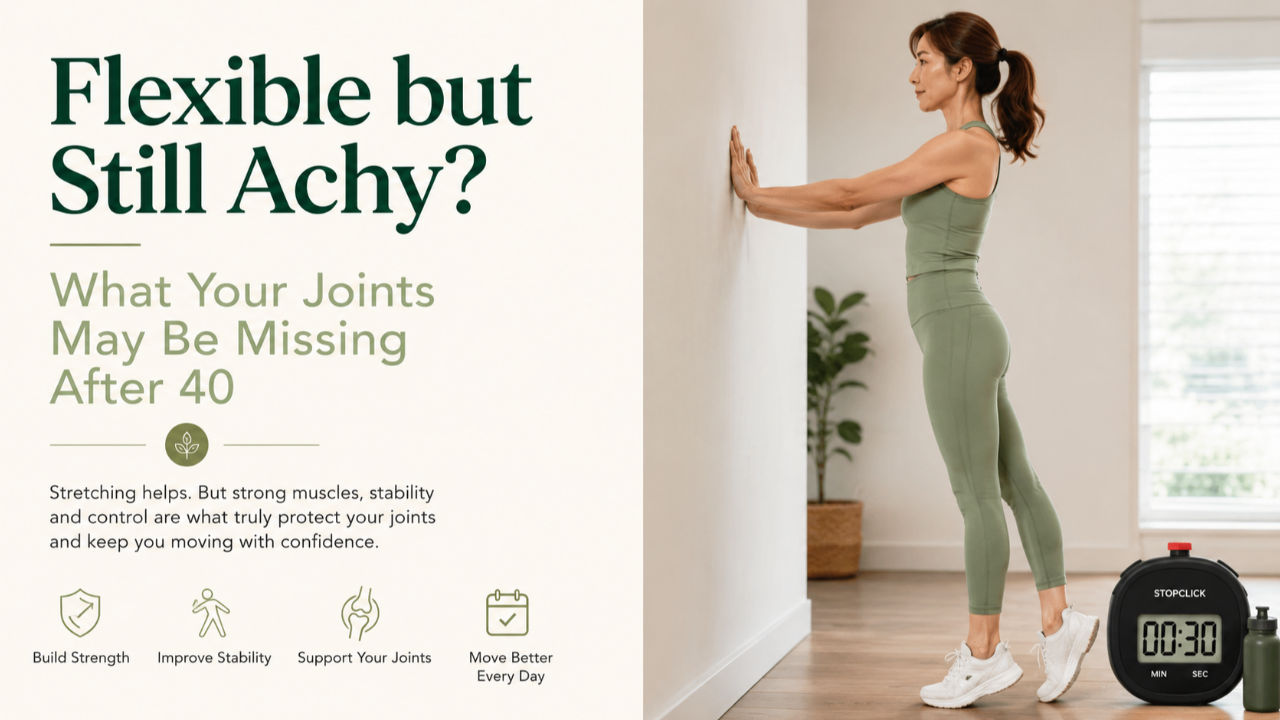
For the shoulders, gentle arm movements can be followed by wall press-ups. For the hips, controlled side steps can strengthen the muscles that help stabilise the pelvis during walking and standing.
The stretch may improve comfort and movement. The strength exercise helps you own and support that movement.
A joint-friendly strength routine does not need to be long
A useful session can be completed in 20 to 30 minutes. Begin with a few minutes of gentle movement, such as marching, shoulder circles and controlled squats to a chair.
Choose four or five exercises that cover the major movement patterns. Sit-to-stands strengthen the thighs and hips, wall press-ups work the upper body, resistance-band rows support the back and shoulders, heel raises strengthen the calves, and a controlled carry challenges posture and grip.
Start with one or two sets of eight to twelve repetitions. The final few repetitions should feel challenging while your technique remains controlled. Guidance from the American College of Sports Medicine supports strength work at least twice weekly, adapted to the individual’s ability and experience.
Do not confuse joint noise with joint damage
Clicks, pops and cracks can sound alarming, particularly when they appear more frequently in midlife. Joint noise without pain, swelling, locking or loss of function is often less concerning than it sounds. The noise may come from tendons moving, pressure changes within the joint or surfaces shifting during movement.
What matters more is the pattern around the noise. A painless knee that clicks during a squat is different from a knee that catches, swells or gives way. The presence of pain, instability or functional change should guide whether further assessment is needed.
Avoid repeatedly testing or forcing a joint simply because it makes a sound. Move within a comfortable range and pay attention to how the joint performs rather than expecting complete silence.
Recovery is part of joint care
Joints and surrounding tissues do not adapt only during exercise. They also need time, sleep and adequate nutrition to recover from the load you place upon them. A demanding work schedule, poor sleep and high stress can reduce how well you tolerate training even when the exercises themselves are appropriate.
Recovery does not always mean complete rest. Gentle walking, mobility work and lighter sessions can maintain movement without adding unnecessary fatigue. Current sports medicine guidance emphasises a broader recovery approach that includes sleep, hydration, nutrition and sensible activity.
If the same routine suddenly feels much harder, look at the context before assuming your body is failing. You may need to reduce the volume temporarily rather than abandon the habit.
Know when discomfort needs professional attention
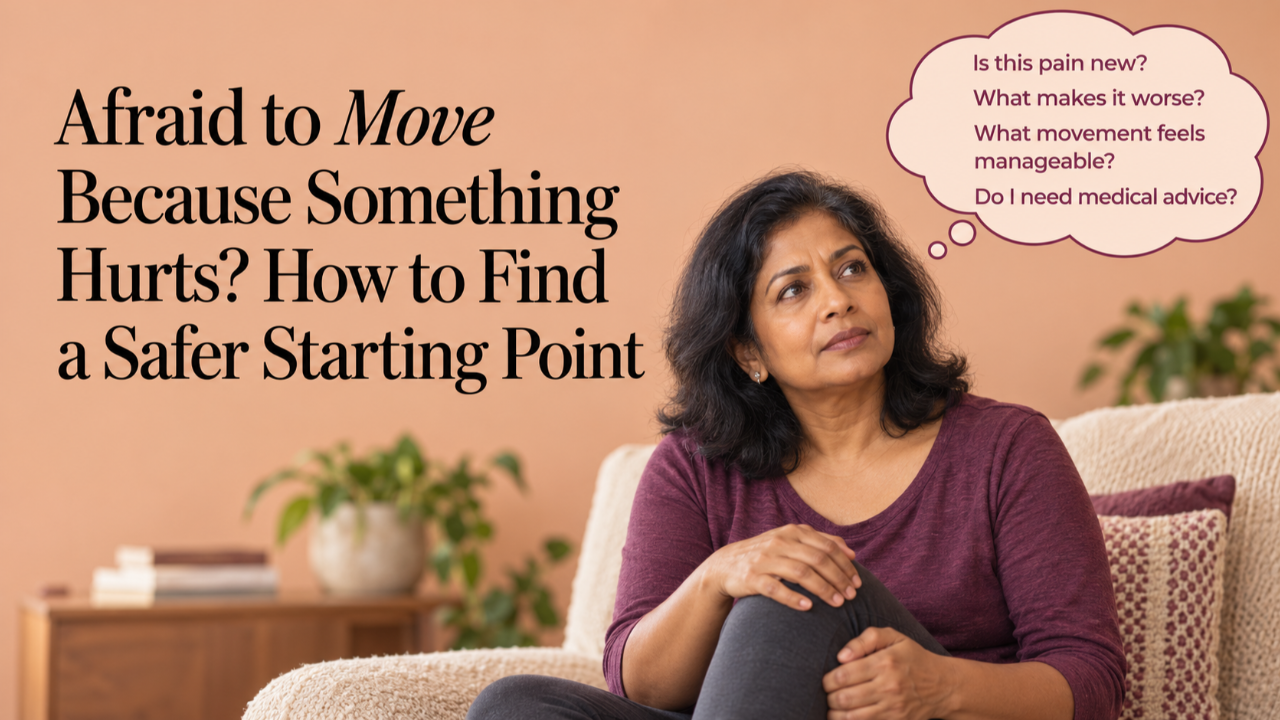
Mild muscular effort during exercise is expected, but sharp, catching or rapidly worsening pain is not something to push through. Persistent swelling, redness, heat, numbness, weakness, joint locking or repeated giving way should be assessed by an appropriate healthcare professional.
You should also seek advice when pain repeatedly wakes you at night, follows an injury or begins to affect your walking and daily function. A physiotherapist or clinician can help establish whether the problem involves the joint, tendon, muscle or another structure.
Exercise is valuable, but it should be matched to the condition. A personalised plan is particularly important when you already have arthritis, a previous injury or unexplained pain.
What your joints may actually be asking for
Your joints may not be asking you to stop stretching. They may be asking you to add the support that stretching cannot provide on its own.
Keep the mobility work that helps you feel comfortable, but add progressive strength, regular changes of position and exercises that improve control. Include walking, swimming or cycling for cardiovascular fitness, and give your body enough recovery to adapt.
Flexibility helps you access movement. Strength helps you manage it.
After 40, joint care is not about trying to move exactly as you did at 25. It is about building enough range, strength and confidence to meet the demands of the life you have now.
Stay connected with news and updates.
Join our mailing list to receive the latest news and updates from our team.
Don't worry, your information will not be shared.
We hate SPAM. We will never sell your information, for any reason.

A soulful, nurturing retreat experience for women, what might change if you gave yourself four days?
At the REVIVAL retreat, you can step away from the demands of everyday life and make space for yourself. We will walk through the Peak District, enjoy gentle yoga and guided meditation, and share gratitude sessions and fireside chats.
Personality profiling and habit transformation sessions will give you time to reflect on where you are now and what you would like to take home with you. Come as you are, alongside a small group of women who have made this time for themselves too.
21–24 June 2027 | Just 10 places
Registration opens soon.
Support Your Body
40 plus body reset anti inflammatory food balance balance hormones balancing hormones beginners strength training bloating blood sugar blood sugar balance body confidence bone density health brain fog brain help breakfast recipes breathwork building resilience core exercises creating space in midlife detox detox your body diabetic management digestion easter recipes emotional balance emotional eating energy evening routines exercise for women exercise recovery in midlife fatigue tips fibre for midlife fitness transformation fixing energy in midlife flexibility fuel guided walking uk gut health health accountability health goals health strategy healthy healthy ageing healthy foods healthy recipes heart health hormonal hormonal balance hormone balance hormone balancing breakfast hormone health hormones hot flashes hydration insulin and midlife january detox joint health joint pain lifestyle foods losing muscle through ageing losing weight low impact cardio making time meal prep meditation meditation tips menopase wellness menopause menopause and digestion menopause exercise menopause fatigue menopause moods menopause nutrition menopause supplements menopause support menopause support for career women menopause symptoms menopause wellness menopause workout mental health for menopause and perimenopause mental health wellness metabolism midlife midlife boundaries midlife energy midlife health & well being midlife reflection midlife reset midlife weight gain midlife wellness milestones mindfulness mindset mobility morning routine morning routine for midlife movement movement and mobility muscle strength nature nutrition nutrition for busy women nutrition for menopause nutrition mistakes made nutriton nutritonal snacks outdoor perimenopause perimenopause nutrition perimenopause support perimenopause symptoms perimenopause wellness perimenopause yoga post menopause support protein reducing cancer risk reducing stress tips reflection for busy women resistance band training retreats 2026 self care self care for professional women self care tips set boundaries sleep sleep and menopause sleep and perimenopause sleep tips spring detox strength training strength training for women 50 plus stretching stretching routines the 30 day detox challenge for midlife women the desk job body tracking fitness vitamins walking weight gain weight loss weight training for women wellness wellness habits womens wellness freedom yin yoga yoga yoga and menopause yoga routine yoga routines yoga stretch