Five Minutes Between Meetings: A Movement Habit Your Body Will Notice
Jul 18, 2026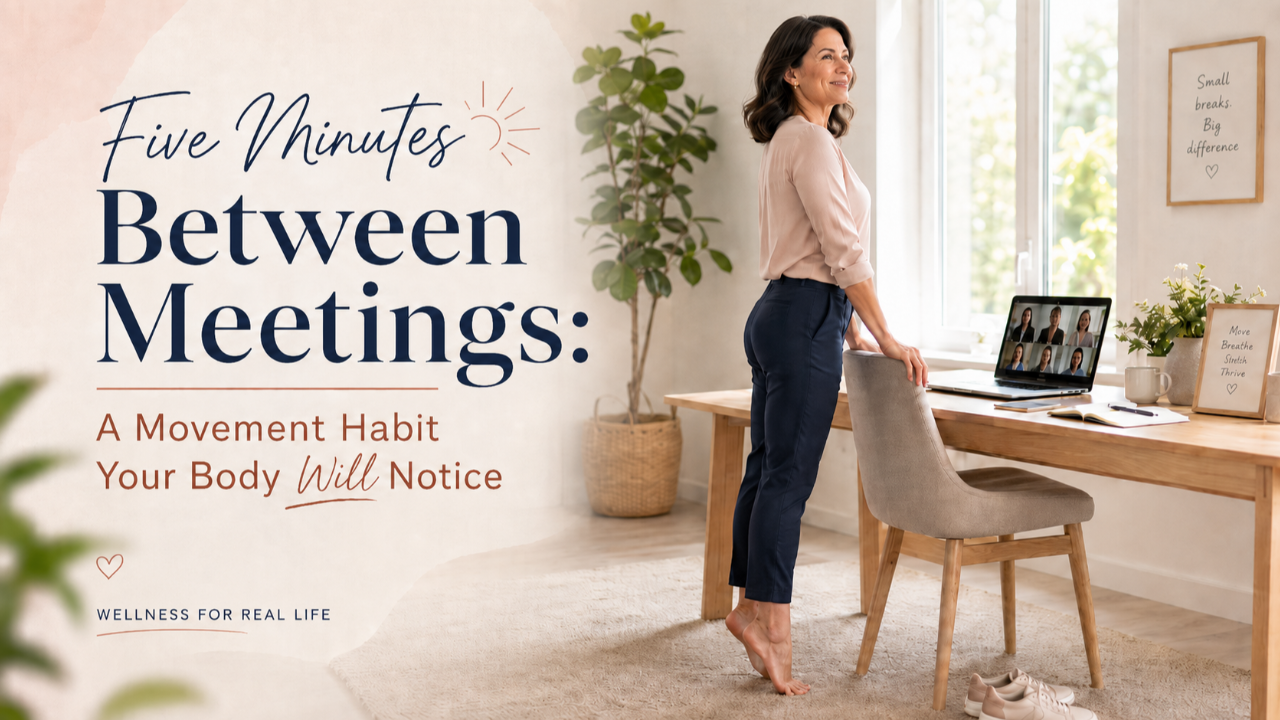
You finish one Zoom meeting and immediately open the link for the next. Your shoulders have crept towards your ears, your hips feel tight and your lower back is beginning to complain. You promise yourself that you will move later, but another email arrives, the phone rings or something at home needs your attention.
For many busy women, the problem is not a complete lack of interest in exercise. It is the number of hours spent sitting almost without noticing. A morning walk, yoga class or gym session is valuable, but it does not automatically prevent you from feeling stiff after several uninterrupted hours at a desk.
This is where a five-minute movement habit can make a meaningful difference. It is not intended to replace exercise. It simply interrupts the long periods of stillness that can leave your body feeling compressed, sluggish and increasingly uncomfortable.
When you sit for an extended period, the muscles in your legs, hips and trunk are doing very little. Your joints remain in the same positions, your posture gradually changes and the circulation-promoting action created by contracting your leg muscles is reduced. You may notice this as heavy legs, tight hips, an aching back or the feeling that you need a few uncomfortable steps before you can move normally again.
Research involving office workers has found that prolonged sitting can increase strain through the back. In one 2024 study, workers who performed brief walking, stretching and mobility exercises every 30 minutes showed less evidence of back muscle overload than those who remained seated continuously for 90 minutes.
Movement breaks may also support your metabolic health. Studies have found that interrupting sitting with short bouts of light walking can reduce the rise in blood glucose and insulin after eating. Simply standing may not always produce the same response, suggesting that gently using your muscles is more helpful than only replacing your chair with a standing desk.
This can be particularly relevant during and after menopause, when protecting cardiovascular and metabolic health becomes increasingly important. A 2025 trial involving postmenopausal women with overweight or obesity found that increasing the number of times participants moved from sitting to standing improved blood pressure over three months.
You do not, however, need to turn every break into a workout. The aim is to change position, activate several large muscle groups and remind your body that the working day includes movement as well as sitting.
Your five-minute between-meetings movement break
Minute one: walk or march
Walk around your room, along the corridor or up and down the stairs. When space is limited, march beside your desk while allowing your arms to swing naturally.
This begins using the muscles in your legs and helps you move out of the folded position created by sitting. Keep the pace comfortable but purposeful. You should feel more awake, not breathless.
Minute two: sit-to-stands
Stand in front of a stable chair with your feet approximately hip-width apart. Send your hips back, gently lower yourself towards the chair and stand again. Use your hands for support when necessary.
Aim for slow, controlled repetitions rather than rushing. This simple movement activates the thighs and gluteal muscles you need for climbing stairs, rising from chairs and maintaining independence later in life.
Minute three: heel raises
Stand behind your chair and hold it lightly for balance. Rise onto the balls of your feet, pause briefly and lower your heels with control. Continue for approximately one minute, resting when required.
Your calf muscles contract each time you lift your heels. This is useful after sitting because the calves play an important role in helping blood return from the lower legs.
Minute four: open the upper body
Stand tall and take your arms out to the sides. Gently draw your shoulder blades back and down, then bring your arms forward as though you are giving yourself a hug. Alternate which arm crosses on top.
You can then place your hands behind your head and slowly rotate your upper body from one side to the other. Keep your hips facing forwards and make the movement comfortable rather than forcing a large twist.
This helps counter the rounded position that often develops while typing, reading emails or leaning towards a laptop screen.
Minute five: move the hips and breathe
Place your hands on your hips and take a small step backwards with one foot. Keep your body upright and gently bend the front knee until you notice a comfortable opening through the front of the back hip. Change sides after approximately 20 to 30 seconds.
Finish by standing tall and taking two or three slow breaths. Allow your shoulders to soften as you breathe out. You should return to your desk feeling more open and alert rather than tired.
The routine does not have to be identical every time. On a particularly busy day, you might walk while listening to a voice note, perform heel raises while waiting for the kettle or complete sit-to-stands before joining your next call. The best movement break is not necessarily the most sophisticated one. It is the one that fits naturally into your day.
A useful approach is to attach movement to something that already happens. Stand and move after every Zoom meeting, before making another drink or whenever you finish a focused piece of work. This removes the need to remember an entirely separate habit.
You can also place a small reminder beside your screen or schedule a quiet notification every 45 to 60 minutes. Computer prompts have been studied as a practical way to encourage workers to interrupt sedentary time, although the reminder is only useful when you act on it.
Do not worry when you cannot manage the full five minutes. Two minutes of walking is better than waiting all day for a perfect 30-minute window that never arrives. Some studies have observed metabolic and vascular benefits from activity breaks lasting only two or three minutes when they are repeated regularly.
It is also important to remember that these small breaks complement rather than replace planned activity. The World Health Organization recommends that adults limit sedentary behaviour while also working towards 150 to 300 minutes of moderate-intensity aerobic activity each week, together with regular muscle-strengthening exercise.
The five-minute habit has a different purpose. It helps prevent your entire working day from becoming one long period of stillness.
Over time, you may notice that you stand up more easily, your shoulders feel less tense at the end of the afternoon and your body no longer needs several hours to recover from sitting. You may also become more aware of the early signs that you have stayed in one position for too long.
You do not need to wait until your back aches, your hips feel locked or your energy has disappeared. Use the natural gaps between meetings as an invitation to move.
Five minutes may not feel like a formal workout, but repeated across a busy week, it becomes something equally valuable: a regular reminder that your body was designed to change position, use its muscles and move throughout the day.
Stay connected with news and updates.
Join our mailing list to receive the latest news and updates from our team.
Don't worry, your information will not be shared.
We hate SPAM. We will never sell your information, for any reason.