Could You Still Do This at 70? The Midlife Moves That Protect Independence
Jul 19, 2026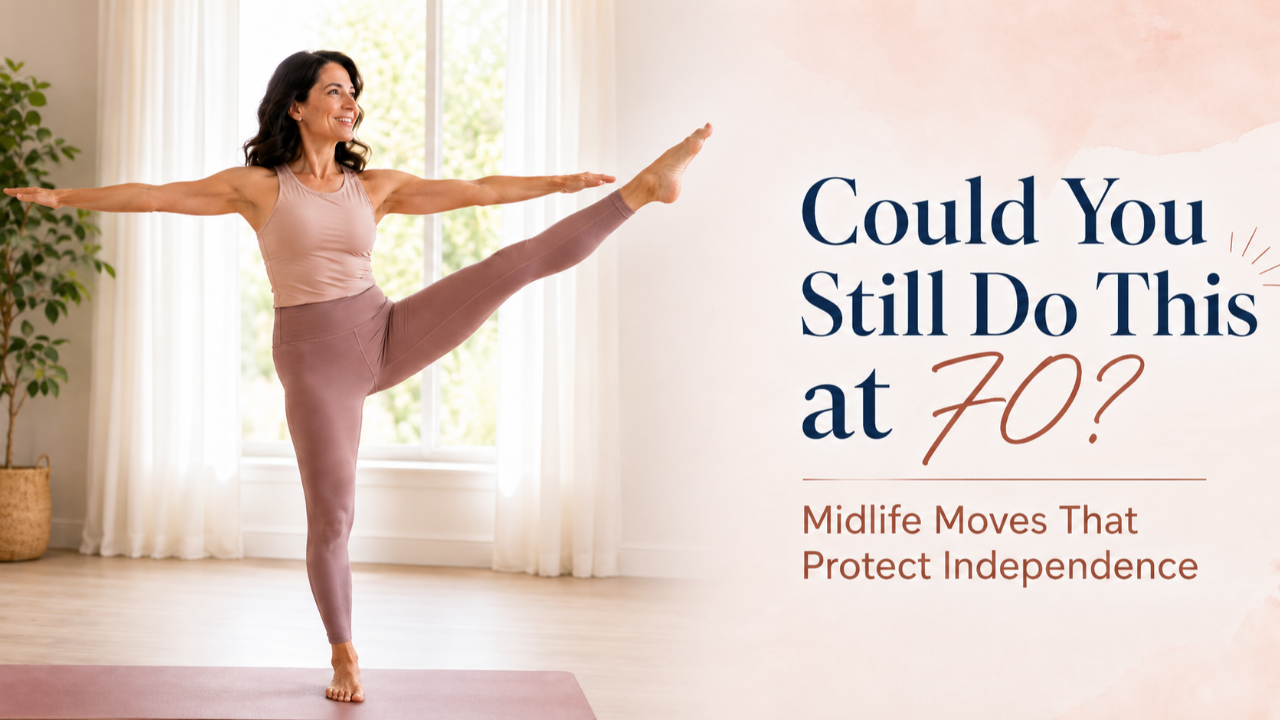
You may not spend much time thinking about whether you will still be able to rise from the floor, carry your own suitcase or climb a flight of stairs when you are 70. Right now, there are meetings to attend, deadlines to meet, family responsibilities to manage and a home that rarely seems to run itself.
Yet independence is not usually lost in one dramatic moment. It can begin with small changes that are easy to dismiss: using your hands to push yourself out of a low chair, avoiding the stairs when there is a lift, feeling less steady when pulling on your trousers or asking someone else to lift a bag that you would once have carried without thinking.
These moments are not an inevitable sign that your best years are behind you. They are useful messages from your body. They suggest that your muscles, balance and movement confidence may need more attention than they did ten or twenty years ago.
The encouraging truth is that midlife gives you a valuable opportunity to act. The way you move now can influence how confidently and independently you are able to live later.
Independence is built through ordinary movements
When we talk about healthy ageing, it is easy to focus on weight, blood pressure or the number of steps completed each day. These measures can matter, but they do not tell the whole story.
Your future freedom will also depend on whether your legs are strong enough to lift you from a chair, whether you can recover your balance after a stumble and whether you have the muscular power to step quickly onto a kerb or move out of the way of an obstacle.
It will be reflected in your ability to get into a car, place a bag in an overhead compartment, walk confidently over uneven ground and get down to the floor and back up again without fear.
These are not athletic achievements. They are the movements that allow you to remain fully involved in your own life.
Harvard Health describes lower-body strength as particularly important for maintaining mobility and independence with age. Strong legs support everyday activities such as walking, using stairs, stepping into a bath and getting in and out of a car. Balance matters too, because many ordinary movements require you to place most or all of your weight through one leg, even when you do not consciously notice it.
Why waiting until later is not the best plan
Muscle strength can gradually decline as we age, but ageing is not the only reason this happens. Inactivity and the underuse of muscle can play a considerable role. Harvard Health notes that strength and power training can help restore muscle function and counter some of the changes often attributed to ageing alone.
This is particularly relevant for women in midlife. Your working day may contain far less natural movement than you realise. You can be extremely busy while remaining physically still for hours—sitting through online meetings, driving, answering emails and completing work at a screen.
You may also have moved away from activities that once challenged your muscles. Children become older and no longer need lifting. Shopping is delivered. Heavy household tasks are outsourced. Escalators, cars and lifts make daily life convenient, but they also remove many of the small physical challenges that once helped maintain strength.
Walking is excellent for your heart, mood and general health, but walking alone may not provide enough resistance to preserve all the strength you need. Your muscles must regularly work against a meaningful challenge if you want them to remain capable.
That challenge does not have to involve intimidating gym equipment. It can come from dumbbells, resistance bands, your own body weight or increasingly demanding versions of everyday movements.
Strength matters more than appearance
Many women first consider strength training because they want to change the shape of their body. There is nothing wrong with wanting to feel more toned, but appearance is only one small part of what strength offers.
Muscle allows you to create force. It helps you lift, push, pull, climb, catch yourself and control the speed at which you lower your body. It also gives your joints support and makes everyday tasks require a smaller proportion of your maximum effort.
Imagine that standing from a chair currently requires almost all the strength available in your legs. The movement will feel demanding. You may need to rock forwards, use your hands or avoid lower seats.
When your legs become stronger, that same chair has not changed—but your capacity has. Standing becomes a smaller and easier task relative to what your muscles can do.
A large systematic review concluded that progressive resistance training can improve physical function in older adults, including both simple and more complex daily activities. Other research has found improvements in strength and functional performance even among people who began training at an advanced age, were highly sedentary or were already living with some functional limitations.
This means it is rarely helpful to assume that you are too old, too stiff or too unfit to begin. The starting point may need to be adapted, but muscles can still respond when they are given an appropriate reason to become stronger.
The chair can tell you more than the scales
One of the most useful movements to observe is your ability to stand from a chair.
Can you rise without pushing through your hands? Can you lower yourself slowly rather than dropping into the seat? Can you repeat the movement several times while maintaining control?
The chair-stand test is widely used as an indicator of lower-body strength and physical function. Research has found that a timed chair stand can provide useful information about functional capacity, while difficulty completing repeated sit-to-stands may also indicate problems with transferring from the floor independently.
This does not mean you should panic when you find the movement difficult. It gives you somewhere practical to begin.
Place a stable chair behind you, keep your feet approximately hip-width apart and lean slightly forwards. Stand up using as little assistance from your hands as you safely can. Then send your hips back and lower yourself slowly.
Begin with the chair height that allows you to move with control. As your strength improves, you can add repetitions, hold a weight close to your chest or practise from a slightly lower seat.
Every controlled repetition is training for real life.
Can you balance on one leg?
You stand briefly on one leg every time you walk, climb stairs, step into a bath or put on a shoe. Good balance relies on your vision, nervous system, joints, muscles and your brain’s ability to process information quickly.
Balance can deteriorate when it is not challenged. Many women only discover this when they wobble during yoga, stumble on uneven ground or find themselves sitting down to get dressed because standing on one leg no longer feels secure.
A study of middle-aged and older adults found an association between the ability to complete a ten-second one-legged stance and survival over the following years. This type of observational research cannot prove that balancing itself extends life, but it highlights how balance can reflect broader physical health and function.
Try standing near a worktop or sturdy chair, where support is immediately available. Lift one foot just clear of the floor and notice what happens. Do not hold your breath or grip your toes.
Begin with five to ten seconds on each side. Over time, build towards longer holds, reduce the amount of support you use or add gentle movements such as turning your head.
The goal is not to pass an internet challenge. It is to improve your body’s ability to keep you upright during ordinary life.
Could you get up from the floor?
Getting down to the floor may not seem important until you need to retrieve something from under a bed, play with a child, practise an exercise or recover after a fall.
Some women begin avoiding the floor because they are unsure how they will get back up. This avoidance reduces opportunities to practise, which can make the movement feel even less familiar and more intimidating.
The ability to sit and rise from the floor requires a combination of leg strength, balance, mobility, coordination and confidence. Research has linked lower performance on sitting-and-rising assessments with poorer health outcomes, although such tests should be viewed as broad indicators rather than predictions of any one person’s future.
Practise beside a sofa or another stable support. Begin in a half-kneeling position, with one knee on a cushion and the opposite foot on the floor. Place your hands on your front thigh or a sturdy surface and push through the front foot to rise.
You can also reverse the movement, slowly lowering one knee towards a cushion. Use as much support as you need. Independence is not about refusing assistance; it is about gradually building the capacity to manage more for yourself.
Anyone with significant joint pain, dizziness, osteoporosis-related movement restrictions or a recent injury should seek individual guidance before practising floor transfers.
Do not forget grip, carrying and pulling
Future independence is not built through squats alone.
You need grip strength to open jars, carry bags, use tools and hold a handrail. You need pulling strength to open a heavy door or move something towards you. You need shoulder strength to reach an object onto a shelf and enough trunk stability to carry weight without losing your balance.
Harvard Health recently reported on research involving more than 5,400 women aged 63 and over, in which stronger grip and faster chair-stand performance were associated with a lower risk of death during the study period. These findings do not mean that grip strength alone determines longevity. They reinforce the idea that simple physical abilities can provide meaningful clues about overall health and resilience.
You can train these abilities by carrying appropriately weighted shopping bags, performing resistance-band rows, holding dumbbells at your sides or simply practising a purposeful loaded carry around your home.
Choose a weight that makes you stand tall and concentrate but does not cause pain or pull you out of position. Carry it for 20 to 30 seconds, rest and repeat.
This kind of training is wonderfully practical. It prepares you for the real objects you want to keep lifting.
Power is the ability to respond quickly
Strength is your ability to produce force. Power is your ability to produce that force quickly.
You use power when you rise swiftly from a chair, catch yourself after a trip or move quickly across a road. It is possible to retain a reasonable amount of strength while gradually losing the speed at which you can use it.
You do not need to start jumping or performing explosive exercises. A safe introduction may be as simple as standing from a chair with purpose, then lowering yourself slowly. You might climb a flight of stairs at a slightly more confident pace or perform a heel raise with a steady lift and controlled return.
The movement should remain technically sound. Faster does not mean careless.
Build a foundation of strength first, then introduce speed gradually and appropriately.
A simple independence routine for busy women
You do not need a complicated programme to begin. Choose movements that represent the life you want to continue living.
Start with eight to twelve controlled chair stands. Follow these with a supported single-leg balance on each side. Perform ten to fifteen heel raises, then complete a resistance-band row or another pulling movement.
Add a short loaded carry using dumbbells, shopping bags or two evenly weighted household items. Finish by practising a supported step-up or one carefully controlled floor transition.
This routine can take approximately ten minutes. Complete it two or three times a week and gradually make it more challenging as it becomes easier.
You might increase the weight you carry, use a stronger resistance band, add another set or reduce the assistance used during a chair stand. Progress should feel purposeful, not punishing.
The World Health Organization recommends regular muscle-strengthening activity for adults, alongside aerobic movement. For adults aged 65 and over, the guidance also emphasises activities that challenge balance and coordination, particularly when mobility is beginning to decline.
You do not need to wait until 65 to follow that advice. Balance, strength and coordination are easier to protect when you begin before they have noticeably deteriorated.
Train for your life, not just your workout
A useful fitness programme should improve what happens outside the exercise session.
Can you carry your luggage through a station? Can you enjoy a walking holiday without worrying about every slope? Can you get onto the floor during a yoga class and rise without embarrassment? Can you continue gardening, travelling, swimming and saying yes to new experiences?
Those are powerful reasons to train.
Your goal does not have to be lifting the heaviest weight in the room. It may be keeping your suitcase light only because you choose to, rather than because you are unable to lift it.
It may be living in a house with stairs without feeling trapped by them. It may be playing with future grandchildren, continuing to travel independently or knowing that your body can support you through an unexpected challenge.
These goals deserve a place in your diary now, not only after something becomes difficult.
Your future body is listening to what you practise today
No single exercise can guarantee lifelong independence. Genetics, illness, injury, environment and access to healthcare all play a part. Movement is not a promise that nothing will ever change.
It is, however, one of the areas where your actions can meaningfully influence your capacity.
Each time you strengthen your legs, challenge your balance or carry something with control, you are practising an ability your future life may require. Each time you choose the stairs, rise from a chair without using your hands or get down to the floor, you remind your body how to complete that task.
You do not have to train like a younger version of yourself. You need to train for the woman you want to become: capable, confident and able to participate fully in her own life.
Ask yourself one simple question: what do I still want to be able to do at 70?
Then begin practising for it today.
Stay connected with news and updates.
Join our mailing list to receive the latest news and updates from our team.
Don't worry, your information will not be shared.
We hate SPAM. We will never sell your information, for any reason.