Are You Losing Strength Without Realising It?
Jun 22, 2026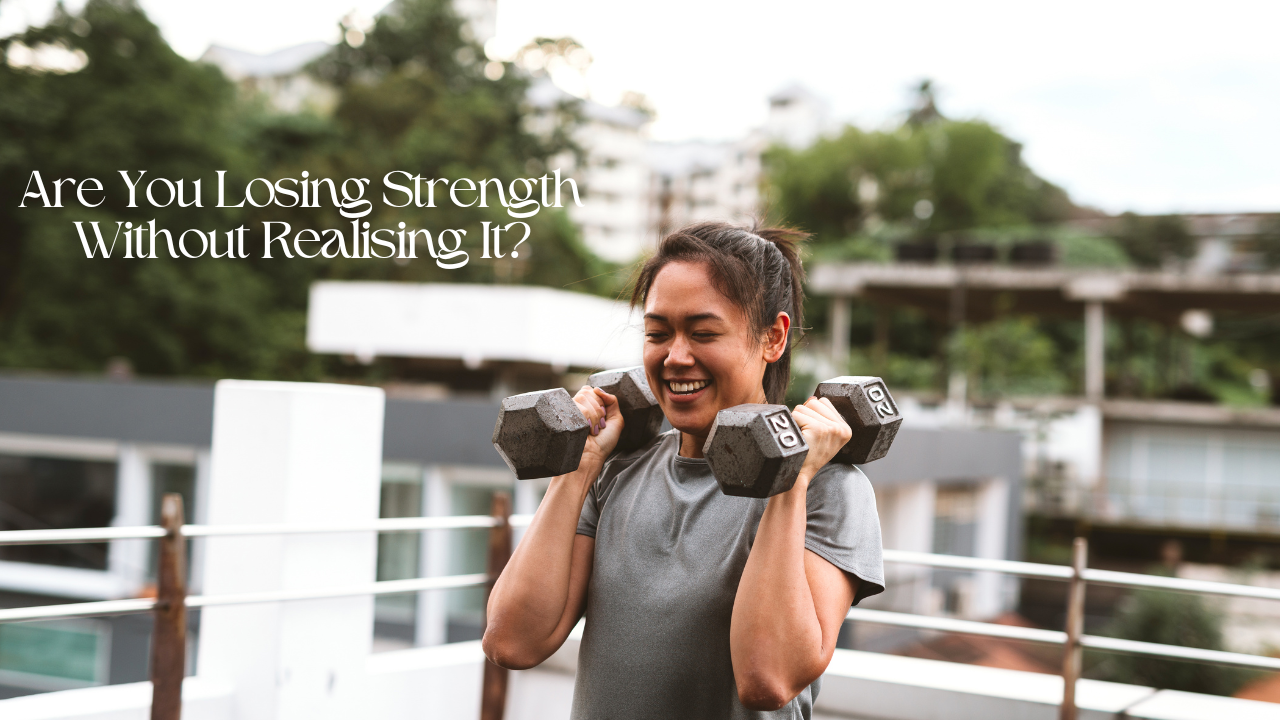
You may still be walking regularly, attending yoga classes and keeping up with a busy life. Yet carrying the shopping feels heavier than it used to. You hesitate before lifting your suitcase into the car, climbing several flights of stairs leaves your legs tired, or getting up from the floor requires a little more effort.
These changes can be easy to dismiss as tiredness, stiffness or simply getting older. However, they may be early signs that you are beginning to lose muscle strength.
Muscle loss rarely arrives as one dramatic moment. It happens gradually, often becoming noticeable through small changes in everyday life long before there is an obvious difference in your appearance.
You may find yourself using your hands to push up from a chair, avoiding heavy bags, struggling to open jars or feeling less stable on uneven ground. Exercise may take longer to recover from, your posture may feel less supported, or activities that once felt easy may now require more concentration.
None of these signs automatically means that you have a medical problem. They are simply useful signals that your muscles may need more attention than they did ten or twenty years ago.
Age-related muscle loss is sometimes called sarcopenia. Although the condition is usually associated with older age, changes in muscle mass and strength begin much earlier. Research suggests that the menopause transition may coincide with an acceleration in the loss of lean body mass, while reduced oestrogen, lower activity levels, disrupted sleep and inadequate nutrition may all contribute.
This does not mean that losing strength is inevitable or irreversible.
Muscle remains remarkably responsive to training throughout life. The challenge is that many women have spent years being encouraged to focus primarily on cardio exercise, calorie burning and weight loss. Walking, swimming, cycling and yoga all offer valuable health benefits, but they do not always provide enough resistance to preserve or increase muscular strength on their own.
To maintain strength, your muscles need to work against a load that feels challenging. That load could come from dumbbells, resistance bands, gym equipment, your own body weight or even carefully chosen household objects.
The important word is progressive. As your body adapts, the exercise needs to become slightly more challenging. This might mean adding a little weight, performing another repetition, using a stronger resistance band or improving your control through the movement.
A study involving women aged between 40 and 60 found that resistance training twice a week increased upper- and lower-body strength in both premenopausal and postmenopausal participants. The researchers found that strength could improve even when visible increases in muscle size were more difficult to achieve after menopause.
That distinction matters. You do not need to develop visibly larger muscles to become meaningfully stronger.
Your first improvements may come from your nervous system learning to use your existing muscles more effectively. You may notice that you can lift a heavier bag, climb the stairs with greater ease or complete an exercise with better balance before you see any physical change in the mirror.
Strength is also about far more than appearance. Your muscles help you stand upright, stabilise your joints, manage blood glucose, maintain mobility and protect your independence. They also place healthy mechanical stress on your bones, which is one reason muscle-strengthening and weight-bearing activity are recommended as part of a bone-health programme.
This becomes increasingly important during and after menopause, when the decline in oestrogen can contribute to reduced bone density. Strength training cannot remove every risk factor for osteoporosis, but research indicates that appropriately designed exercise can help maintain physical function and may help reduce the loss of bone mineral density in postmenopausal women.
Strength can also influence the way you feel about your body. Instead of judging it only by its weight, shape or clothing size, you begin to value what it can do.
There is a quiet confidence in knowing that you can lift your own suitcase, carry your shopping, move furniture, get up from the ground and remain steady on your feet. These may not sound like glamorous fitness goals, but they are the foundations of an active and independent future.
A practical starting point is two full-body strength sessions each week. UK physical activity guidance recommends strengthening activities that work the major muscle groups on at least two days a week. The NHS suggests beginning gradually and working towards approximately 8 to 12 repetitions for each exercise, completing at least two sets where appropriate.
Your routine does not need to be complicated. It can include a squat or sit-to-stand movement for your legs, a hip-hinge movement for your hips and glutes, a pushing exercise for your chest and shoulders, a pulling movement for your back, and a carrying exercise for your grip and core.
The final few repetitions should feel challenging while still allowing you to maintain good technique. When the movement becomes consistently easy, that is usually a sign that you are ready to increase the resistance slightly.
You also do not need to begin with heavy weights. A woman who is new to strength training may be sufficiently challenged by standing up from a chair without using her hands, performing a wall press-up or using a light resistance band. Strength is built by starting at the right level and progressing from there, not by copying somebody else’s workout.
Track improvements that matter in real life. Notice whether you can rise from a chair more easily, carry your bags without changing hands, walk uphill with greater confidence or use a heavier weight with good control. These signs may tell you more about your progress than the number on the scales.
Recovery matters too. Muscles need sufficient protein, rest and sleep to repair after exercise. Constantly dieting, skipping meals or exercising intensely without allowing time to recover can make it harder to protect the muscle you already have.
Most importantly, do not wait until you feel “fit enough” to begin. Strength training is not something you earn the right to do after losing weight. It is one of the ways you create a stronger, more capable body now.
A loss of strength is not a personal failure, and it is not a sign that your best years are behind you. It is information. Your body is telling you that what supported you in your thirties may no longer be enough in your forties, fifties and beyond.
The answer is not to punish your body with more exercise. It is to give it the specific form of movement it now needs.
Start gently. Lift consistently. Allow yourself to progress.
The goal is not simply to look stronger. It is to keep doing the things you love, trusting your body and moving through the years ahead with confidence.
Stay connected with news and updates.
Join our mailing list to receive the latest news and updates from our team.
Don't worry, your information will not be shared.
We hate SPAM. We will never sell your information, for any reason.