Why Your Working-Day Breakfast Is Leaving You Hungry by 10am
Jul 08, 2026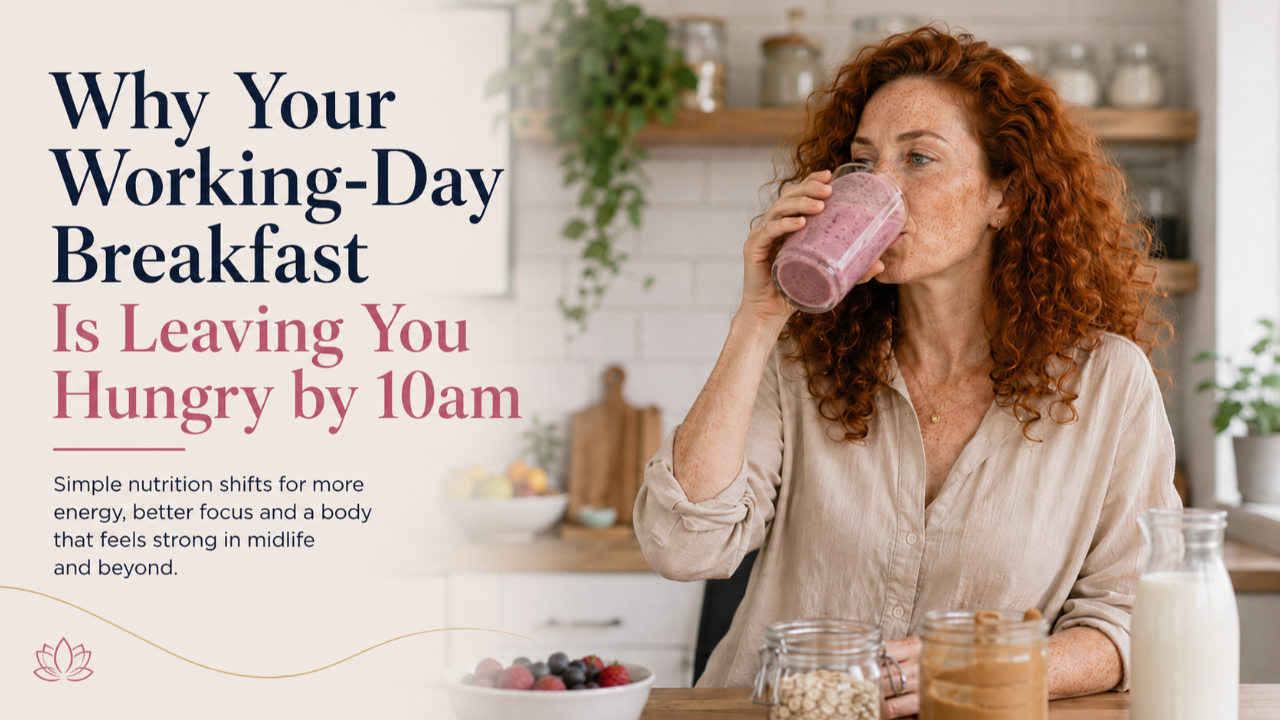
You ate breakfast, so why are you already hungry again?
Perhaps you grabbed a piece of toast before leaving home, ate a bowl of cereal while checking emails or picked up a coffee and pastry on the way to work. At the time, it seemed enough. Yet by 10am, your concentration is slipping and you are thinking about biscuits, another coffee or whatever you can find between meetings.
For many busy women in midlife, morning hunger is not a sign of greed, poor willpower or a lack of discipline. It is often a perfectly understandable response to a breakfast that delivered some energy but did not contain enough of the nutrients that help a meal feel satisfying.
The answer is not necessarily to eat a much larger breakfast. It may simply be to build a better-balanced one.
The problem with a quick-energy breakfast
Toast, cereal, fruit juice, pastries and flavoured breakfast bars can be convenient, particularly when mornings are rushed. However, some of these choices are mainly made from refined carbohydrates and may contain relatively little protein or fibre.
Carbohydrates are not the enemy. Your brain and muscles use them for energy, and wholegrain carbohydrates can be an important part of a healthy diet.
The difficulty arises when breakfast contains mostly rapidly digested carbohydrates without enough protein, fibre or healthy fat to slow the meal down and make it more sustaining.
You may feel energised briefly, but hunger can return surprisingly quickly.
Harvard Health recommends upgrading a breakfast of coffee and toast by adding foods that provide protein, fibre and unsaturated fats. This combination can help keep hunger at bay until lunchtime while supporting wider cardiovascular health.
What is missing from your breakfast?
A satisfying breakfast generally needs more than one food group.
Think of your morning meal as having three useful components:
Protein helps support muscle maintenance and can make meals feel more filling.
Fibre slows digestion and helps regulate the body’s use of sugars, which may support steadier hunger and blood-sugar levels.
Healthy fats from foods such as nuts, seeds, avocado or natural nut butter can add flavour and staying power.
You do not need to calculate these components perfectly. Simply look at your usual breakfast and ask whether all three are reasonably represented.
Toast with jam, for example, contains carbohydrate but little protein. A banana provides useful nutrients and fibre, but may not be enough on its own to sustain a demanding morning. Coffee can make you feel more alert, but it is not a substitute for food.
Protein may be the overlooked piece
Protein is frequently associated with bodybuilding, dieting or sports nutrition. In reality, it is a basic nutrient needed for the maintenance and repair of body tissues, including muscle.
This becomes especially relevant as women move through their forties and beyond. Muscle mass becomes harder to preserve with age, particularly when physical activity decreases. Harvard Health identifies adequate protein and resistance training as two important parts of protecting muscle as we grow older.
Breakfast is also the meal at which many women consume the least protein.
You may eat chicken, fish, beans or tofu at dinner, but have only a small amount of milk on cereal in the morning. This means most of your daily protein becomes concentrated later in the day.
Research discussed by Harvard Health suggests that including protein at breakfast may reduce appetite later in the day. It may also be useful to distribute protein across breakfast, lunch and dinner rather than relying almost entirely on the evening meal.
That does not mean breakfast needs to become enormous. It means it should contain an identifiable source of protein.
Why this matters during a working morning
Hunger is distracting.
It can make it harder to concentrate during meetings, write clearly, make decisions or remain patient when the day becomes demanding. You may find yourself drinking more caffeine, grazing repeatedly or eating whatever is most convenient because you have become too hungry to make a considered choice.
This is not a personal failing. It is often what happens when the body has not received enough nourishment earlier in the day.
A more satisfying breakfast can create a steadier foundation for the morning. It will not eliminate every craving or guarantee perfect concentration, but it may reduce the cycle of quick breakfast, early hunger, emergency snack and afternoon fatigue.
The “healthy” breakfast that may not be enough
Some breakfasts appear very healthy but are still too light for the person eating them.
Consider these common examples:
- Fruit on its own
- A small bowl of cereal with very little milk
- Plain porridge made with water
- One slice of toast
- A green smoothie made mainly from fruit and vegetables
- A low-calorie breakfast bar
- Coffee with a small yoghurt
None of these foods is inherently bad. The issue is whether the overall meal contains enough substance to support your morning.
Porridge made with water could be strengthened with milk or fortified soya milk, yoghurt, nuts or seeds.
Fruit could be paired with Greek-style yoghurt, cottage cheese or nut butter.
Toast could be topped with eggs, beans, smoked salmon, houmous or peanut butter.
A smoothie could contain milk, fortified soya milk, yoghurt, oats, nut butter or tofu rather than relying mainly on fruit.
The goal is not to discard the breakfast you enjoy. It is to complete it.
A simple breakfast formula
A practical working-day breakfast can be built around this formula:
One source of protein
Choose from:
- Greek-style or high-protein yoghurt
- Eggs
- Cottage cheese
- Milk or fortified soya milk
- Tofu
- Beans
- Natural peanut or almond butter
- Nuts and seeds
- Smoked salmon
- Leftover chicken, fish or pulses
Harvard’s Nutrition Source recommends prioritising healthy protein sources such as fish, poultry, beans, nuts and soya foods, while limiting processed meats.
One fibre-rich carbohydrate
Choose from:
- Porridge oats
- Wholegrain toast
- Wholegrain cereal with a sensible sugar content
- Fruit
- Berries
- Wholegrain wraps
- Quinoa
- Beans or lentils
Whole grains retain more of their natural nutrients than refined grains and can provide a more useful nutritional package.
A little healthy fat
Choose from:
- Nuts
- Seeds
- Avocado
- Natural nut butter
- Olive oil
- Chia seeds
You do not need every breakfast to contain large portions of all three. The formula is simply a useful way to spot what may be missing.
Seven breakfasts for busy working women
1. Upgraded porridge
Make porridge with milk or fortified soya milk. Add Greek-style yoghurt, berries and a spoonful of seeds.
This takes little longer than ordinary porridge but provides more protein, fibre and texture.
2. Eggs and wholegrain toast
Serve boiled, scrambled or poached eggs with wholegrain toast and tomatoes, spinach or mushrooms.
Eggs provide protein and several other nutrients, although Harvard recommends keeping the wider diet varied and including plant-based proteins regularly rather than relying on eggs for every breakfast.
3. Yoghurt bowl
Combine plain Greek-style yoghurt with berries, oats, chia seeds and a small portion of nuts.
This can be prepared the night before and carried to work.
4. Beans on toast
Choose beans with wholegrain toast and add tomatoes, spinach or mushrooms.
Beans provide both protein and fibre, making them particularly useful for a filling plant-based breakfast.
5. Breakfast wrap
Fill a wholegrain wrap with eggs or tofu, spinach and a little avocado.
Wrap it in foil and take it with you on mornings when you cannot sit down at home.
6. Balanced smoothie
Blend milk or fortified soya milk with yoghurt, berries, oats and nut butter.
A smoothie made only with fruit and juice may not keep you full for long. Adding protein and fibre makes it more substantial.
7. Overnight oats
Combine oats, milk or fortified soya milk, yoghurt, berries and chia seeds. Leave overnight in the fridge.
Chia seeds contribute fibre, healthy fats and a modest amount of protein.
What if you are not hungry first thing?
Not everyone wants to eat immediately after waking, and there is no need to force down a large meal simply because breakfast is considered healthy.
You could eat something smaller at home and take a more substantial option to work. Alternatively, prepare breakfast in advance and eat it when your appetite appears.
The important question is not whether you eat at a fashionable time. It is whether your first meal supports the hours that follow.
For example, coffee at 7am followed by yoghurt, fruit, oats and nuts at 9am may work better for you than forcing yourself to eat a large breakfast at 6.30am.
Do you need a high-protein product?
Probably not.
Many ordinary foods provide useful amounts of protein without needing to be labelled “high protein”. Yoghurt, eggs, beans, tofu, milk, nuts and fish can all contribute.
Protein powders can be convenient, but they are supplements rather than essential foods. Harvard Health advises obtaining most protein from whole foods where possible and using powders when they genuinely make eating enough protein easier.
Some protein bars and breakfast products also contain significant amounts of added sugar, sweeteners or highly processed ingredients. Read the complete label rather than being persuaded by the word “protein” on the front.
How much protein should breakfast contain?
There is no single breakfast target suitable for every woman.
Protein needs depend on body size, age, activity, health and the rest of the day’s diet. The general adult recommended dietary allowance is approximately 0.8 grams of protein per kilogram of body weight per day, although this is intended as a basic requirement rather than a personalised optimum.
Rather than becoming fixated on numbers, begin by ensuring breakfast contains a meaningful protein source.
Harvard Health notes that the body may make better use of protein when intake is distributed through the day, with approximately 20 to 40 grams consumed at a time rather than most of the daily amount being eaten in one or two large meals.
For many women, a breakfast supplying roughly 15 to 25 grams may be a practical improvement, but it is not a compulsory prescription. Some will need more and others less.
Women with kidney disease, significant liver disease or another medical condition requiring dietary management should obtain personalised advice before substantially increasing protein intake.
Your breakfast may not be the only reason you feel hungry
Morning hunger is normal. It does not automatically mean anything is wrong.
However, frequent or unusually intense hunger may also be influenced by:
- Poor or disrupted sleep
- A very small evening meal
- Increased exercise
- Stress
- Certain medications
- Changes in blood-sugar regulation
- Pregnancy
- Thyroid problems
- Other health conditions
Sleep disruption is particularly relevant in midlife. Perimenopause, stress and poor sleep can all affect concentration and how well you cope with the working day.
If hunger changes suddenly, feels extreme or is accompanied by unexplained weight loss, excessive thirst, frequent urination, weakness or other concerning symptoms, speak to a healthcare professional.
Try the 10am breakfast test
For the next five working days, notice how you feel two or three hours after breakfast.
Ask yourself:
- Am I comfortably satisfied or urgently looking for food?
- Can I concentrate through the morning?
- Did breakfast contain a clear source of protein?
- Did it include a fibre-rich food?
- Was coffee supporting breakfast or replacing it?
- Did I eat enough overall?
Change only one element at a time.
Add yoghurt to your porridge. Put eggs on your toast. Pair fruit with nuts. Replace a refined cereal with oats. Add beans or tofu to a savoury breakfast.
Then observe whether the morning feels different.
This is more useful than following a rigid meal plan because it helps you identify what actually works for your appetite, schedule and body.
Breakfast should support your life, not complicate it
A nourishing breakfast does not need to be beautifully arranged, freshly cooked or photographed.
It can be overnight oats eaten at your desk, eggs boiled the previous evening, yoghurt carried in your work bag or wholegrain toast topped with peanut butter while you prepare for the day.
Convenience can be part of a healthy routine. Frozen fruit, canned beans, wholegrain bread, pre-portioned yoghurt and unsweetened fortified foods can all make mornings easier. Harvard’s Nutrition Source notes that certain frozen, canned and prepared foods can be valuable time-saving options in busy households.
The best breakfast is not the one that looks most impressive. It is the one that gives you enough nourishment to begin your day without thinking constantly about your next opportunity to eat.
You do not need to fear carbohydrates, count every gram or create a complicated morning routine.
You may simply need to stop asking coffee and toast to carry you through a working morning they were never designed to sustain.
Stay connected with news and updates.
Join our mailing list to receive the latest news and updates from our team.
Don't worry, your information will not be shared.
We hate SPAM. We will never sell your information, for any reason.