Why You Feel Better When You Step Outside: The Science of Nature and Hormones in Midlife
Mar 31, 2026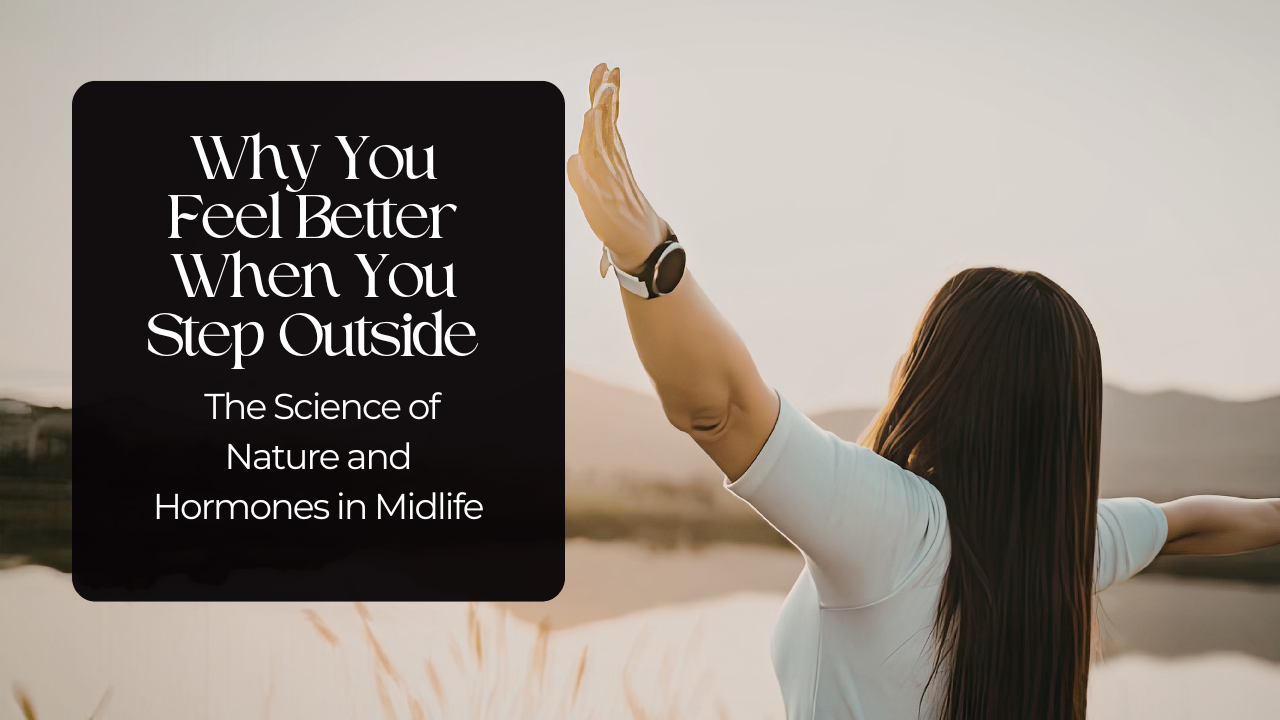
There is a noticeable shift that happens the moment you step outside.
Not always dramatic. Often subtle.
Your shoulders drop slightly. Your breathing changes. The mental noise that has been running in the background begins to soften, even if just a little. What felt heavy inside a room feels more manageable in open air.
For many professional women, this experience is familiar but rarely examined.
It is often dismissed as “fresh air” or a change of scenery.
But what if that shift is not incidental?
What if it is physiological?
Your Body Responds to Environment More Than You Realise
Your body is constantly interpreting your surroundings.
Indoors, particularly in environments that are structured, busy, and information rich, your nervous system remains engaged. Screens, notifications, artificial lighting, and ongoing cognitive demand all signal activity.
Even when you are sitting still, your system is processing.
Outside, the signals change.
Natural light, open space, variation in sound, and visual depth all communicate something different to your brain. These inputs are associated with safety, not demand.
Your nervous system responds accordingly.
The Hormonal Impact of Being Indoors All the Time
In midlife, this distinction becomes more important.
As estrogen and progesterone decline, your body becomes more sensitive to stress. Cortisol, your primary stress hormone, becomes more influential and often remains elevated for longer.
Indoor environments that require constant attention can reinforce this.
Even low level, continuous engagement can keep your system in a state of activation. Over time, this contributes to:
- mental fatigue
- reduced emotional bandwidth
- disrupted sleep
- inconsistent energy
This is not because your environment is inherently harmful.
It is because your physiology now requires more variation.
Nature as a Direct Regulator of the Nervous System
When you step into a natural environment, several things begin to shift at once.
Research has shown that exposure to nature can reduce cortisol levels, lower heart rate, and improve parasympathetic nervous system activity, the part responsible for recovery.
This is not about exercise intensity.
Even slow walking, or simply being in a natural setting, can create measurable changes.
This is why you may feel calmer after a short walk, even if nothing in your external life has changed.
Your internal state has.
Why This Matters More in Midlife
In earlier years, your body may have tolerated continuous stimulation more easily.
In midlife, that tolerance often decreases.
Your system becomes less efficient at maintaining balance under constant input. This means that the absence of natural environments becomes more noticeable in how you feel.
Nature, in this context, is not an optional extra.
It becomes a form of regulation.
A way of resetting your system so that it does not remain in a state of continuous demand.
The Cognitive Shift That Comes with Being Outside
There is also a cognitive effect.
When you are in nature, your attention changes. Instead of focusing narrowly on tasks, your awareness broadens. This type of attention, often referred to as “soft fascination,” allows your brain to recover from directed, effortful thinking.
For women who spend much of their day making decisions, managing information, and staying mentally engaged, this shift is significant.
It creates space.
Not just physically, but mentally.
Making This Work in a Real Life Schedule
The most important thing to understand is that this does not require large amounts of time.
Short, consistent exposure is effective.
A walk between meetings. Time outside in the morning. Even a few minutes of stillness in a natural setting can begin to shift your internal state.
What matters is not the duration, but the change in environment.
This is not about escaping your life.
It is about supporting your body within it.
A More Intelligent Way to Think About Nature
Nature is often positioned as something restorative, but in midlife, it becomes something more precise.
It is a tool.
A way to regulate your nervous system, support hormonal balance, and reduce the cumulative effects of constant input.
For professional women, this is not about adding something new to your routine.
It is about recognising what creates the greatest return.
A Final Thought
The reason you feel better when you step outside is not accidental.
Your body is responding exactly as it is designed to.
And in a stage of life where internal balance requires more support, that response becomes something worth paying attention to.
Not as a luxury.
But as part of how you stay well.
Stay connected with news and updates.
Join our mailing list to receive the latest news and updates from our team.
Don't worry, your information will not be shared.
We hate SPAM. We will never sell your information, for any reason.